
30 Best Recruitment Website Examples 2026
A recruitment website has a harder job than most business sites: it has to serve two people at once. A candidate wants to see vacancies. An employer wants to see that you can fill theirs. Most agencies try to do both from the same paragraph, and the visitor has to work out which half is meant for them.
So rather than describe thirty recruitment websites, we opened them — and then we clicked through to the job board on every one that had one. That second step is the whole point. An agency site is a shopfront for a stock of vacancies, and a shopfront is only worth studying if you look at what is on the shelves. Twenty-five of the thirty had a board we could open. Five publish no vacancies at all, and every one of those is an executive search firm, which turns out not to be a coincidence.
What we looked for
Twelve checks, all of them things a visitor either sees or does not see in the first screen, plus what we found one hop further in. Nothing here is a matter of taste: either two audiences are named or they are not, either the vacancy count is on the page or it is not.
What happens when you click Jobs
Here is the thing these businesses are actually selling, and how far you get toward it. Each rung below is a subset of the one above it — only sites that clear one can appear on the next.
The drop from 22 to 11 is where the sector loses its nerve: of the twenty-two boards with countable vacancies on them, eleven decline to say how many they hold. That is the one number a candidate uses to judge whether a site is worth a second visit. Worse, only six of the thirty put a search box for those vacancies in the first screen at all, and only three state the total anywhere on the homepage.
Every job board we opened, side by side
Read in a browser at 1280×860, then the jobs link followed one hop into whatever sits behind it.
| Agency | Audiences named | Job board | On the homepage | Search in fold | Platform |
|---|---|---|---|---|---|
| Tattersall Recruiting | both | yes, no count | no | no | WordPress |
| Zensho Agency | none | none | no | no | WordPress |
| JDM Talent | none | none | no | no | WordPress |
| Burõ Talent | employers only | none | no | no | Webflow |
| Marble Recruitment | both | yes, no count | no | yes | WordPress |
| Clarity Recruiting | both | yes, no count | 6 | no | WordPress |
| Freshminds | both | 13 roles | no | no | Access Volcanic |
| Stopgap | both | 6 roles | 6 | yes | Access Volcanic |
| Pivotal Talent Search | employers only | yes, no count | no | no | WordPress |
| Aquent | both | yes, no count | no | no | WordPress |
| Mitchell Adam | both | yes, no count | 6 | no | WordPress |
| Opal Digital | candidates only | yes, no count | 16 | no | Webflow |
| Hunt Club | none | none | no | no | bespoke |
| Heidrick & Struggles | none | none | no | no | bespoke |
| Zebra People | both | yes, no count | 5 | no | WordPress |
| Understanding Recruitment | both | 40 roles | no | no | Vennture |
| Trust in SODA | both | yes, no count | 8 | no | SourceFlow |
| Harnham | both | yes, no count | no | no | WordPress |
| Goodman Masson | both | yes, no count | no | no | Webflow |
| Tiger Recruitment | both | 273 roles | 24 | no | WordPress |
| Zachary Daniels | both | yes, no count | no | no | WordPress |
| Barrington James | both | 93 roles | 10 | no | Vennture |
| Matchtech | both | 1292 roles | 3 | yes | Vennture |
| Fawkes & Reece | both | 755 roles | 14 | yes | WordPress |
| Medacs Healthcare | both | 488 roles | 9 | no | SourceFlow |
| Engage Education | both | 923 roles | 40 | yes | WordPress |
| BCL Legal | both | 327 roles | 44 | yes | bespoke |
| Pareto | both | yes, no count | no | no | SourceFlow |
| Harris Hill | both | 39 roles | no | no | Duda |
| Cathedral Appointments | both | yes, no count | 33 | no | bespoke |
Read the job board column first. Five agencies publish nothing, fourteen run a board without saying how big it is, and 11 state a figure — from 6 roles to 1292.
The two-audience problem
Every agency serves candidates and employers, and the homepage has one first screen to route both. Twenty-three of the thirty name both audiences before you scroll, using wording that varies but always does the same job: “I want to apply” beside “I want to hire”, “Get Hired” beside “Find Employees”, “Find the right jobs” beside “Find the right people”.
The seven that do not split are the interesting ones, because five of them are the same firms that publish no vacancies at all: Zensho Agency, JDM Talent, Burõ Talent, Hunt Club and Heidrick & Struggles. Every one is executive search. They address clients only, advertise nothing, and sell judgement rather than a vacancy list — so the single-audience homepage is a deliberate position, not an oversight. If you run a contingency or temp desk, it is not a model you can borrow.
Best Recruitment Website Examples
Table of contents — all thirty recruitment websites
- Tattersall Recruiting
- Zensho Agency
- JDM Talent
- Burõ Talent
- Marble Recruitment
- Clarity Recruiting
- Freshminds
- Stopgap
- Pivotal Talent Search
- Aquent
- Mitchell Adam
- Opal Digital
- Hunt Club
- Heidrick & Struggles
- Zebra People
- Understanding Recruitment
- Trust in SODA
- Harnham
- Goodman Masson
- Tiger Recruitment
- Zachary Daniels
- Barrington James
- Matchtech
- Fawkes & Reece
- Medacs Healthcare
- Engage Education
- BCL Legal
- Pareto
- Harris Hill
- Cathedral Appointments
1. Tattersall Recruiting
Built with: WordPress
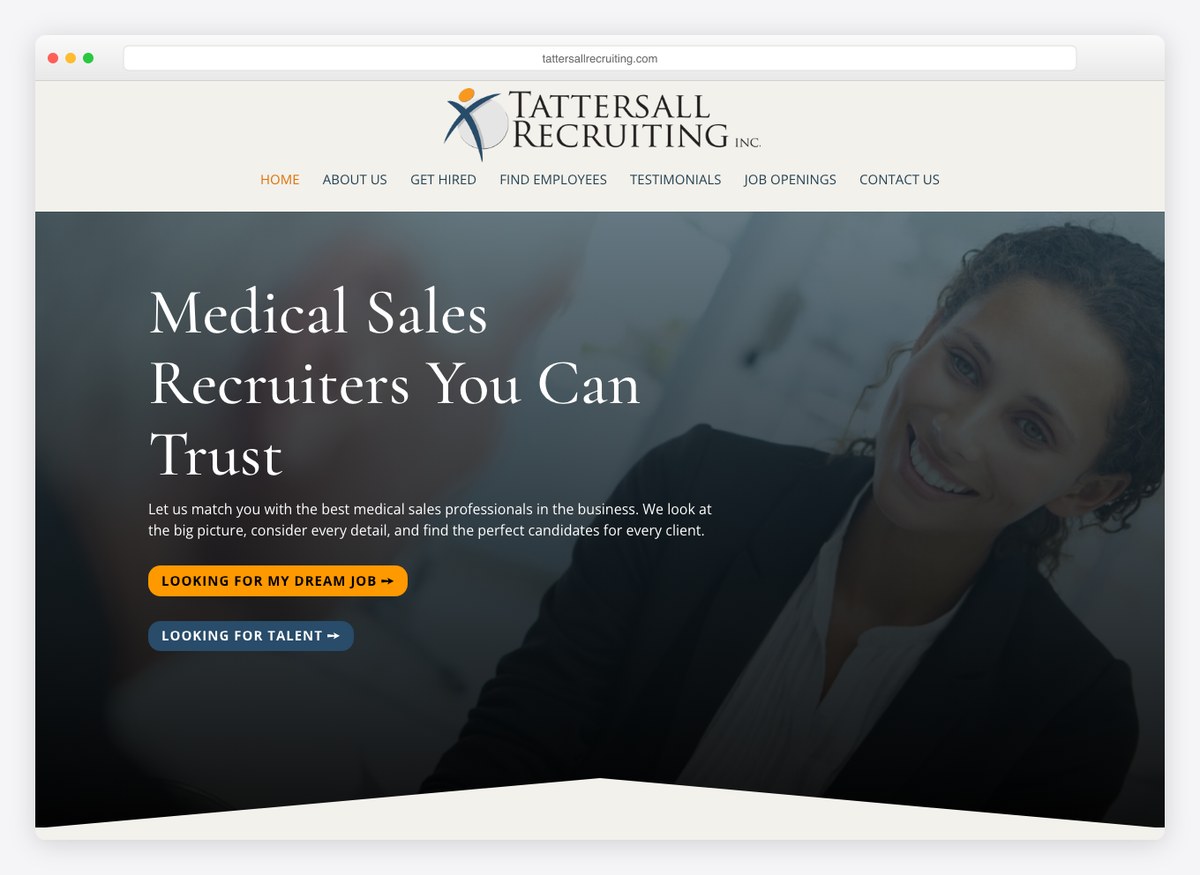
A single specialism stated in the first line: medical sales, not “talent solutions”. The nav splits the two audiences plainly — Get Hired next to Find Employees — and the hero repeats the split as two buttons. There is a job board behind it, though no count of what is on it.
2. Zensho Agency
Built with: WordPress
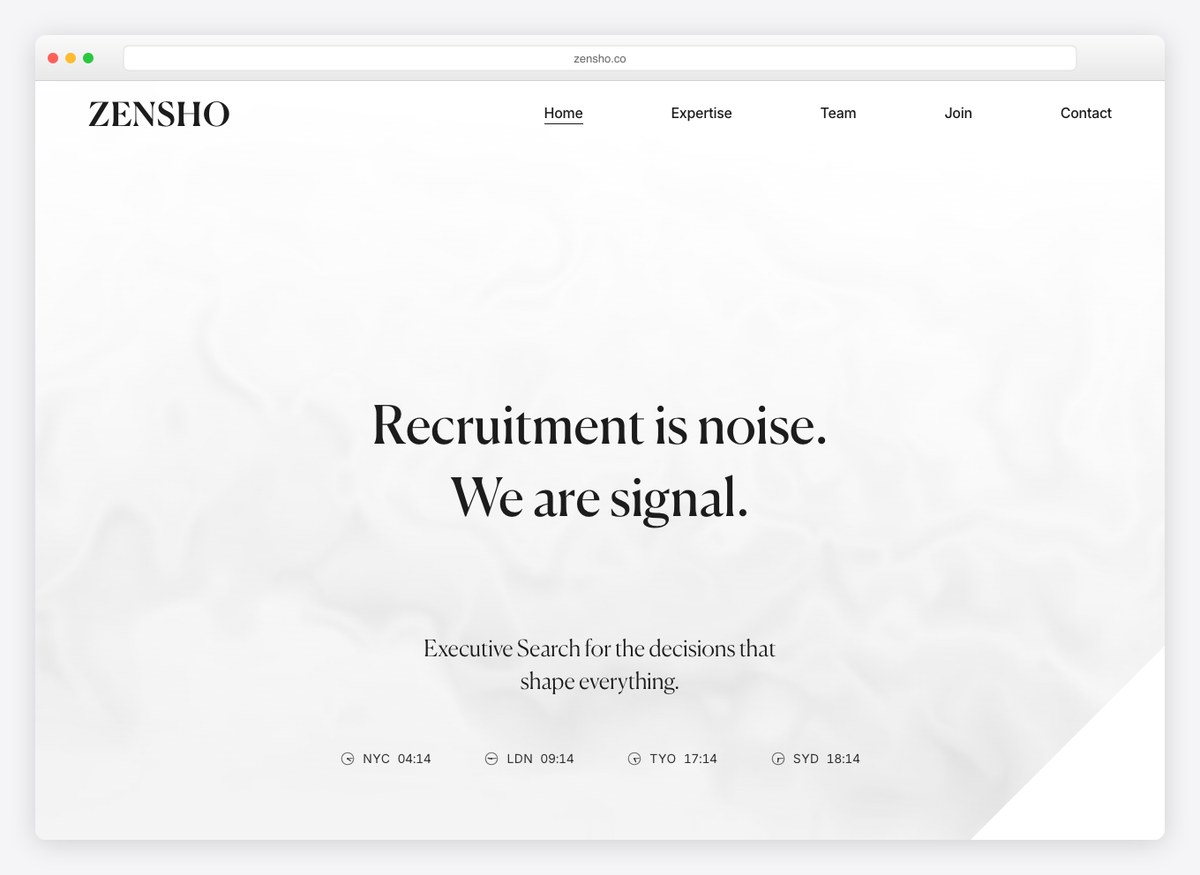
Three lines of type on cream, no photograph, no stock imagery: “Recruitment is noise. We are signal.” Zensho publishes no vacancies at all, which for retained executive search is a position rather than an omission — the work is confidential and the site sells judgement.
3. JDM Talent
Built with: WordPress
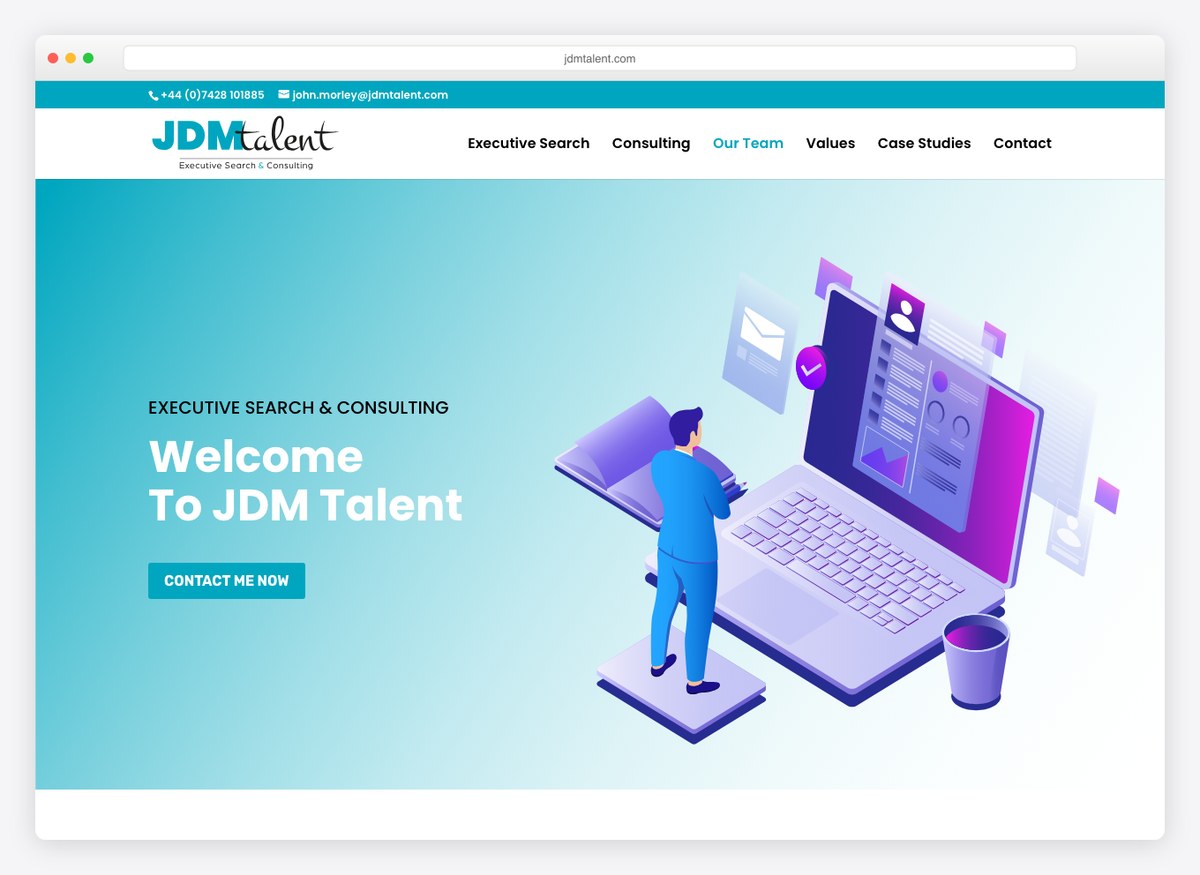
An illustrated hero in cyan and violet, unusual in a sector that defaults to photographs of people shaking hands. The nav is entirely client-facing — Executive Search, Consulting, Case Studies — with no candidate route and no job board.
4. Burõ Talent
Built with: Webflow
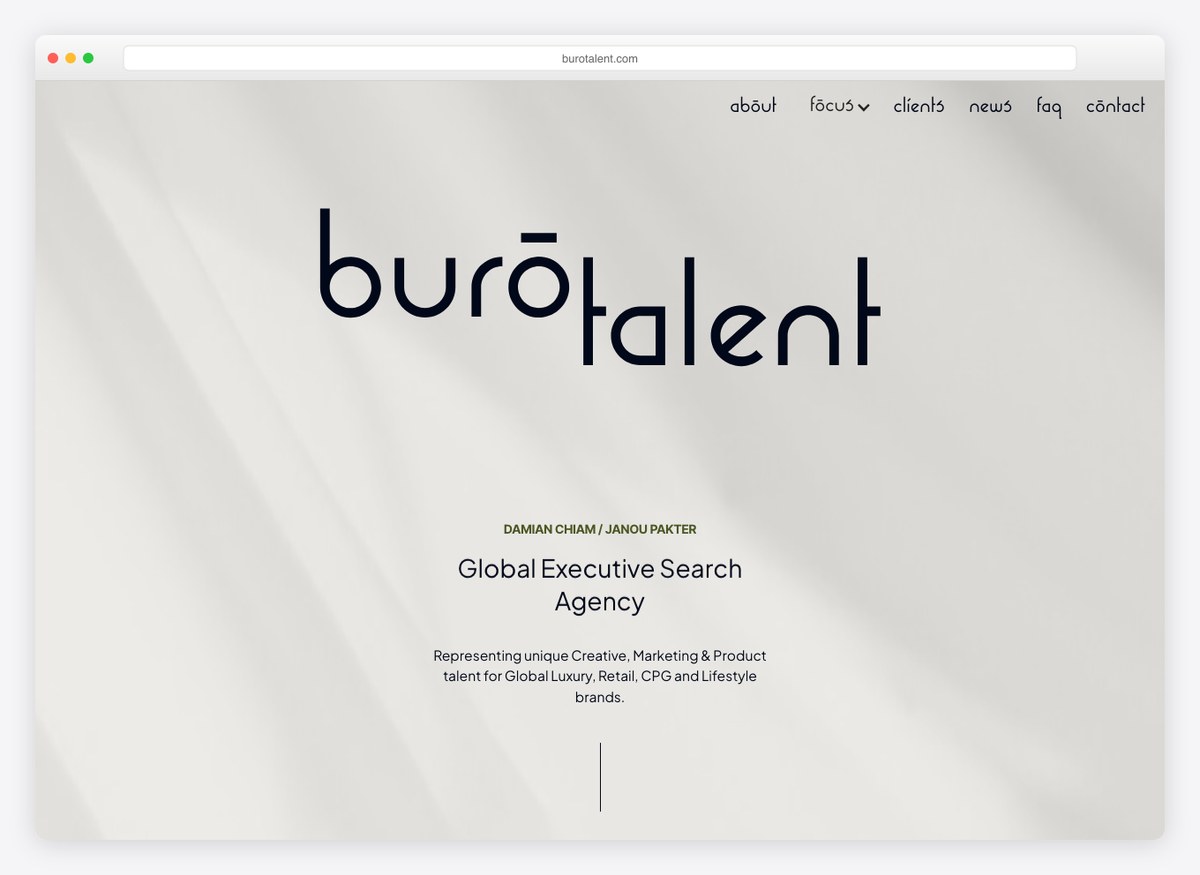
The wordmark is the hero, set large on a soft grey ground with no imagery competing against it. Navigation runs by discipline rather than audience: Creative, Marketing, Product, then Roles We Place. No vacancies are published.
5. Marble Recruitment
Built with: WordPress · CRM: Bullhorn Automation
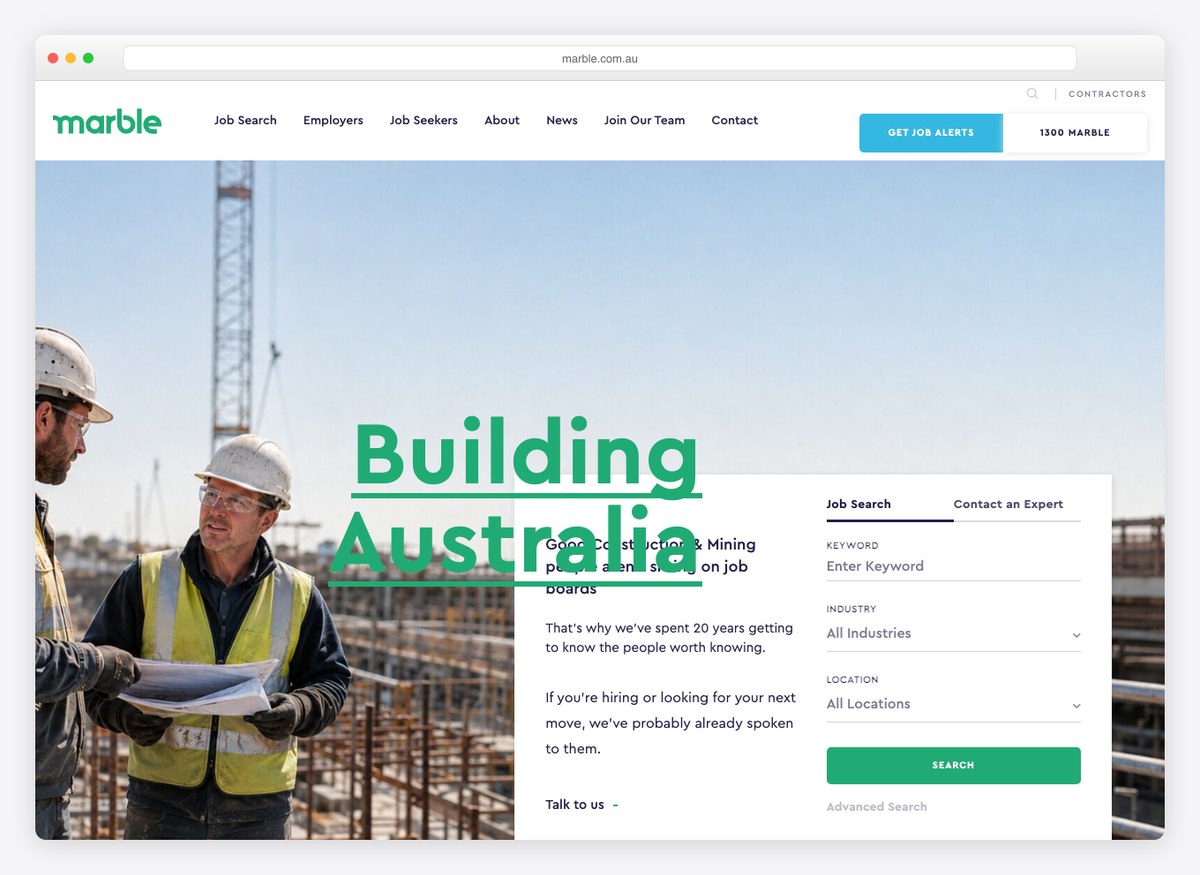
One of only six sites here that put a working job search in the first screen, with keyword, industry and location fields sitting beside the hero rather than behind a click. Job Seekers and Employers are separate top-level items, and a phone number is tappable in the fold.
6. Clarity Recruiting
Built with: WordPress
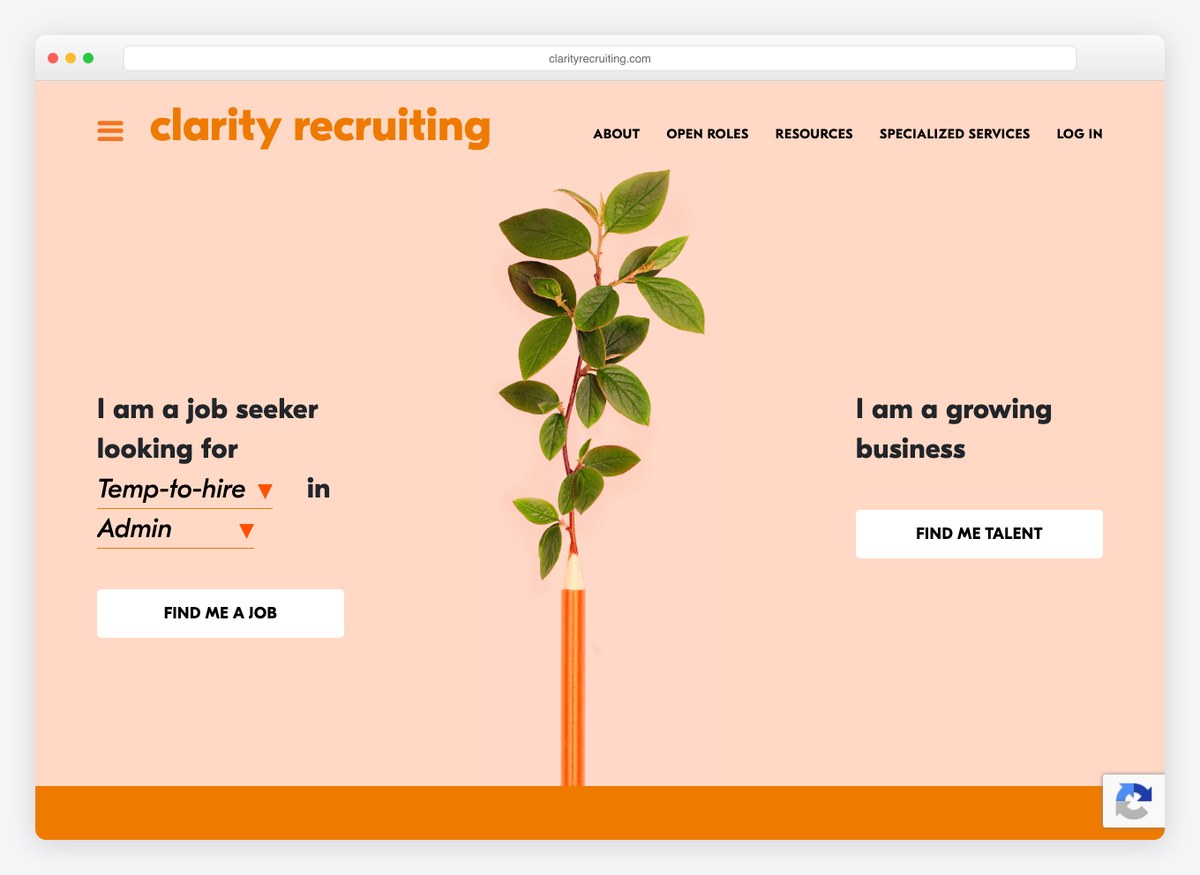
Two sentences finish themselves with dropdowns: “I am a job seeker looking for [Temp-to-hire] in [Admin]” beside “I am a growing business”. It is the clearest audience split in the set. Read the headline figure carefully though — “346,946 jobs landed” is placements since 2000, not live vacancies.
7. Freshminds
Built with: Access Volcanic · CRM: Bullhorn Automation
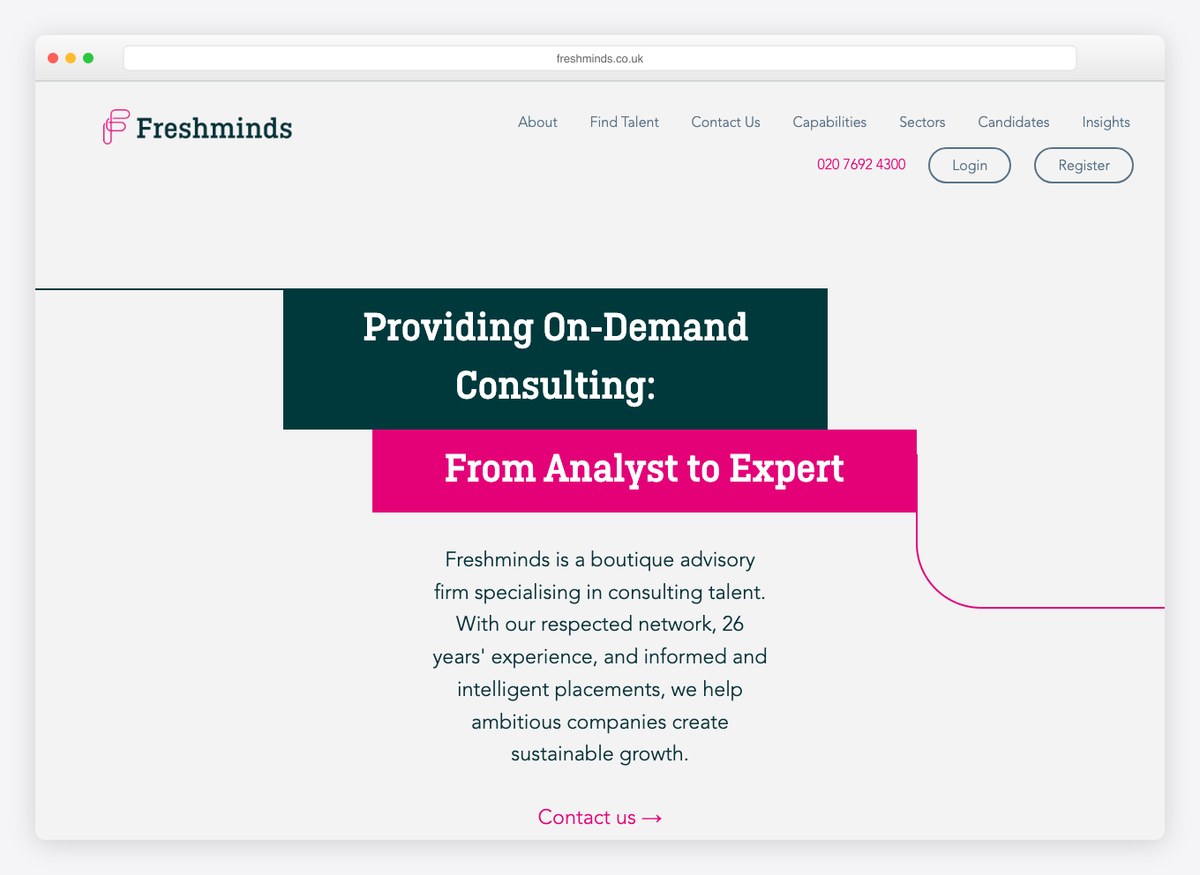
A boutique consulting-talent firm that leads with the shape of the work rather than the sector, in magenta and deep teal on near-white. Candidates and Find Talent are separate nav items, and both a login and a register route exist for returning users.
8. Stopgap
Built with: Access Volcanic
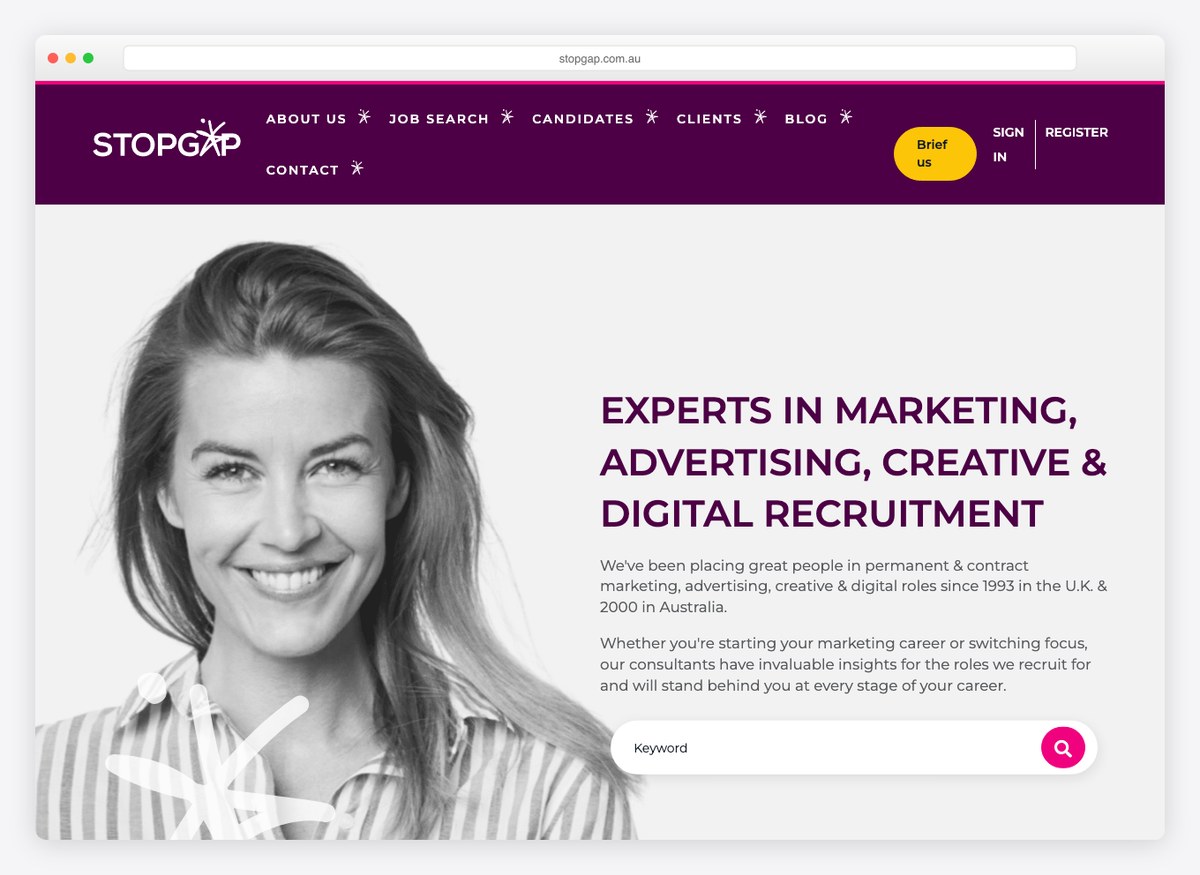
Aubergine and yellow, a combination nobody else here uses, over a full-bleed portrait. The header carries Job Search, Candidates and Clients as separate destinations, and the job search sits in the first screen. The board itself is small and honest about it.
9. Pivotal Talent Search
Built with: WordPress
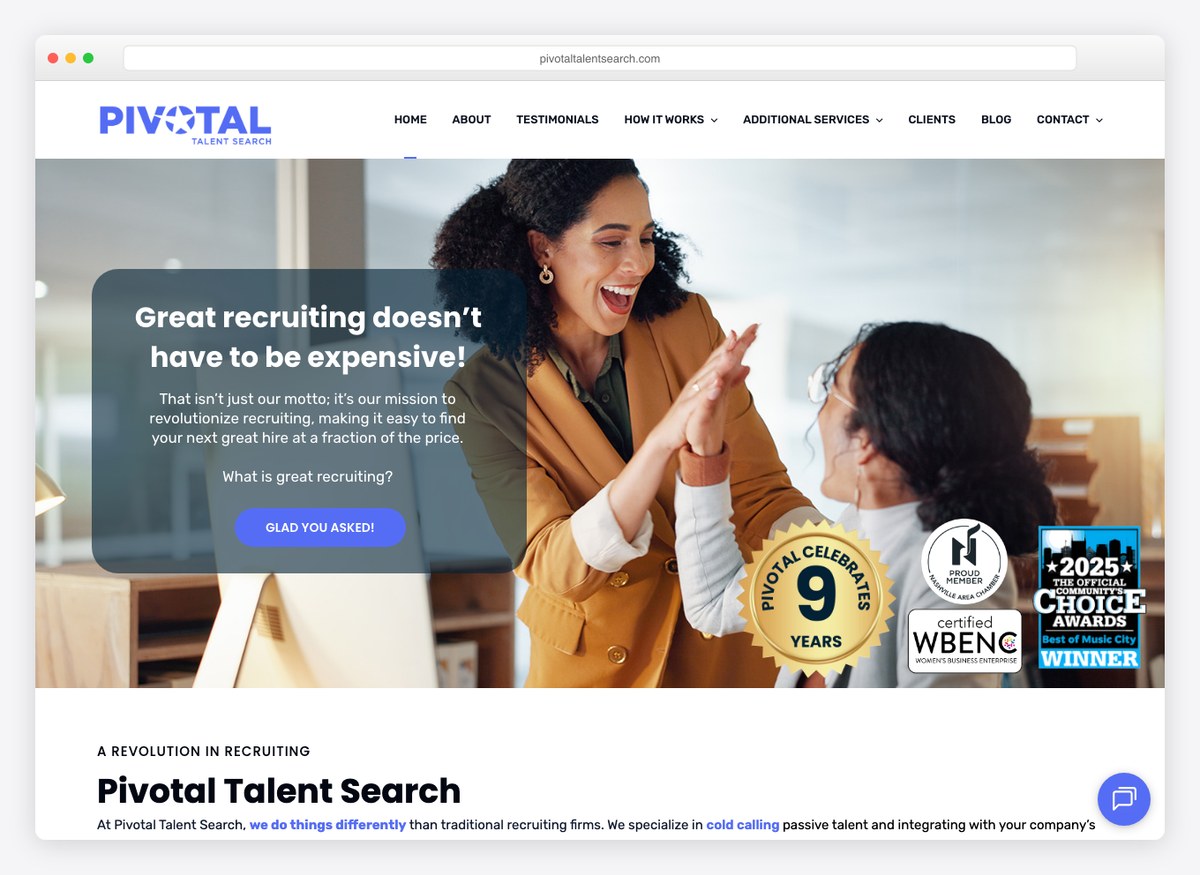
An unusually busy first screen: hero, video card, and five award badges stacked along the lower edge. The board behind it is large, hosted on a dedicated recruiting platform rather than the site’s own CMS.
10. Aquent
Built with: WordPress
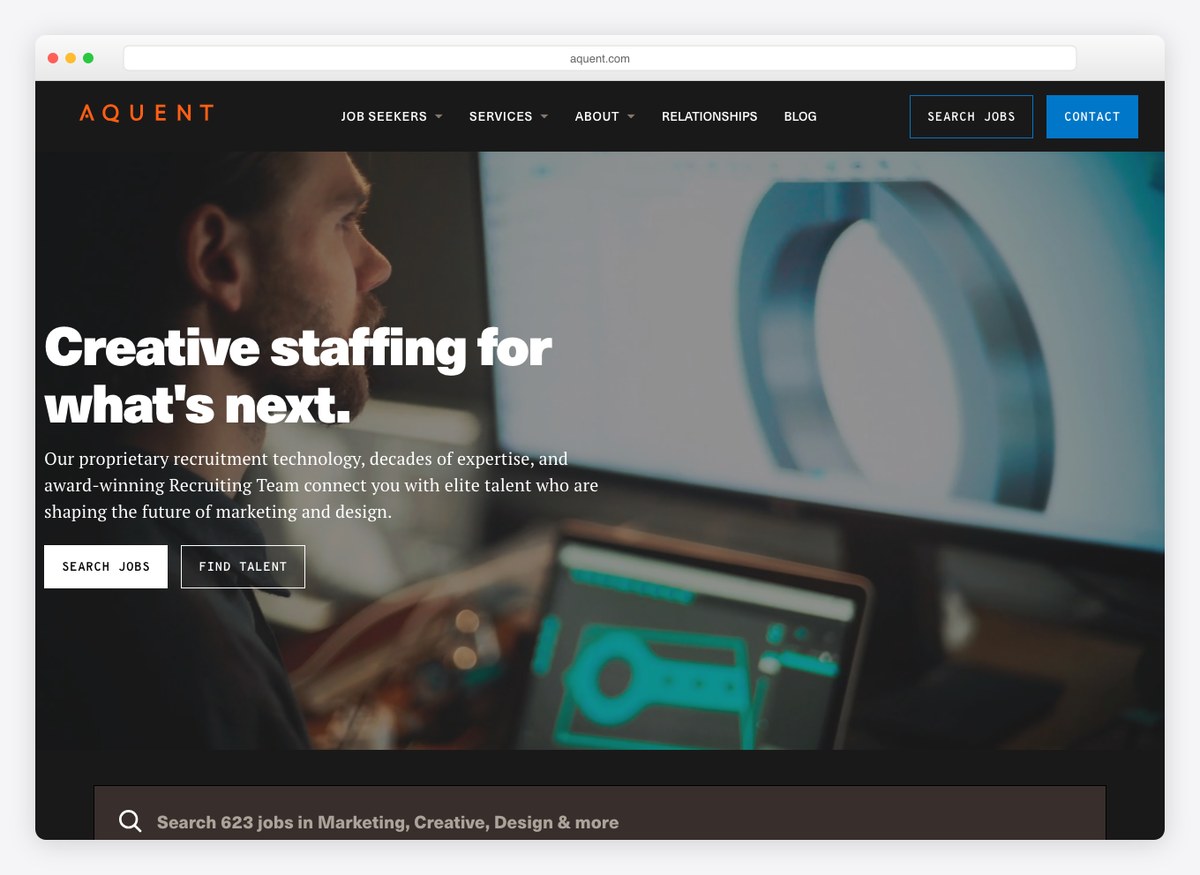
The only site here that states its live vacancy count where you would actually look for it — inside the search box itself, which reads “Search 623 jobs in Marketing, Creative, Design & more”. Search Jobs and Find Talent sit side by side in the header.
11. Mitchell Adam
Built with: WordPress
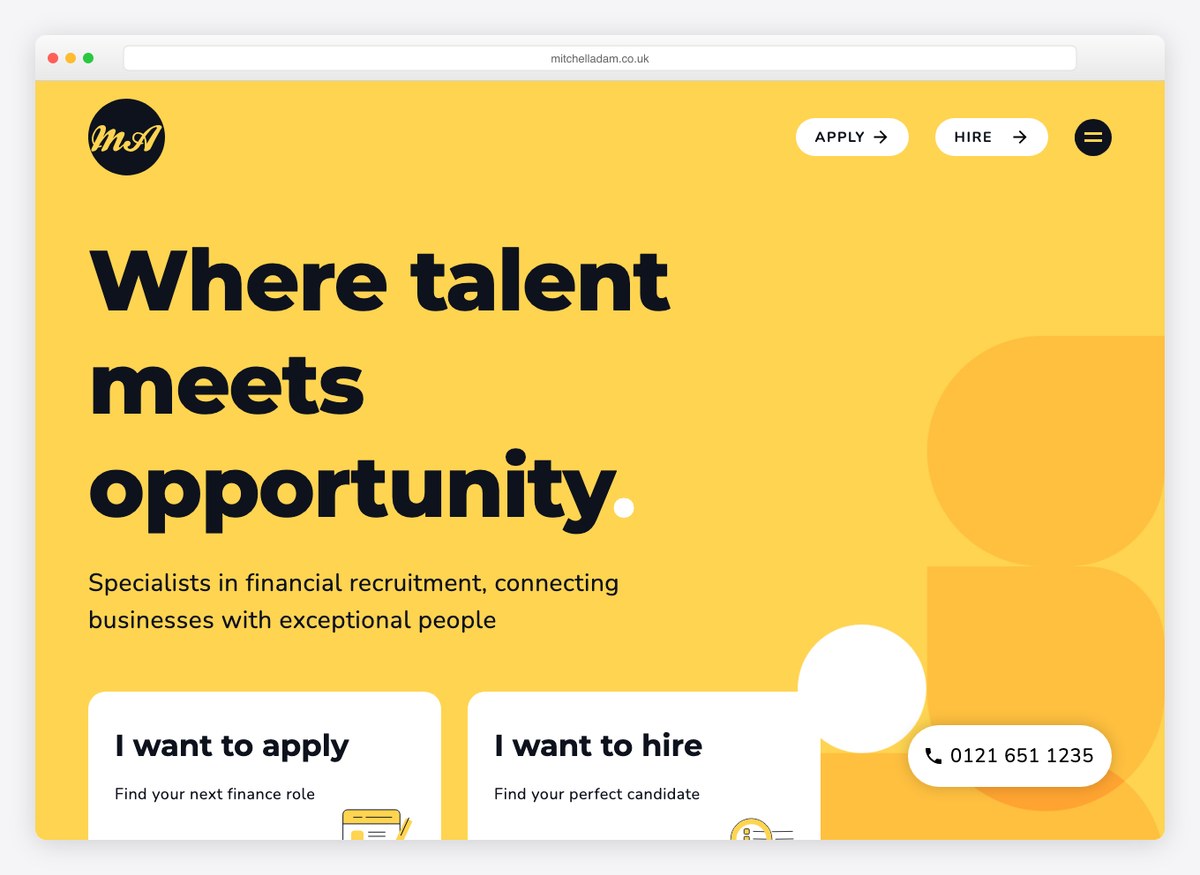
Two cards, side by side, in the first screen: “I want to apply” and “I want to hire”, each with a one-line explanation underneath. The whole page is one yellow field with black type. Live vacancies are listed on the homepage rather than hidden behind a board.
12. Opal Digital
Built with: Webflow
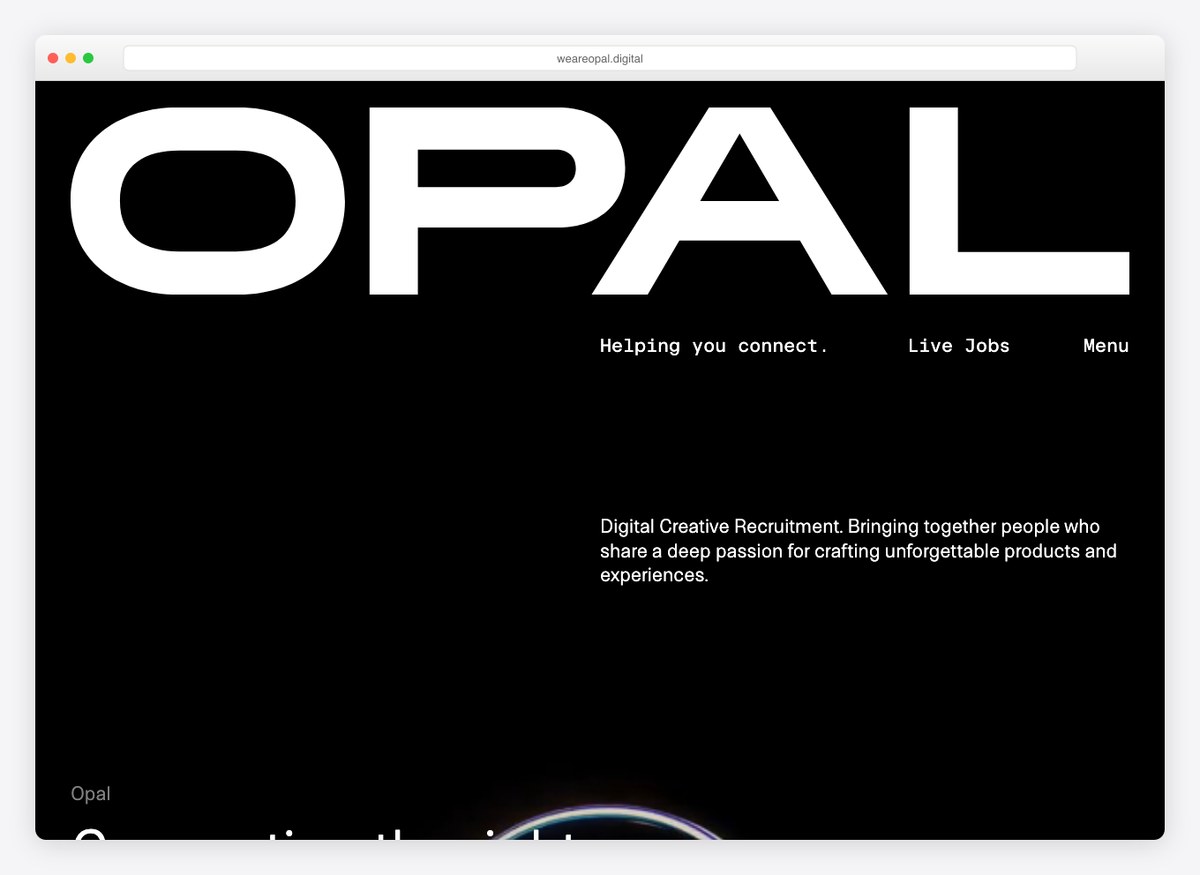
A black screen with the word OPAL set edge to edge and almost nothing else. Live roles are listed further down the homepage rather than behind a job board, which is a defensible choice for a small agency with a handful of vacancies at a time.
13. Hunt Club
Built with: a bespoke build
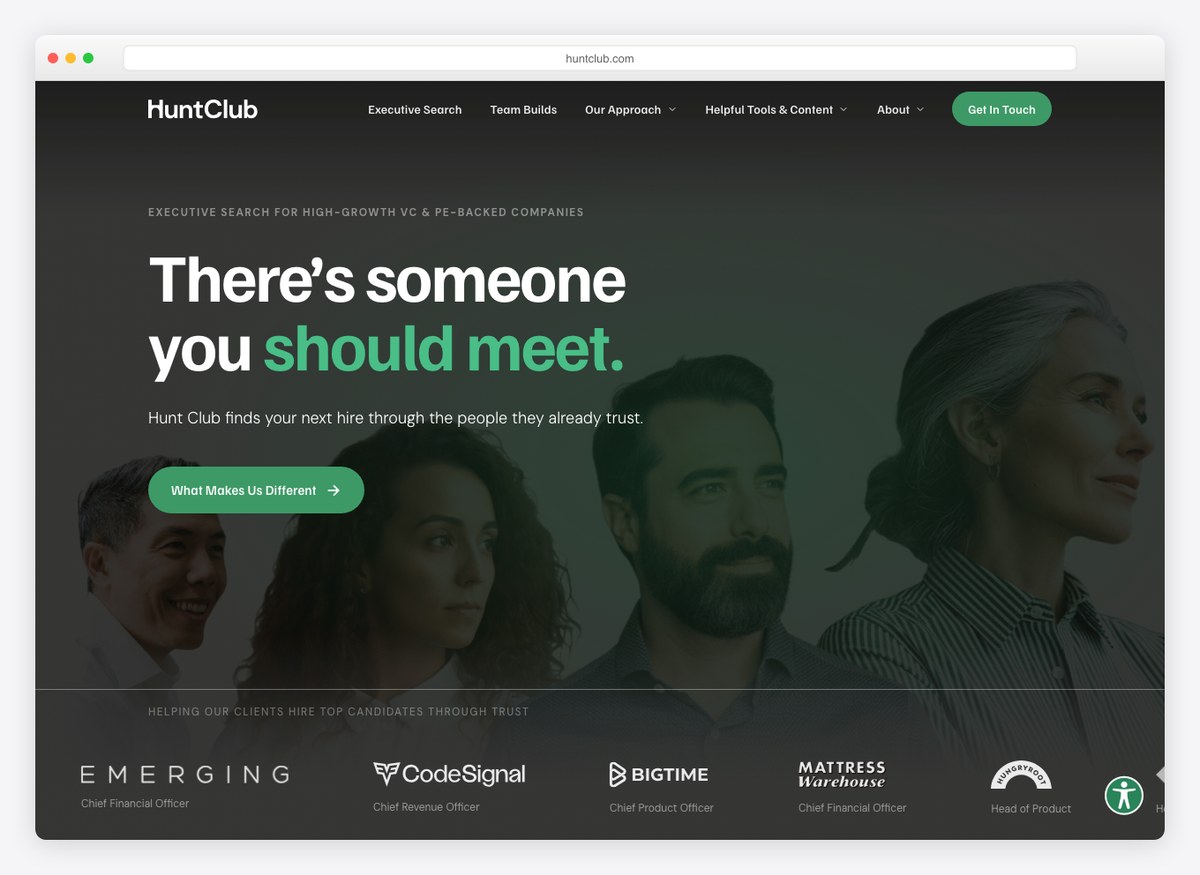
Dark, photographic and entirely employer-facing: “There’s someone you should meet.” Hunt Club sells access to a network rather than a vacancy list, so there is no job board and no candidate door — the logos of client companies do the persuading.
14. Heidrick & Struggles
Built with: a bespoke build
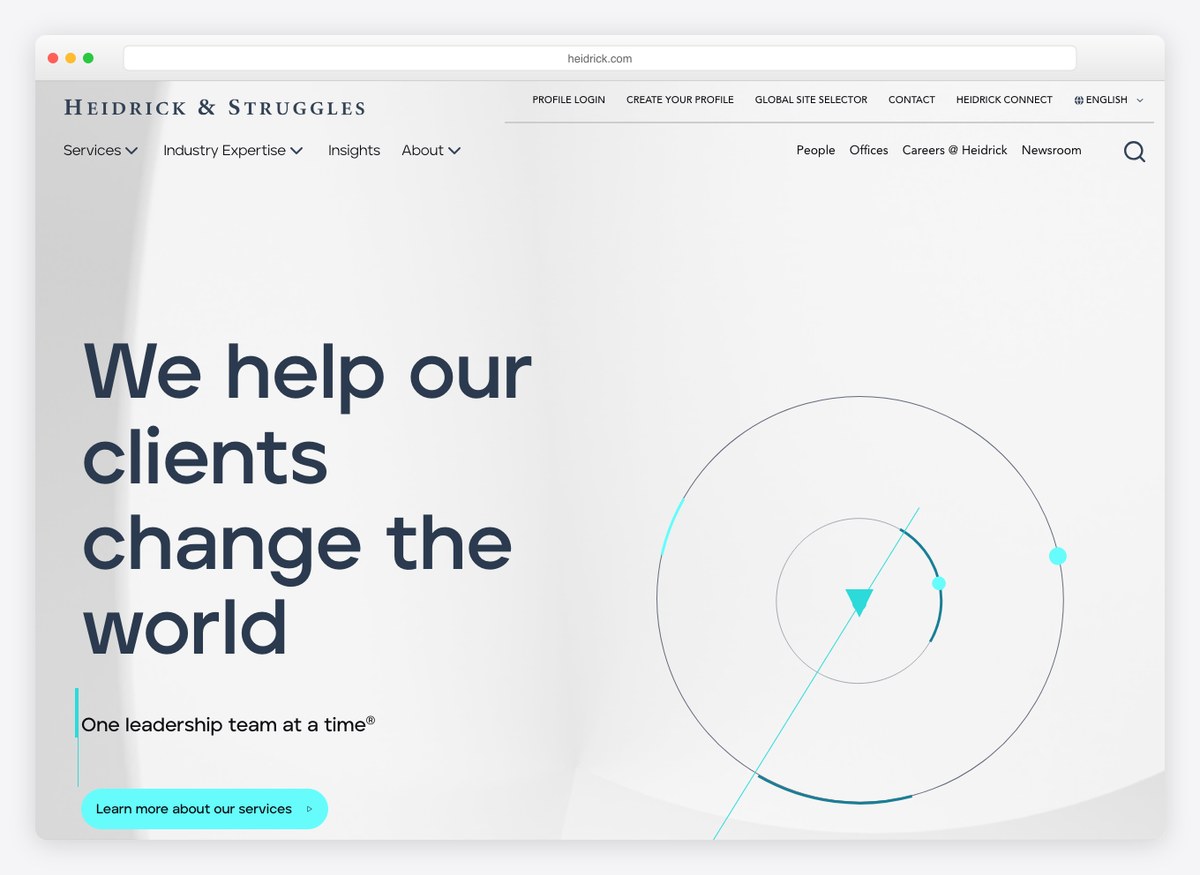
The largest firm here, and the plainest: a serif sentence on near-white with a single thin diagram in cyan. There is no public job board — the only vacancies linked are Heidrick’s own openings — and a candidate profile login stands in for one.
15. Zebra People
Built with: WordPress
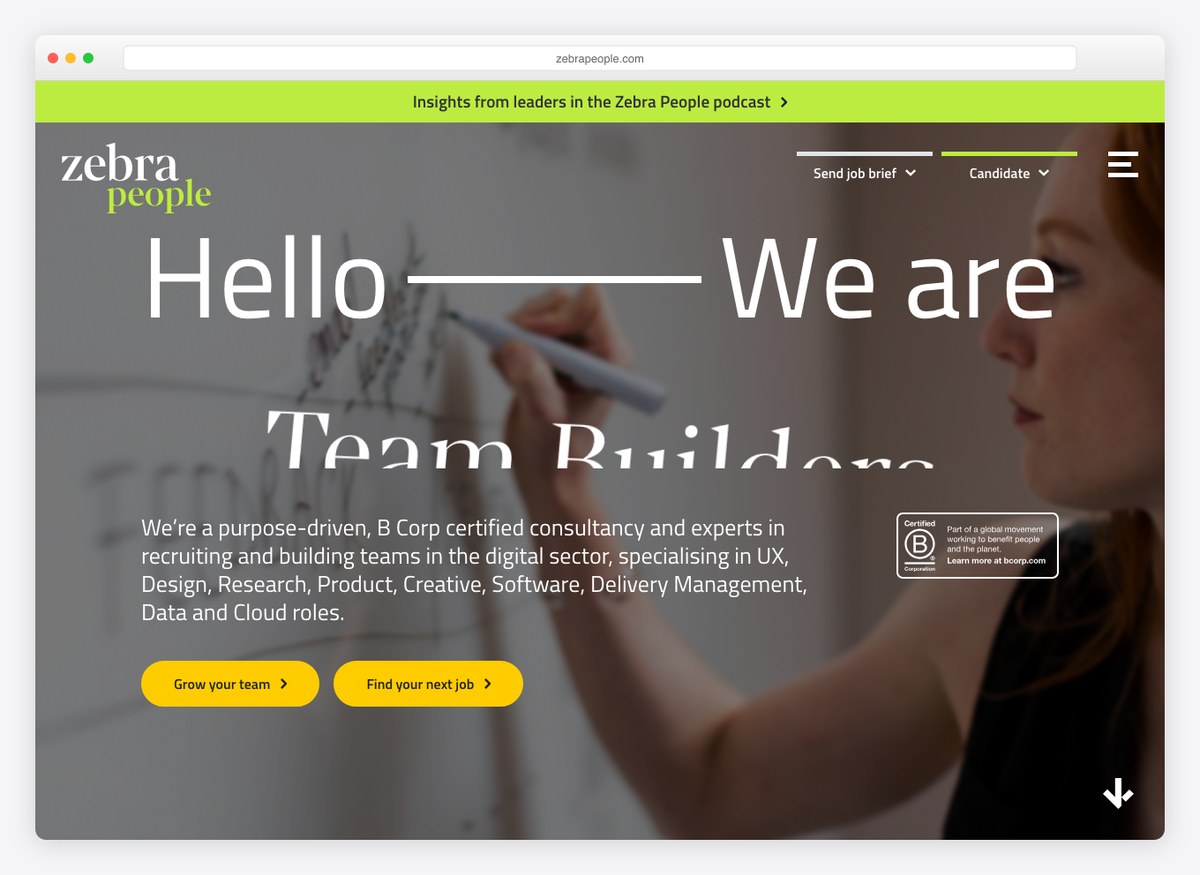
Acid green and yellow against black, with a specialism narrow enough to state in a sentence: product, design, research and data. B Corp certification is shown in the first screen, and both a live role count and a CV route are available without scrolling.
16. Understanding Recruitment
Built with: Vennture · CRM: Bullhorn Automation
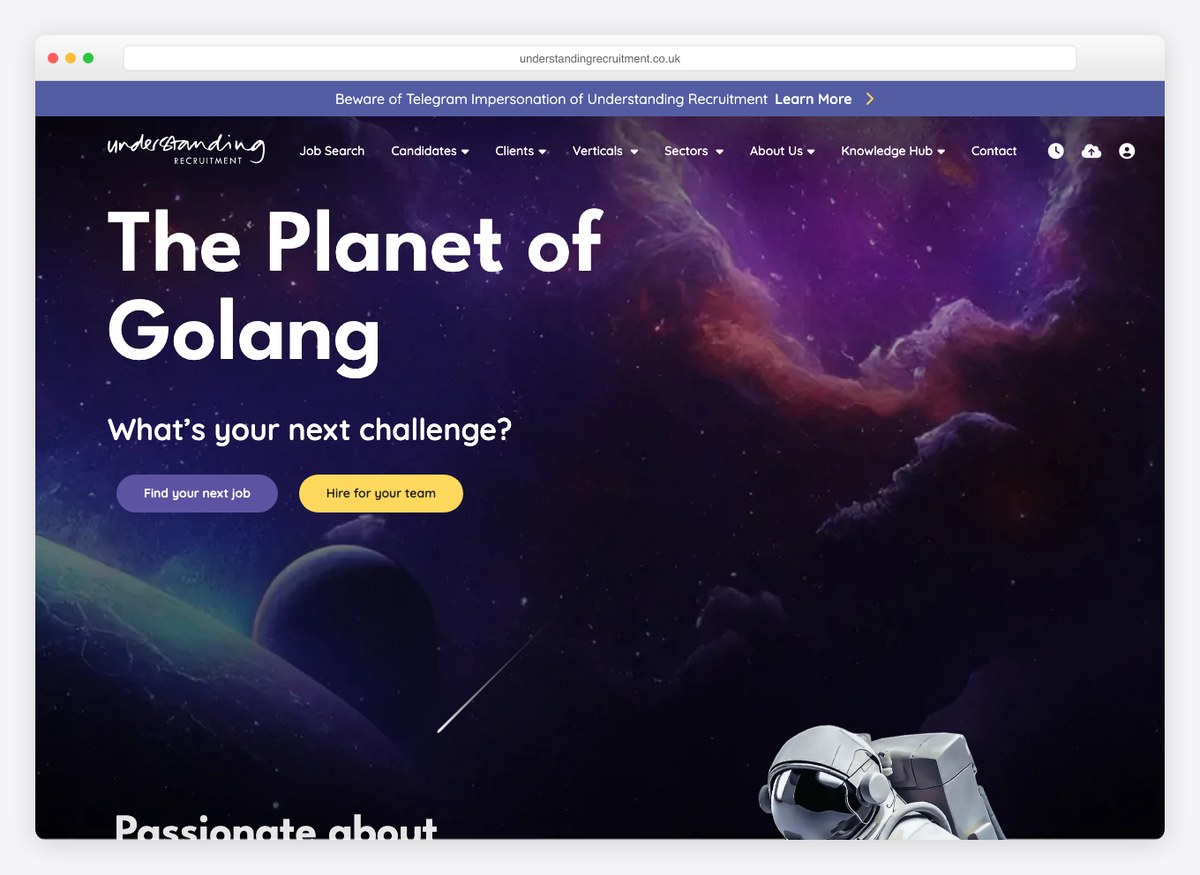
The hero cycles through the languages it recruits for — a space scene with a rotating headline in the form “The Planet of [language]”. Behind it is a board that states its own size honestly: forty roles, and it says forty.
17. Trust in SODA
Built with: SourceFlow · CRM: Bullhorn Automation
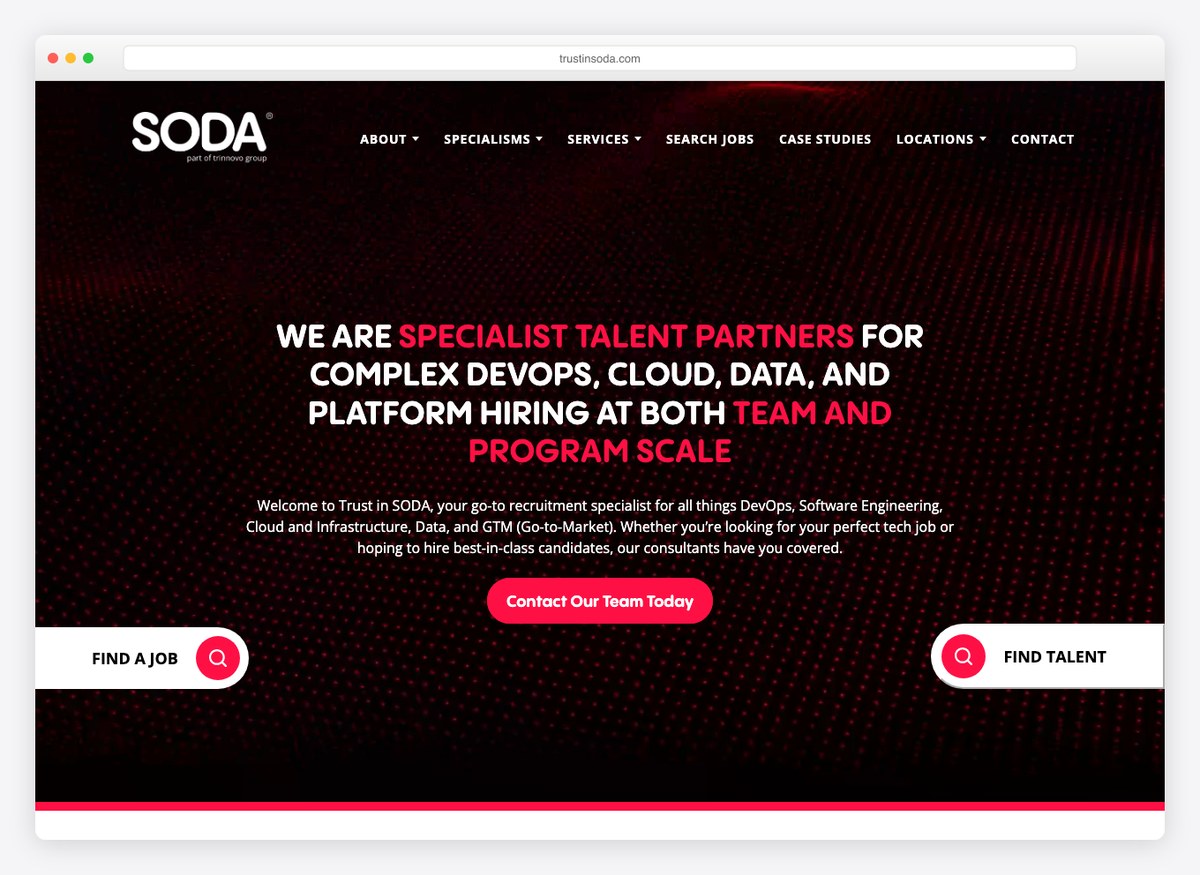
Black with a hot pink accent, and a headline that names the technical specialisms rather than gesturing at them: DevOps, cloud, data and platform hiring. Find A Job and Find Talent are given equal weight as paired controls in the first screen.
18. Harnham
Built with: WordPress · CRM: Bullhorn Automation
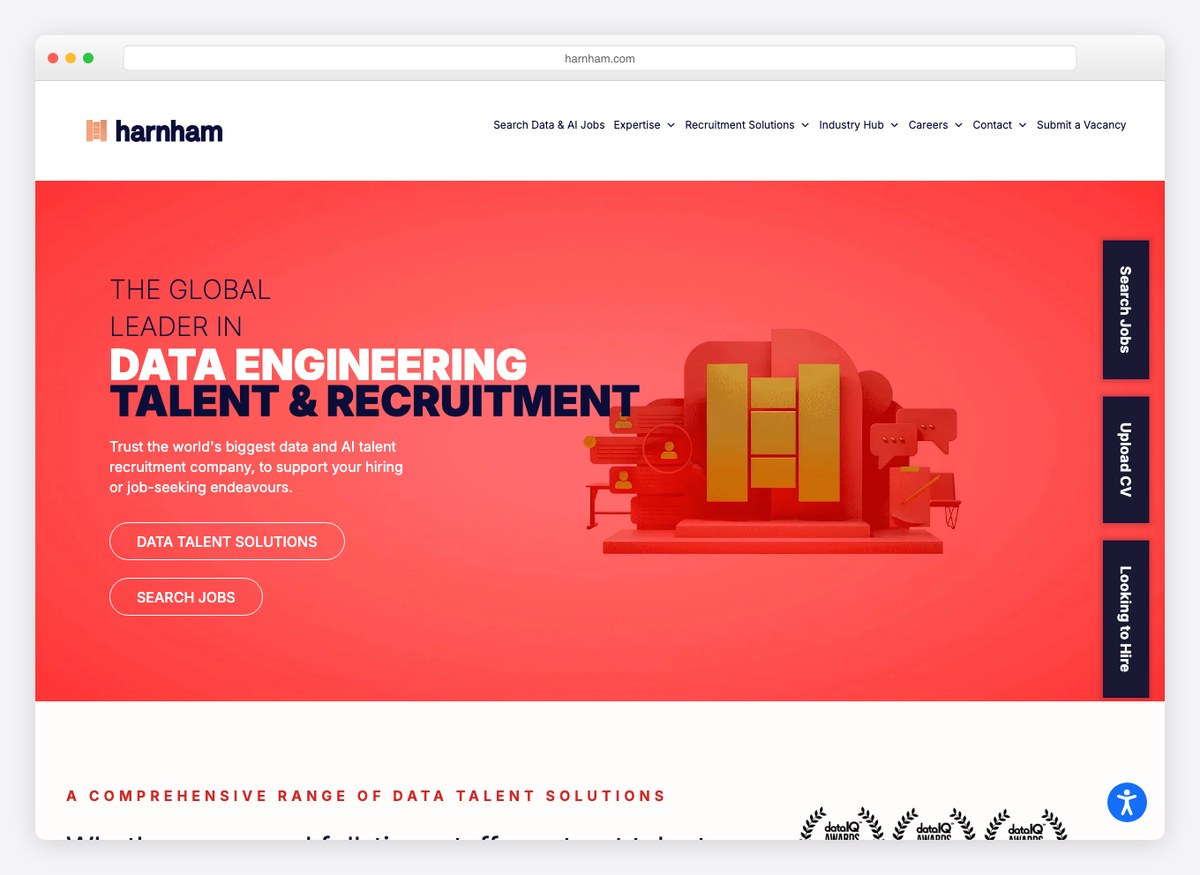
Red covering most of the first screen with an isometric illustration, and a fixed rail of three vertical tabs — Search Jobs, Upload CV, Looking to Hire — running down the right edge so both audiences have a permanent route. The brand name appears only as a logo.
19. Goodman Masson
Built with: Webflow · CRM: Bullhorn Automation
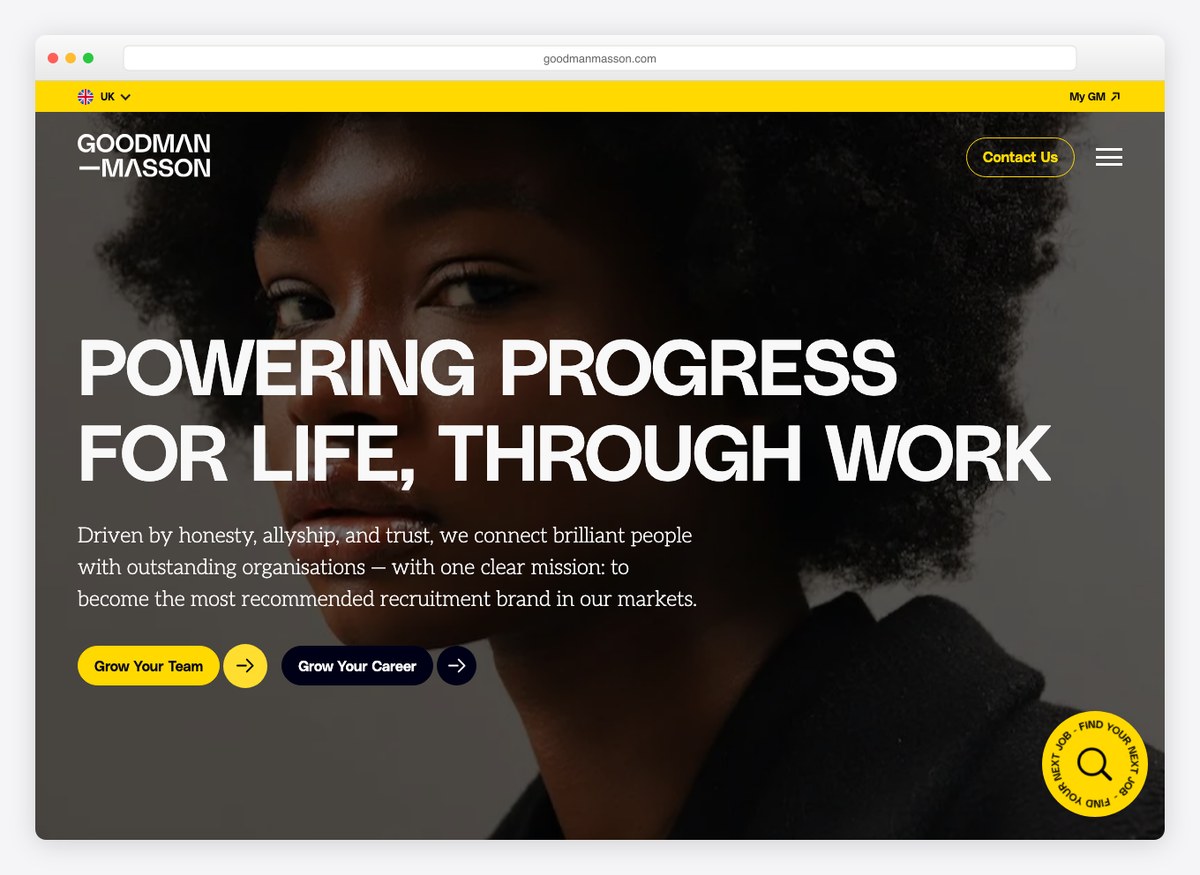
Black and a single saturated yellow, with a portrait and a mission statement rather than a service list. Two buttons split the audiences by intent rather than label: Grow Your Team and Grow Your Career.
20. Tiger Recruitment
Built with: WordPress
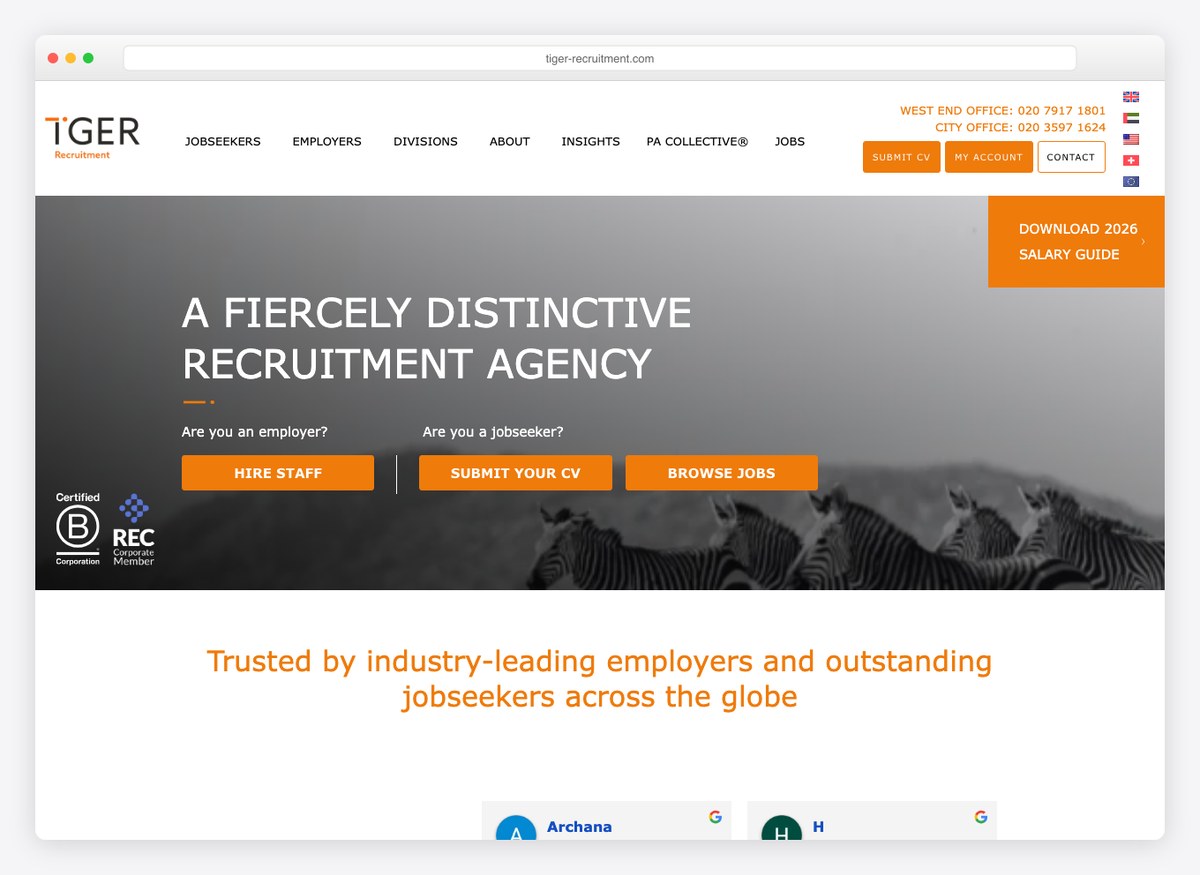
A business-support specialist that asks the question outright above two rows of buttons: “Are you an employer? Are you a jobseeker?” — then Hire Staff, Submit Your CV and Browse Jobs. The board behind it lists 273 roles and shows the count on the page.
21. Zachary Daniels
Built with: WordPress · CRM: Bullhorn Automation
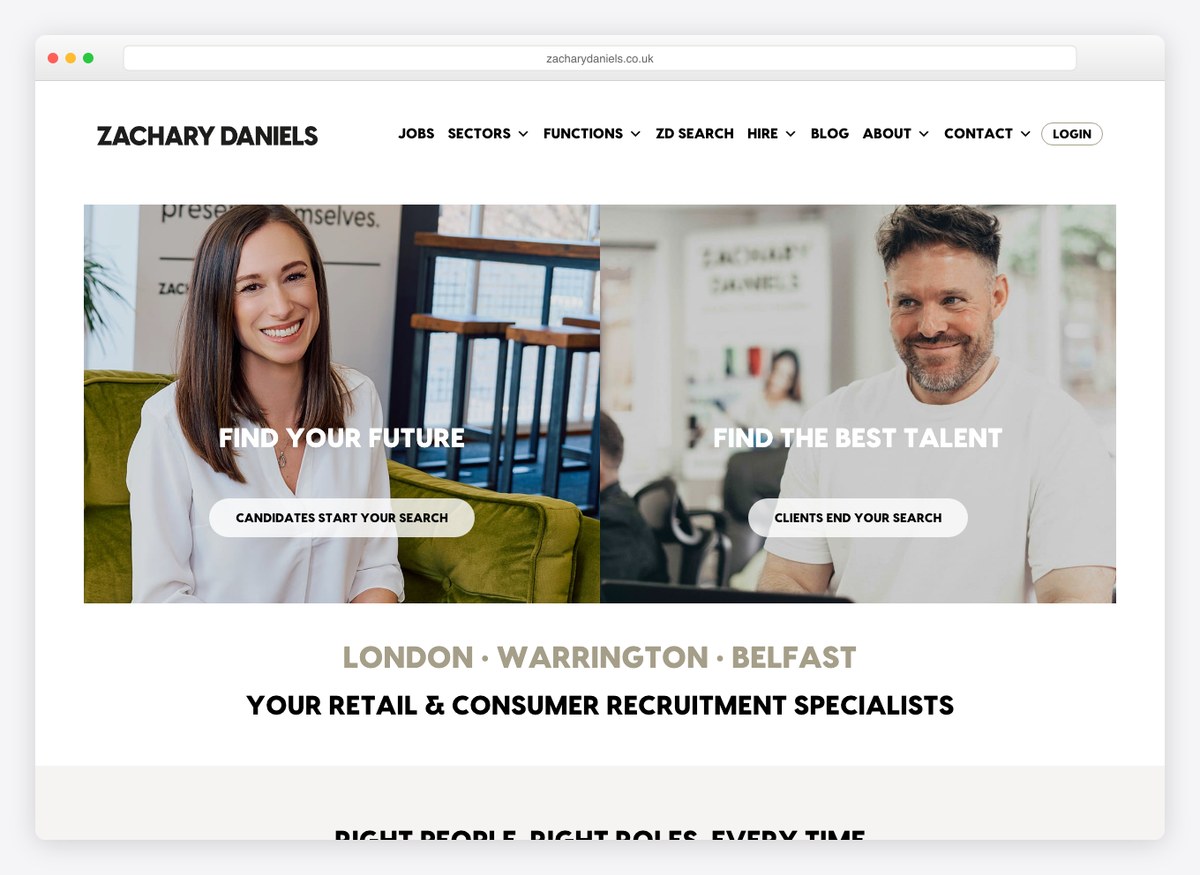
Two photographs side by side, each captioned with the audience it belongs to: Find Your Future for candidates, Find The Best Talent for clients. Underneath, three office locations and the sector, stated in one line: retail and consumer.
22. Barrington James
Built with: Vennture · CRM: Bullhorn Automation
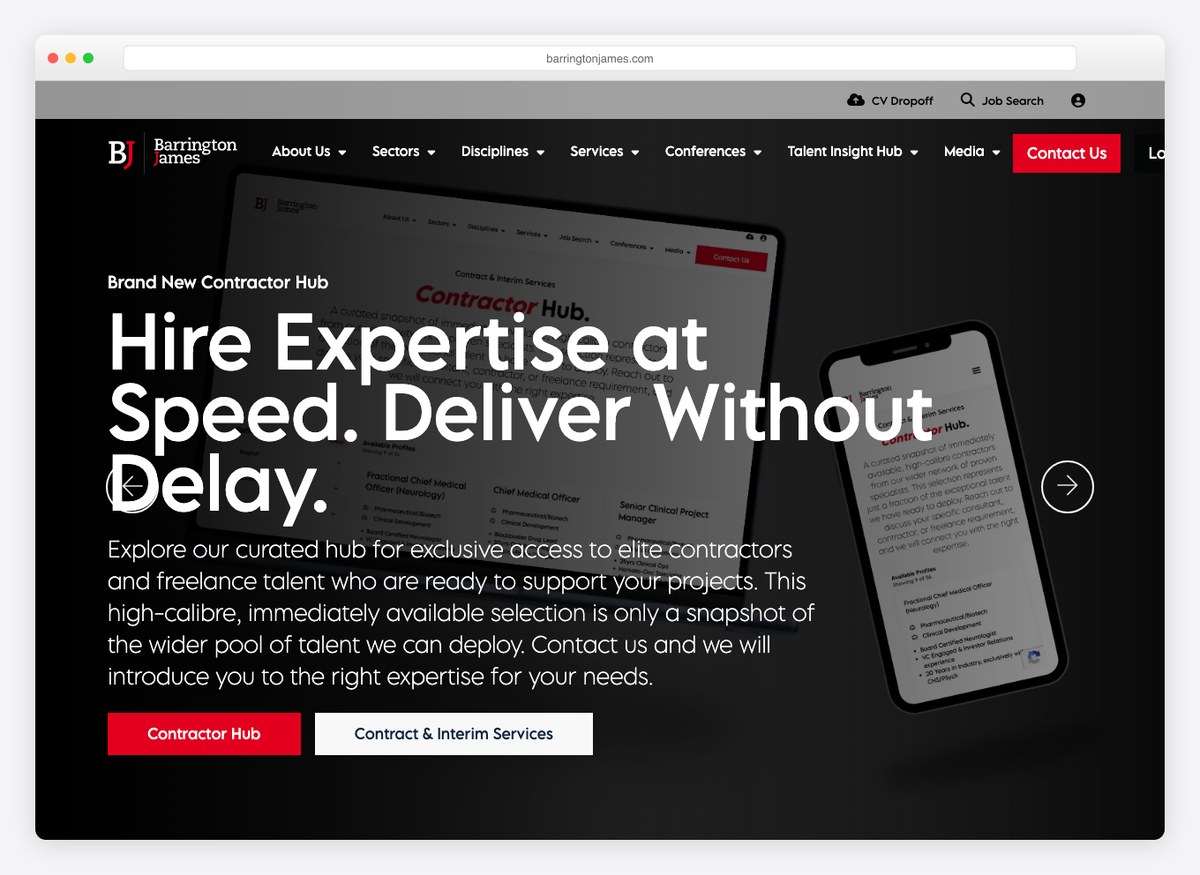
A near-black first screen selling a contractor hub rather than the agency, with a phone mockup and a single red accent. The board states its own size — 93 roles — and ten live vacancies are also listed on the homepage.
23. Matchtech
Built with: Vennture · CRM: Bullhorn Automation
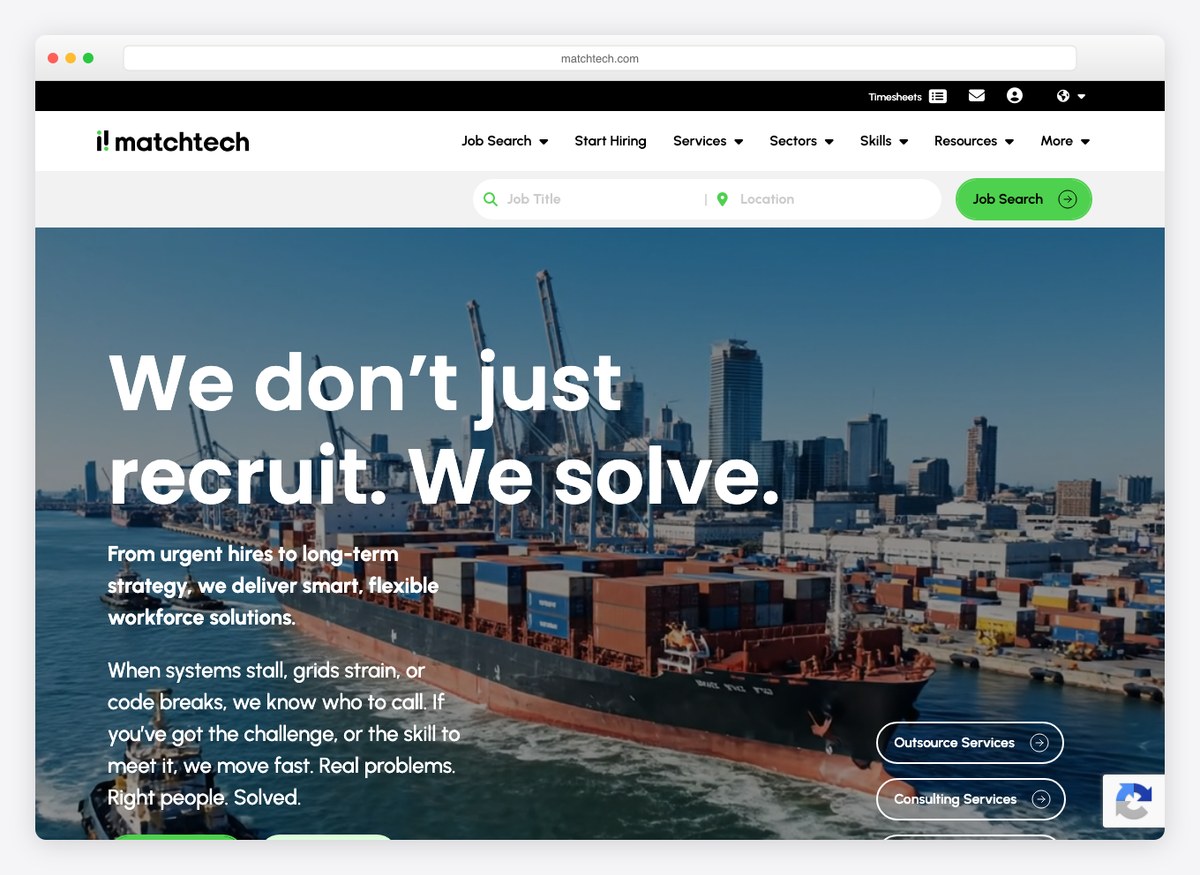
One of six sites with a job search in the first screen, and the largest board in the set at 1,291 live roles. The headline argues rather than describes: “We don’t just recruit. We solve.”
24. Fawkes & Reece
Built with: WordPress
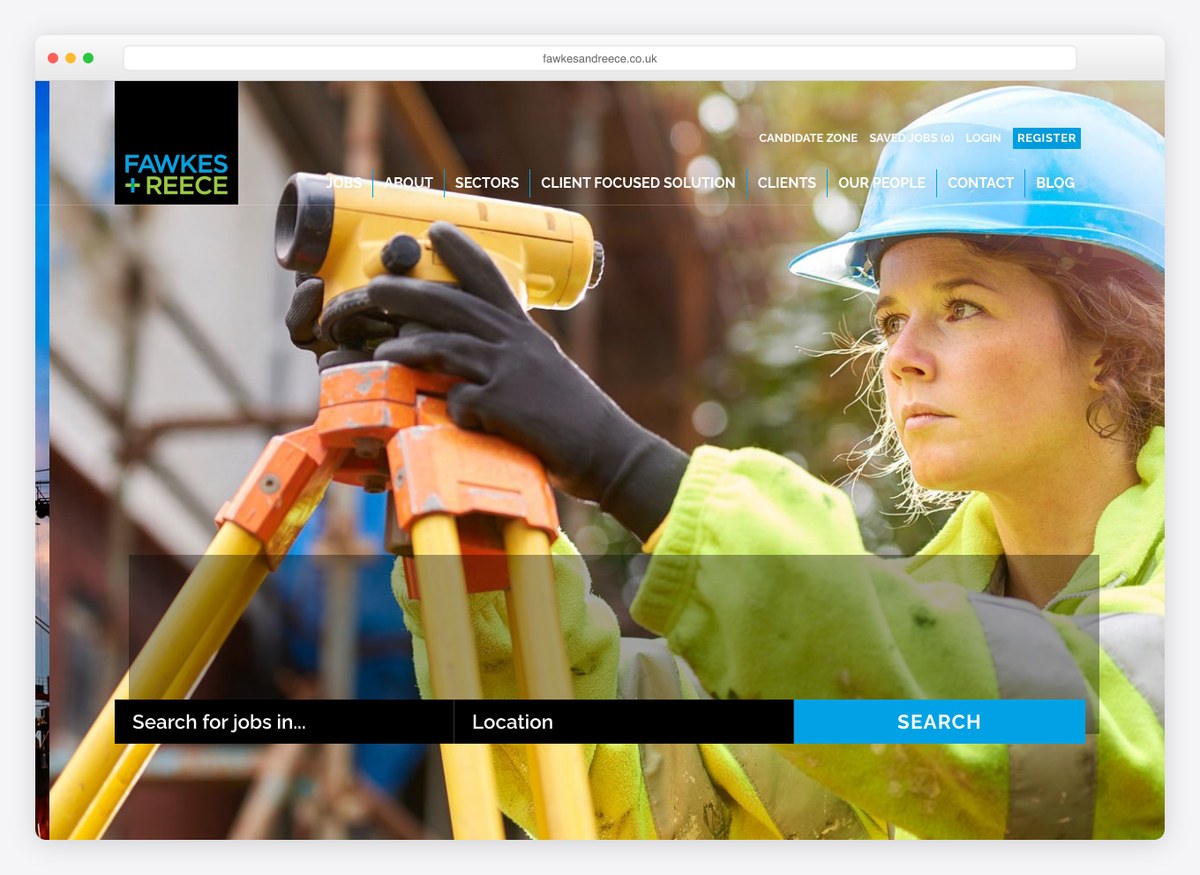
A construction recruiter that looks like one — a surveyor and a site engineer photographed on site — with a search bar laid over the image. The board carries 755 roles and the homepage lists fourteen of them without a click.
25. Medacs Healthcare
Built with: SourceFlow
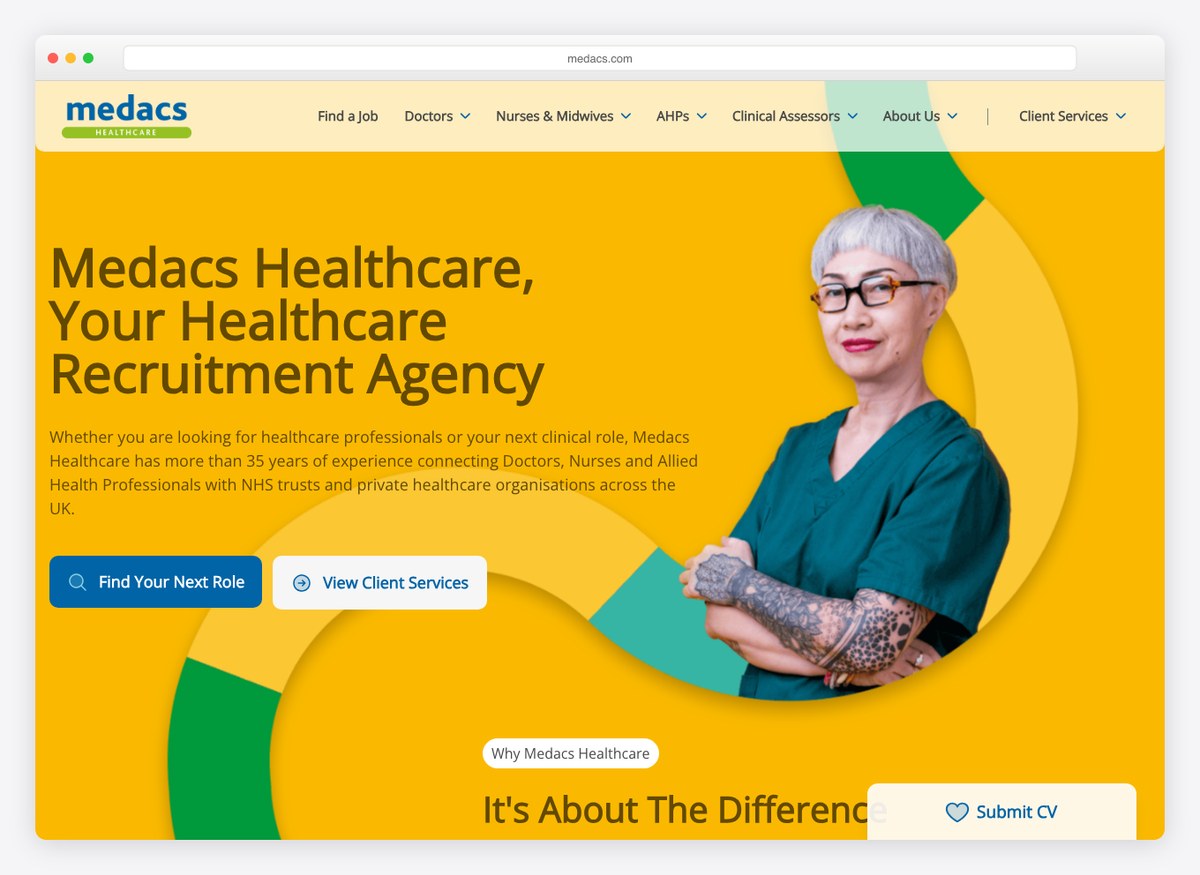
Yellow, green and teal arranged as overlapping arcs behind a nurse, which is a long way from the blue that healthcare recruiters default to. A large board sits behind it and the homepage links nine live roles directly.
26. Engage Education
Built with: WordPress
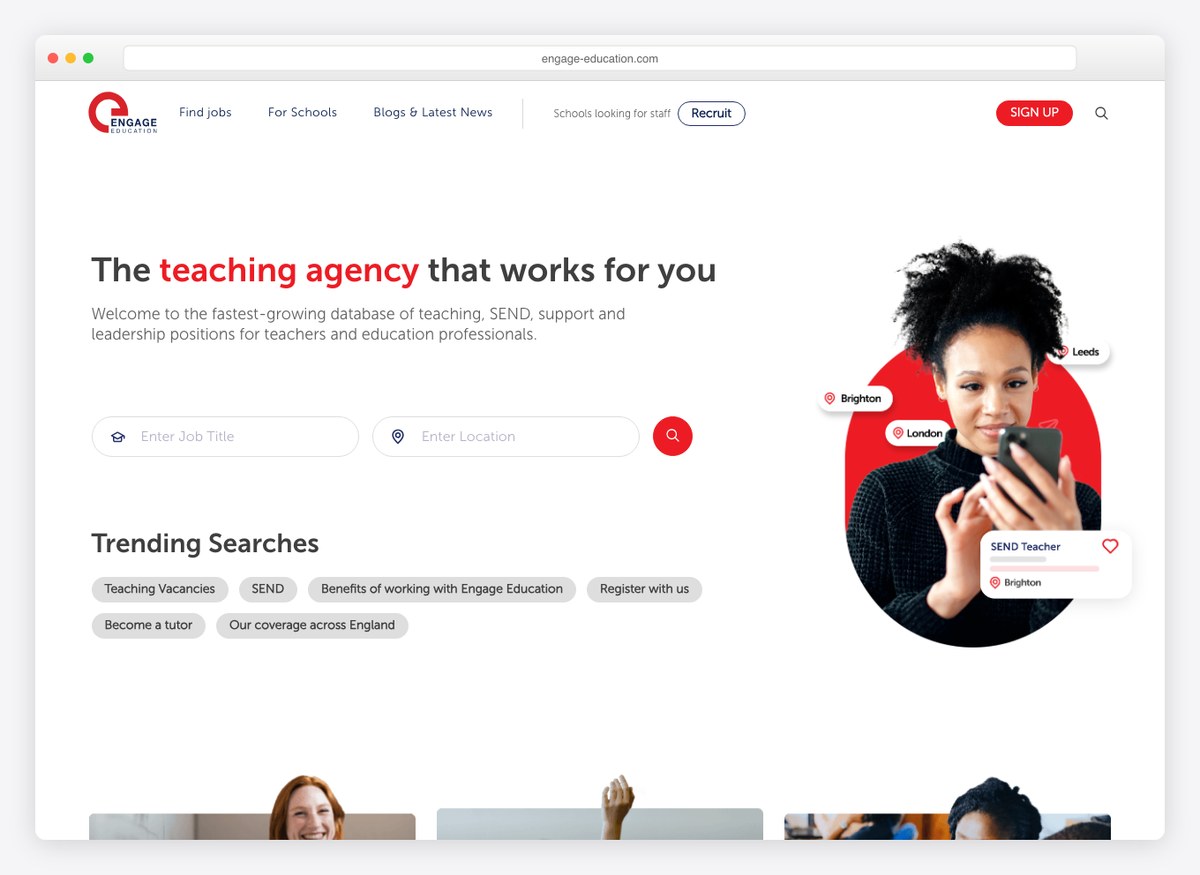
Trending Searches sit under the search box as tappable chips — SEND, teaching vacancies, become a tutor — which is a job board treating itself like a shop. Forty live roles are linked from the homepage and the board states 900-plus.
27. BCL Legal
Built with: a bespoke build
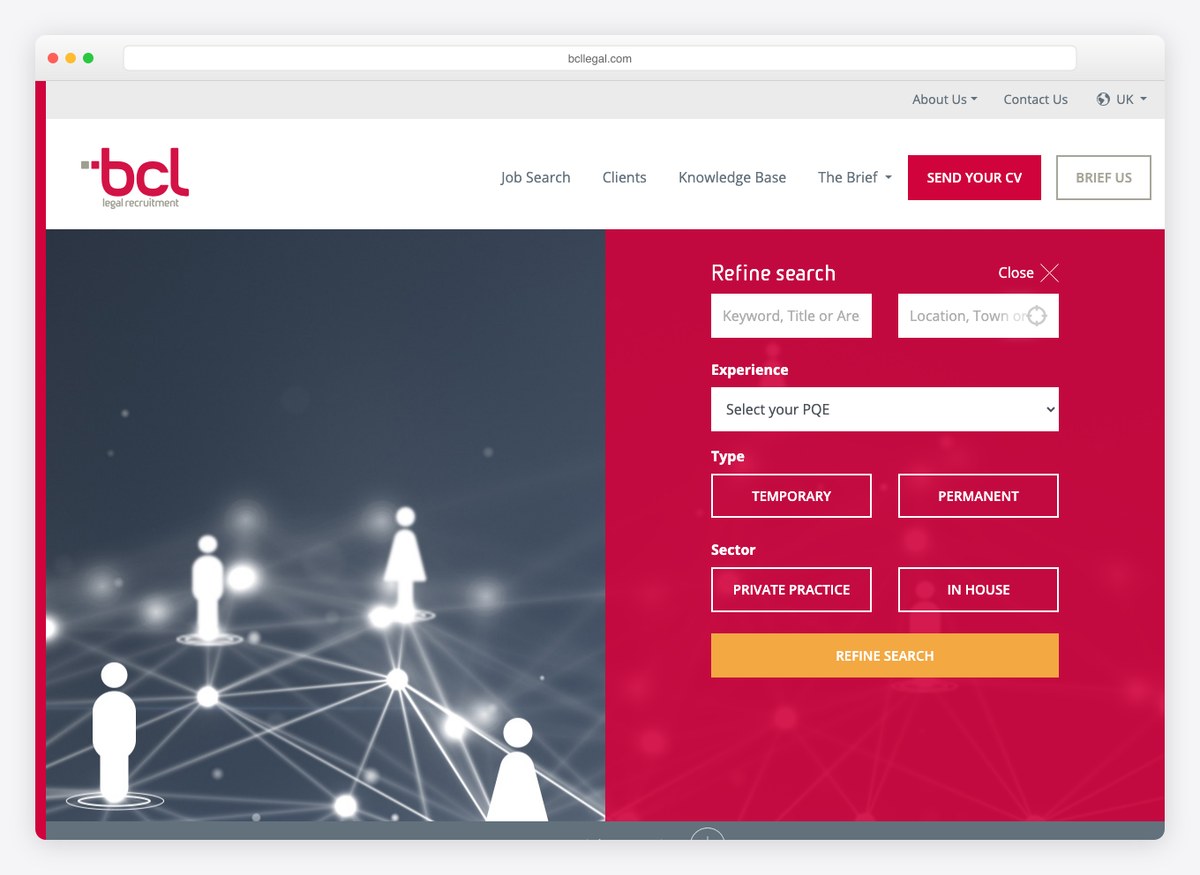
The busiest board in the set: 109 vacancy links, with 44 of them reachable straight from the homepage. A refine-search panel in the first screen filters by PQE, contract type and practice area before you have left the front page.
28. Pareto
Built with: SourceFlow
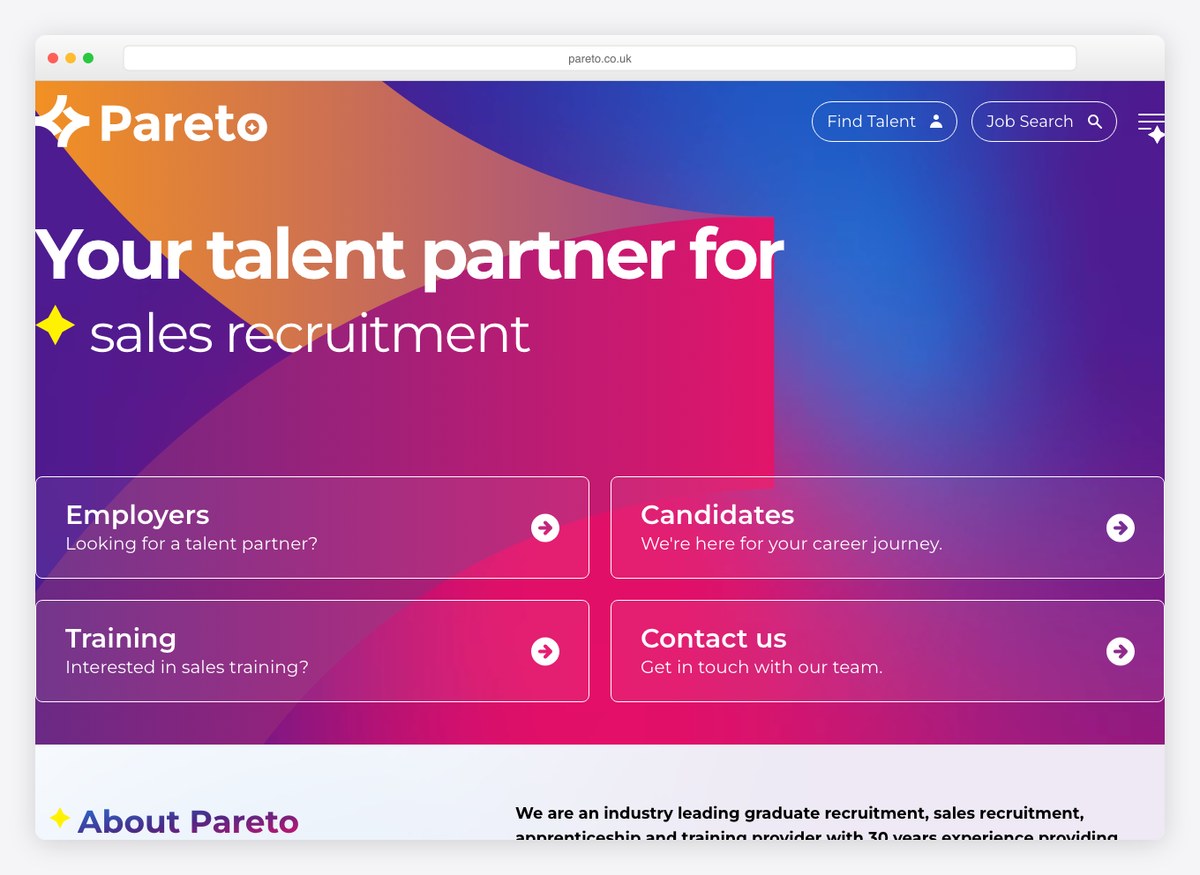
A magenta-to-indigo gradient and a rotating headline that names each specialism in turn. Below it, four labelled doors rather than two — Employers, Candidates, Training and Contact — which is the most explicit routing here.
29. Harris Hill
Built with: Duda
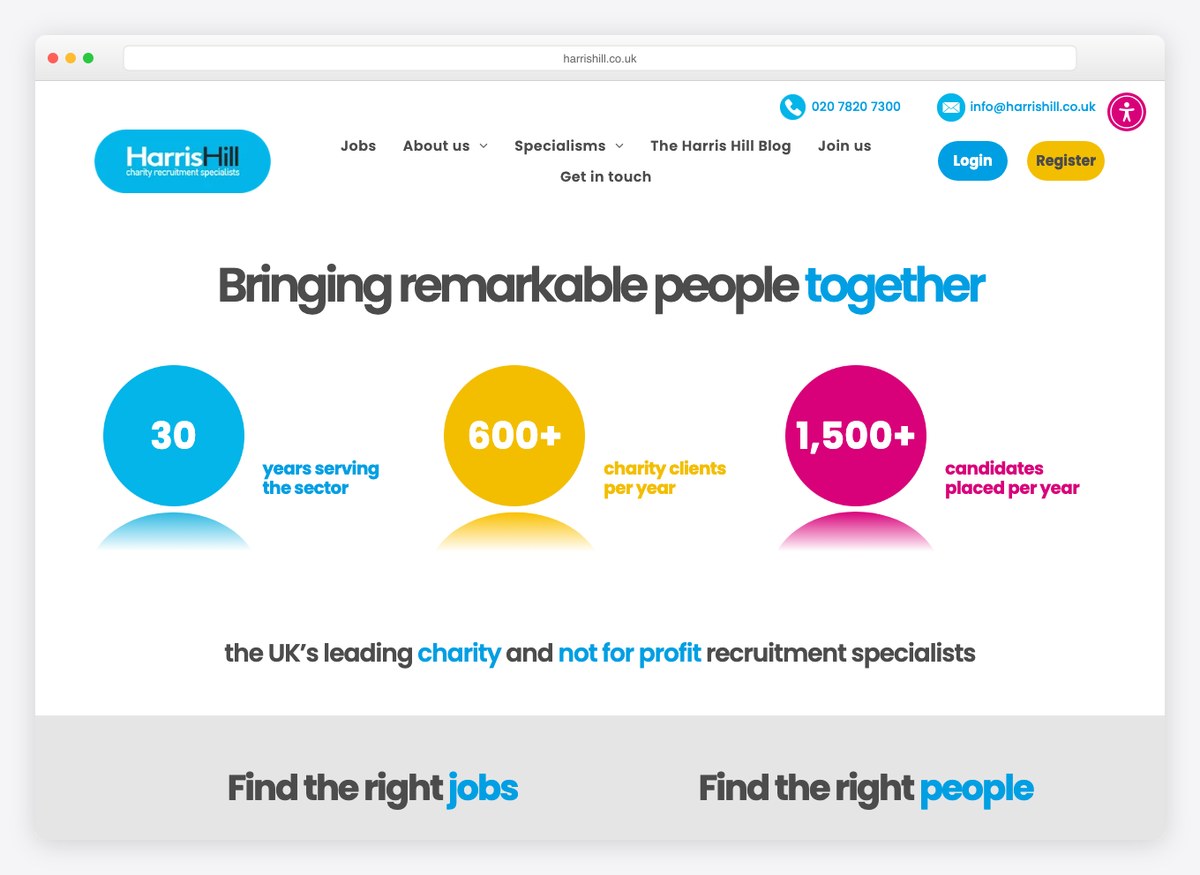
Three figures in the first screen, stated as numbers rather than adjectives: years serving the sector, charity clients per year, candidates placed per year. The footer of the fold splits cleanly into Find the right jobs and Find the right people.
30. Cathedral Appointments
Built with: a bespoke build
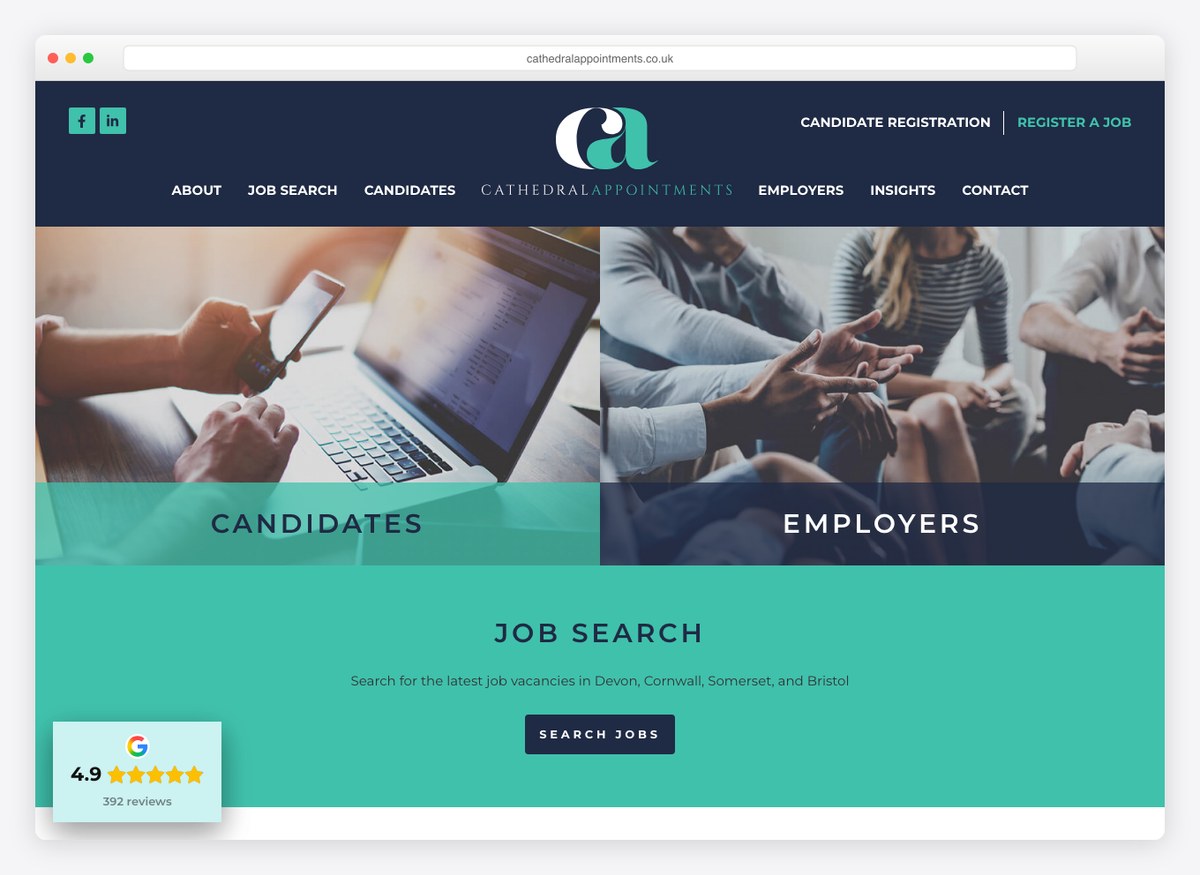
Two photographs, labelled CANDIDATES and EMPLOYERS, with a job search bar directly beneath them — the audience split and the search in the same screen. It names ten sectors and the region it covers, which a national brand cannot do.
What the thirty palettes have in common
Every swatch below is sampled from that site’s own screenshot above, not from a brand guideline.
The ground — what the page sits on
The accent — where colour actually appears
Two patterns worth stealing. Blue is the sector default, but almost never as a background — it appears as an accent on 13 of the thirty and as the ground on only 2, so the blue you remember from recruitment sites is usually a button, not a page. And three sites use no chromatic colour at all: Zensho Agency, Burõ Talent and Opal Digital, every one of them an executive search or creative boutique, where the restraint is the positioning.
What a recruitment website needs
If you are building or rebriefing one of these, the measurements above sort the requirements into what almost everyone does, what half do, and what almost nobody does. The last group is where the opportunity is, because a visitor comparing three agency sites will notice the one that answers the question the other two dodge.
- Name both audiences in the first screen. 23 of the thirty do, and the wording barely matters — “I want to apply / I want to hire”, “Get Hired / Find Employees”, “Find the right jobs / Find the right people” all work. What fails is making the visitor read a paragraph to find out which half is theirs.
- Put the vacancy count on the page. Only three of the thirty do. It is a single dynamic number pulled from a board you already run, and it answers “is this agency active?” before anyone clicks.
- Put a job search in the first screen. 6 of 30. Everyone else asks for a click first, which is a click between a candidate and the only thing they came for.
- Let people leave a CV without a vacancy. 13 of 30 offer it. Most candidates arrive when you have nothing suitable listed; a CV route is how you keep them.
- Name your sectors. 21 of the thirty name three or more. Specialism is what an agency sells, and a visitor cannot infer it from “talent solutions”.
- Show proof. 19 of 30 carry testimonials, case studies or reviews. In a trade with a reputation problem this is not decoration.
- A phone number is optional here, unlike the trades. Only 7 of 30 put a tappable number in the first screen — recruitment is researched, not summoned, and that is a real difference from a plumber or a roofer.
Who builds recruitment websites
The platform answer in this niche is not the one you would guess, and it is not the one a generic site-builder comparison will tell you. Fourteen of the thirty run WordPress, which is the single most common answer. But eight run a recruitment-specific platform that a normal CMS check cannot even see, because these vendors ship no generator tag and are only visible in the asset hosts the page requests: Vennture (3), SourceFlow (3) and Access Volcanic (2).
That matters because a recruitment site has a requirement an ordinary business site does not: it has to ingest a live vacancy feed from your CRM and generate a page per role, with filters, alerts and applications wired to the same system your consultants already work in. General website builders do not do that. It is the same shape of answer we found on car dealer sites, where a live inventory feed rules out the generic tools.
The layer underneath tells the same story more loudly. Whatever built the site, nine of the thirty are running Bullhorn’s automation platform behind it. The front end varies; the recruitment CRM behind it is frequently the same one. If you are choosing a platform, the practical question is not “which builder looks nicest” but “what talks to my CRM”.
If you are on WordPress and want the job board on the same install, a job board WordPress theme handles the listing, filtering and application flow. For staffing agencies specifically, we measured a separate set of staffing agency website examples, and our job board templates cover the listing side on its own.
Recruitment website questions, answered
Who builds the best recruitment websites?
Measured across these thirty sites, there is no single answer — but there is a clear split. Fourteen run WordPress, usually with a page builder. eight run a platform built specifically for recruitment agencies — Vennture (3), SourceFlow (3) and Access Volcanic (2) — which generic CMS detection cannot identify at all because they ship no generator tag. A further 3 use Webflow and 1 Duda, and four run something bespoke.
The more useful finding sits behind the website: nine of the thirty run Bullhorn automation. Agencies choose the CRM first and the website second, which is why the sector platforms exist — they are built to plug into it.
What should a recruitment website include?
From what these thirty sites actually do: a clearly labelled route for candidates and a separate one for employers (23 of 30 have both), a searchable list of live vacancies, a way to submit a CV when nothing suitable is listed (13 of 30), named sectors rather than “talent solutions” (21 name three or more), and proof in the form of testimonials or case studies (19 of 30).
The two things most of them miss are the cheapest to add: the number of live vacancies on the page (3 of 30) and a job search box in the first screen (6 of 30).
Do recruitment agencies need a job board on their website?
Not all of them. Five of these thirty publish no vacancies whatsoever, and every one is an executive search firm: Zensho Agency, JDM Talent, Burõ Talent, Hunt Club and Heidrick & Struggles. Retained search work is confidential, the roles are not advertised, and the site sells judgement to clients rather than opportunities to candidates. Those same firms are also the ones that do not split their homepage between two audiences, because they only have one.
For contingency, temporary and volume recruitment the answer is the opposite: the board is the product. 11 of the boards we opened state their own size, ranging from 6 roles to 1292.
Can you build a recruitment website on WordPress?
Yes, and it is the most common choice here — fourteen of the thirty. The thing to plan for is not the website but the vacancy feed: your board needs to pull live roles from your CRM and publish a page per role rather than have consultants paste jobs in by hand.
A job board WordPress theme covers listing, filtering and applications. If your CRM is Bullhorn, JobAdder or Vincere, check the integration before choosing the theme — that constraint is why eight of the sites here use a recruitment-specific platform instead.
How is a recruitment website different from a staffing agency website?
In practice the terms overlap, and the sites look similar. The useful distinction is volume: staffing and temp businesses live on a large, fast-moving board and design the homepage around search, while search and specialist recruitment firms lead with sector expertise and consultants. We measured staffing agency websites separately if you want that comparison.
How we chose these
Opened every site
Each one loaded in a real browser at 1280×860 and judged from the live page, not from an old screenshot in our media library.
30 checked · 30 re-captured
Clicked through to the job board
One hop from the homepage into whatever the jobs link leads to, then counted what was listed. An agency’s vacancy list is the product, so a description that never opens it is not worth much.
25 boards opened · 5 publish none
Checked the machine against the screenshot
Counts that looked wrong were wrong: one agency’s “vacancies” were a job reference number, another’s were a phone number, and a third’s were LinkedIn’s site-wide total. The audience split was verified by eye on all 30.
30 captures reviewed
Sampled the colours from the captures
Palettes are quantised from each site’s own screenshot and then curated, so every swatch describes the page you can see rather than a published brand palette.
30 palettes · sampled, not quoted
The pattern across all thirty is the same one we keep finding: the expensive things are done well and the cheap things are skipped. These sites have professional photography, considered typography and clear positioning — and then 3 of 30 tell you how many jobs they have, and 6 of 30 let you search for one without a click. If you take one thing from this page, take the vacancy count. It is a single number from a database you already run.
Browse the other Professional services website examples (16 more collections), or see website examples for every industry.

Related Posts


Comments (0)