

Elementor Statistics 2026: Market Share, Usage & Trends
Elementor has 10 million+ active installs, says it powers 22 million+ sites, and accounts for 43% of detected WordPress page-builder usage. However, competition from the Block Editor and Full Site Editing, Bricks Builder, and other alternatives is intensifying, with Elementor’s share down from about 56% in 2024. Here are 50+ Elementor statistics covering usage, market share, competitors, performance, and the evolving WordPress builder landscape for 2026.
Key Elementor Statistics (2026)
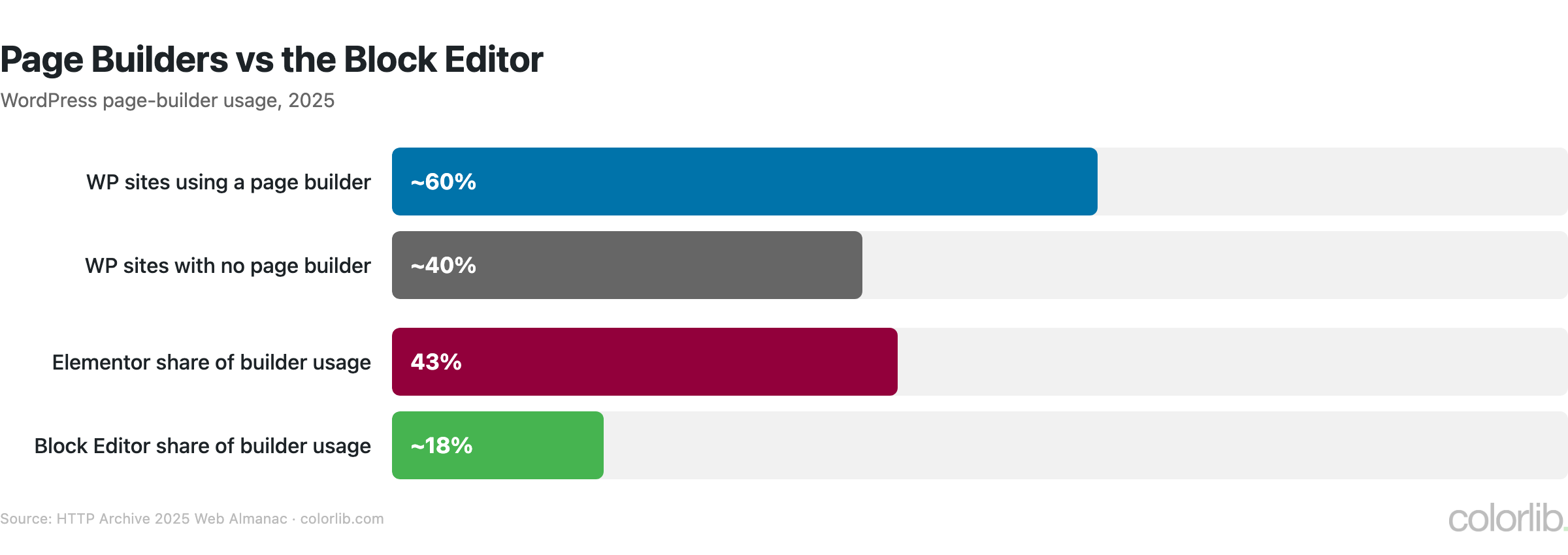
- 10 million+ active WordPress installs (WordPress.org)
- 13% of all websites, by Elementor’s own count (Elementor)
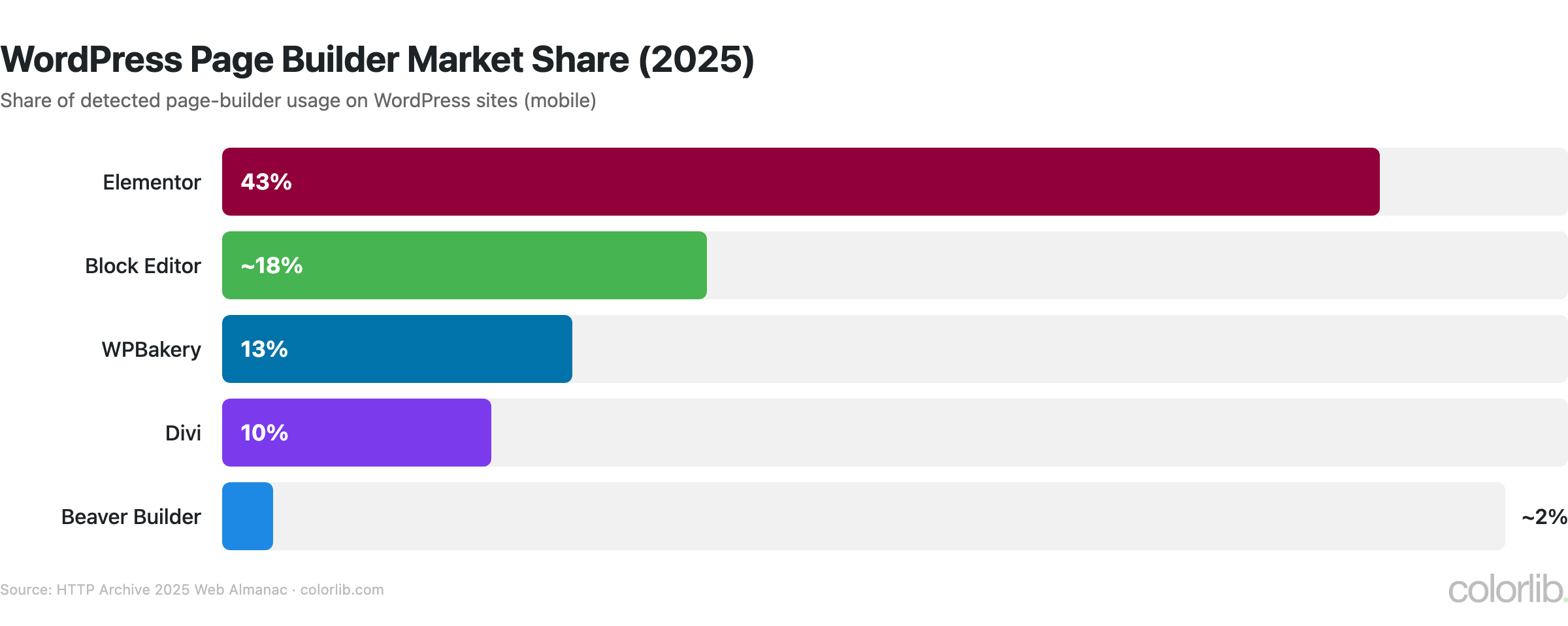
- 43% of detected WordPress page-builder usage in 2025, down from about 56% in 2024 (HTTP Archive)
- 22 million+ websites built with Elementor (Elementor)
- Elementor Pro pricing: $60-$204/year (Elementor)
- The WordPress Block Editor accounts for about 18% of detected page-builder usage (HTTP Archive)
- ~60% of WordPress sites use a page builder (HTTP Archive)
Elementor Market Share & Usage
| Metric | Value | Source |
|---|---|---|
| Active installs | 10 million+ | WordPress.org |
| Share of all websites (Elementor’s figure) | 13% | Elementor |
| Share of detected page-builder usage (2025) | 43% | HTTP Archive |
| Share of detected page-builder usage (2024) | 56% | HTTP Archive |
| Total websites ever built | 22 million+ | Elementor |
| WordPress.org rating | 4.5/5 (7,300+ reviews) | WordPress.org |
| GitHub stars | 7,000+ | GitHub |
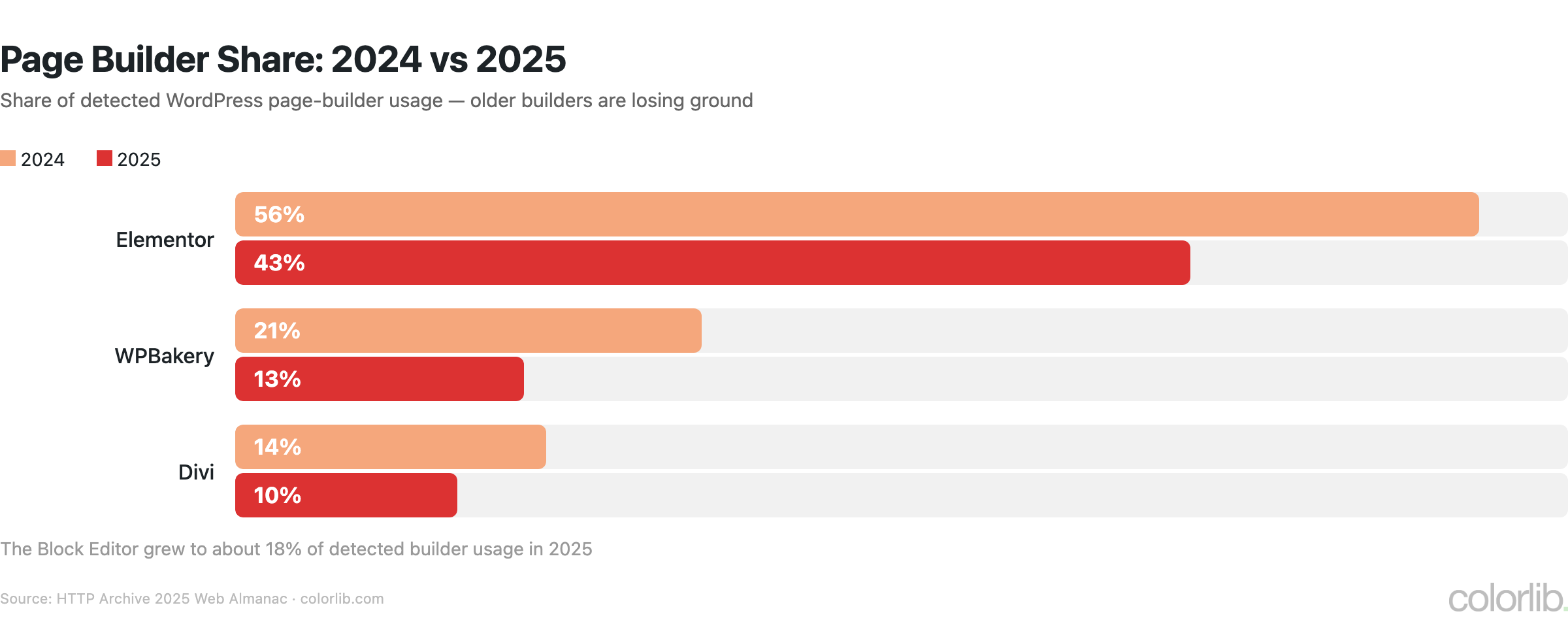
- Elementor is the most popular WordPress page builder by a significant margin, though its share of detected page-builder usage fell from about 56% in 2024 to 43% in 2025 (HTTP Archive)
- Elementor says it powers 13% of all websites; with WordPress on 40.2% of the web (W3Techs), that would mean roughly one in three WordPress sites
- Elementor maintains a strong 4.5/5 rating on WordPress.org with over 7,300 reviews
- For the broader WordPress ecosystem context, see our WordPress statistics report
Elementor vs. Other Page Builders
| Builder | Active Installs | Share of Builder Usage (2025) | Trend (2024 → 2025) |
|---|---|---|---|
| Elementor | 10M+ | 43% | Declining (from 56% in 2024) |
| WPBakery | Premium (not on WordPress.org) | 13% | Declining (from 21%) |
| Divi Builder | Premium (not on WordPress.org) | 10% | Declining (from 14%) |
| Beaver Builder | 100K+ (Lite) | ~2% | Steady |
| WordPress Block Editor | Built into WP | ~18% | Growing |
| Bricks Builder | Premium (not on WordPress.org) | — | Popular with developers |
- Bricks Builder is a premium builder favoured by performance-focused developers for its leaner code output; it is not distributed on WordPress.org, so no public install count exists
- The WordPress Block Editor grew to about 18% of detected page-builder usage in 2025 (HTTP Archive) — it’s free, built-in, and increasingly capable
- WPBakery fell from about 21% to 13% and Divi from 14% to 10% between 2024 and 2025, while Beaver Builder held steady at about 2% — older builders are losing share to block-native tools
- Approximately 60% of WordPress sites now use some form of page builder (HTTP Archive)
Elementor Features & Pricing
| Feature | Free | Pro ($60-$204/yr) |
|---|---|---|
| Widgets | 40+ | 57-85 Pro widgets on top |
| Templates | 100+ | 300+ |
| Theme Builder | No | Yes |
| WooCommerce Builder | No | Yes (Advanced and up) |
| Popup Builder | No | Yes (Advanced and up) |
| Form Builder | No | Yes |
| Custom CSS | No | Yes (Advanced and up) |
| Dynamic Content | No | Yes |
| AI features | No | Via Elementor One AI credits |
- Elementor Pro plans range from $60/year (Essential, 1 site) to $204/year (Expert, 25 sites); Elementor One bundles with AI credits cost $180-$432 for the first year
- The free version includes 40+ widgets and 100+ templates — enough for basic sites but limited for professional use
- Elementor AI was introduced in 2023 and allows AI-generated text, images, code, and layouts directly in the editor
- The Theme Builder (Pro only) is the primary reason for upgrading — it enables custom headers, footers, archive pages, and single post templates
- Third-party add-ons extend Elementor further: Essential Addons alone (1M+ active installs) adds 120+ widgets
Gutenberg’s Impact on Elementor
| Metric | Value | Source |
|---|---|---|
| Block Editor share of page-builder usage (2025) | ~18% | HTTP Archive |
| Block themes available | 1,800+ | WordPress.org |
| Pages using Block Editor + Site Editor together | 0.2% | HTTP Archive |
| WP sites with no page builder | ~40% | HTTP Archive |
| Gutenberg blocks available | 90+ core | WordPress.org |
| Gutenberg plugin rating | 2.1/5 (3,800+ reviews) | WordPress.org |
- The Block Editor’s rise to about 18% of detected page-builder usage represents the biggest long-term threat to Elementor’s dominance
- Over 1,800 block themes are now available on WordPress.org
- Only 0.2% of pages combine the Block Editor with the Site Editor, so full site editing is still early
- The Gutenberg plugin rates 2.1/5 on WordPress.org, well below Elementor’s 4.5/5
- The shift to Gutenberg FSE is gradual — most agencies and freelancers still prefer Elementor for client projects requiring complex layouts
Elementor Performance Statistics
- Elementor’s main performance criticism is DOM bloat — page builders often generate more complex DOM structures and larger CSS and JavaScript bundles (HTTP Archive)
- Elementor has improved performance with reduced CSS, lazy loading, and element caching in recent versions, but the architecture remains heavier
- WordPress sites as a whole pass Core Web Vitals on only 45% of mobile sites, versus 85% for Duda and 74% for Wix (HTTP Archive)
- For more on how design tools affect performance, see our web design statistics report
Key Takeaways
- Elementor dominates but is declining. With 10M+ installs and 43% of detected page-builder usage, Elementor is still #1 — but its share has dropped from about 56% in 2024 as alternatives gain ground.
- The Block Editor is the long-term threat. Already about 18% of detected page-builder usage and built into WordPress core, it will gradually reduce demand for third-party builders.
- Performance is Elementor’s Achilles’ heel. DOM bloat and heavy CSS/JS are the trade-off for its flexibility, on a platform where only 45% of sites pass Core Web Vitals on mobile.
- Bricks is the developer’s choice. Bricks attracts performance-conscious developers with clean code output and smaller page sizes.
- 60% of WordPress sites now use builders. The page builder category continues expanding, with builders becoming the default way to create WordPress sites rather than coding custom themes.
- AI features are the new battleground. Elementor AI, Divi AI, and Gutenberg’s evolving capabilities mean AI-powered design will differentiate builders in 2026 and beyond.
Sources
- WordPress.org — Elementor Plugin Page
- Elementor — About / Company Info
- HTTP Archive 2025 Web Almanac — CMS Chapter
- HTTP Archive — Core Web Vitals Report
- WordPress.org — Platform Statistics
- Elementor — Pricing Page
Frequently Asked Questions
How many websites use Elementor?
Elementor has 10 million+ active WordPress installs and, by its own count, has been used to build 22 million+ websites and powers 13% of the web. HTTP Archive found it on 43% of detected WordPress page-builder usage in 2025.
Is Elementor still the best page builder?
Elementor remains the most popular page builder by a wide margin, but “best” depends on priorities. For ease of use and widget variety, Elementor leads. For performance and clean code, Bricks Builder is superior. For budget-conscious users, Gutenberg FSE is free and built into WordPress. Elementor’s share of detected page-builder usage fell from about 56% in 2024 to 43% in 2025 as alternatives improve. See our graphic design statistics for broader design tool trends.
Will Gutenberg replace Elementor?
Not immediately, but the Block Editor already accounts for about 18% of detected page-builder usage and is becoming increasingly capable. Over 1,800 block themes are available on WordPress.org. However, only 0.2% of pages combine the Block Editor with the Site Editor, the Gutenberg plugin rates 2.1/5 on WordPress.org against Elementor’s 4.5/5, and core lacks advanced features like popup builders, form builders, and the same level of drag-and-drop polish. Mainstream adoption will likely take several more years.
How much does Elementor Pro cost?
Elementor Pro starts at $60/year for 1 site (Essential), with plans at $84/year (Advanced Solo, 1 site), $108/year (Advanced, 3 sites), and $204/year (Expert, 25 sites). Elementor One bundles, which add AI credits and services like image optimization, cost $180 (1 site) to $432 (unlimited sites) for the first year. The free version includes 40+ widgets and basic functionality; Theme Builder requires Pro, and WooCommerce Builder, Popup Builder, and Custom CSS require Advanced or higher. For the full WordPress ecosystem landscape, see our WordPress statistics report.

Related Posts






I must say, for the payment system, that punishes the small webiste owners and small developers, I personally started hating Elementor and will never use it again. I started using Blocksy and Stackable and it works great. Took a couple of hours longer to learn, but now I’m free from huge payments, the website just works, is stable and faster than with Elementor.