

15 Best jQuery Plugins & Effects for Websites (Still Working in 2026)
15 jQuery Plugins & Effects: Legacy Status and Modern Alternatives (2026)
jQuery plugins powered the interactive web for over a decade. While jQuery usage has declined — from a peak of 78.5% of all websites in early 2022 to 65.5% in October 2026, according to W3Techs — these plugins remain in production across millions of sites. If you maintain an existing jQuery codebase, knowing which plugins are still viable matters. If you are building something new, knowing the modern alternatives saves you from inheriting legacy dependencies.
This guide covers 15 of the most influential jQuery plugins and effects libraries, with honest assessments of their 2026 status and the best vanilla JavaScript or framework-native replacements. For broader industry data, see our web development statistics roundup.
Plugin Status & Alternatives Comparison
| Plugin | Category | Size (gzipped) | Last Release | Modern Alternative |
|---|---|---|---|---|
| Animate.css | CSS animations | ~5 KB | 2020 | Native CSS animations / Motion |
| ScrollReveal | Scroll animations | ~6 KB | 2021 | CSS @scroll-timeline / GSAP ScrollTrigger |
| AOS | Scroll animations | ~5 KB | 2018 | CSS scroll-driven animations / GSAP |
| Waypoints | Scroll triggers | ~3 KB | 2016 | IntersectionObserver API |
| Isotope | Filtering & sorting | ~10 KB | 2018 | CSS Grid + vanilla JS filtering |
| Masonry | Grid layout | ~7 KB | 2018 | CSS display: grid-lanes (Safari only so far) / CSS columns |
| Parallax.js | Parallax scrolling | ~2 KB + jQuery | 2017 | CSS background-attachment: fixed / GSAP |
| Typed.js | Typewriter effect | ~3 KB | 2026 | Already vanilla JS (v3 is GPLv3 or paid license) |
| CountUp.js | Number animation | ~2 KB | 2026 | Already vanilla JS (v2+ dropped jQuery) |
| Magnific Popup | Lightbox | ~7 KB | 2024 | GLightbox / Fancybox 6 |
| Slick | Carousel/slider | ~10 KB | 2026 | Swiper / Splide |
| Owl Carousel 2 | Carousel/slider | ~11 KB | 2018 | Swiper / Splide |
| Select2 | Enhanced select | ~20 KB | 2026 | Tom Select / Choices.js |
| DataTables | Data tables | ~42 KB | 2026 | DataTables 3 (no jQuery) / TanStack Table / AG Grid |
| jQuery Validation | Form validation | ~8 KB | 2026 | Native constraint validation API |
Animation & Effects Libraries
1. Animate.css
Animate.css is a pure CSS library — it never required jQuery. It provides 80+ keyframe animations (bounce, fade, flip, rotate, slide, zoom) as CSS classes. Adding animate__bounce to any element triggers the animation. Despite competition from GSAP and native CSS, Animate.css remains popular because of its simplicity: no JavaScript configuration, no initialization, just add a class.
2026 status: Still viable. There has been no new release since 4.1.1 in 2020, but plain CSS keyframes do not age: it works perfectly in modern browsers, and the CSS-only approach means zero JavaScript overhead. For simple entrance animations on scroll (paired with IntersectionObserver), Animate.css remains a valid choice.
Modern alternative: Write custom CSS @keyframes for exactly the animations you need. Modern CSS supports all of Animate.css’s effects natively. The library’s value is convenience, not capability.
2. ScrollReveal
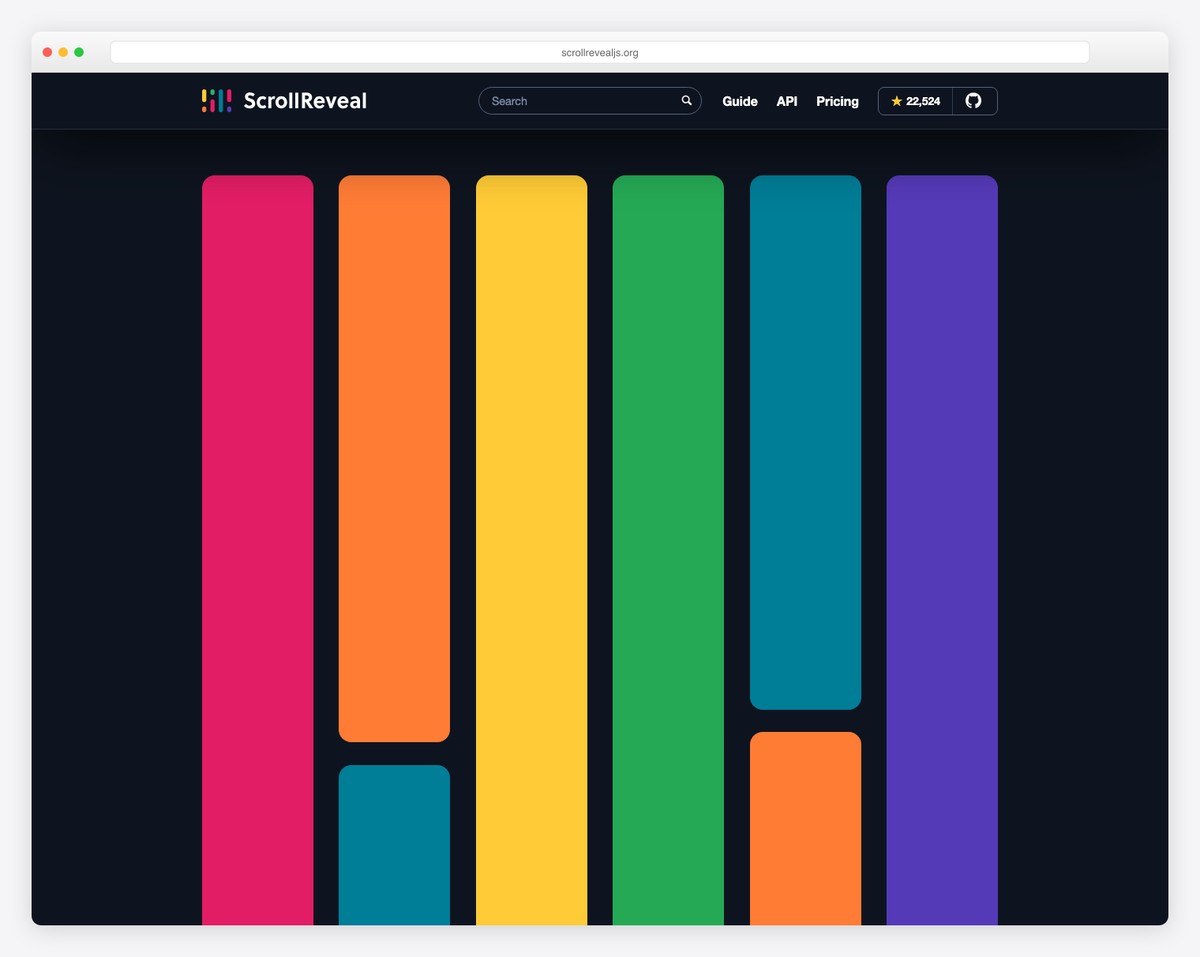
ScrollReveal animates elements into view as the user scrolls. It tracks scroll position with requestAnimationFrame and provides a declarative API: ScrollReveal().reveal('.headline', { delay: 200 }). The library handles staggering, sequencing, and configurable easing without jQuery.
2026 status: Functional but unmaintained (last release 4.0.9 in 2021). The library still works but receives no bug fixes, and its GPLv3 license means closed-source commercial sites need a paid commercial license.
Modern alternative: CSS scroll-driven animations (supported in Chrome and Edge 115+ and Safari 26+; Firefox only in preview builds) handle most ScrollReveal use cases without JavaScript. For broader browser support, GSAP’s ScrollTrigger provides superior control with active maintenance.
3. AOS (Animate on Scroll)
AOS triggers CSS animations when elements scroll into view. Configuration is via HTML data attributes (data-aos="fade-up", data-aos-delay="200"), making it designer-friendly. AOS includes 30+ built-in animations and supports custom animations via CSS. At about 5 KB gzipped, it is one of the lightest scroll animation libraries.
2026 status: Still widely used. The last stable release (2.3.4) and an unfinished 3.0 beta both date from 2018, but the library is stable and functional. It remains a popular choice for landing pages and marketing sites where designers want scroll animations without writing JavaScript.
Modern alternative: For the same data-attribute-driven approach, no modern library has replaced AOS. GSAP ScrollTrigger is more powerful but requires JavaScript configuration. Native CSS scroll-driven animations are the eventual replacement but lack AOS’s ease of use.
4. Waypoints
Waypoints triggers callbacks when an element scrolls to a specified position. It powered countless “sticky nav on scroll,” “lazy load on scroll,” and “animate on scroll” features. jQuery was optional — Waypoints had a standalone vanilla JS build.
2026 status: Obsolete. The IntersectionObserver API (supported in all major browsers since 2019) does everything Waypoints did, natively, with better performance. There is no reason to use Waypoints in 2026.
Modern alternative: IntersectionObserver — a native browser API that replaces Waypoints entirely in about 10 lines of code.
Layout Libraries
5. Isotope
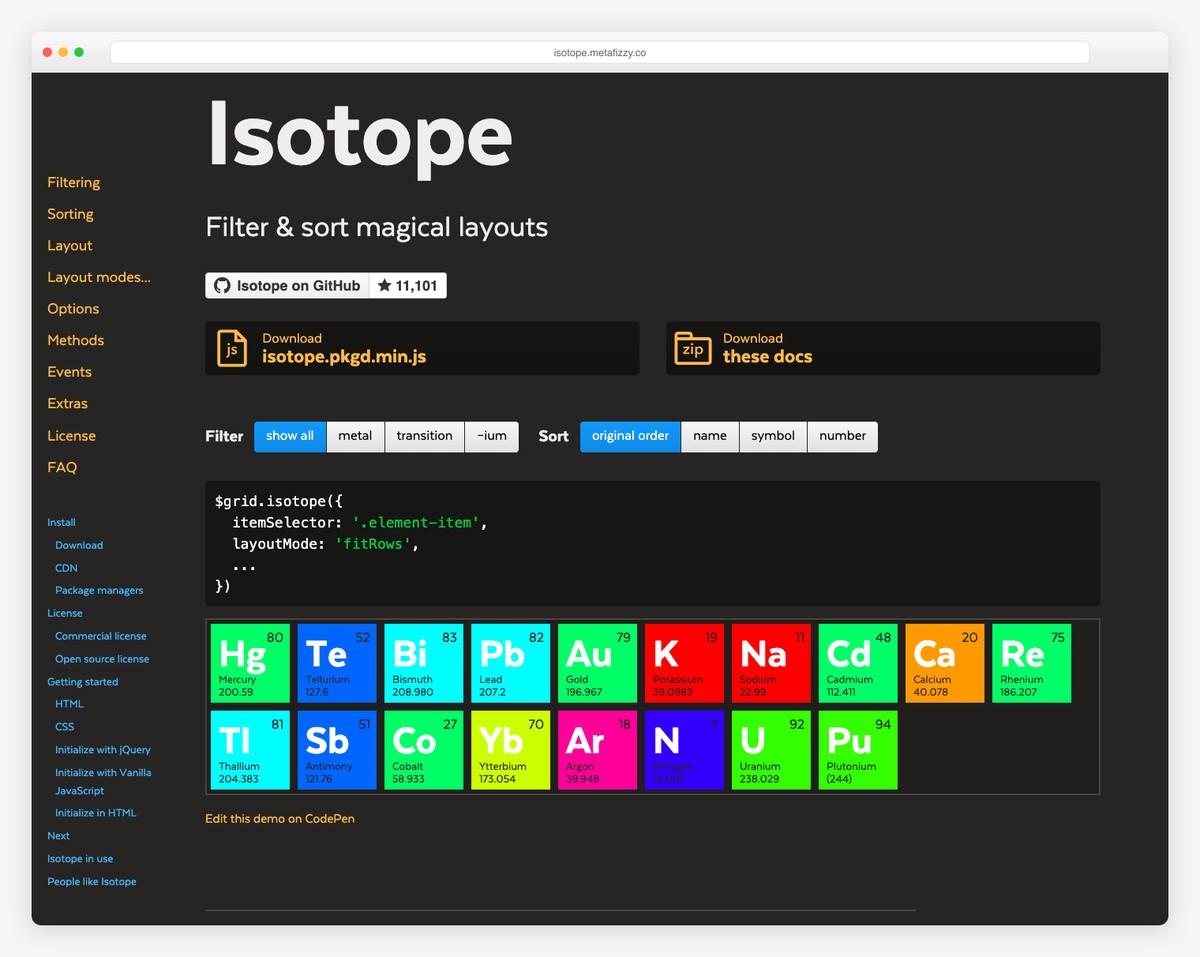
Isotope provides filterable, sortable, animated grid layouts. Click a filter button and items smoothly rearrange. It combines Masonry-style layouts with filtering logic and animated transitions. The jQuery dependency is optional in recent versions.
2026 status: Functional, GPLv3 license (commercial license required for non-open-source projects). The filtering and sorting logic remains useful for portfolio grids, product catalogs, and team member pages.
Modern alternative: CSS Grid handles the layout. Vanilla JavaScript with classList toggling and CSS transitions handles filtering and animation. For complex filtering, combine with a lightweight library like MixItUp or List.js. The animation can be CSS-based using View Transitions API for smooth reflows.
6. Masonry
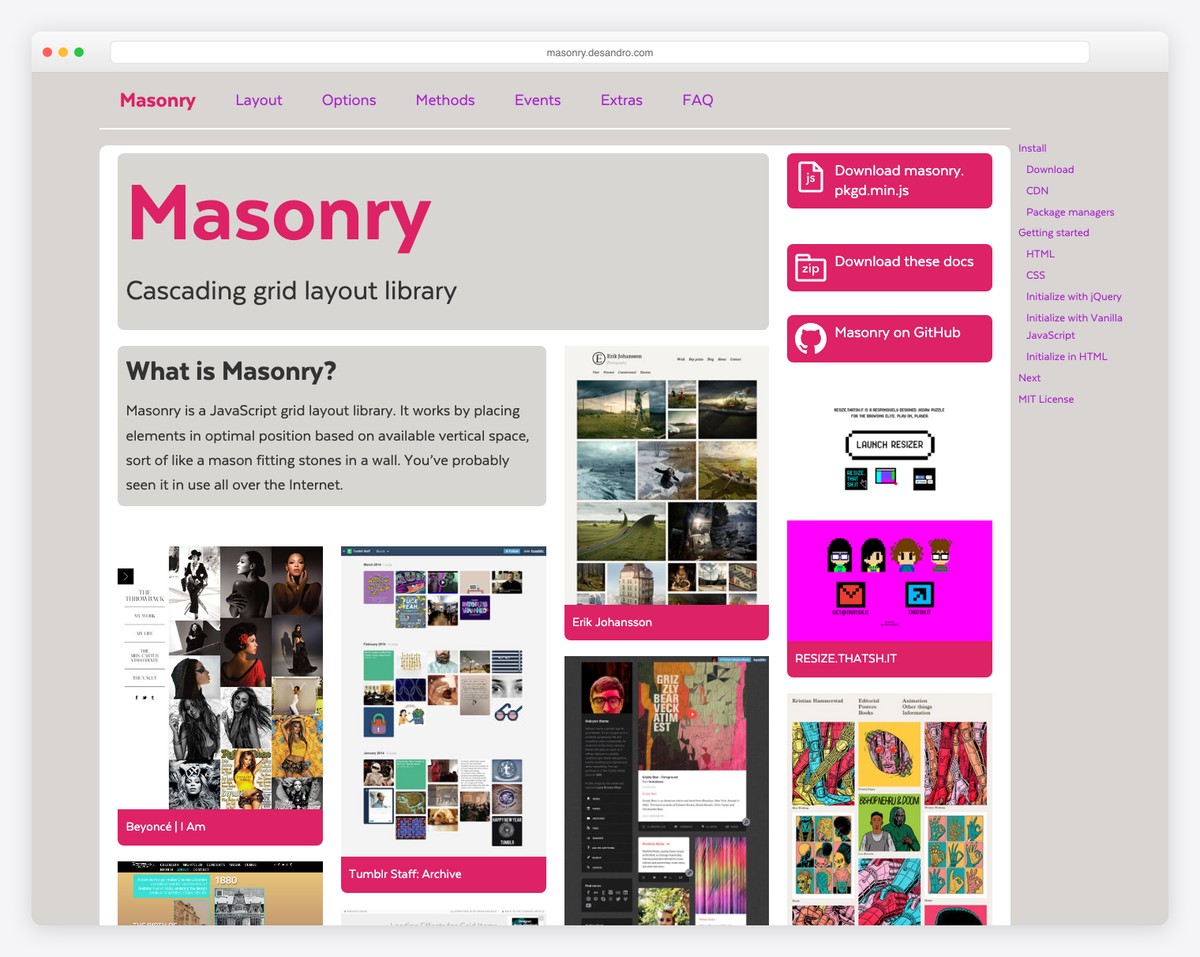
Masonry creates Pinterest-style layouts where items of varying heights fit together without gaps. It calculates positions JavaScript-side and absolutely positions each item. The library works standalone (no jQuery required since v4).
2026 status: Still the best option for true masonry layouts. Native CSS masonry has been standardized as display: grid-lanes, but so far only Safari (26.4+) ships it; Chrome and Firefox do not support it in stable releases. Until it ships in all major browsers, Masonry.js remains necessary.
Modern alternative: CSS columns property creates a similar visual effect but orders items top-to-bottom rather than left-to-right, which is wrong for chronological content. True CSS masonry is arriving browser by browser but is not cross-browser yet. Masonry.js remains the correct tool for now.
Visual Effects
7. Parallax.js
Parallax.js creates scroll-based parallax effects where background images move at a different speed than foreground content. Several plugins shared this name; this one, by PixelCog, is a jQuery plugin driven by data-parallax="scroll" attributes on elements with background images. Its last release, 1.5.0, dates from 2017.
2026 status: Outdated. Simple parallax effects work with pure CSS (background-attachment: fixed or transform: translateZ() with perspective). Complex parallax requires GSAP ScrollTrigger.
Modern alternative: CSS for simple parallax, GSAP ScrollTrigger for complex multi-layer parallax with scrub control.
8. Typed.js
Typed.js creates a typewriter effect — text appears character by character as if being typed, with a blinking cursor. It supports multiple strings (type, delete, type next), custom speeds, and loop functionality. Typed.js began as a jQuery plugin but has been dependency-free vanilla JavaScript since v2.
2026 status: Maintained and widely used. Version 3.0 (January 2026) added an API for appending strings and moved from MIT to GPLv3, with paid commercial licenses for closed-source sites; version 2.1 remains available under MIT. At about 3 KB gzipped with no dependencies, Typed.js is lightweight enough to justify keeping.
Modern alternative: Typed.js itself is already modern vanilla JS. For a zero-dependency approach, the effect can be built with ~30 lines of vanilla JavaScript and CSS @keyframes for the cursor blink.
9. CountUp.js
CountUp.js animates a number from zero (or any start value) to a target value. Used for statistics sections (“10,000+ customers served”), dashboard counters, and pricing pages. Version 2+ is pure vanilla JavaScript with no jQuery dependency, TypeScript support, and IntersectionObserver integration for scroll-triggered counting.
2026 status: Actively maintained, with version 2.10 released in 2026. At about 2 KB gzipped with no dependencies, CountUp.js is the best option for number animation.
Modern alternative: CountUp.js is already the modern solution. A simpler version can be built with requestAnimationFrame and IntersectionObserver in ~20 lines of vanilla JS.
Sliders & Lightboxes
10. Slick Carousel
Slick was the most popular jQuery carousel with responsive breakpoints, autoplay, center mode, variable width, lazy loading, and infinite loop. After years without a release, Slick 2.0 (September 2026) added jQuery 4 compatibility and accessibility fixes.
2026 status: Legacy, though no longer abandoned. jQuery is still required, and the 2.0 release fixed bugs rather than modernizing the feature set. Still functional, but it keeps jQuery on the page.
Modern alternative: Swiper (most features) or Splide (lightest, best accessibility). Both cover every Slick use case without jQuery.
11. Owl Carousel 2
Owl Carousel 2 provided responsive carousels with touch/drag, autoplay, and lazy loading. Last updated 2018, jQuery required.
2026 status: Legacy and abandoned. jQuery is required, there has been no release since 2.3.4 in 2018, and its own README tells users to switch to another slider.
Modern alternative: Swiper or Splide. Migration involves restructuring markup to use .swiper-wrapper / .swiper-slide classes and replacing jQuery initialization with vanilla JS.
12. Magnific Popup
Magnific Popup was the most popular jQuery lightbox, supporting images, videos, iframes, and inline content with responsive behavior. Version 1.2.0 (2024) replaced functions deprecated in jQuery 3.7 and disabled HTML in titles by default to close an XSS risk.
2026 status: Legacy. Works and gets occasional fixes, but requires jQuery.
Modern alternative: GLightbox (~15 KB gzipped, vanilla JS, MIT, excellent video support) or Fancybox 6 (~37 KB gzipped, vanilla JS, more features, paid license for production sites). Both provide superior touch handling and modern CSS transitions.
Form & Data Libraries
13. Select2
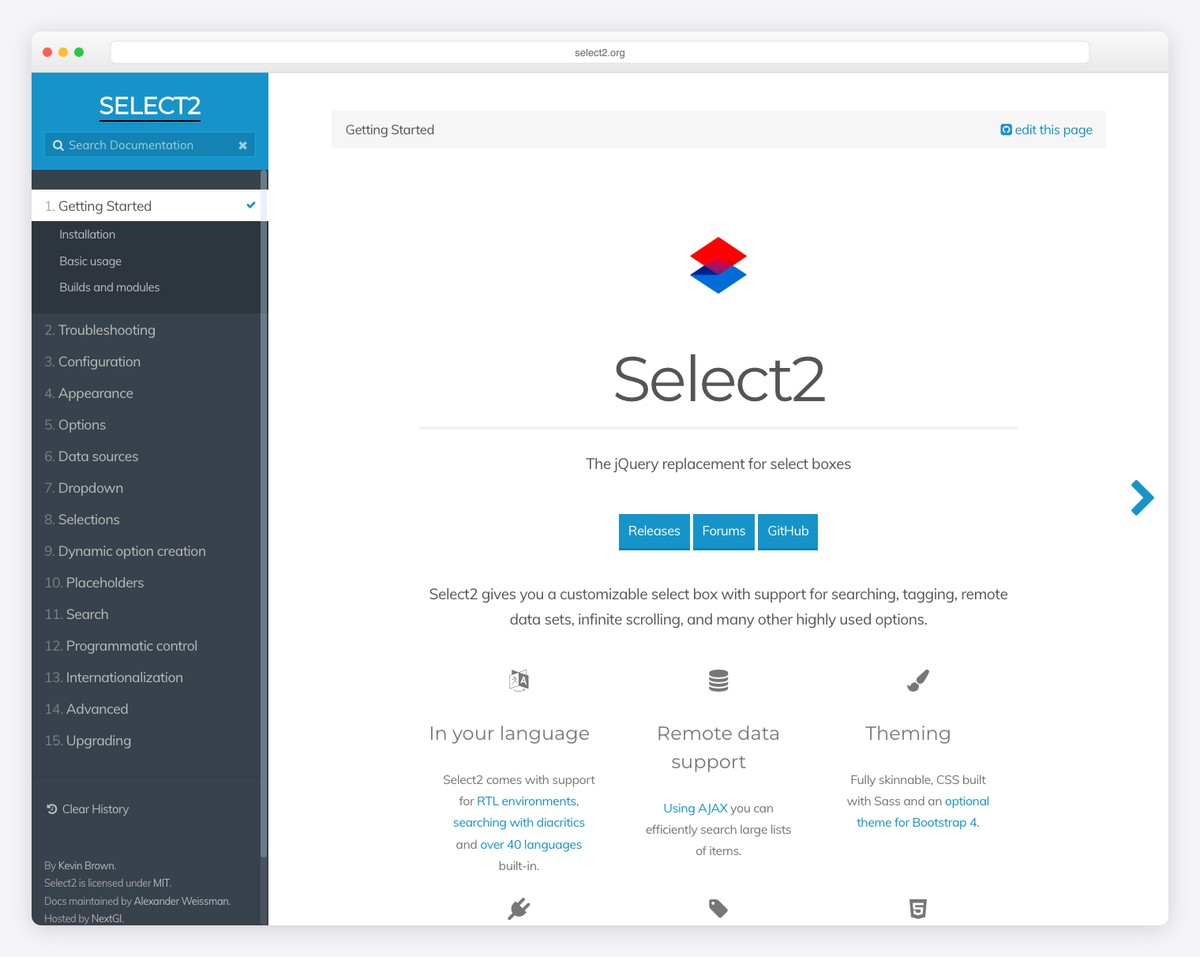
Select2 transforms standard HTML <select> elements into searchable, taggable, AJAX-powered dropdowns. It handles multi-select with tag UI, remote data loading, and custom templating. jQuery is required.
2026 status: Still maintained and widely deployed: the long-awaited 4.1.0 final shipped in May 2026, supporting jQuery up to 4.x and removing long-deprecated modules. The jQuery dependency is its main liability.
Modern alternative: Tom Select (fork of Selectize.js, no jQuery, 16 KB) or Choices.js (no dependencies, ~21 KB gzipped). Both provide searchable selects, tagging, and remote data without jQuery.
14. DataTables

DataTables transforms HTML tables into interactive data grids with pagination, search, sorting, column reordering, and export (CSV, Excel, PDF). It is the most widely deployed data table solution on the web, powering admin panels and dashboards across every industry. Since version 3 it no longer requires jQuery.
2026 status: Actively maintained. DataTables 3 (July 2026) rewrote the core and extensions in TypeScript and dropped the jQuery dependency, so it no longer blocks a jQuery removal. The core stays free and MIT-licensed, while a new paid DataTables Plus tier bundles the premium extensions.
Modern alternative: TanStack Table (headless, framework-agnostic, ~15 KB) for custom UIs, or AG Grid (enterprise-grade, free community edition) for complex data requirements. Both suit framework-driven UIs but require more setup than DataTables.
15. jQuery Validation
jQuery Validation provides client-side form validation with built-in rules (required, email, URL, min/max length, etc.), custom rules, error message placement, and conditional validation. It is still widely used in WordPress plugins and legacy forms.
2026 status: Maintained but outdated in approach. jQuery required.
Modern alternative: The native HTML5 Constraint Validation API handles most validation needs: required, pattern, minlength, type="email", and setCustomValidity(). For complex validation (cross-field, async), use libraries like Zod (schema validation) or Vest (form validation framework, ~5 KB).
Migration Priority Guide
| Priority | Plugin | Action | Why |
|---|---|---|---|
| High | Waypoints | Replace with IntersectionObserver | Native API, zero dependencies |
| High | Slick / Owl Carousel | Replace with Swiper or Splide | jQuery required; Owl abandoned, Slick only lightly maintained |
| High | Magnific Popup | Replace with GLightbox | Rarely updated, jQuery required |
| Medium | Parallax.js | Replace with CSS or GSAP | Simple CSS does the job |
| Medium | Select2 | Replace with Tom Select | Remove jQuery dependency |
| Medium | jQuery Validation | Replace with native API | Browser validation is good enough |
| Low | Animate.css | Keep or write custom CSS | No jQuery, no JS, still works fine |
| Low | AOS | Keep or use GSAP ScrollTrigger | No jQuery, stable, lightweight |
| Low | Typed.js / CountUp.js | Keep | Already vanilla JS, maintained (check Typed.js v3 license) |
| Low | DataTables | Keep; upgrade to v3 to drop jQuery | Actively maintained, massive feature set |
| Low | Masonry | Keep until CSS masonry ships | No native replacement yet |
The general rule: if a plugin requires jQuery and your goal is to remove jQuery, replace it. If a plugin is already vanilla JS (Typed.js, CountUp.js, Animate.css, AOS), keep it unless you have a specific reason to change. And for the few plugins with no native replacement (Masonry, DataTables for complex tables), keep them: neither needs jQuery any more (DataTables since version 3), so they do not stand in the way of removing it.

Related Posts





Comments (0)