
50+ Blogging Statistics: Traffic, Content & Monetization (2026)
There are an estimated 600 million+ blogs worldwide, WordPress.com users alone publish about 70 million posts a month, and marketers rank their website, blog and SEO as their top ROI channel. Yet only 13.9% of bloggers in Orbit Media’s 2026 survey say their blog delivers strong results, and fewer than 10% of blogs generate any income. Here are 50+ blogging statistics covering industry size, content trends, traffic, monetization, and business blogging for 2026.
Key Blogging Statistics (2026)
- An estimated 600 million+ blogs exist worldwide (Blogging Wizard)
- An estimated 7.5 million blog posts published daily (Internet Live Stats)
- WordPress powers 40.2% of all websites in October 2026 (W3Techs)
- Average blog post length: 1,312 words in 2026 (Orbit Media)
- 92.4% of bloggers use AI for blogging in 2026 (Orbit Media)
- Website, blog and SEO rank as marketers’ #1 ROI channel (HubSpot)
- Fewer than 10% of blogs generate any income (WebTribunal via Blogging Wizard)
Blogging Industry Size
| Metric | Value | Source |
|---|---|---|
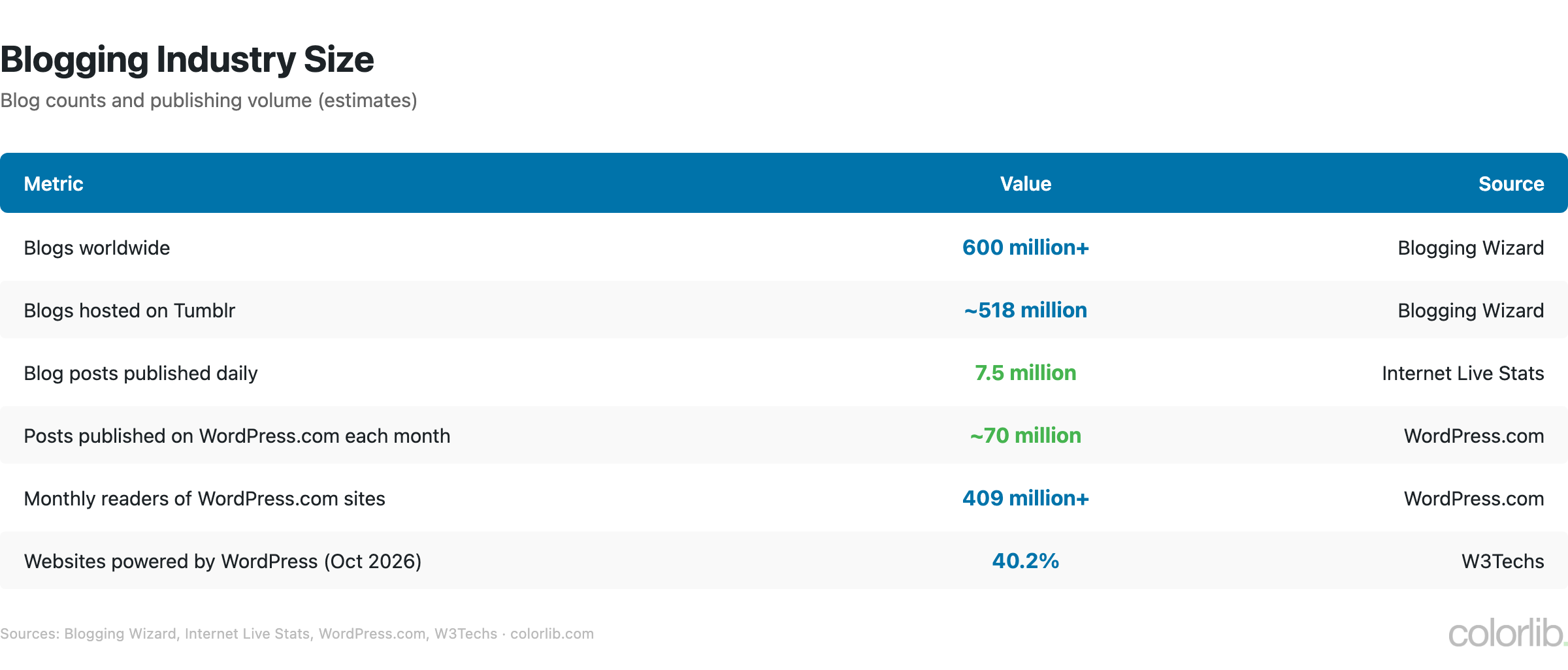
| Total blogs worldwide (estimate) | 600 million+ | Blogging Wizard |
| Blog posts published daily (estimate) | 7.5 million | Internet Live Stats |
| Posts published on WordPress.com each month | ~70 million | WordPress.com |
| Monthly readers of WordPress.com sites | 409 million+ | WordPress.com |
| Blogs hosted on Tumblr (estimate) | ~518 million | Blogging Wizard |
| Substack publishers earning from subscriptions (June 2026) | 100,000+ | Substack |
- The estimated 600 million blogs figure includes all blogging platforms — WordPress.org, WordPress.com, Tumblr, Blogger, Medium, Substack, and others
- Tumblr alone accounts for roughly 518 million (about 86%) of those blogs, though most are inactive or low-content
- WordPress.com users publish about 70 million new posts and 77 million comments each month, and more than 409 million people view WordPress.com sites monthly
- Newsletter platforms like Substack (100,000+ publishers earning from subscriptions) and Ghost are blurring the line between blogging and email publishing
- WordPress remains the dominant blogging platform — see our WordPress statistics for the full breakdown
Blog Content Statistics
| Metric | Value | Source |
|---|---|---|
| Average blog post length (2026) | 1,312 words | Orbit Media |
| Average time to write a post (2026) | 3 hours 20 minutes | Orbit Media |
| Bloggers using AI for blogging | 92.4% | Orbit Media |
| Bloggers reporting strong results | 13.9% (all-time low) | Orbit Media |
| Bloggers collaborating with influencers | 7% (25% in 2017) | Orbit Media |
| Survey respondents | 1,042 content marketers | Orbit Media |
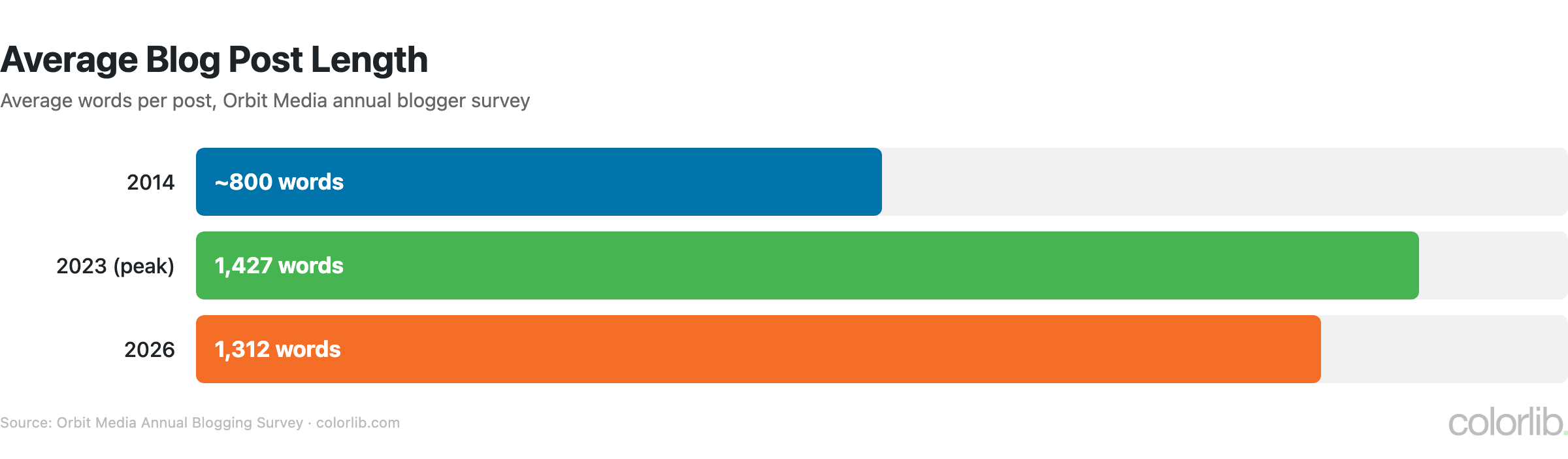
- The average blog post grew from about 800 words in 2014 to a peak of 1,427 words in 2023, then fell to 1,312 words in 2026 as AI sped up production
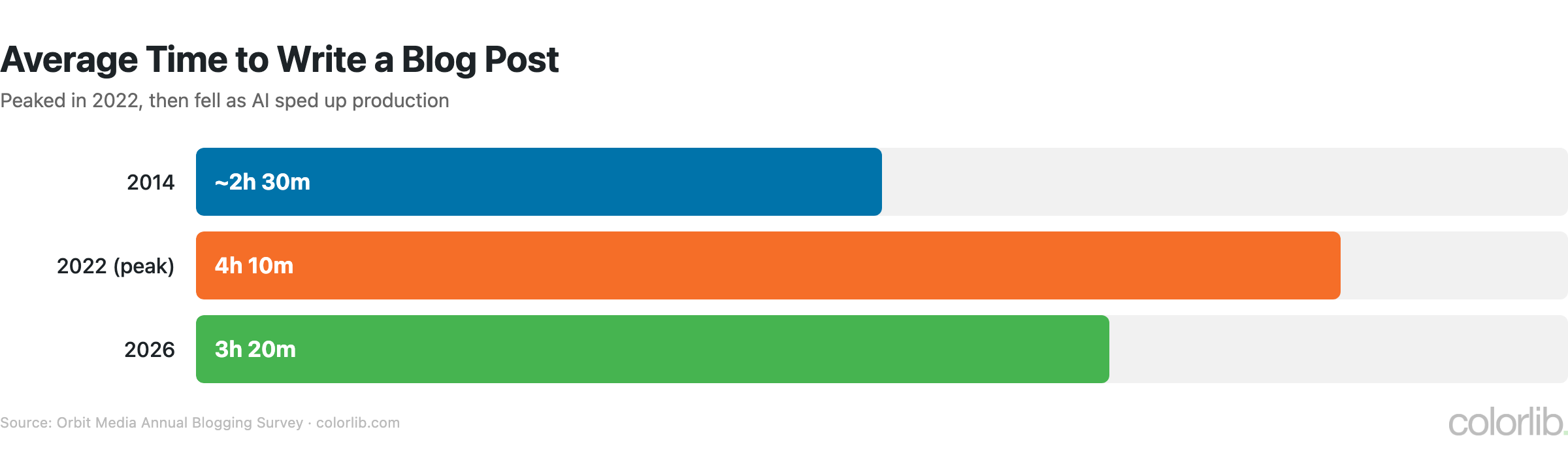
- Writing time fell to 3 hours 20 minutes per post in 2026, down from a peak of 4 hours 10 minutes in 2022 and about 2.5 hours in 2014
- 92.4% of bloggers now use AI for blogging, but Orbit Media found AI use does not correlate with stronger results; non-users are simply more likely to report disappointing ones
- Only 13.9% of bloggers say their blog delivers strong results, an all-time low in Orbit Media’s survey of 1,042 content marketers
- Influencer collaboration is the strongest predictor of success (2.6x the benchmark), yet only 7% of bloggers do it, down from 25% in 2017
Blog Traffic & SEO Statistics
| Metric | Value | Source |
|---|---|---|
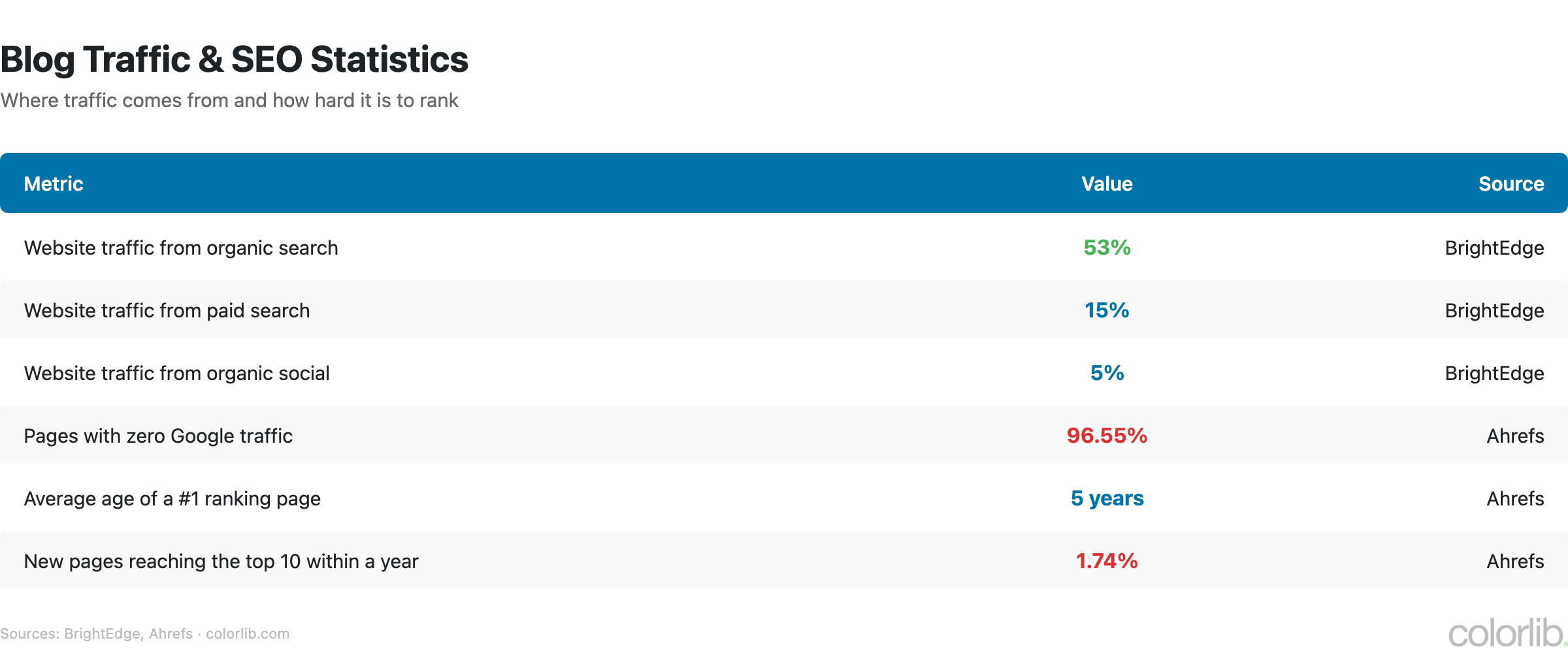
| Website traffic from organic search | 53% | BrightEdge |
| Website traffic from paid search | 15% | BrightEdge |
| Website traffic from organic social | 5% | BrightEdge |
| Pages with zero Google traffic | 96.55% | Ahrefs |
| Average age of a #1 ranking page | 5 years | Ahrefs |
| New pages reaching the top 10 within a year | 1.74% | Ahrefs |
- Despite billions of blog posts, 96.55% of pages get zero traffic from Google — only well-optimized, authoritative content breaks through
- Organic search drove 53% of trackable website traffic in BrightEdge’s research, more than paid search (15%) and organic social (5%) combined
- For deeper SEO insights, see our SEO statistics roundup
Blog Monetization Statistics
| Metric | Value | Source |
|---|---|---|
| Blogs generating any income (estimate) | <10% | WebTribunal via Blogging Wizard |
| Income from affiliates (bloggers earning $7,500-$25,000/month) | 42.2% | RankIQ via Blogging Wizard |
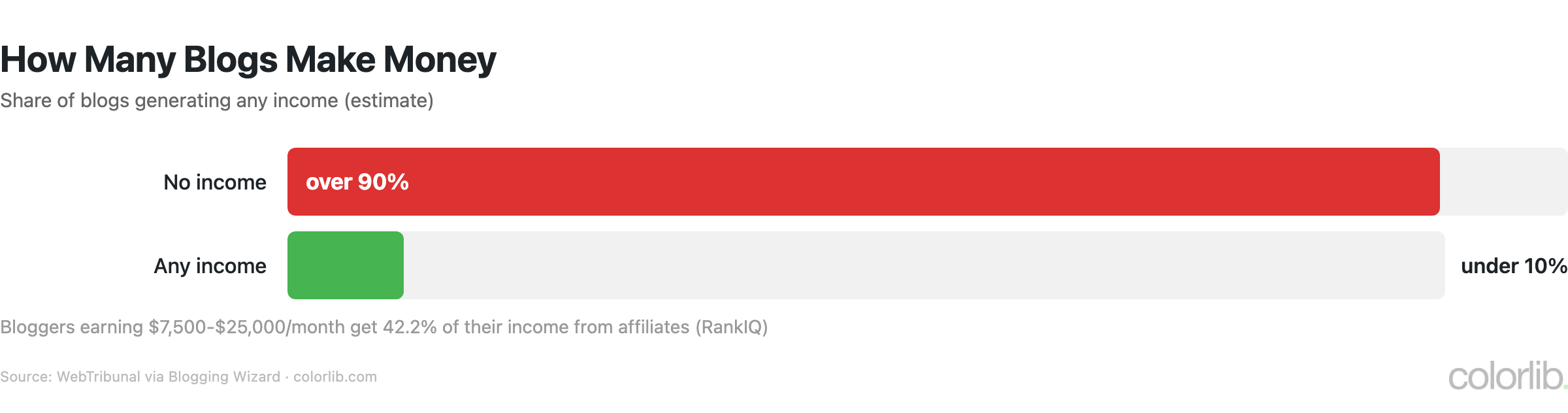
- Fewer than 10% of blogs generate any income, according to WebTribunal’s estimate
- Affiliate marketing is the biggest earner for professional bloggers: those making $7,500-$25,000 a month get 42.2% of their income from affiliates (RankIQ)
Business Blogging Statistics
| Metric | Value | Source |
|---|---|---|
| Marketers naming website/blog/SEO a top ROI channel | 27% (#1 channel) | HubSpot |
| Marketers using blog posts (2025) | 38% (#3 format) | HubSpot |
| Small businesses seeing ROI from blog posts | 23% more likely than average | HubSpot |
| Marketers planning to use AI in content creation (2026) | ~94% | HubSpot |
| B2B marketers creating short articles and blog posts | 94% | CMI via Semrush |
| Marketers publishing 2-6 times per week | 12% by 2022 (28% in 2014) | Orbit Media |
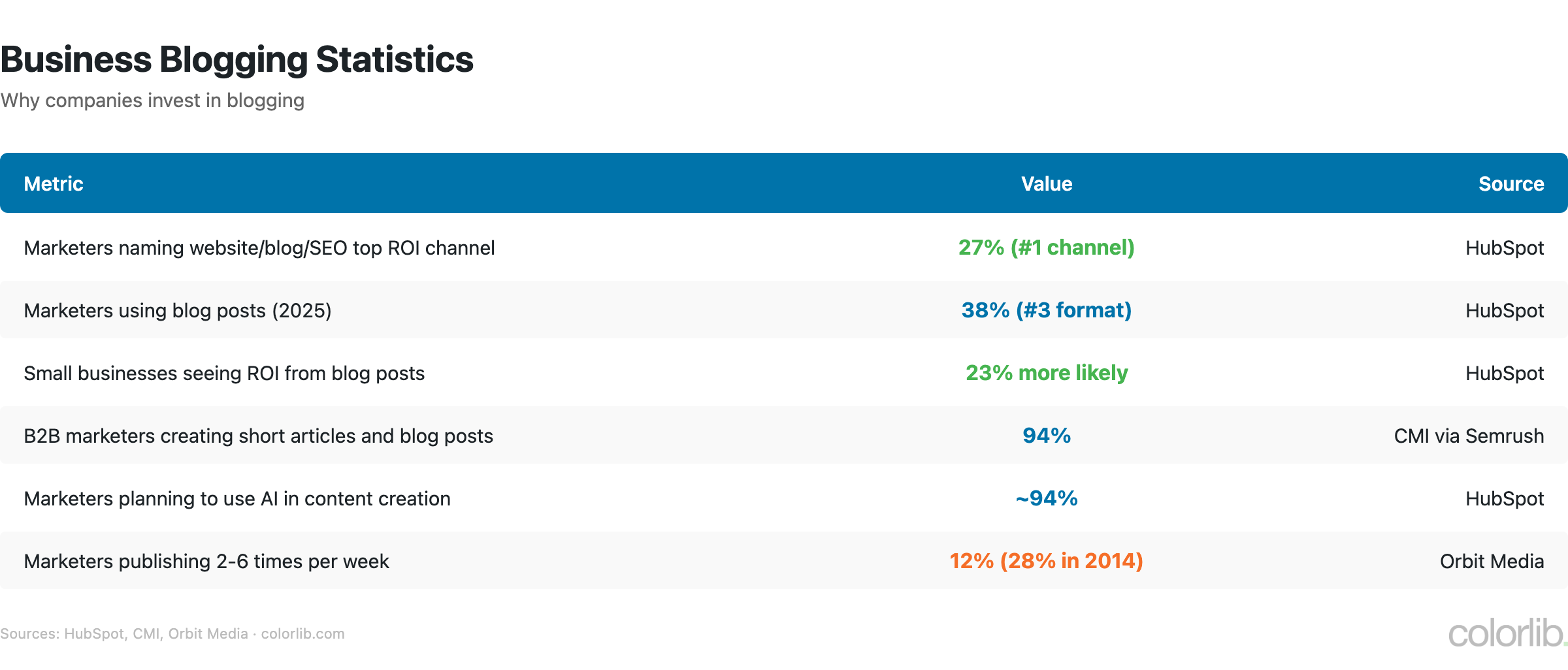
- Marketers rank website, blog and SEO as their #1 ROI-generating channel (27%), just ahead of paid social media (26%)
- 94% of B2B marketers create short articles and blog posts, according to the Content Marketing Institute
- Blog posts were the third most popular content format in 2025, used by 38% of marketers, behind short-form video (60%) and long-form video (38%)
- Publishing frequency has dropped: marketers publishing 2-6 times per week fell from 28% in 2014 to 12% by 2022, while monthly publishing doubled
- For web-related content marketing, see our content marketing statistics report
Key Takeaways
- Blogging is massive but brutally competitive. An estimated 600 million blogs and 7.5 million daily posts compete for attention, yet 96.55% of pages get zero Google traffic. Quality and SEO determine success.
- Effort still pays. Bloggers who put the most effort into each post remain the most likely to report strong results, even though the average post (1,312 words in 2026) has gotten shorter since its 2023 peak.
- Monetization is rare. Fewer than 10% of blogs generate any income, and affiliate marketing is the largest income source for professional bloggers.
- Business blogging drives real ROI. Marketers rank website, blog and SEO as their top ROI channel, and small businesses are 23% more likely than average to see ROI from blog posts.
- AI is transforming content creation. 92.4% of bloggers now use AI, but AI use does not correlate with stronger results; the edge comes from original research, expert collaboration and human editing.
- Organic search is the primary traffic source. Organic search drove 53% of trackable website traffic in BrightEdge’s research, while organic social (5%) is a secondary distribution channel, not a primary discovery tool.
Sources
- Orbit Media — Annual Blogging Survey
- HubSpot — Marketing Statistics
- Semrush — Content Marketing Statistics
- Ahrefs — Search Traffic Study
- Blogging Wizard — Blogging Statistics
- BrightEdge — Organic Share of Traffic
- WordPress.com — Activity
- Substack — A Business Model That Works for Creators
- Internet Live Stats
Frequently Asked Questions
How many blogs are there in 2026?
There are an estimated 600 million+ blogs worldwide across all platforms, including WordPress, Tumblr, Blogger, Medium, Substack, and others, with Tumblr hosting roughly 518 million of them. Internet Live Stats estimates about 7.5 million new blog posts are published every day, and WordPress.com users alone publish about 70 million posts a month. However, many of these blogs are inactive — only a fraction publish regularly and receive meaningful traffic.
How long should a blog post be?
The average blog post was 1,312 words in Orbit Media’s 2026 survey, down from a peak of 1,427 words in 2023. Long-form, keyword-focused articles still correlate with strong results in Orbit’s data. However, the optimal length depends on the topic — some queries are best answered in 500-800 words, while comprehensive guides benefit from 2,000-5,000 words. Quality and comprehensiveness matter more than hitting a specific word count.
Can you still make money blogging in 2026?
Yes, but it’s harder than ever. Fewer than 10% of blogs generate any income, according to WebTribunal’s estimate. The most successful bloggers diversify revenue across display ads, affiliate marketing, sponsored content, and digital products. Success requires consistent publishing, strong SEO, and niche authority built over 2-3+ years. For the technical platform choices behind successful blogs, see our WordPress statistics report.
Do businesses need a blog?
The data strongly says yes. Marketers rank website, blog and SEO as their #1 ROI-generating channel in HubSpot’s 2026 State of Marketing report, and small businesses are 23% more likely than average to see ROI from blog posts. Among B2B marketers, 94% create short articles and blog posts. The compound traffic growth from consistent blogging makes it one of the most cost-effective long-term marketing investments.

Related Posts






Comments (0)