
Elementor Statistics 2026: Market Share, Usage & Trends
Last updated: March 2026
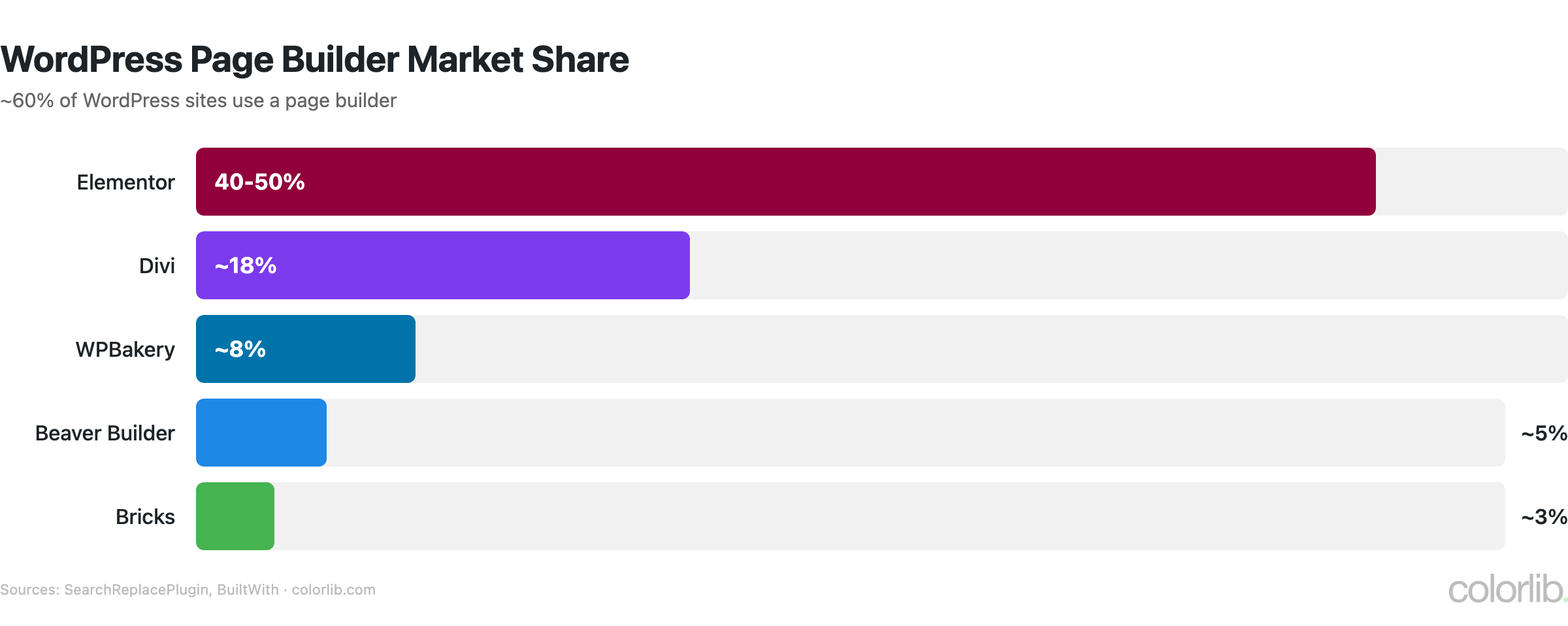
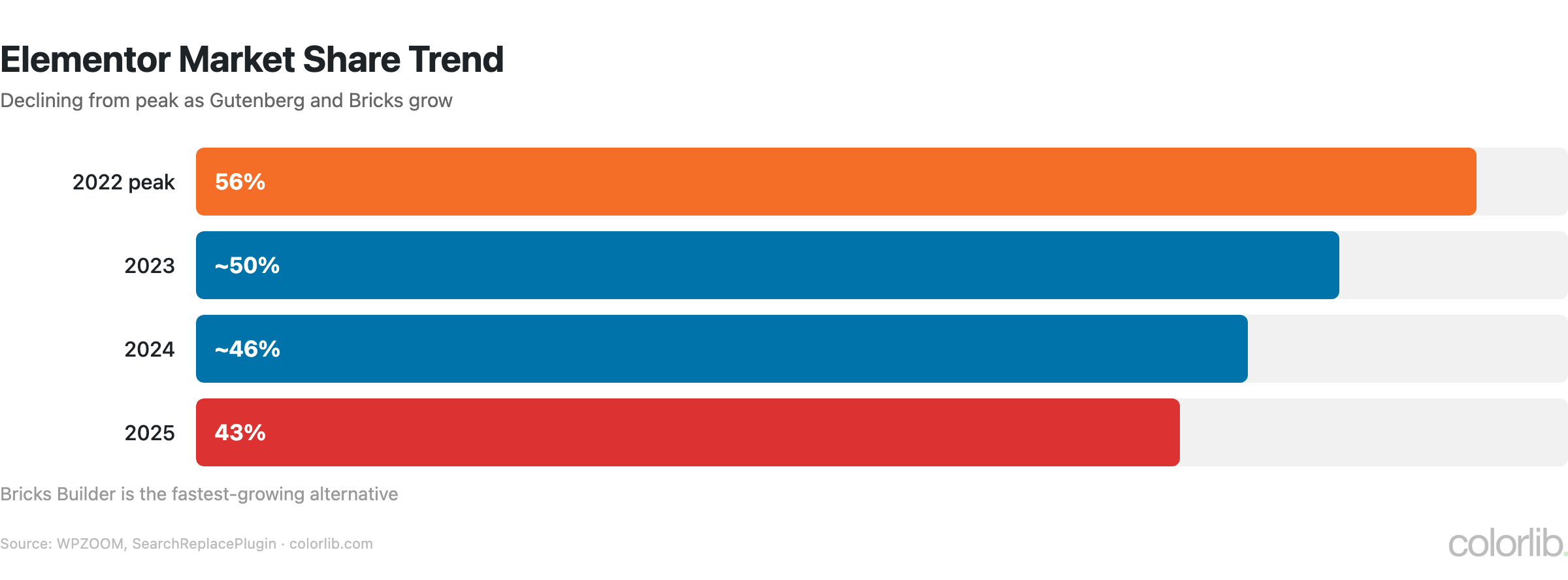
Elementor has 10 million+ active installs, powers 13.1% of all WordPress sites, and holds 40-50% of the page builder market. However, competition from Gutenberg’s Full Site Editing, Bricks Builder, and other alternatives is intensifying, with Elementor’s market share declining from its 2023 peak of 56%. Here are 100+ Elementor statistics covering usage, market share, competitors, performance, and the evolving WordPress builder landscape for 2026.
Key Elementor Statistics (2026)
- 10 million+ active WordPress installs (WordPress.org)
- 13.1% of all WordPress sites use Elementor (BuiltWith)
- 40-50% of WordPress page builder market (declining from 56%) (BuiltWith)
- 12 million+ websites built with Elementor (Elementor)
- Elementor Pro pricing: $59-$399/year (Elementor)
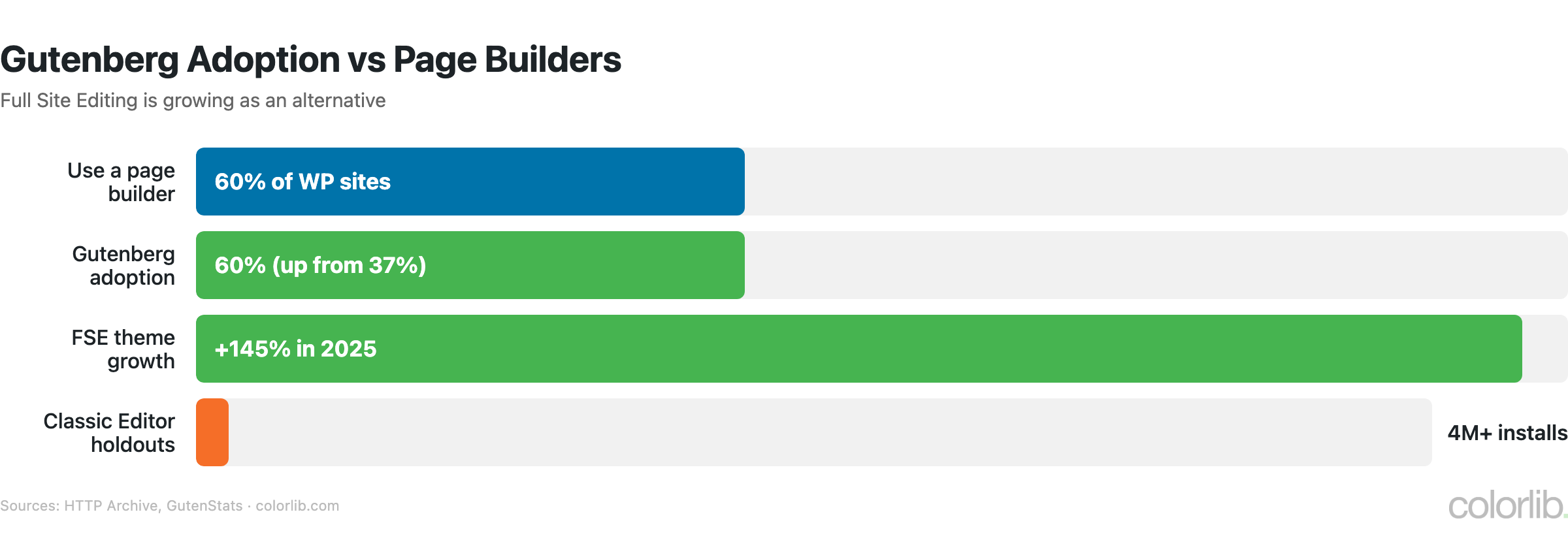
- Gutenberg FSE growing 145% YoY (WordPress.org)
- ~60% of WordPress sites use a page builder (BuiltWith)
Elementor Market Share & Usage
| Metric | Value | Source |
|---|---|---|
| Active installs | 10 million+ | WordPress.org |
| Share of WordPress sites | 13.1% | BuiltWith |
| Page builder market share | 40-50% | BuiltWith |
| Peak market share (2023) | 56% | BuiltWith |
| Total websites ever built | 12 million+ | Elementor |
| WordPress.org rating | 4.6/5 (6,500+ reviews) | WordPress.org |
| GitHub stars | 5,800+ | GitHub |
| Elementor Pro subscribers (est.) | 2-3 million | Industry estimates |
- Elementor is the most popular WordPress page builder by a significant margin, though its market share has declined from 56% (2023) to 40-50% (2026)
- 13.1% of all WordPress websites use Elementor — given WordPress powers 42.6% of the web, that translates to approximately 5.6% of all websites
- An estimated 2-3 million sites use Elementor Pro, generating $120-180 million in annual recurring revenue
- Elementor maintains a strong 4.6/5 rating on WordPress.org with over 6,500 reviews
- For the broader WordPress ecosystem context, see our WordPress statistics report
Elementor vs. Other Page Builders
| Builder | Active Installs | Market Share | Growth Trend |
|---|---|---|---|
| Elementor | 10M+ | 40-50% | Declining (from 56%) |
| WPBakery | 4.5M+ | 15-18% | Declining |
| Divi Builder | 3M+ | 10-12% | Stable |
| Beaver Builder | 600K+ | 3-4% | Declining |
| Bricks Builder | 150K+ | 1-2% | Fastest growing |
| Gutenberg FSE | Built into WP | Growing 145% YoY | Rapidly expanding |
| Breakdance | 80K+ | <1% | Growing |
- Bricks Builder is the fastest-growing commercial builder, attracting performance-focused developers who value clean code output and speed
- Gutenberg Full Site Editing is growing 145% YoY as WordPress core evolves — it’s free, built-in, and increasingly capable
- WPBakery and Beaver Builder are both losing market share to Elementor and newer alternatives
- Divi Builder maintains a stable 10-12% share with its loyal user base and lifetime pricing option
- Approximately 60% of WordPress sites now use some form of page builder, up from 45% in 2022
Elementor Features & Pricing
| Feature | Free | Pro ($59-$399/yr) |
|---|---|---|
| Widgets | 40+ | 100+ |
| Templates | 100+ | 300+ |
| Theme Builder | No | Yes |
| WooCommerce Builder | No | Yes |
| Popup Builder | No | Yes |
| Form Builder | No | Yes |
| Custom CSS | No | Yes |
| Dynamic Content | No | Yes |
| AI features | Limited | Full AI generation |
- Elementor Pro plans range from $59/year (Essential, 1 site) to $399/year (Agency, 1,000 sites)
- The free version includes 40+ widgets and 100+ templates — enough for basic sites but limited for professional use
- Elementor AI was introduced in 2023 and allows AI-generated text, images, code, and layouts directly in the editor
- The Theme Builder (Pro only) is the primary reason for upgrading — it enables custom headers, footers, archive pages, and single post templates
- Third-party Elementor add-on plugins add 500+ additional widgets (Essential Addons, PowerPack, etc.)
Gutenberg’s Impact on Elementor
| Metric | Value | Source |
|---|---|---|
| Gutenberg FSE growth | 145% YoY | WordPress.org |
| Block themes available | 2,500+ | WordPress.org |
| Sites using block themes | 8-12% of WP sites | BuiltWith |
| WP sites with no page builder | 40% | BuiltWith |
| Gutenberg blocks available | 90+ core | WordPress.org |
| Gutenberg satisfaction rating | 3.2/5 (improving) | WordPress community surveys |
- Gutenberg Full Site Editing is growing 145% year-over-year, representing the biggest long-term threat to Elementor’s dominance
- Over 2,500 block themes are now available on WordPress.org, up from just 400 in 2023
- 8-12% of WordPress sites now use full block themes (like Twenty Twenty-Four), bypassing page builders entirely
- Gutenberg’s user satisfaction (3.2/5) remains below Elementor’s (4.6/5), but is steadily improving with each WordPress release
- The shift to Gutenberg FSE is gradual — most agencies and freelancers still prefer Elementor for client projects requiring complex layouts
Elementor Performance Statistics
| Metric | Elementor | Bricks | Gutenberg |
|---|---|---|---|
| Average page weight | 3.2 MB | 1.8 MB | 1.5 MB |
| DOM elements (typical page) | 1,500-3,000 | 400-800 | 300-600 |
| CSS file size | 400-800 KB | 100-200 KB | 50-150 KB |
| JS file size | 300-600 KB | 80-150 KB | 50-100 KB |
| LCP (median) | 3.5s | 2.2s | 2.0s |
| CWV pass rate | 25-35% | 55-65% | 45-55% |
- Elementor’s main performance criticism is DOM bloat — typical pages contain 1,500-3,000 DOM elements due to wrapper divs, significantly impacting rendering speed
- Bricks Builder produces 40-60% less code output than Elementor for equivalent layouts, which is driving its rapid adoption among developers
- Elementor has improved performance with reduced CSS, lazy loading, and element caching in recent versions, but the architecture remains heavier
- Core Web Vitals pass rate for Elementor sites is 25-35%, below the WordPress average (33-40%) and significantly below Bricks (55-65%)
- For more on how design tools affect performance, see our web design statistics report
Key Takeaways
- Elementor dominates but is declining. With 10M+ installs and 40-50% of the builder market, Elementor is still #1 — but its share has dropped from 56% as alternatives gain ground.
- Gutenberg FSE is the long-term threat. Growing 145% YoY and built into WordPress core, Gutenberg Full Site Editing will eventually reduce demand for third-party builders.
- Performance is Elementor’s Achilles’ heel. DOM bloat, heavy CSS/JS, and a 25-35% CWV pass rate put Elementor behind Bricks, Gutenberg, and even the overall WordPress average.
- Bricks is the developer’s choice. As the fastest-growing commercial builder, Bricks attracts performance-conscious developers with clean code output and smaller page sizes.
- 60% of WordPress sites now use builders. The page builder category continues expanding, with builders becoming the default way to create WordPress sites rather than coding custom themes.
- AI features are the new battleground. Elementor AI, Divi AI, and Gutenberg’s evolving capabilities mean AI-powered design will differentiate builders in 2026 and beyond.
Sources
- WordPress.org — Elementor Plugin Page
- Elementor — About / Company Info
- BuiltWith — Elementor Usage Statistics
- HTTP Archive — Core Web Vitals Report
- WordPress.org — Platform Statistics
- Elementor — Pricing Page
Frequently Asked Questions
How many websites use Elementor?
Elementor has 10 million+ active WordPress installs and has been used to build 12 million+ websites total. It powers 13.1% of all WordPress sites and holds 40-50% of the page builder market. An estimated 2-3 million sites use the paid Elementor Pro version.
Is Elementor still the best page builder?
Elementor remains the most popular page builder by a wide margin, but “best” depends on priorities. For ease of use and widget variety, Elementor leads. For performance and clean code, Bricks Builder is superior. For budget-conscious users, Gutenberg FSE is free and built into WordPress. Elementor’s market share has declined from 56% to 40-50% as alternatives improve. See our graphic design statistics for broader design tool trends.
Will Gutenberg replace Elementor?
Not immediately, but Gutenberg FSE is growing 145% YoY and becoming increasingly capable. Over 2,500 block themes are available, and 8-12% of WordPress sites already use full block themes. However, Gutenberg’s user satisfaction (3.2/5) still lags Elementor’s (4.6/5), and it lacks advanced features like popup builders, form builders, and the same level of drag-and-drop polish. The transition will likely take 3-5 more years for mainstream adoption.
How much does Elementor Pro cost?
Elementor Pro starts at $59/year for 1 site (Essential), with plans at $99/year (Advanced, 3 sites), $199/year (Expert, 25 sites), and $399/year (Agency, 1,000 sites). The free version includes 40+ widgets and basic functionality, but professional features like Theme Builder, WooCommerce Builder, Popup Builder, and Custom CSS require Pro. For the full WordPress ecosystem landscape, see our WordPress statistics report.

Related Posts






Very Useful and informative piece of content it is.
I must say, for the payment system, that punishes the small webiste owners and small developers, I personally started hating Elementor and will never use it again. I started using Blocksy and Stackable and it works great. Took a couple of hours longer to learn, but now I’m free from huge payments, the website just works, is stable and faster than with Elementor.
Thank you for the recommendation Piotrek! I have used Blocksy a lot but never in combination with Stackable. Will look into it.