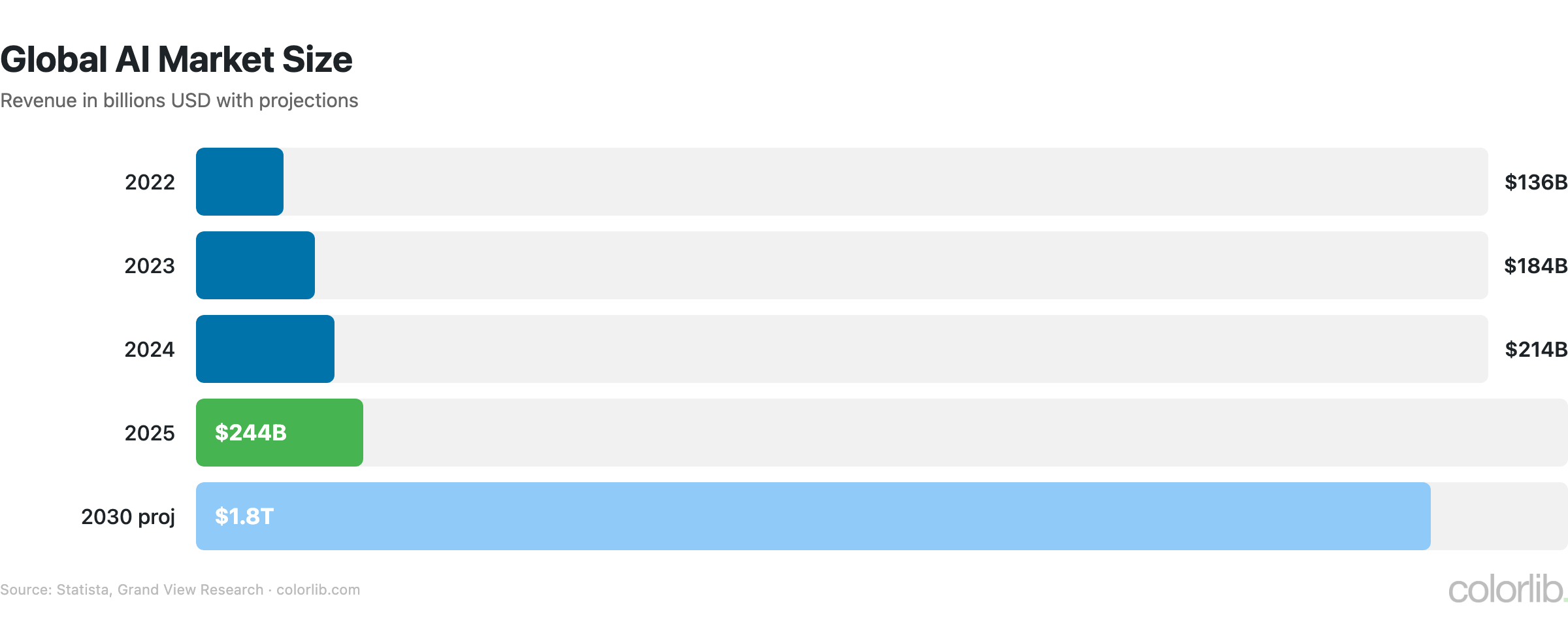
The global AI market reached $244 billion in 2025 and is projected to hit $1.8 trillion by 2030. 72% of businesses have adopted AI in at least one function, AI venture funding surpassed $100 billion in 2024, and 77% of developers now use AI coding tools daily. From generative AI chatbots to autonomous agents, artificial intelligence is reshaping every industry. Here are 150+ AI statistics covering market size, adoption, generative AI, the workplace, coding tools, investment, and regulation for 2026.
Key AI Statistics (2026)
Global AI market size: $244 billion in 2025, projected $1.8 trillion by 2030 (Grand View Research)
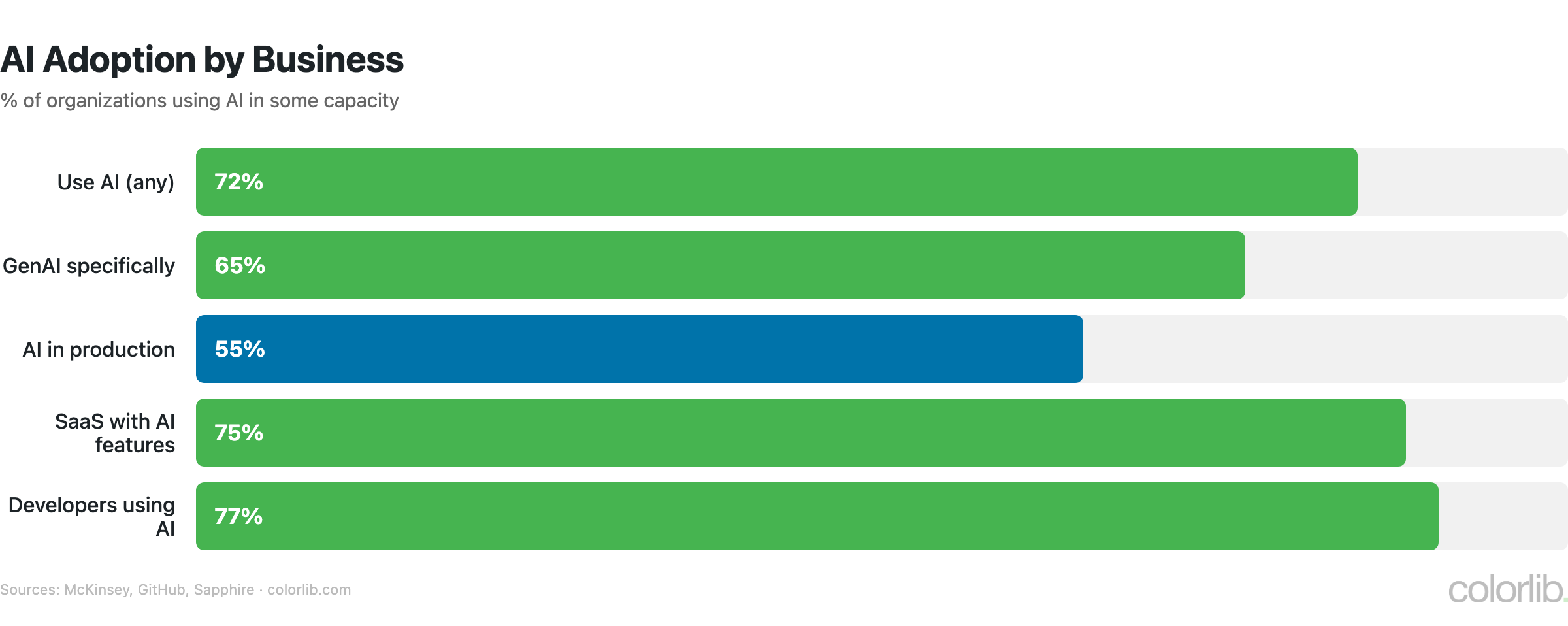
72% of organizations have adopted AI in at least one business function (McKinsey)
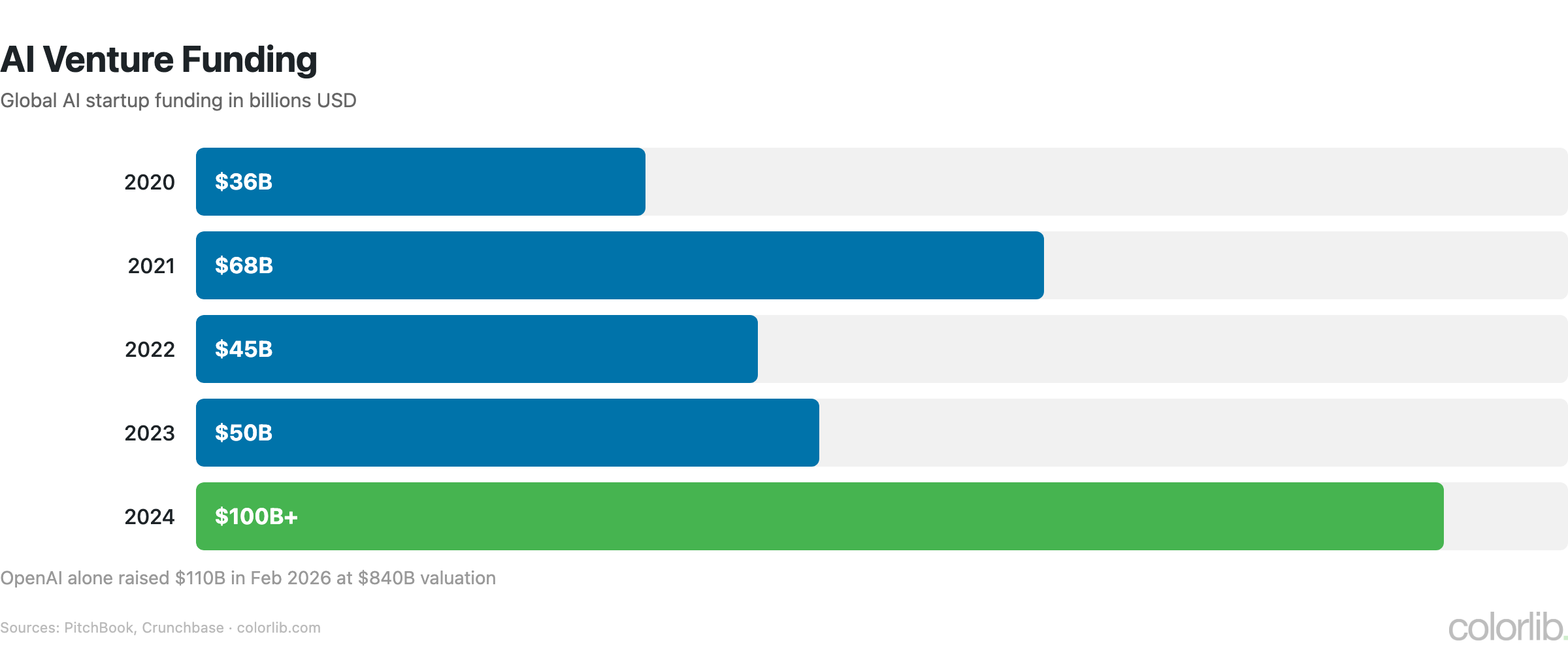
AI venture funding exceeded $100 billion in 2024 (CB Insights)
77% of developers use AI coding tools daily (GitHub)
The AI market grew 38% year-over-year from 2024 to 2025, fueled by enterprise generative AI adoption and massive infrastructure buildouts from hyperscalers
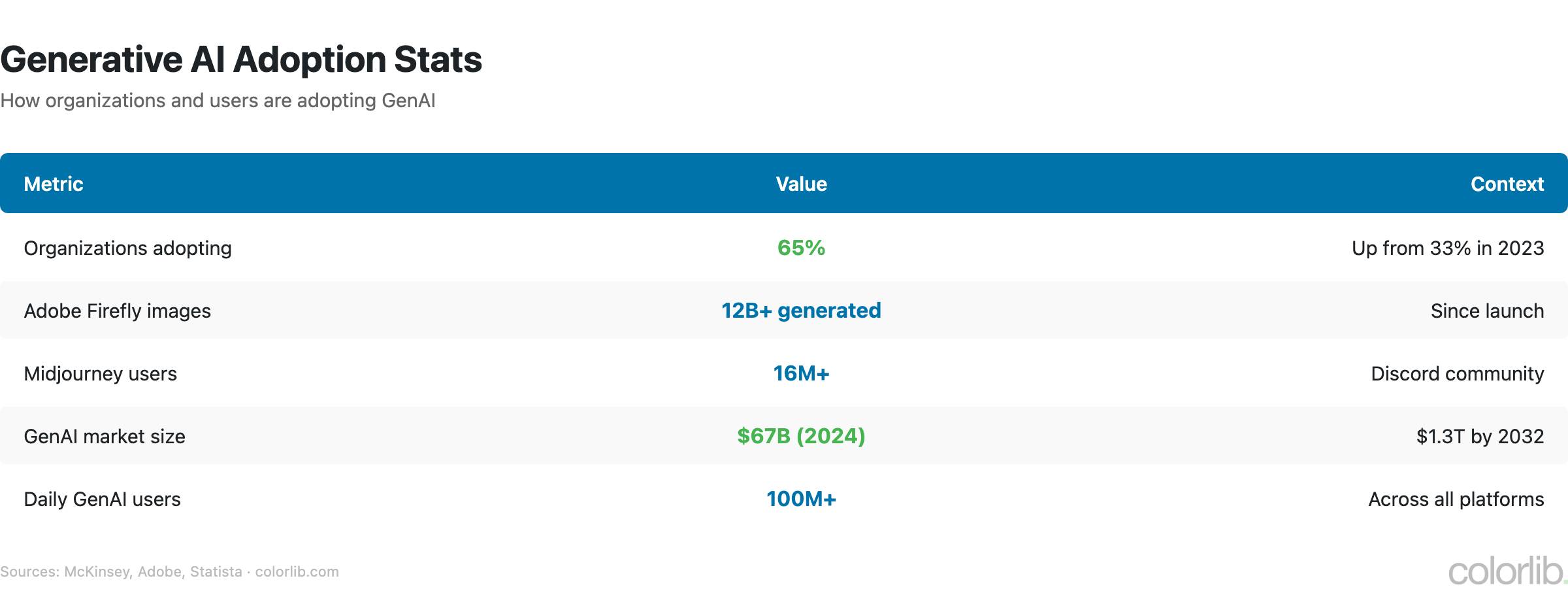
Generative AI alone accounts for $67 billion of the total AI market — roughly 27% — up from under $10 billion in 2022
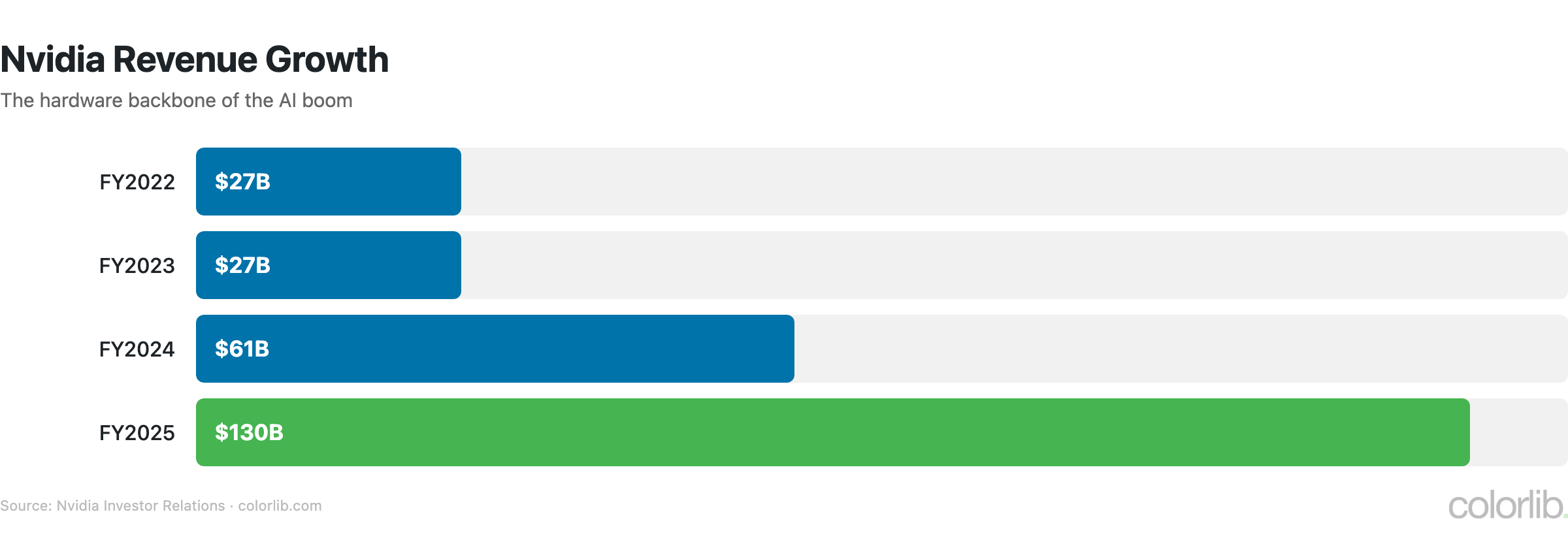
Nvidia’s data center revenue — a proxy for AI compute demand — grew from $47.5 billion to $115 billion in a single fiscal year
PwC estimates AI will contribute $15.7 trillion to global GDP by 2030, more than the current combined output of China and India
The US accounts for roughly 60% of global AI revenue, followed by China (15%) and the UK (5%)
Generative AI reached mass adoption faster than any technology in history — ChatGPT went from 0 to 100 million users in 2 months, compared to 9 months for TikTok and 2.5 years for Instagram
75% of SaaS companies have shipped AI-powered features, transforming everything from customer support to code review
An estimated 15% of new content published online is now AI-generated or AI-assisted, up from under 2% before ChatGPT launched
Hugging Face hosts over 1 million open-source AI models, making AI more accessible to developers and researchers worldwide
The most common generative AI use cases are content creation (68%), summarization (55%), customer service (47%), and code generation (42%)
AI Chatbot Landscape
Platform
Users (2026)
Company
ChatGPT
900M+ weekly
OpenAI
Google Gemini
450M monthly
Google
DeepSeek
97M monthly
DeepSeek (China)
Microsoft Copilot
400M+ monthly
Microsoft
Claude
~35M monthly
Anthropic
Perplexity
22M monthly
Perplexity AI
Grok
~40M monthly
xAI
Meta AI
700M+ monthly
Meta
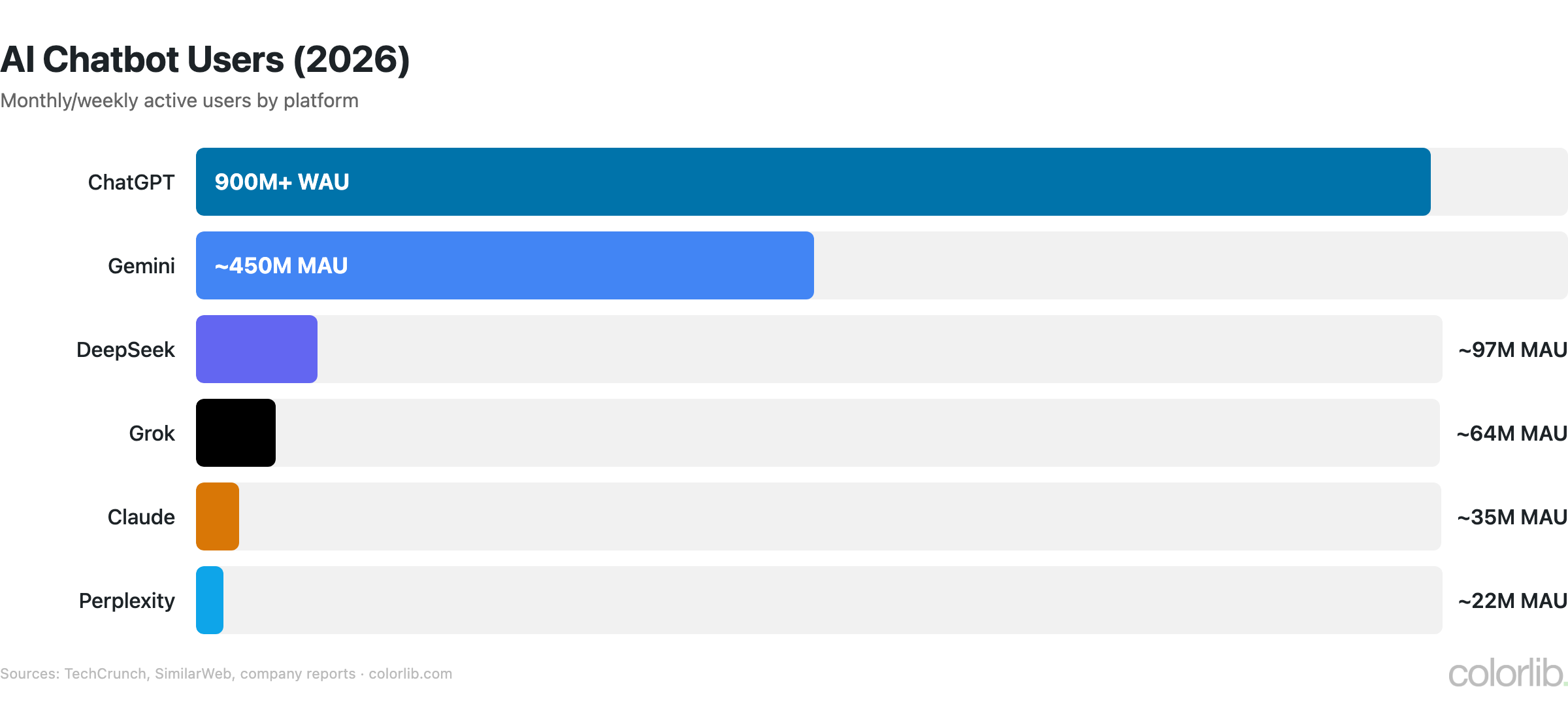
ChatGPT remains the dominant AI chatbot with 900 million+ weekly active users, though its market share has dropped from 87% to 68% as competitors grow — see our full ChatGPT statistics for the complete breakdown
Meta AI is the dark horse — integrated across Facebook, Instagram, WhatsApp, and Messenger, it reaches 700 million+ monthly users without a standalone app
DeepSeek disrupted the industry in January 2025 by training a competitive model for just $5.6 million, challenging the assumption that AI requires billions in compute
Perplexity pioneered AI-powered search, growing to 22 million users and proving there’s demand for conversational information retrieval
The AI chatbot market is expected to reach $42 billion by 2030, growing at a 23.3% CAGR
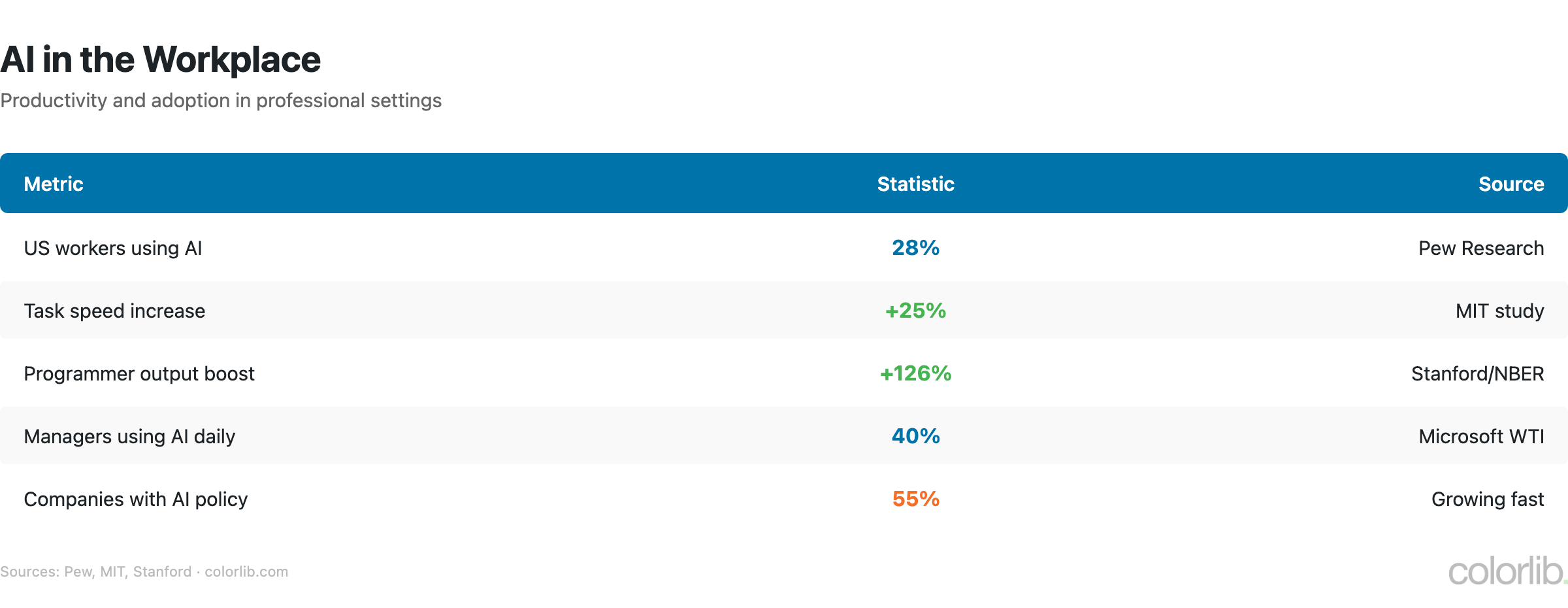
46% of workers now use AI tools at work, but 28% admit to using AI without their employer’s knowledge — a phenomenon called “shadow AI”
AI delivers a 20-40% productivity boost for knowledge workers, with the biggest gains in writing (40%), coding (30%), and data analysis (25%)
Goldman Sachs estimates 300 million jobs globally are exposed to AI automation, though most will be augmented rather than fully replaced
Only 37% of companies have formal AI usage policies, creating compliance and security risks as workers adopt tools independently
Interestingly, 32% of companies are hiring more due to AI — the technology is creating new roles (AI trainers, prompt engineers, AI ethics officers) even as it automates others
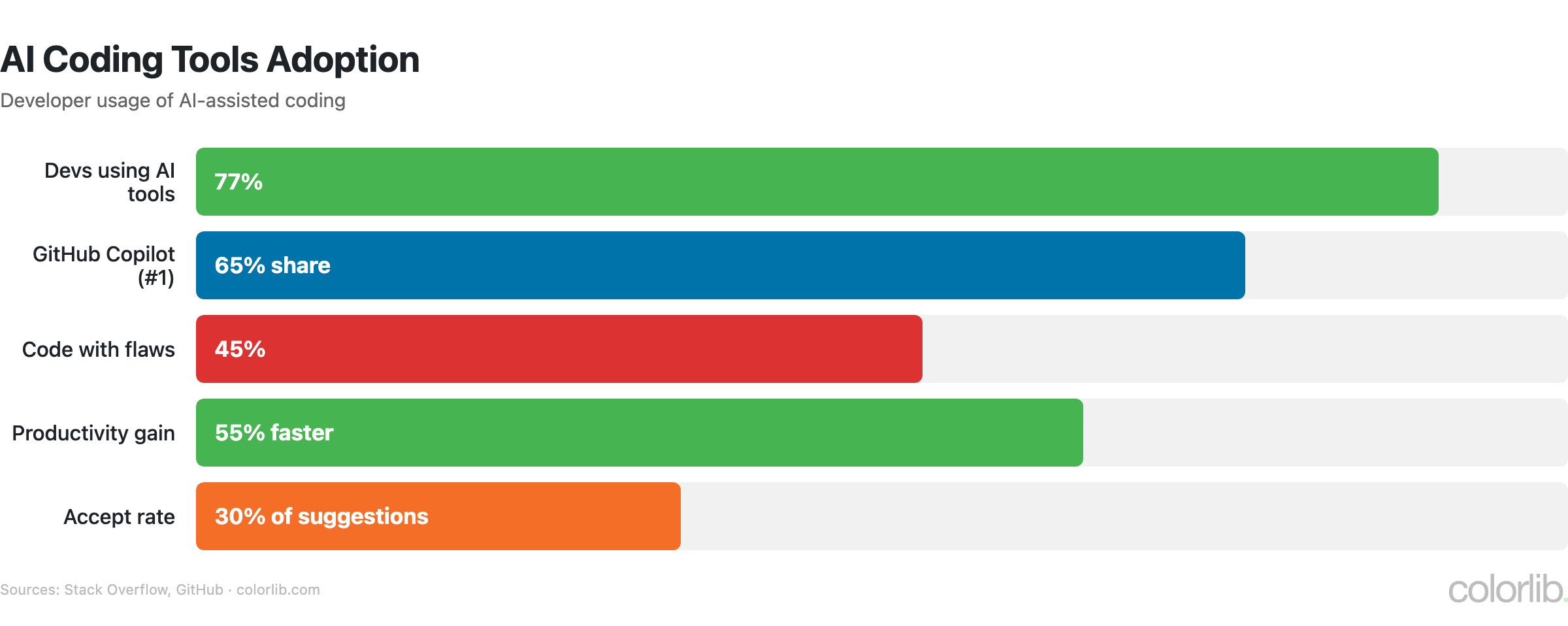
77% of developers use AI coding tools daily or weekly, making AI assistance the new baseline for software development
GitHub Copilot processes 400 million+ code suggestions per month, with developers accepting about 30% of them
AI coding tools deliver a 26-55% productivity boost, with the highest gains in boilerplate code, tests, and documentation
However, 45% of AI-generated code contains security vulnerabilities — a major concern as AI-written code enters production systems. Code review and testing remain essential
Gartner predicts that by 2028, 75% of enterprise software engineers will use AI assistants, up from 10% in early 2023. For more on how this impacts web development, see our dedicated report
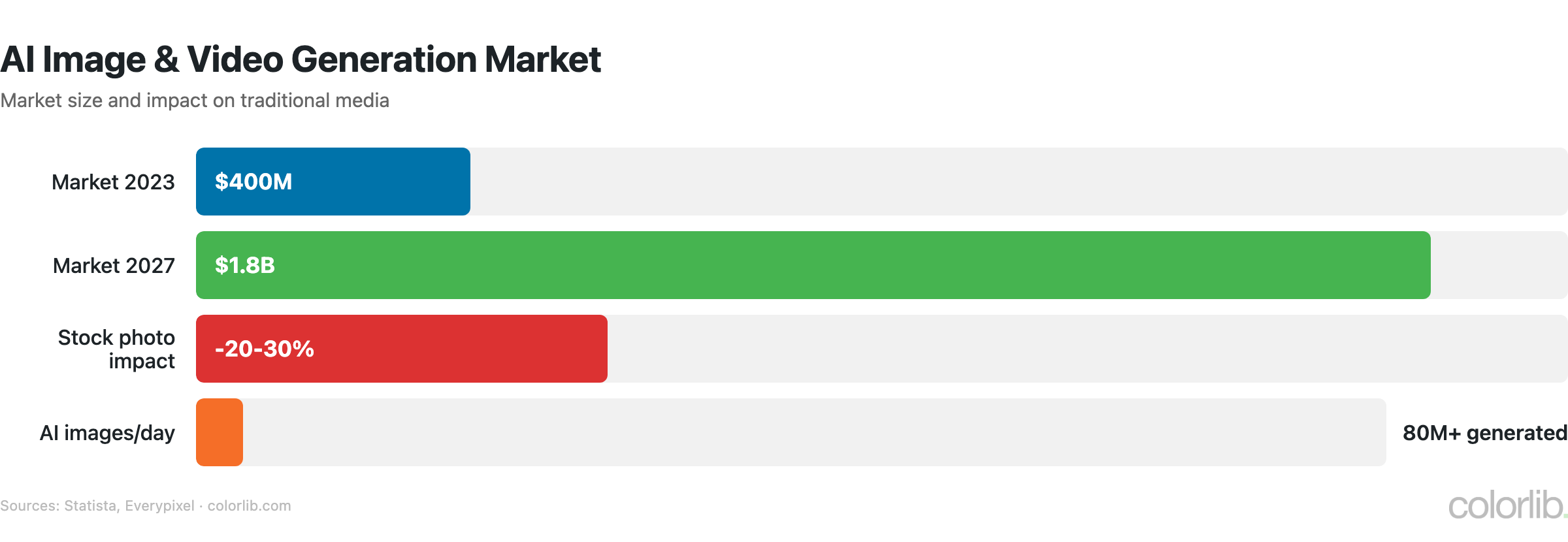
Over 80 million AI images are generated every day, and more than 15 billion total have been created since the technology emerged — that’s more than the total number of photos taken in the first 150 years of photography
Midjourney leads the creative AI space with 21 million+ users, while DALL-E and Stable Diffusion power most API-based image generation
AI video generation is the fastest-growing segment, with tools like Sora, Runway, and Kling producing increasingly cinematic results. The market is expected to reach $2.5 billion by 2028
68% of designers now use AI tools in their workflow, primarily for concept generation, mood boards, and asset creation. See our graphic design statistics for more on how AI is transforming the creative industry
Stock photo companies are pivoting to AI — Shutterstock and Adobe both launched AI generation tools, while Getty Images filed lawsuits against AI companies using their data for training
AI venture funding surpassed $100 billion in 2024, more than doubling from $49 billion in 2023 — AI accounted for nearly half of all VC investment globally
OpenAI’s $300 billion valuation makes it the most valuable private company in history, surpassing SpaceX
Nvidia briefly became the world’s most valuable company at $3.6 trillion, driven by insatiable demand for its H100 and Blackwell AI chips
The “Magnificent Seven” tech stocks (Apple, Microsoft, Nvidia, Google, Amazon, Meta, Tesla) collectively spent $200+ billion on AI infrastructure in 2025
There are now 80+ AI startup unicorns (valued at $1B+), up from just 15 in 2020
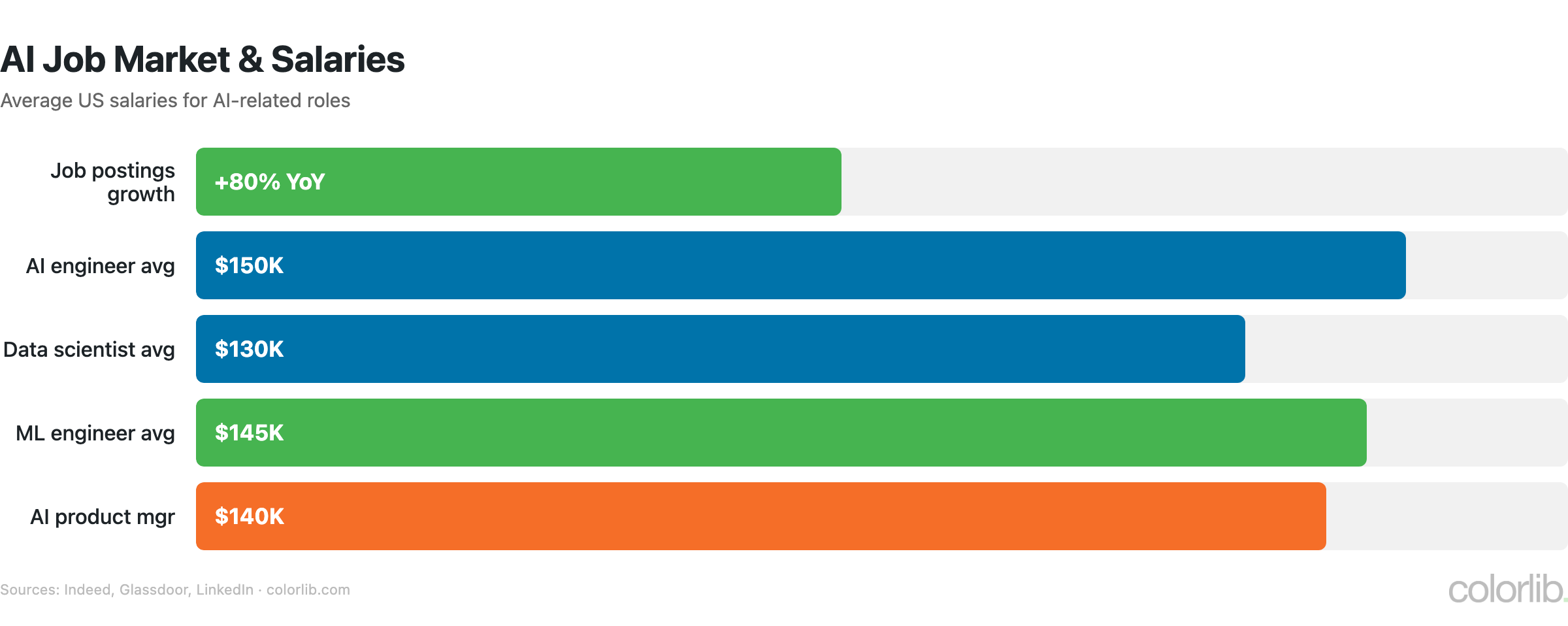
AI job postings grew 80% year-over-year, making AI/ML engineering the fastest-growing job category in tech
The demand-to-supply ratio for AI engineers is 3.5:1 — there are 3.5 open positions for every qualified candidate
The World Economic Forum predicts AI will create 97 million new jobs by 2030 while displacing 85 million — a net positive of 12 million jobs, though the transition will be disruptive
“Prompt engineer” emerged as a legitimate career paying $120,000-$175,000, though the role is evolving as AI tools become more intuitive
21% of all tech job postings now list AI skills as a requirement, up from 8% in 2022
The EU AI Act — the world’s first comprehensive AI law — began enforcement in February 2025, banning high-risk applications like social scoring and real-time biometric surveillance
Over 60 countries have enacted or proposed AI-specific regulations, though approaches vary widely — from the EU’s risk-based framework to China’s content-generation rules
45% of AI-generated code contains security vulnerabilities, highlighting the need for human review even as AI accelerates development
AI hallucination rates have improved dramatically — from 21.8% in 2021 to under 1% for leading models in 2025 — but remain a concern for high-stakes applications like healthcare and legal
250+ AI-related lawsuits were filed in 2024, primarily around copyright (training data), deepfakes, and AI-generated misinformation
The global AI market reached $244 billion in 2025 and is projected to grow at a 36.6% CAGR to reach $1.8 trillion by 2030. Generative AI alone accounts for $67 billion, and AI infrastructure spending exceeds $325 billion annually. PwC estimates AI will add $15.7 trillion to the global economy by the end of the decade.
What percentage of companies use AI?
72% of organizations have adopted AI in at least one business function, according to McKinsey’s 2025 survey. In tech and financial services, adoption exceeds 80%. However, only 11% have fully scaled AI across their enterprise — most companies are still in early or pilot stages. 65% of companies specifically use generative AI regularly, nearly double from the year before.
Will AI replace jobs?
The World Economic Forum projects AI will displace 85 million jobs but create 97 million new ones by 2030 — a net positive of 12 million jobs. Goldman Sachs estimates 300 million jobs are exposed to automation, but most will be augmented rather than eliminated. The most vulnerable roles involve repetitive data processing, while new roles in AI development, training, ethics, and oversight are growing rapidly. Workers who learn to use AI tools effectively will have a significant advantage.
Which AI chatbot has the most users?
ChatGPT leads with 900 million+ weekly active users, followed by Meta AI (700M+ monthly across Facebook/Instagram/WhatsApp), Google Gemini (450M monthly), Microsoft Copilot (400M+ monthly), and DeepSeek (97M monthly). However, ChatGPT’s market share dropped from 87% to 68% as competitors gained ground. See our full ChatGPT statistics report for detailed user and revenue data.
How much money is invested in AI?
AI venture funding exceeded $100 billion in 2024, accounting for nearly half of all global VC investment. The major tech companies (Microsoft, Google, Amazon, Meta) collectively invested over $200 billion in AI infrastructure in 2025. OpenAI alone is valued at $300 billion, Anthropic at $61.5 billion, and xAI at $50 billion. Nvidia’s AI-driven market cap peaked at $3.6 trillion.
Is AI-generated code safe to use?
AI coding tools boost productivity by 26-55%, but 45% of AI-generated code contains security vulnerabilities. This doesn’t mean you shouldn’t use AI for coding — 77% of developers already do. The key is treating AI-generated code the same way you’d treat code from a junior developer: always review it, run security scans, and test thoroughly before deploying to production. For more on AI’s impact on development, see our web development statistics report.
Key Takeaways
AI is a $244 billion market growing at 37% annually. By 2030, it’s projected to reach $1.8 trillion and contribute $15.7 trillion to global GDP — making it the most significant economic force since the internet.
72% of businesses use AI, but only 11% have fully scaled it. The gap between adoption and maturity represents an enormous opportunity for companies that can move from pilots to production.
The AI chatbot war is intensifying. ChatGPT’s dominance is eroding (87% to 68% market share), with Gemini, Meta AI, DeepSeek, and Claude all growing rapidly. No single winner is guaranteed.
AI is transforming how we build software. 77% of developers use AI coding tools, and ~25% of new code is AI-generated. But 45% of that code has security flaws — human oversight isn’t optional.
The investment is staggering — and unprecedented. $100B+ in VC funding, $200B+ in big tech infrastructure spending, and $300B company valuations. Whether this leads to returns or a bubble will define the decade.
Rok is a professional content creator, WordPress developer and enthusiastic marketer who spends most of his day behind the screen, working on ULTIDA, client projects and listening to black metal. But he never misses a daily workout to get the blood flow going.






Comments (0)