
50+ Sales Statistics: Benchmarks, Trends & Data (2026)
Global B2B ecommerce was worth $24.1 trillion in 2025, 80% of sales require 5 or more follow-ups, and sellers who partner with AI tools are 3.7x more likely to meet quota. Here are 50+ sales statistics covering market size, benchmarks, cold outreach, CRM, AI adoption, and remote selling for 2026.
Key Sales Statistics (2026)
- Global B2B ecommerce: $24.1 trillion in 2025 (Grand View Research)
- Median B2B SaaS sales cycle: 84 days (Optifai)
- 80% of sales require 5+ follow-ups (Invesp)
- Sellers who partner with AI tools are 3.7x more likely to meet quota (Gartner via Salesforce)
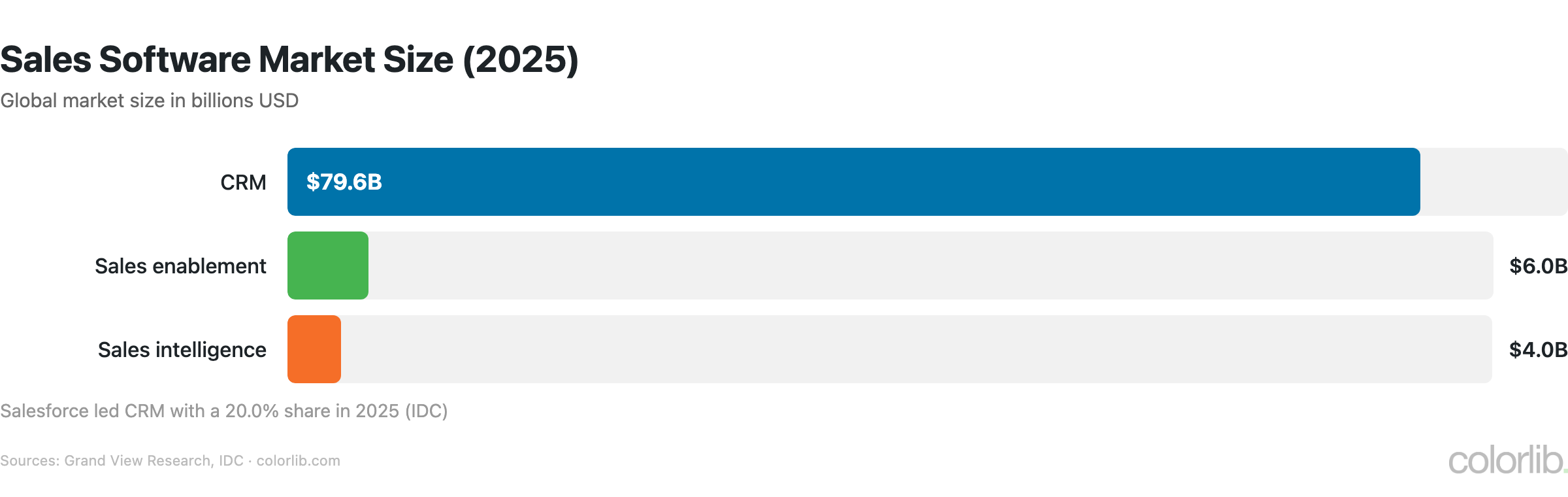
- CRM market: $79.6 billion in 2025 (Grand View Research)
- 67% of B2B buyers prefer a rep-free experience (Gartner)
- Average B2B new-logo win rate: 19% (Ebsta x Pavilion)
- B2B software reps hitting quota: about 43% per quarter (RepVue)
Sales Market Overview
| Metric | Value | Source |
|---|---|---|
| Global B2B ecommerce (2025) | $24.1 trillion | Grand View Research |
| CRM market size (2025) | $79.6 billion | Grand View Research |
| Sales enablement platform market (2025) | $6.0 billion | Grand View Research |
| Sales intelligence market (2025) | $4.0 billion | Grand View Research |
| Typical base pay range (US sales rep) | $66,000-$100,000 | Glassdoor |
| Average OTE (Account Executive) | $130,000-$180,000 | RepVue |
| Tools used to close deals (per seller) | 8 on average | Salesforce State of Sales 2026 |
- B2B ecommerce, at $24.1 trillion in 2025, is several times larger than consumer (B2C) ecommerce — a fact that surprises most people
- Sellers use an average of 8 tools to close deals, and 42% feel overwhelmed by too many tools (Salesforce State of Sales 2026)
- Salesforce led the CRM market with a 20.0% share in 2025 (IDC), and its CRM revenue was more than four times that of its nearest competitor
Sales Metrics & Benchmarks
| Metric | Value | Source |
|---|---|---|
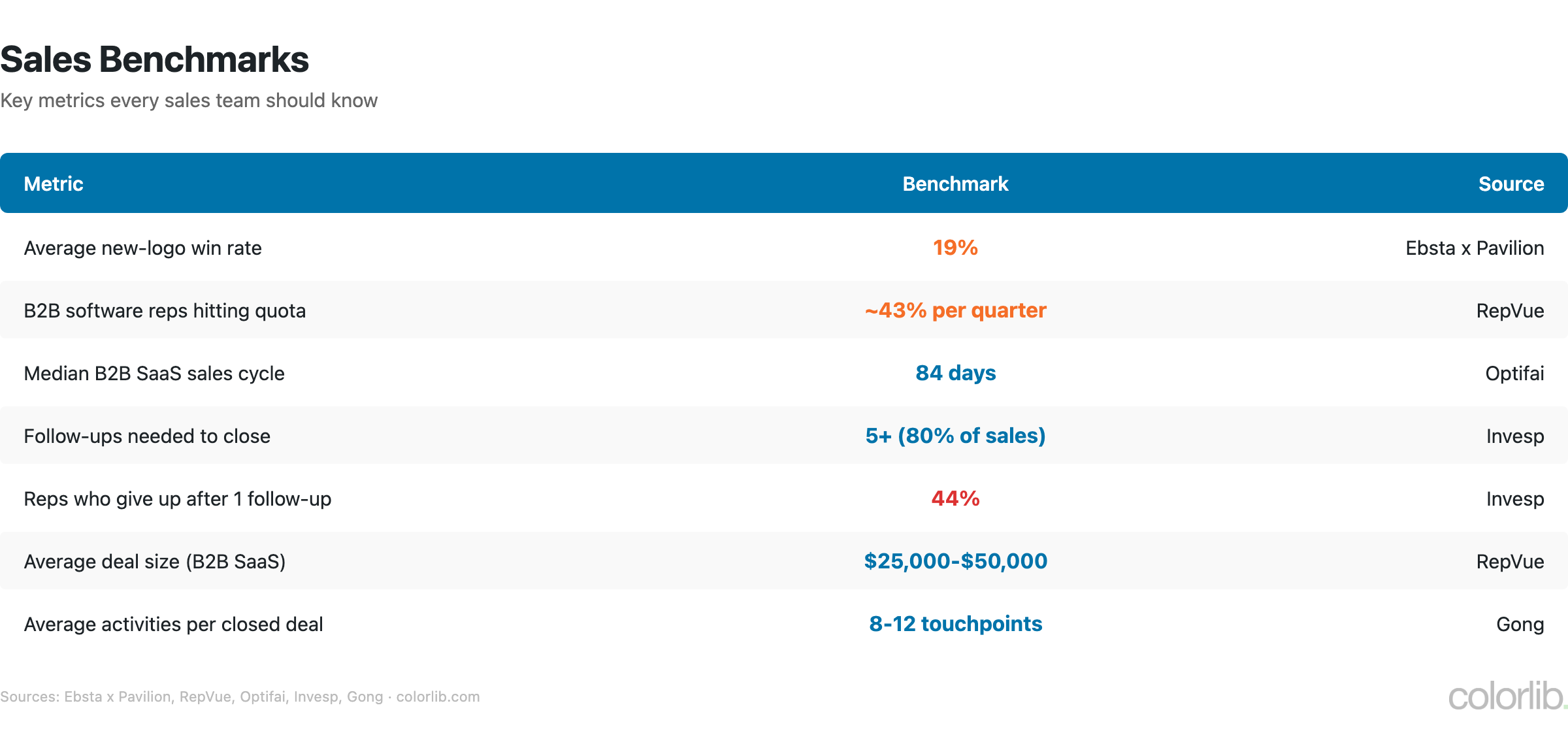
| Average new-logo win rate | 19% | Ebsta x Pavilion |
| B2B software reps hitting quota | about 43% per quarter | RepVue |
| Median B2B SaaS sales cycle | 84 days | Optifai |
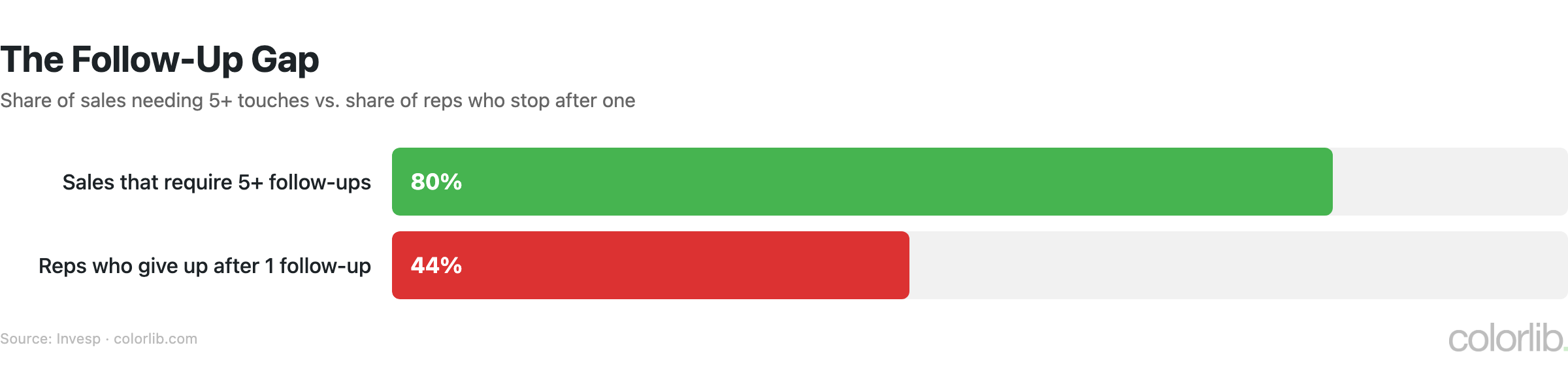
| Follow-ups needed to close | 5+ (80% of sales) | Invesp |
| Reps who give up after 1 follow-up | 44% | Invesp |
| Average deal size (B2B SaaS) | $25,000-$50,000 | RepVue |
| Average activities per closed deal | 8-12 touchpoints | Gong |
- Only about 43% of B2B software reps hit quota in a typical quarter (RepVue), and Ebsta x Pavilion found 78% of sellers missed quota in 2024
- 44% of reps give up after one follow-up, despite 80% of deals requiring 5+ touches to close
- Involving decision-makers in the first two stages of a deal lifts win rates by 55%, and top performers’ win rates are 43% higher than average (Ebsta x Pavilion)
- 57% of sales professionals say the sales cycle is getting longer (Salesforce State of Sales 2026)
Cold Outreach Statistics
| Metric | Value | Source |
|---|---|---|
| Average cold email response rate | 1-5% | Mailshake |
| Cold call connection rate | 2-3% | Gong |
| Cold calls needed per meeting | 209 | ZoomInfo |
| Email open rate (sales outreach) | 24% | Mailshake |
| Personalized emails response boost | 32% higher | Outreach |
| LinkedIn InMail response rate | 10-25% | |
| Multi-channel outreach lift | 2x higher reply | Outreach |
| Best email length for replies | 50-125 words | Lavender |
- It takes an average of 209 cold calls to book a single meeting — making cold calling the least efficient outreach method
- Personalized cold emails (company name, role, pain point) achieve 32% higher response rates than generic templates
- LinkedIn InMail outperforms cold email with 10-25% response rates, especially for reaching director+ level contacts
- 57% of C-level buyers prefer to be contacted by phone, while managers and individual contributors prefer email
- Multi-channel sequences (email + LinkedIn + phone) produce 2x higher reply rates than single-channel outreach
- The optimal cold email is 50-125 words — shorter emails get 40% higher response rates than emails over 200 words
CRM & Sales Technology
| Metric | Value | Source |
|---|---|---|
| CRM market size (2025) | $79.6 billion | Grand View Research |
| CRM adoption rate | 91% (companies 10+ employees) | Grand View Research |
| CRM ROI | $8.71 per $1 spent | Nucleus Research |
| Salesforce CRM market share (2025) | 20.0% | IDC |
| CRM data quality issues | 30% of data decays annually | ZoomInfo |
| Sales reps time on selling | Only 40% | Salesforce State of Sales 2026 |
| Sales reps time on non-selling tasks | 60% | Salesforce State of Sales 2026 |
| Sales tech spend per rep | $5,000-$15,000/year | Forrester |
- Sales reps spend only 40% of their time actually selling (35% for Gen Z reps) — the rest goes to admin tasks, data entry, research, and meetings (Salesforce State of Sales 2026)
- CRM delivers $8.71 return for every $1 invested (Nucleus Research, 2014 study), making it one of the highest-ROI enterprise software categories
- 30% of CRM data decays every year (people change jobs, companies merge), requiring constant maintenance
- 74% of sales professionals are focusing on data cleansing, and top performers are far more likely to prioritize data hygiene (79% vs. 54% of underperformers) (Salesforce State of Sales 2026)
AI in Sales
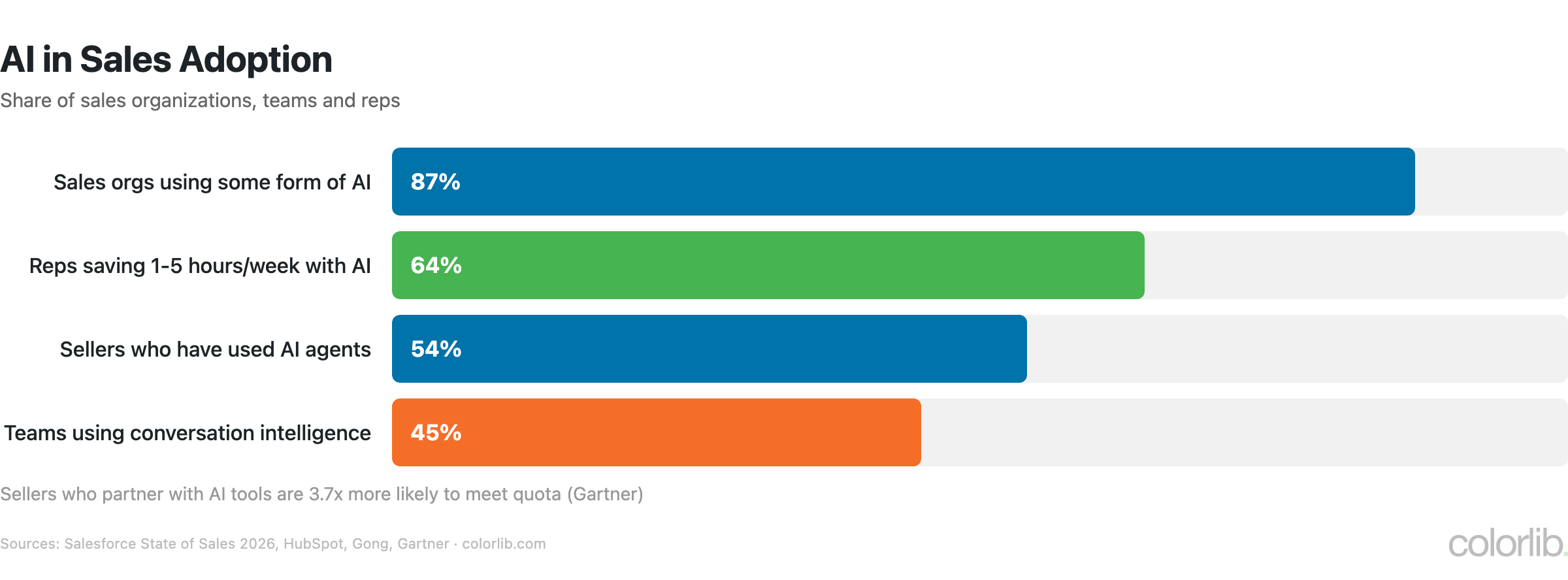
| Metric | Value | Source |
|---|---|---|
| Sellers partnering with AI tools | 3.7x more likely to meet quota | Gartner via Salesforce |
| Sales organizations using some form of AI | 87% | Salesforce State of Sales 2026 |
| AI time savings (per rep/week) | 1-5 hours (64% of reps) | HubSpot |
| AI forecasting accuracy improvement | 50% more accurate | Gong |
| AI-generated email personalization | 41% higher open rates | Lavender |
| Conversation intelligence adoption | 45% of sales teams | Gong |
| Sellers who have used AI agents | 54% | Salesforce State of Sales 2026 |
- Sellers who partner with AI tools are 3.7x more likely to meet quota (Gartner), and top performers are 1.7x more likely than underperformers to use AI agents for prospecting (Salesforce)
- 64% of sales professionals say using AI to automate manual tasks saves them 1-5 hours per week (HubSpot)
- Conversation intelligence tools (Gong, Chorus) analyze 100% of calls vs. the 1-2% that managers could manually review
- AI-powered sales forecasting is 50% more accurate than human judgment alone
- Sales teams rank investing in AI as their #1 growth tactic, and nearly 9 in 10 sellers plan to use AI agents by 2027 (Salesforce State of Sales 2026)
Remote Selling Statistics
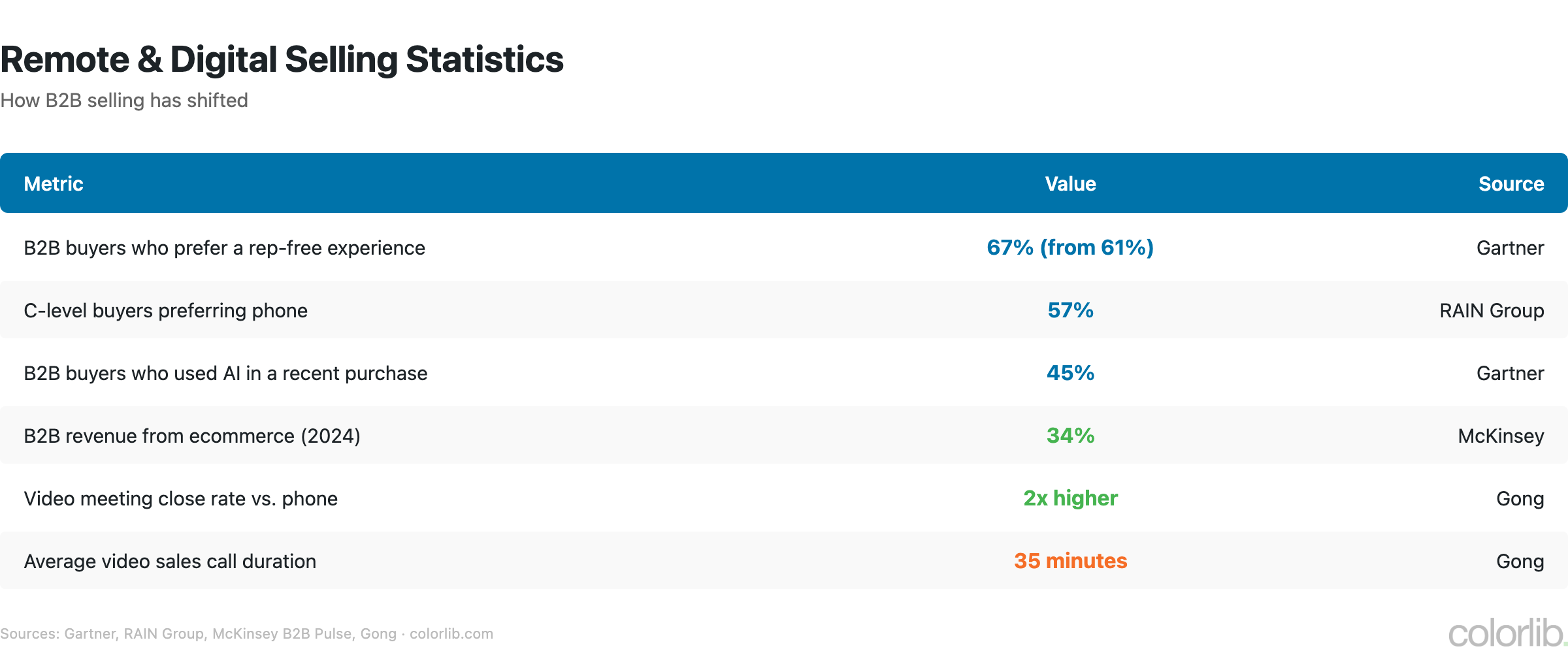
| Metric | Value | Source |
|---|---|---|
| B2B buyers who prefer a rep-free experience | 67% | Gartner |
| B2B revenue from ecommerce (2024) | 34% | McKinsey |
| Video meeting effectiveness vs. phone | 2x higher close rate | Gong |
| C-level buyers preferring phone | 57% | RAIN Group |
| Average video sales call duration | 35 minutes | Gong |
| B2B buyers who used AI in a recent purchase | 45% | Gartner |
- 67% of B2B buyers prefer a rep-free experience for at least part of their purchase (Gartner, 2025 survey), up from 61% a year earlier
- Video meetings close deals at 2x the rate of phone calls — yet 37% of reps still default to audio-only
- Despite the self-service trend, 57% of C-level executives still prefer phone contact for complex, high-value purchases
- Ecommerce has become the top B2B revenue channel: online sales account for 34% of revenue at a typical B2B organization (McKinsey B2B Pulse 2024)
Key Takeaways
- Most reps miss quota. Only about 43% of B2B software reps hit their targets in a typical quarter. The gap between top performers and the rest is widening, largely driven by technology adoption.
- Follow-up is everything. 80% of sales need 5+ touches, but 44% of reps give up after one. Persistence, not talent, separates winners.
- AI is the new unfair advantage. Sellers who partner with AI tools are 3.7x more likely to meet quota, and most reps say AI saves them 1-5 hours a week.
- Buyers want self-service. 67% prefer a rep-free experience for at least part of their purchase. Sales teams must shift from gatekeeping to guiding.
- CRM is essential but underused. $79.6B market, 91% adoption, $8.71 ROI per $1. Yet reps still spend 60% of their time on non-selling work.
- Multi-channel outreach wins. Email + LinkedIn + phone = 2x reply rates. LinkedIn InMail (10-25%) outperforms cold email (1-5%) for B2B prospecting.
Sources
- Salesforce — State of Sales Report (2026)
- Gartner — B2B Buyer Survey (2025)
- Gong — Revenue Intelligence Reports
- Grand View Research — CRM Market Analysis
- Invesp — Sales Follow-Up Statistics
- McKinsey — B2B Pulse Survey (2024)
- Nucleus Research — CRM ROI Study
- RepVue — Sales Compensation Data
- RepVue — Cloud Sales Index
- Ebsta x Pavilion — 2025 GTM Benchmarks Report
- IDC — CRM Market Share Ranking (2025)
- HubSpot — AI in B2B Sales Research
- Optifai — Pipeline Study (2026)
- Lavender — Email Effectiveness Research
- Grand View Research — B2B Ecommerce Market Size
Frequently Asked Questions
What is the average sales win rate?
The average B2B new-logo win rate was 19% in Ebsta x Pavilion’s 2025 GTM Benchmarks (based on 655,000 opportunities), meaning roughly 1 in 5 opportunities converts to a closed deal. Top performers’ win rates are 43% higher than average, and involving decision-makers early lifts win rates by 55%. Win rates also vary by deal size and by how long a deal drags on: late-stage deals that slip by more than two months win far less often.
How many follow-ups does it take to close a sale?
80% of sales require 5 or more follow-ups to close. Despite this, 44% of sales reps give up after just one follow-up. The average closed deal involves 8-12 touchpoints across multiple channels (email, phone, LinkedIn, meetings). Persistence is the single biggest differentiator between top performers and average reps. For more on outreach effectiveness, see our lead generation statistics.
How is AI changing sales?
AI is transforming every stage of the sales process. 87% of sales organizations now use some form of AI (Salesforce State of Sales 2026), and sellers who partner with AI tools are 3.7x more likely to meet quota (Gartner). Key applications include: AI email writing (41% higher open rates), conversation intelligence (analyzing 100% of calls), predictive forecasting (50% more accurate), and AI agents for prospecting, which 54% of sellers have already used. 64% of sales pros say AI automation saves them 1-5 hours per week on manual tasks (HubSpot).
Do B2B buyers still want to talk to sales reps?
It depends on the buyer level and purchase complexity. 67% of B2B buyers prefer a rep-free experience for at least part of their purchase (Gartner, 2025 survey). However, 57% of C-level executives still prefer phone conversations for complex, high-value deals. The trend is clear: sales reps need to shift from information gatekeepers to strategic advisors who add value that self-service cannot. For related insights, explore our digital marketing statistics.
For more business data, explore our lead generation statistics, digital marketing statistics, and online shopping statistics.

Related Posts


Comments (0)