
22 Best Content Writer Portfolio Examples 2026
The best content writer portfolios show published work with the client named, organise it the way buyers search, and make it easy to see what hiring the writer involves. These 22 portfolios come from content marketers and B2B SaaS writers, freelance and staff journalists, technical writers, content designers, an SEO writer, a ghostwriter, a speechwriter, a grant writer, and health and finance specialists.
We rechecked all 19 sites from the previous version of this list and kept 3: the others now redirect to different businesses, return errors, have turned into coaching or services pages, show nothing newer than a few years ago, or suit our copywriter list better. We then tested more than 200 web addresses, read about 200 inner pages such as portfolio, pricing, about and contact pages, and identified each platform from the site’s code rather than guessing.
Best Content Writer Portfolio Examples
1. Belinda Roozemond
Built with: Squarespace
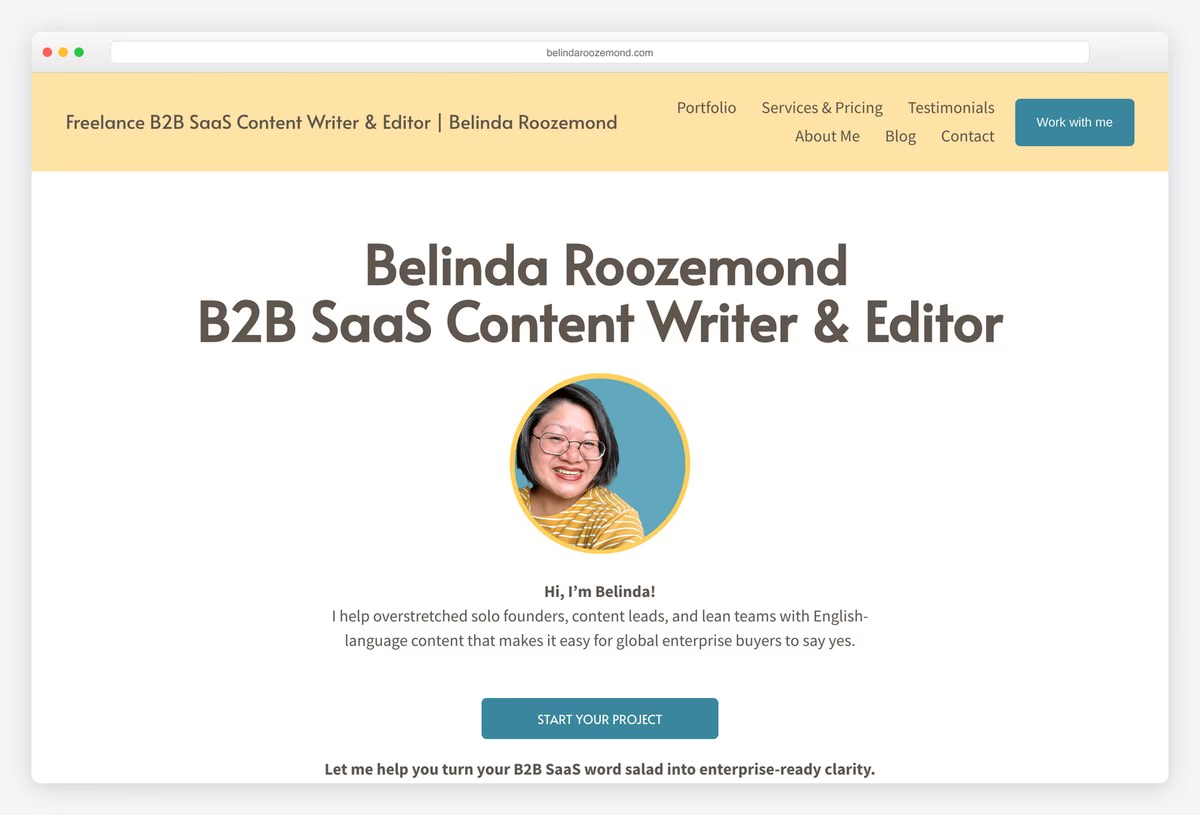
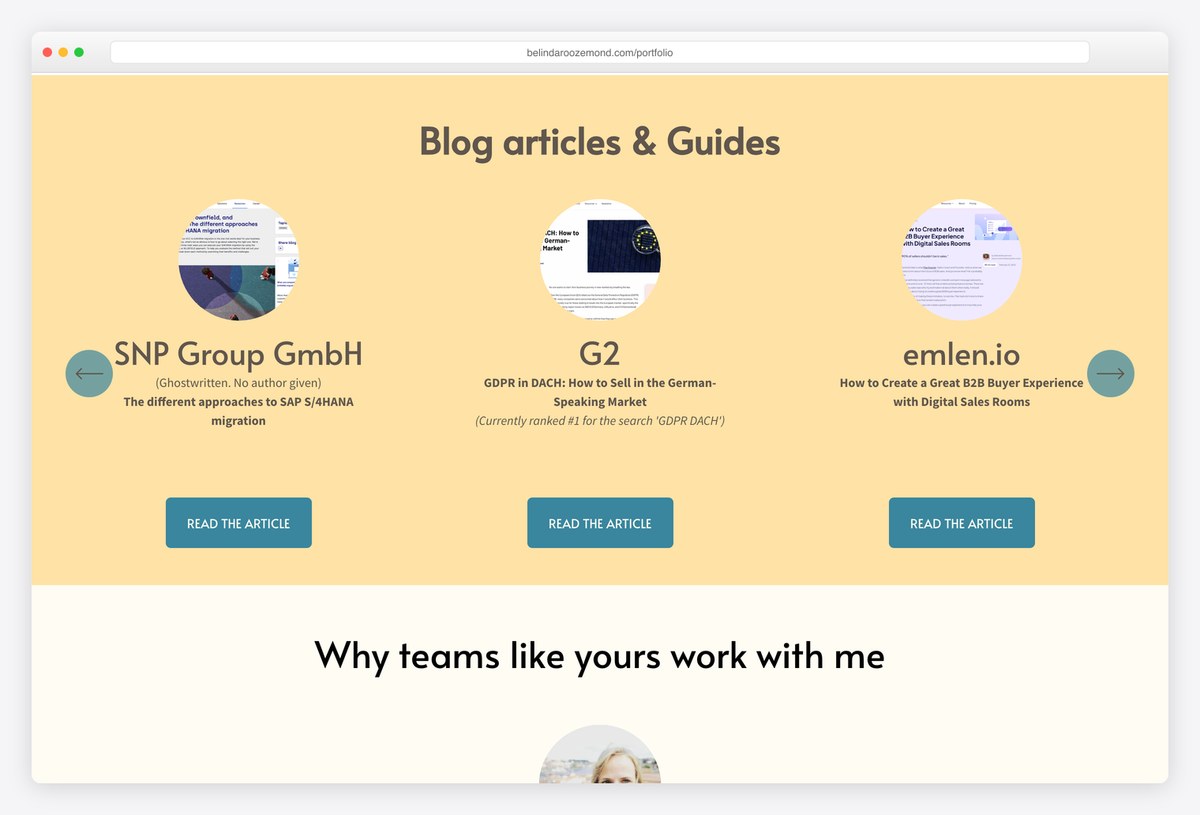
Belinda Roozemond is a B2B SaaS content writer and editor based in Germany, and her portfolio solves the ghostwriting problem openly. Every sample names the client and links to the live piece, and unbylined work is labelled, such as Ghostwritten. No author given for SNP Group or Ghostwritten for the CMO at Leadfeeder.
Her pricing page gives a starting price for each format, from blog posts to case studies, and lists what she does not do. Each testimonial states how long the client has worked with her and invites you to ask them for a reference.
What stands out: Label ghostwritten samples instead of leaving them out.
2. Douglas Fox
Built with: WordPress
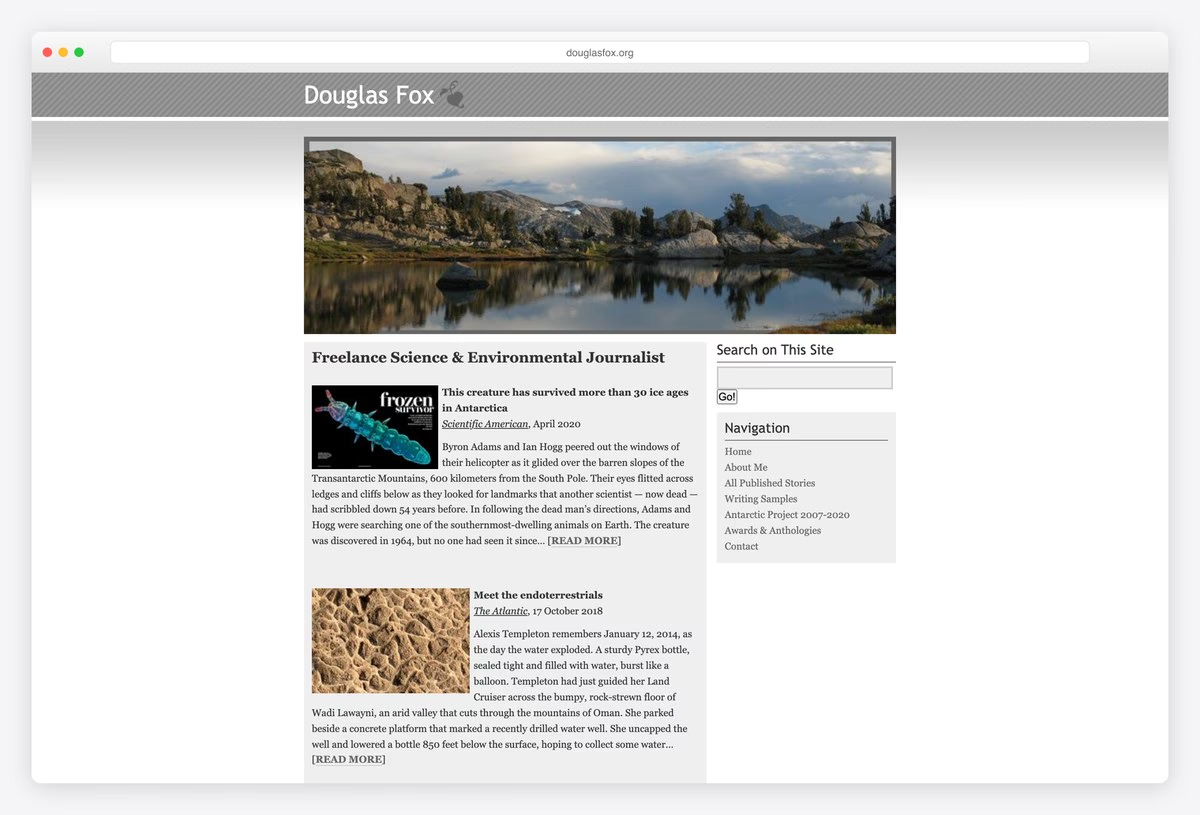
Douglas Fox is a freelance science and environmental journalist, and his All Published Stories page is the clearest clip archive in this list. Every story is grouped by year with the outlet and date, from National Geographic and Science News to Scientific American, and features and cover stories are marked as such.
The homepage skips the introduction and opens on excerpts of his long reads. A separate Awards & Anthologies page records his selections for The Best American Science & Nature Writing and the AAAS Kavli Science Journalism Gold Award.
What stands out: Date every clip so editors can see you are working now.
3. Christian De Pape
Built with: Custom code (Netlify)
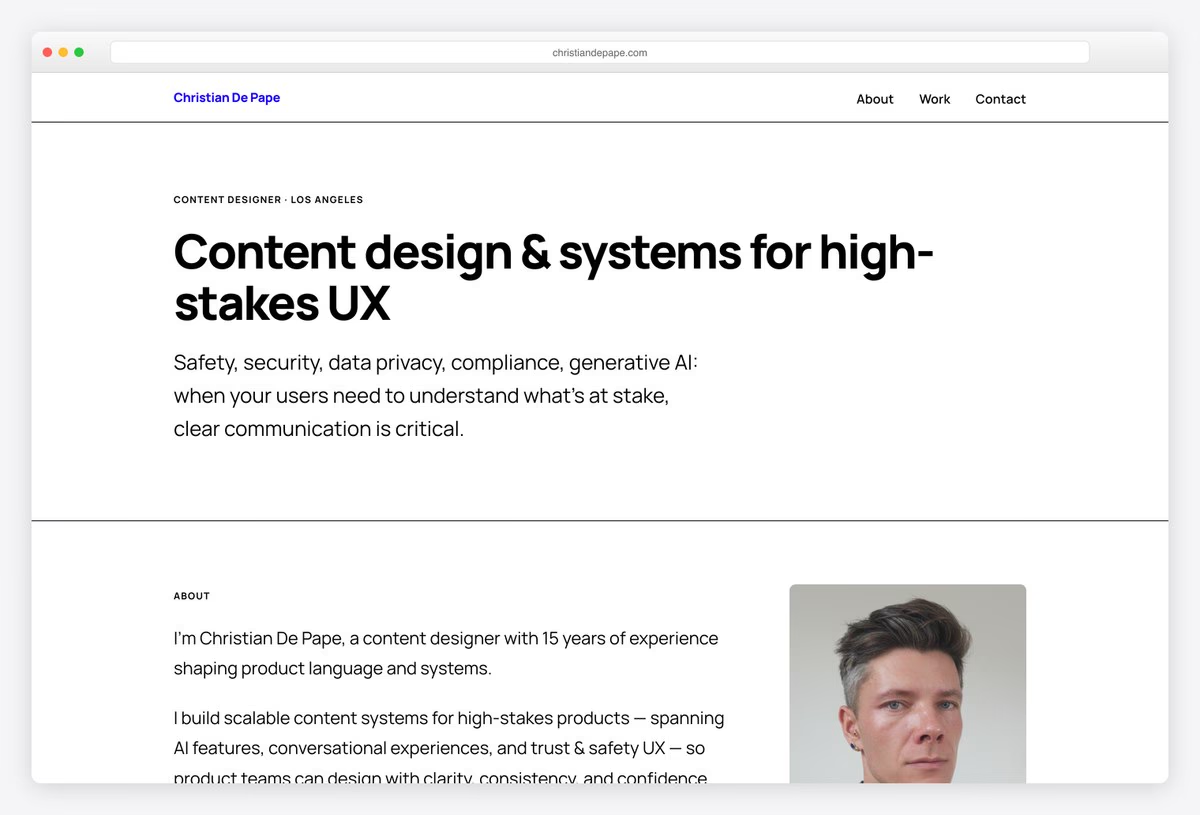
Christian De Pape is a Los Angeles content designer who specialises in high-stakes UX, and his first screen says so: safety, security, data privacy, compliance and generative AI. Project cards state the problem and, where he has one, the result, such as a 70% increase in filter usage for the Zendesk audit log.
His UX writing samples are hosted in FigJam, so a hiring manager sees the words inside the full flow, with before and after states and design annotations. Clients are listed with what he wrote for each, from Zendesk to Stripe.
What stands out: Show interface copy inside the flow, not as loose strings.
4. Paul Maplesden
Built with: Squarespace
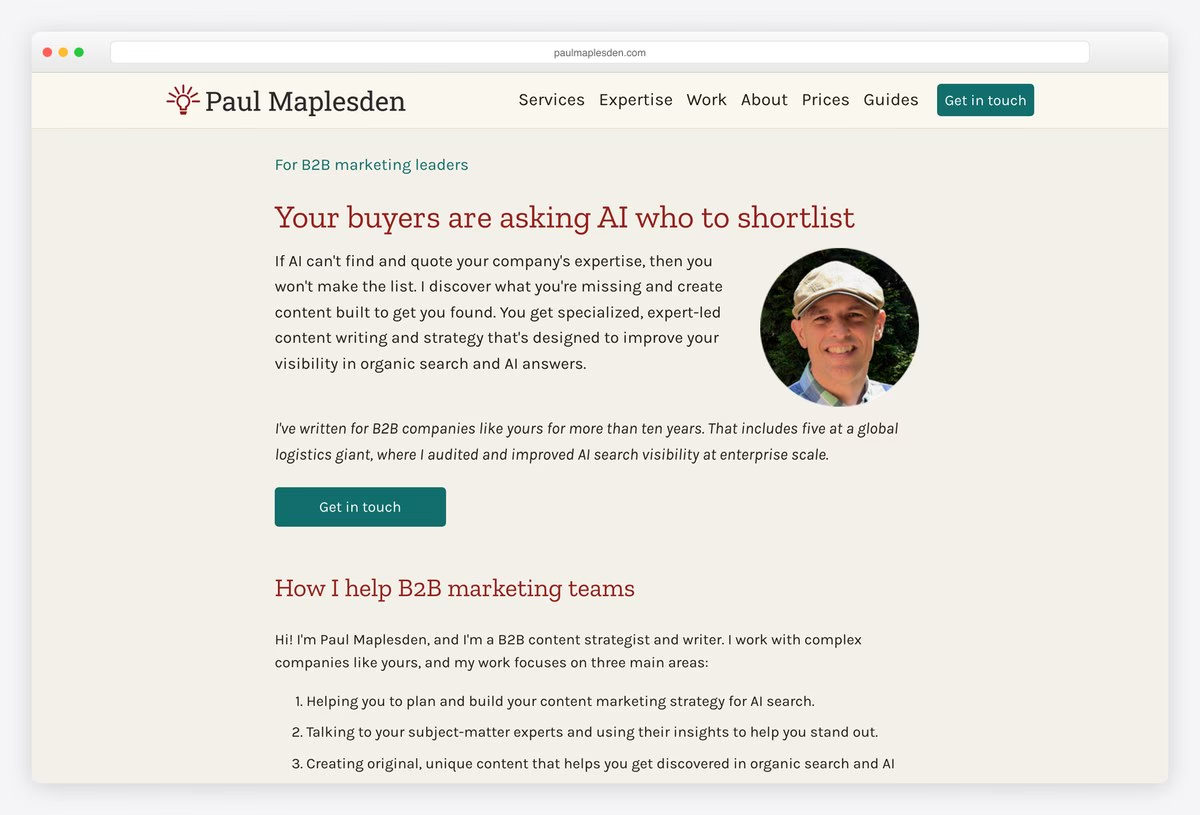
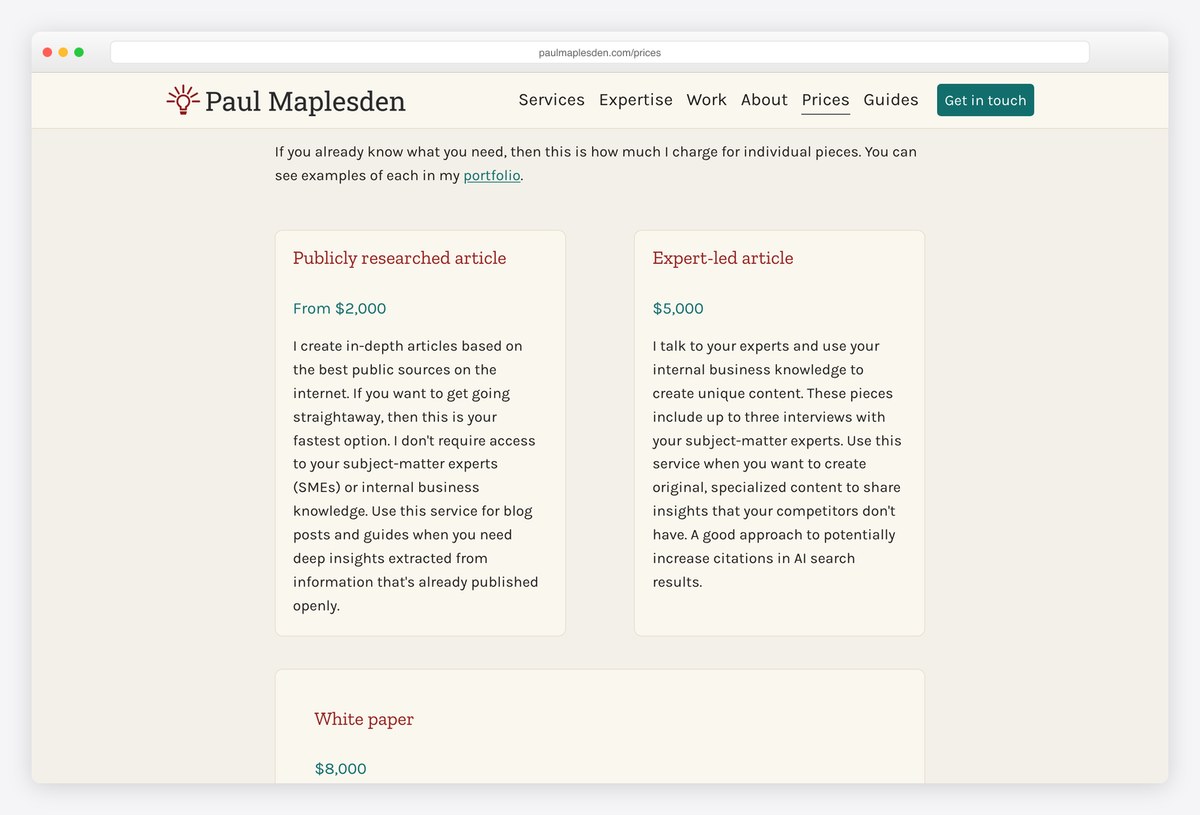
Paul Maplesden writes B2B content about logistics, finance and technology, and his Prices page is the most specific in this list. Researched articles start at $2,000, expert-led articles with up to three interviews cost $5,000, and white papers $8,000, so a marketing lead knows the budget before calling.
The portfolio is grouped by client and topic, such as four GEODIS white papers on logistics or nine Driven Insights articles on SaaS metrics, and a separate Clients page describes every company he has written for.
What stands out: Publish a price per format so buyers can qualify themselves.
5. Hilary Liftin
Built with: Squarespace
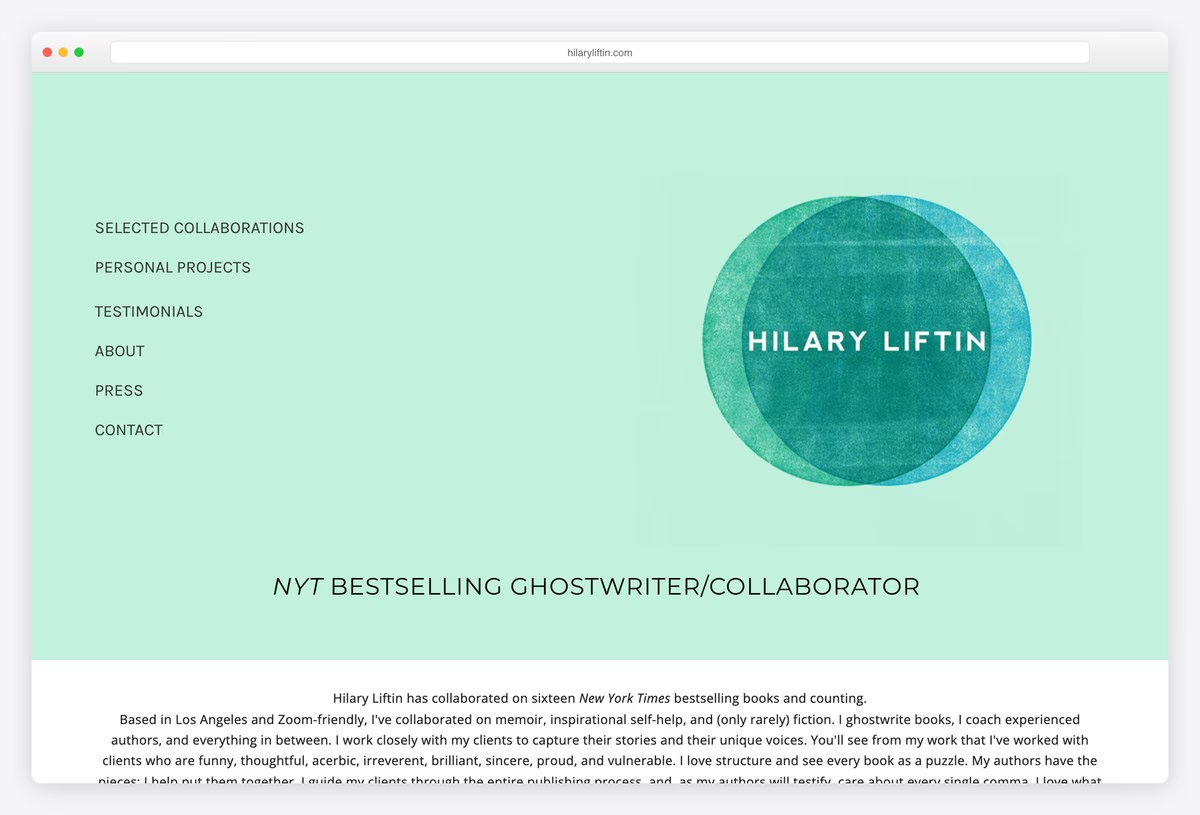
Hilary Liftin ghostwrites celebrity memoirs, and her homepage proves the work without a single byline. The first lines say she has collaborated on sixteen New York Times bestsellers, and a Selected Collaborations carousel shows the covers. Her About page names some of the books, including Think Like a Monk by Jay Shetty.
Her testimonials come from the editors and publishers who hire collaborators, at Simon & Schuster and Gallery Books. The contact page gives her own email alongside her literary agent, Daniel Greenberg at Levine Greenberg Rostan.
What stands out: Let editors vouch for work you cannot sign.
6. Rachel Pascal
Built with: WordPress
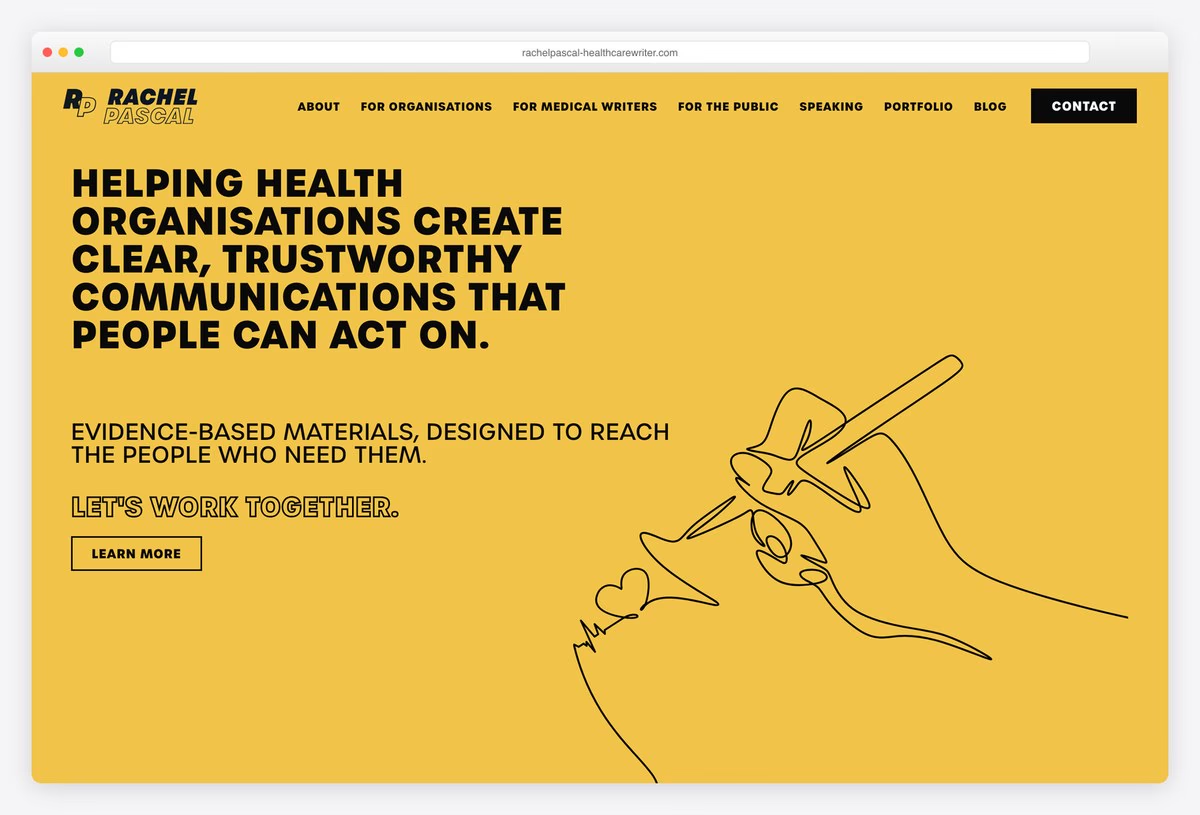
Rachel Pascal is a medical and health writer with more than fifteen years of experience, and her portfolio is candid about confidential work. Public samples are grouped by format, from journal articles to patient education, and a note lists what she cannot show, including advisory board reports and sales aids.
Case studies explain the brief and the deliverable, such as a five-article series for Wounds International built from an expert advisory board meeting. The homepage splits visitors three ways: organisations, writers she mentors, and the public, who get her Make Sense Health project.
What stands out: Say what you cannot share, and what kind of work it is.
7. Nathan Ojaokomo
Built with: Next.js
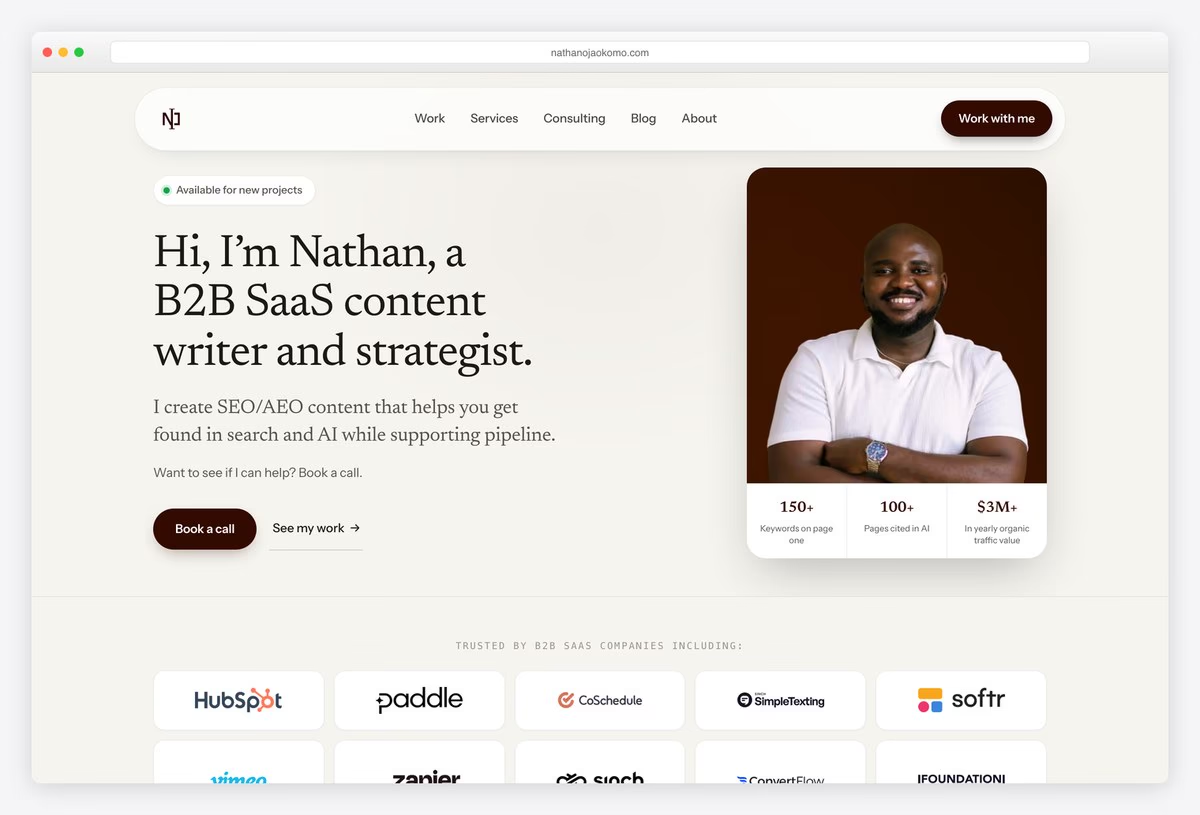
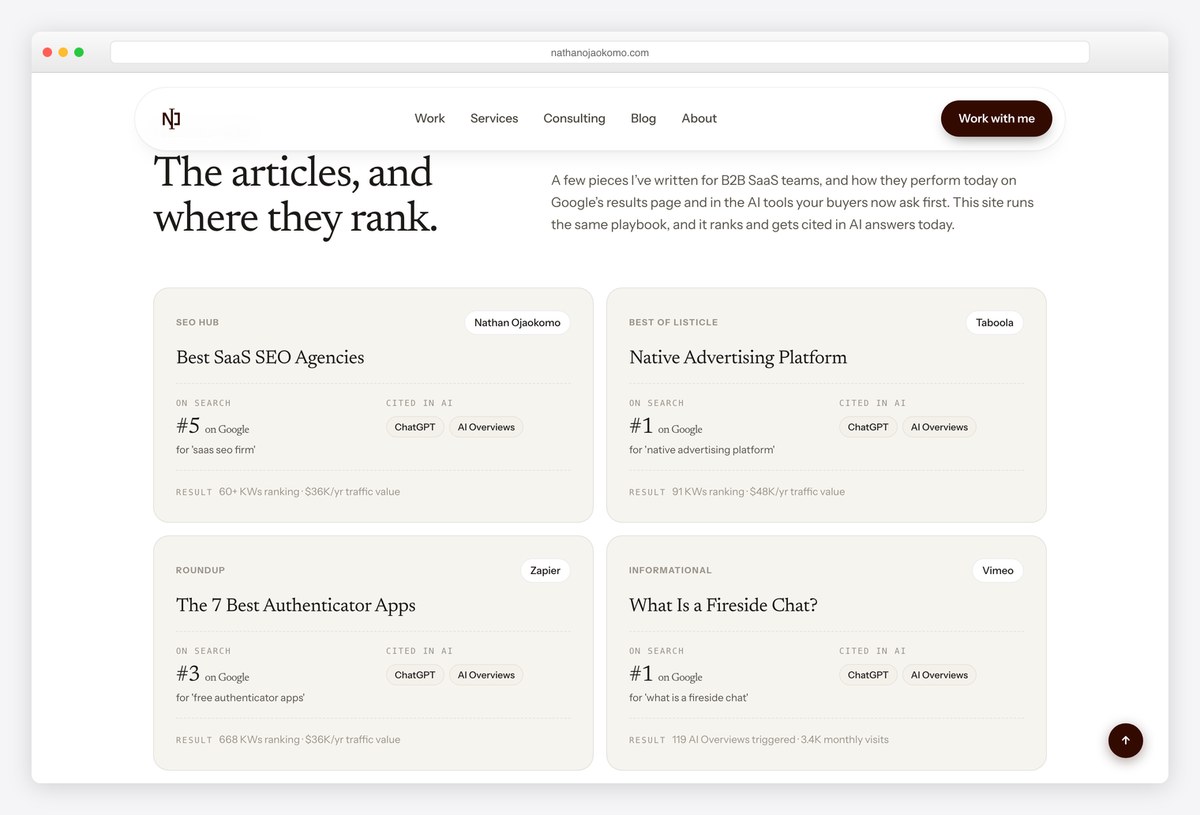
Nathan Ojaokomo writes B2B SaaS content from Ibadan, Nigeria, and his selected work reports where each article ranks, not just who published it. A Zapier roundup sits at #3 on Google for free authenticator apps and a Vimeo explainer at #1 for what is a fireside chat, with the AI tools that cite each.
His About page tells how he started, earning around $1 per 1,000 words and writing guest posts to build bylines before landing HubSpot, Zapier and Vimeo. Articles start at $700, and a homepage badge says he is available for new projects.
What stands out: Show results a client can check for themselves.
8. Jen A. Miller
Built with: WordPress
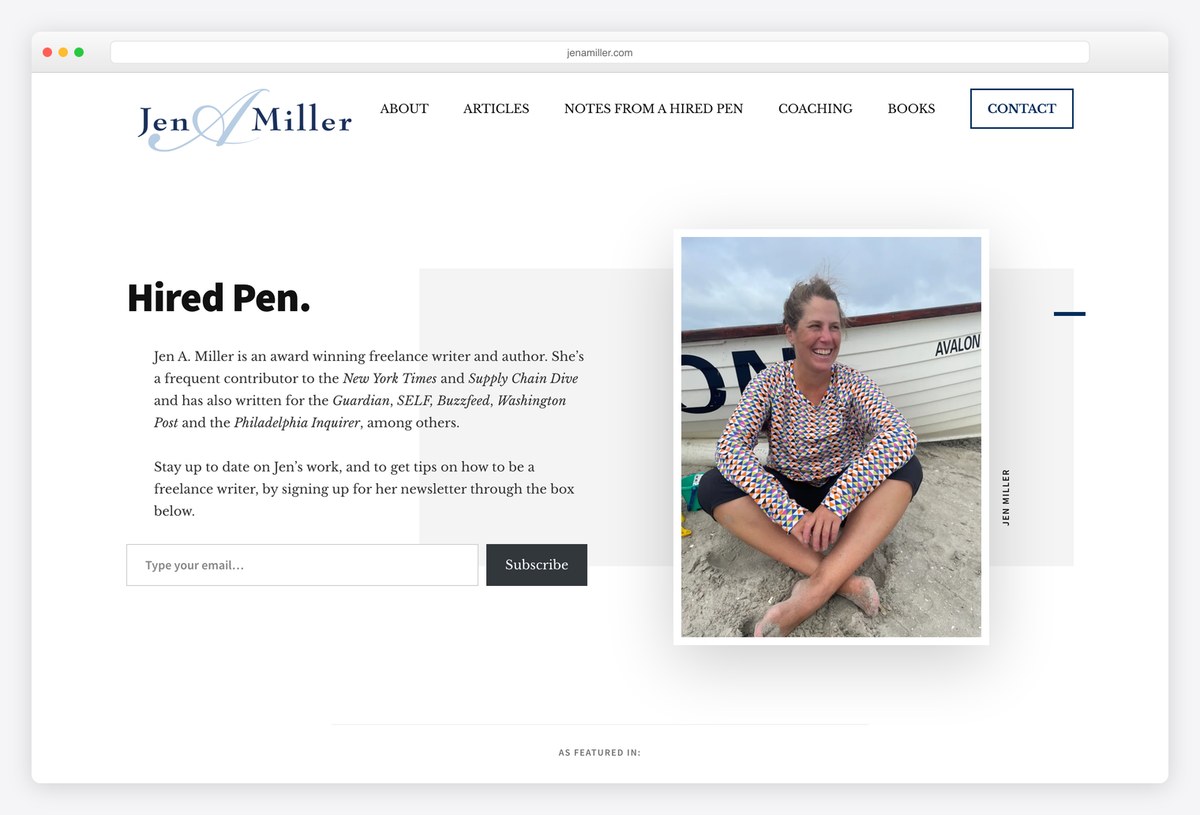
Jen A. Miller is a freelance journalist and author whose menu doubles as a map of her markets. Lifestyle, B2B, Reporting, Essays, Travel and Higher Education each open an archive of clips with an excerpt, the outlet and the date, from The New York Times to CIO Dive and Clinical Laboratory News.
The Higher Education section sells a less obvious service: cover stories for alumni magazines, annual reports, and ghostwritten speeches for university presidents and deans. Her newsletter, Notes from a Hired Pen, posts freelance advice most weeks, which keeps the whole site visibly current.
What stands out: Name menu items after the markets that hire you.
9. Ina Ciobanu
Built with: Docusaurus (GitHub Pages)
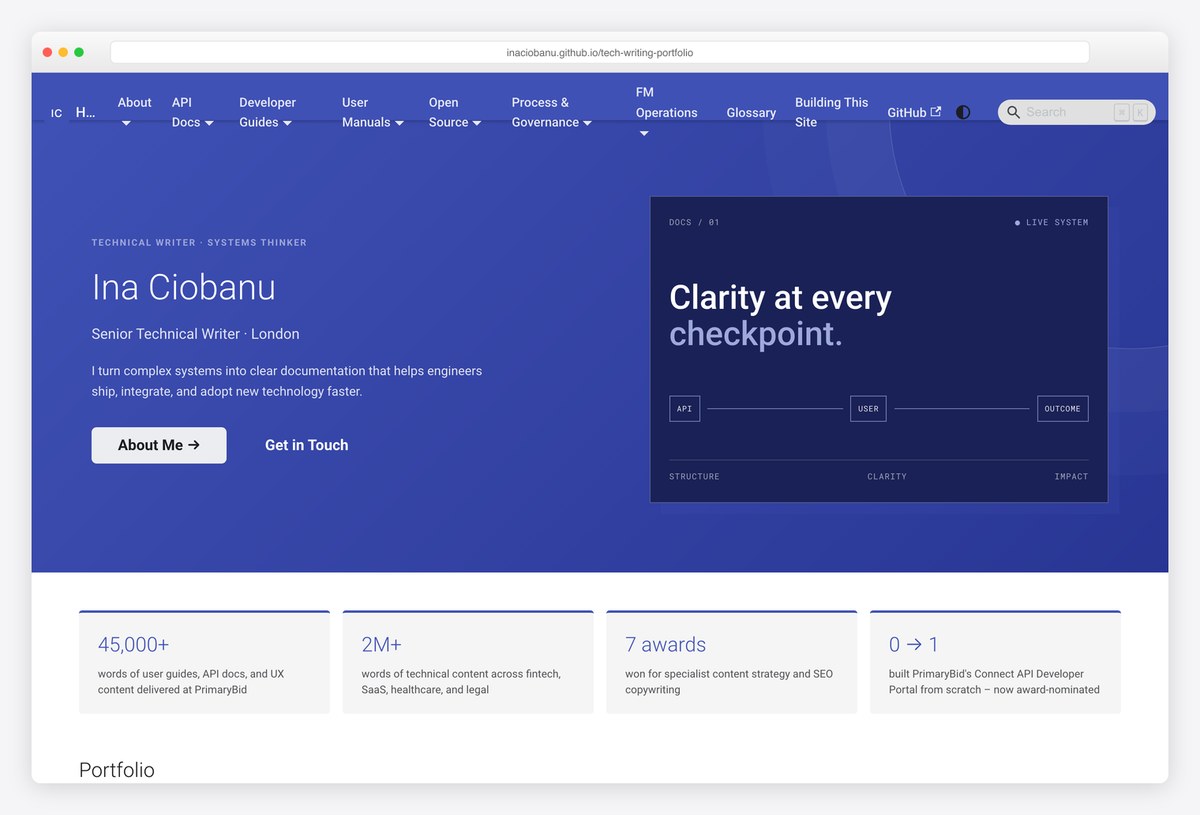
Ina Ciobanu is a senior technical writer in London, and her portfolio is itself a documentation site, built with Docusaurus and published on GitHub Pages. A hiring manager can search it, browse API docs, guides and user manuals, and read sample reference pages generated from an OpenAPI spec.
A Building This Site page explains the docs-as-code setup behind it, from prose linting with Vale to PR previews, which shows her process as well as the output. The homepage adds numbers, such as 45,000+ words of user guides, API docs and UX content delivered at PrimaryBid.
What stands out: Let the portfolio use the tools you would use on the job.
10. Elise Dopson
Built with: Squarespace
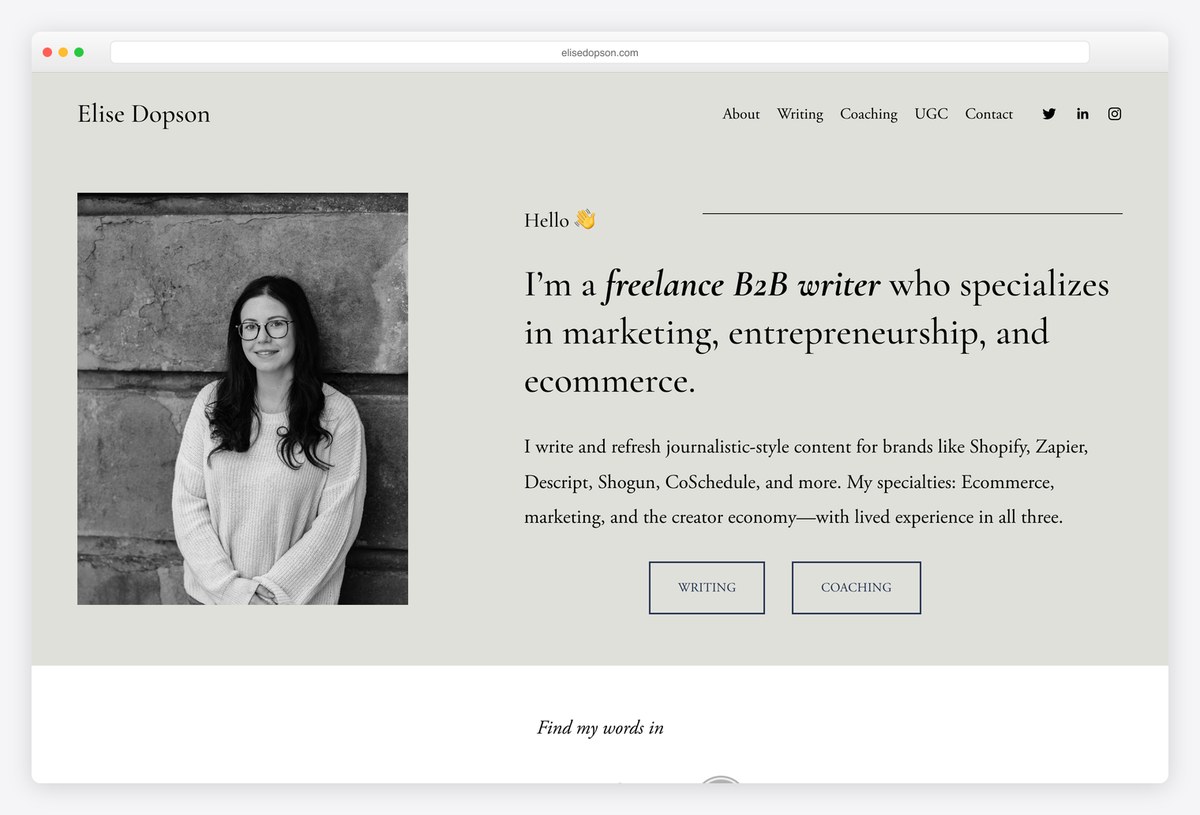
Elise Dopson writes journalistic B2B content for commerce and martech brands, and her Writing page groups samples by topic: Ecommerce, retail + DTC, Creators + entrepreneurship, and Marketing. Each title is labelled with the client, such as for Shopify Plus or for Content Marketing Institute, and links to the live article.
The contact form deals with price before the first reply. It asks for a monthly content budget, from $1,500 – $3,000 upwards, and states that her rates start at $1/word. Named testimonials from content managers at Shopify and Uscreen sit on the homepage.
What stands out: Put your starting rate on the contact form.
11. Brian Jenner
Built with: WordPress
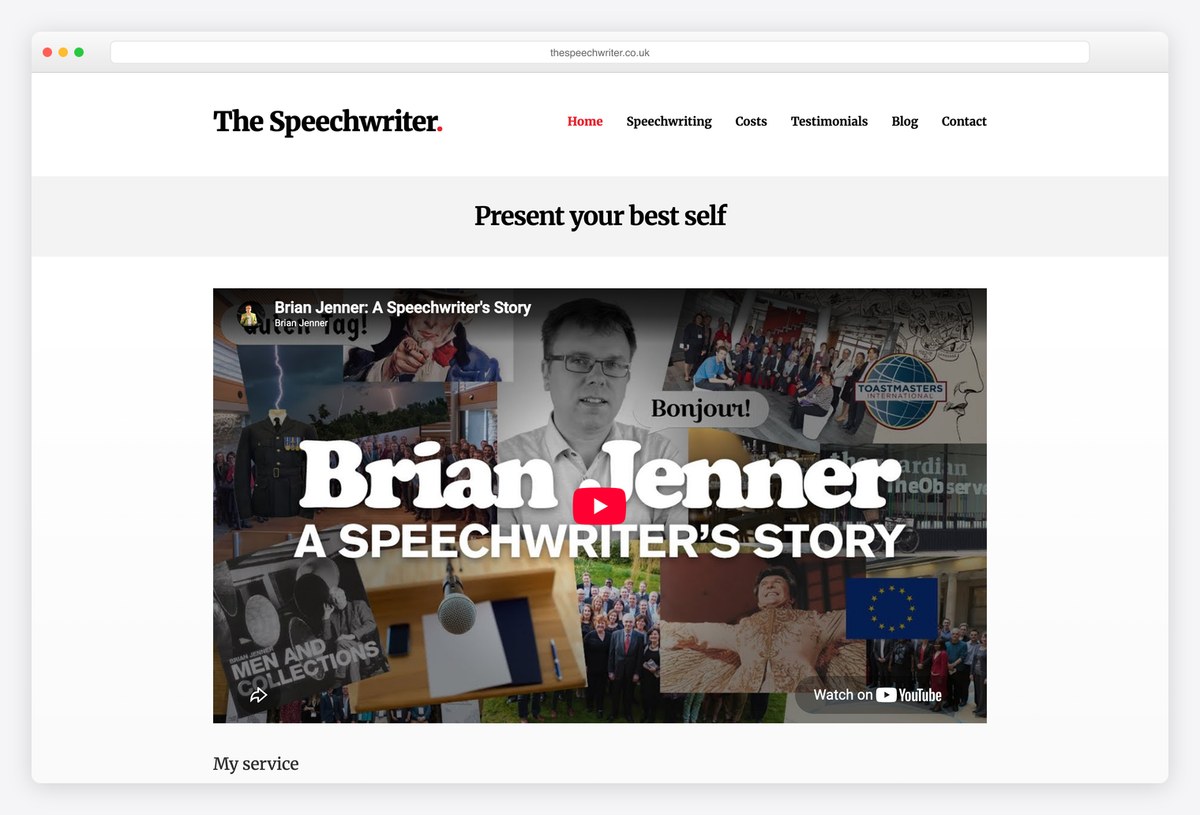
Brian Jenner is a UK speechwriter, and because speechwriting is confidential, his portfolio is a page of anonymised jobs with prices. Its prices run from keynotes for a FTSE 100 chairman down to hourly rewriting and wedding and birthday speeches.
Each job is described in a few sentences, such as warning a groom that his 45-minute thank-you speech risked cutting into the band’s set, so a client sees the judgment involved without seeing the speech. He also runs the UK Speechwriters’ Guild.
What stands out: Describe confidential jobs without naming the client.
12. Eric R Stone
Built with: Webflow
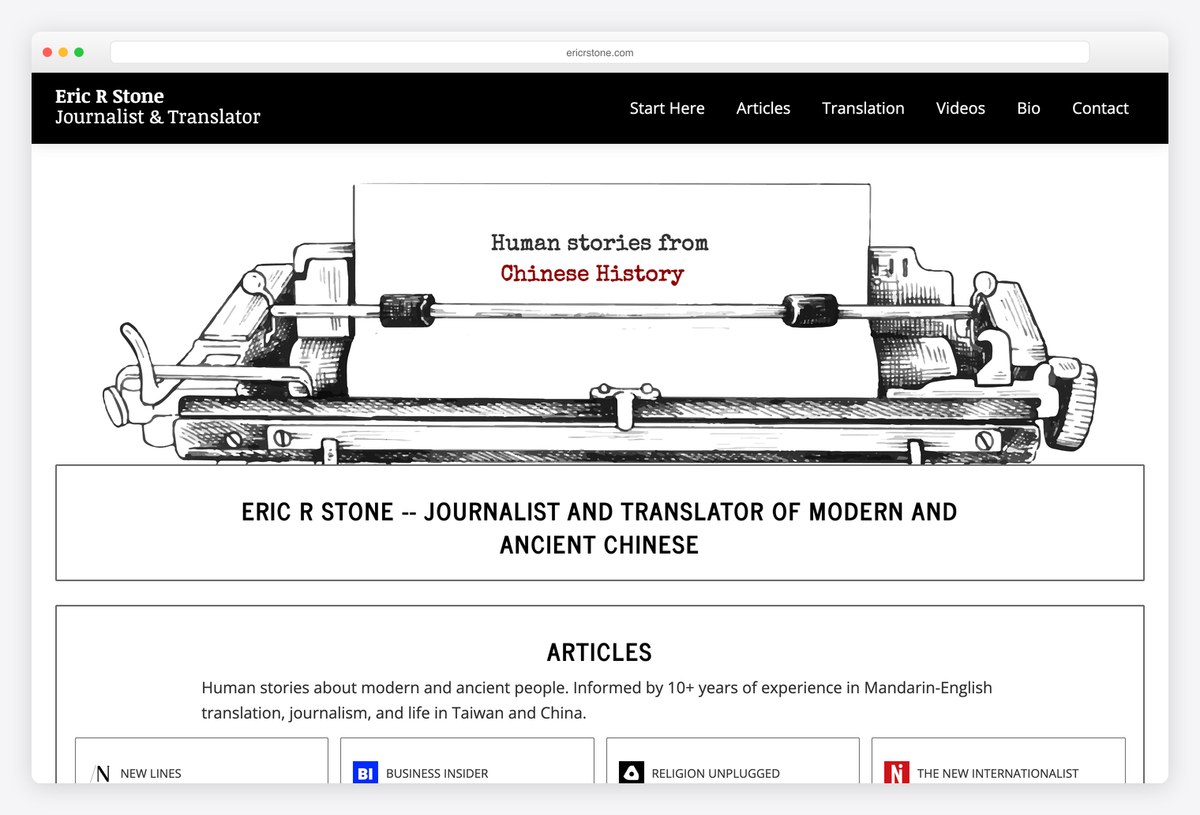
Eric R Stone is an American journalist and translator based in Taiwan, and his homepage carries two businesses without muddling them. Articles come first, as cards with the outlet and date, and translation follows with testimonials from clients in Singapore, Taiwan and Ukraine.
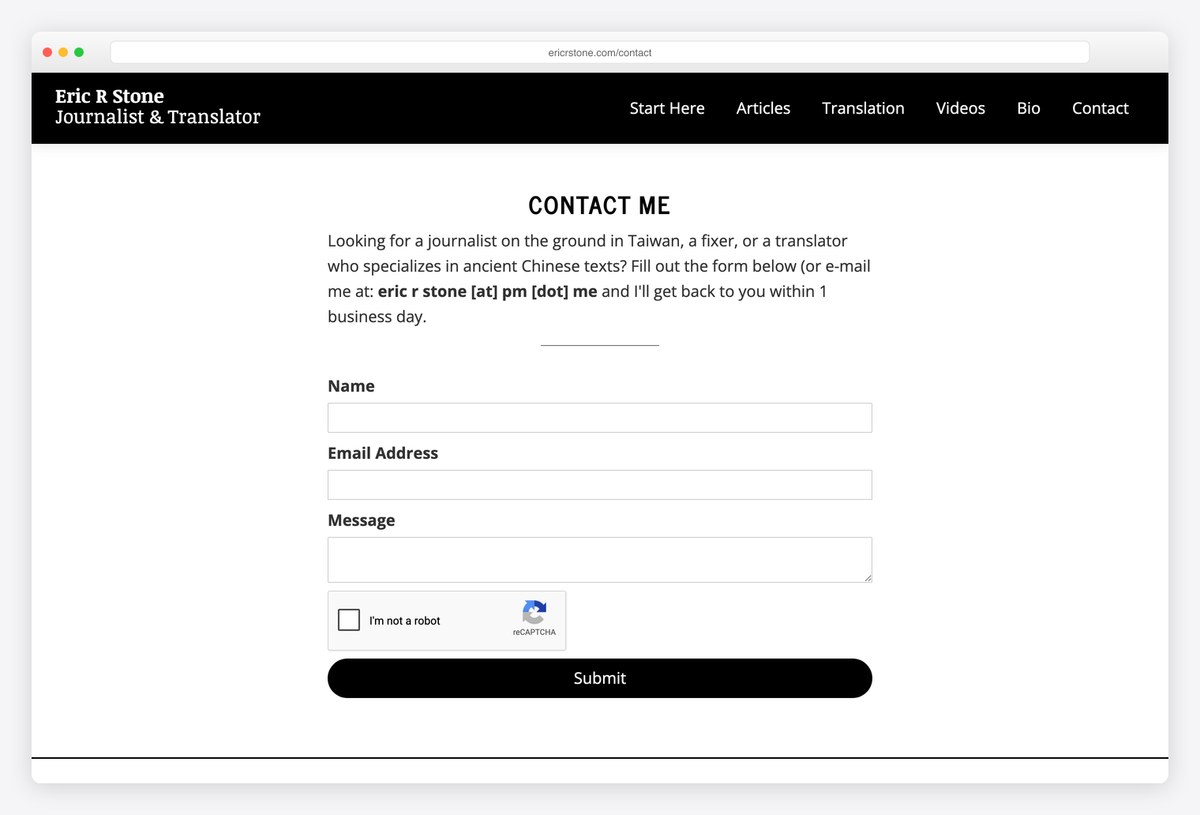
The contact page is written for three kinds of buyer: an editor who needs a journalist on the ground in Taiwan, a production that needs a fixer, and anyone with ancient Chinese texts to translate. It promises a reply within one business day.
What stands out: Tell each type of client how to hire you.
13. Emily Stevens
Built with: Custom code (Netlify)
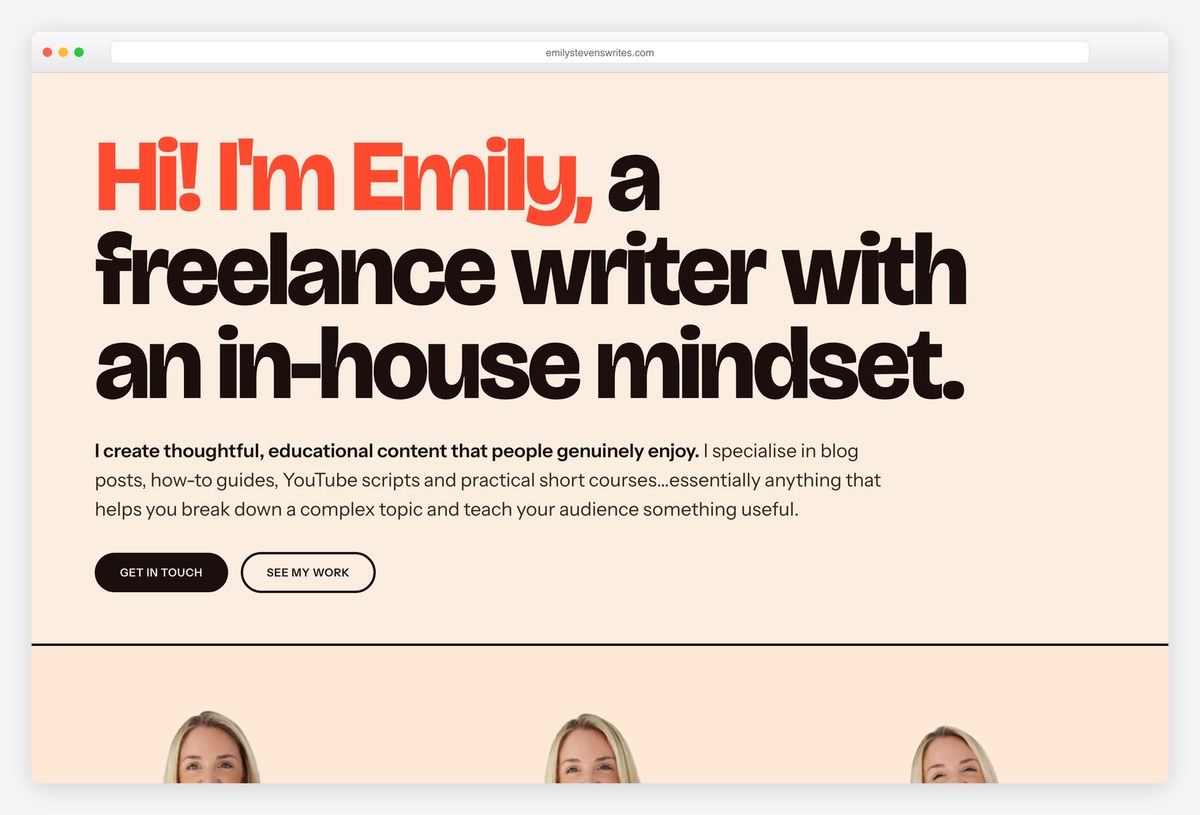
Emily Stevens is a Berlin-based writer of educational content, and her portfolio opens with three case studies before any article links. The first explains how she grew the CareerFoundry blog from 60k to 400k monthly organic visits as its managing editor, which tells a content lead she understands their job.
Below that, each client gets a sentence of context and a list of selected articles linking to the live pieces, from AND Academy’s design guides to Babbel for Business. Her homepage story explains the switch from hiring freelance writers to being one.
What stands out: Open with case studies, then link the articles.
14. Zina Kumok
Built with: Squarespace
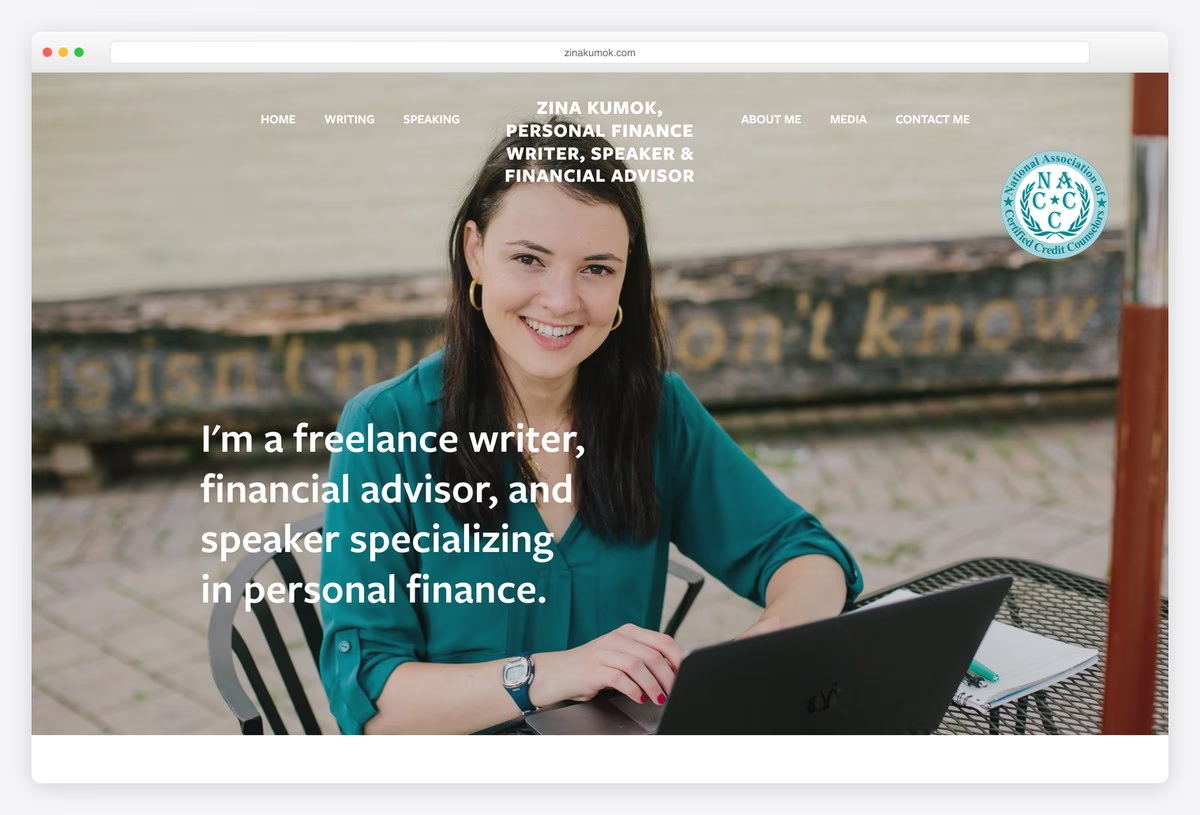
Zina Kumok is a personal finance writer who is also a licensed financial advisor, and she puts that credential in the first line of her homepage. Her portfolio is sorted by money topic, from retirement to credit scores, with the publication named before each headline, such as Forbes Advisor, CBS News or Slate.
Speaking testimonials from universities and newsrooms back up her third line of work. The contact page separates the jobs cleanly: blog posts, ghostwritten articles and editing go to one address, and enquiries about financial advice go to her firm.
What stands out: Lead with the credential that makes your niche writing credible.
15. Karen Rempel
Built with: WordPress
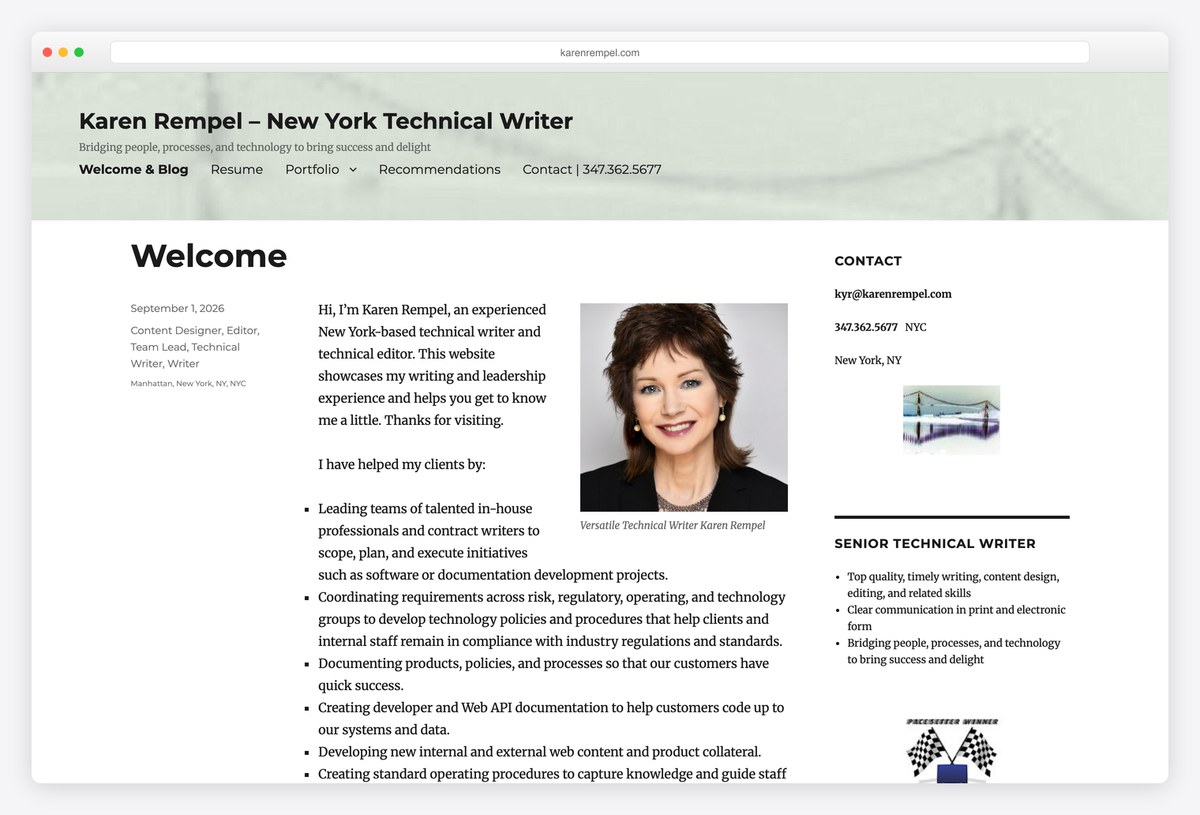
Karen Rempel is a New York technical writer and team lead, and her Portfolio menu is organised by document type: developer documentation, knowledge base, online help, SOPs, software documentation and web API documentation. Each project names the tools used, from Markdown and Confluence Wiki to FrameMaker.
Samples come with outcomes, such as documentation that supported over 1,900 banking staff through a new banking system and a help set of over 20,000 files. Her Recommendations page lists her role on each engagement above the client’s quote.
What stands out: Sort samples by document type, the way job ads are written.
16. Sarah R Kessler
Built with: Google Sites
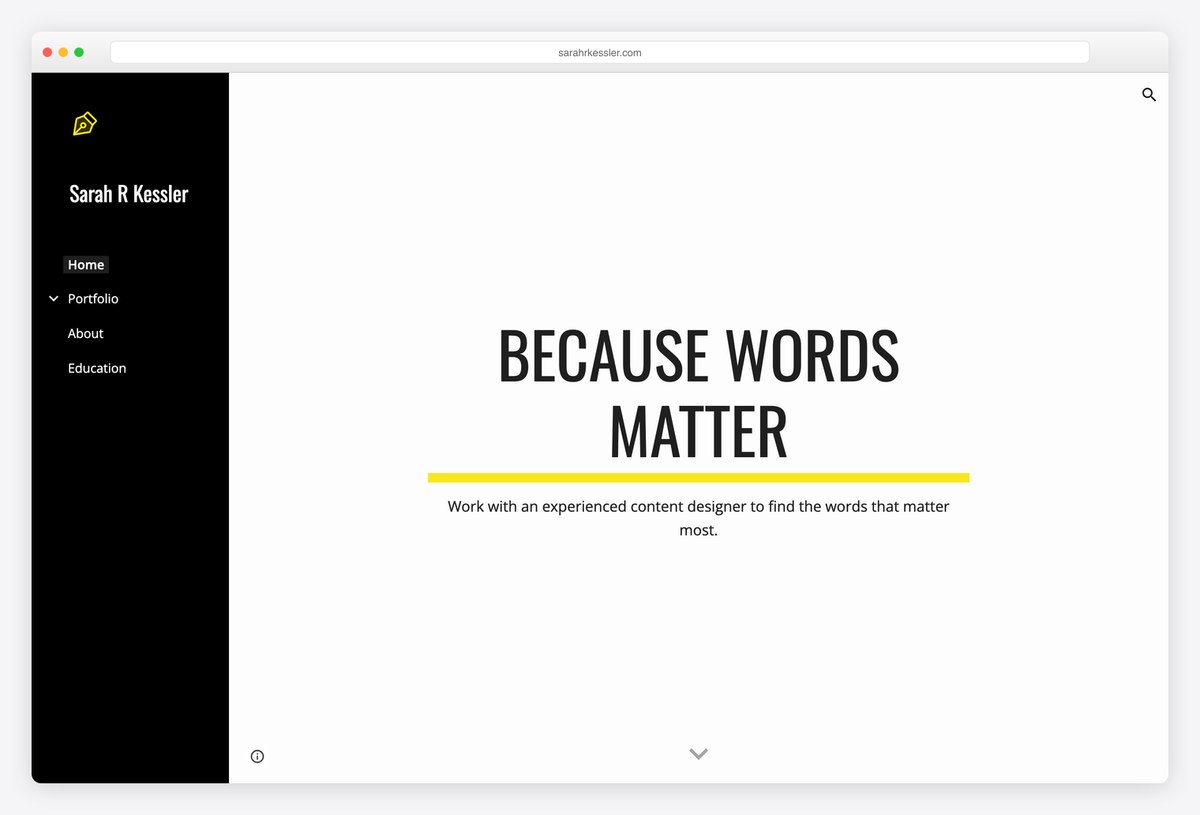
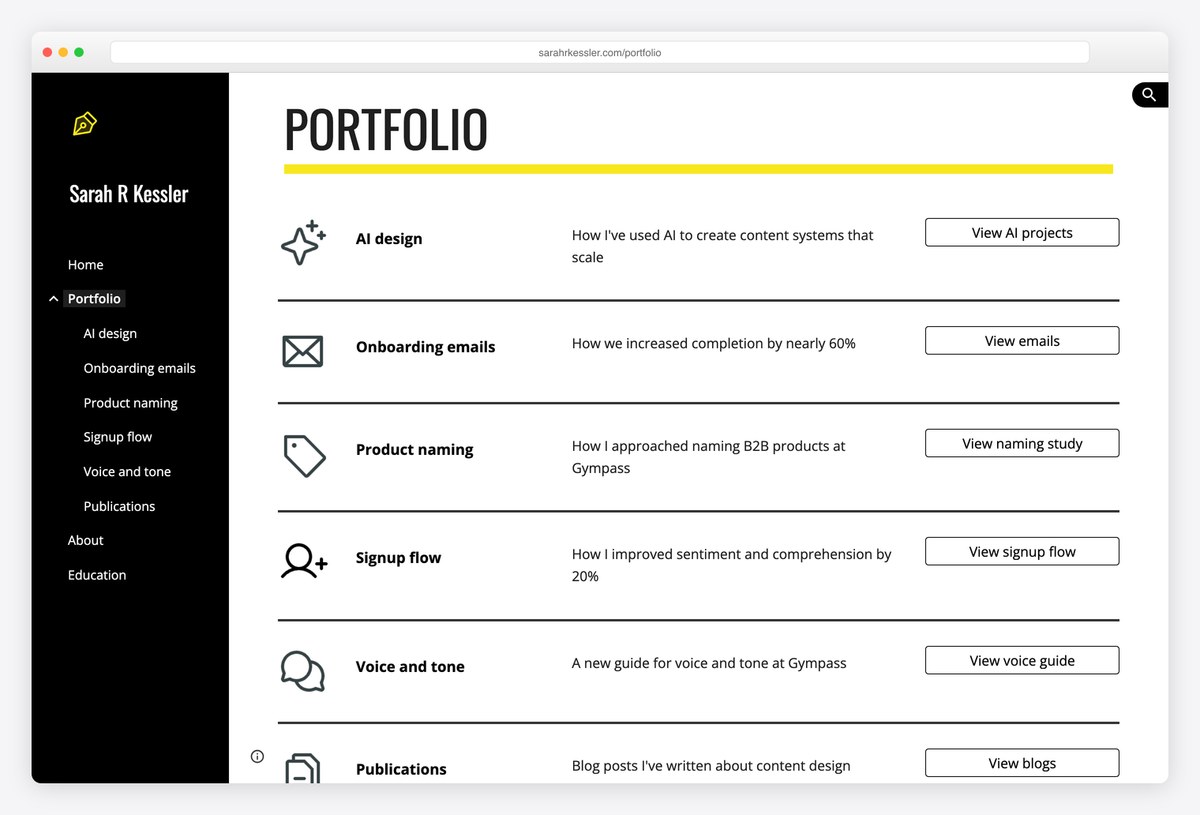
Sarah R Kessler is a senior content designer in New York City, and her portfolio shows that a free builder is enough when the case studies are strong. It runs on Google Sites and lists a work history from freelance UX writing to Senior Content Designer at Justworks.
Each case study is titled with its result, such as onboarding emails that increased completion by nearly 60% and a signup flow that improved sentiment and comprehension by 20%. Testimonials come from a manager, a teammate and a mentee from her UX writing mentoring.
What stands out: Put the result in the case study’s title.
17. Niki Wanner
Built with: Squarespace
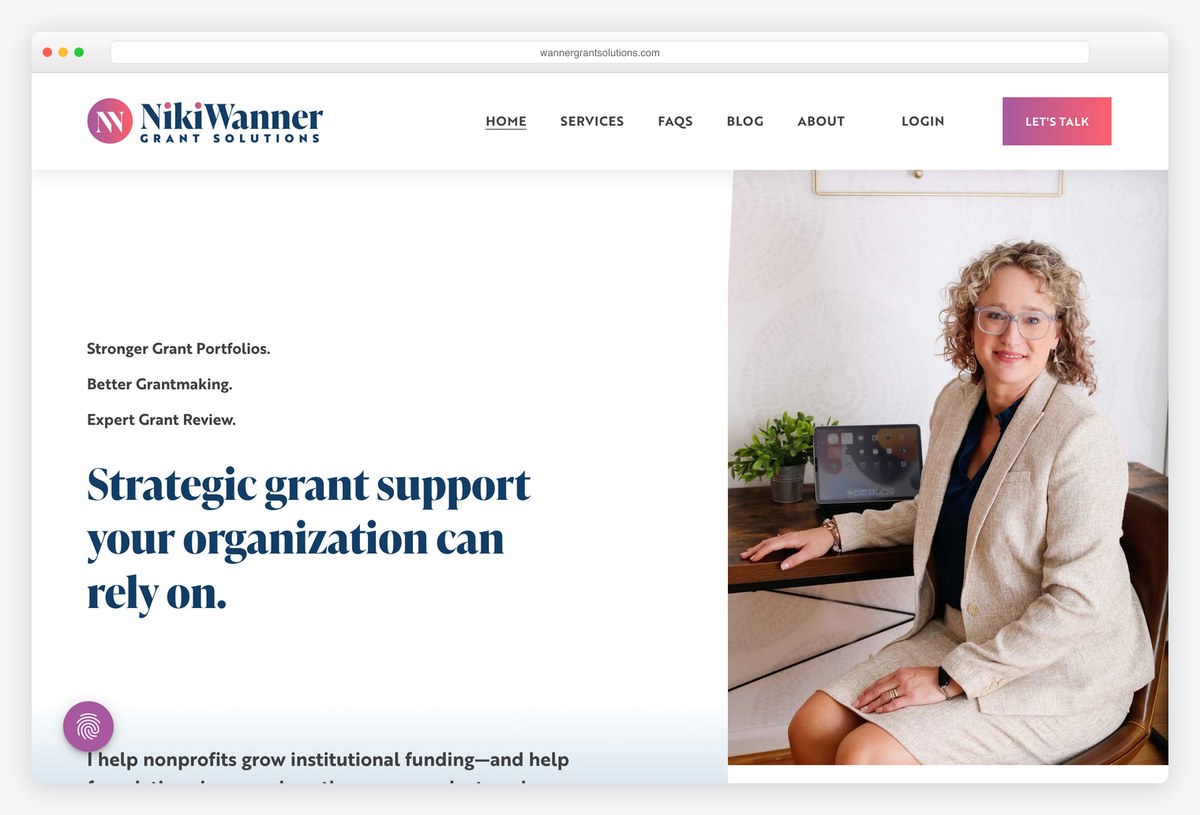
Niki Wanner is a grant writer and consultant, and her homepage says who she works with: nonprofits operating for three or more years, with a budget of $5M or more and at least $500k in grants already secured. That filter saves both sides a wasted call.
Instead of samples, which grant proposals rarely allow, a carousel highlights grants won, and services split into foundation grants, government grants, proposal review and funder research. She also helps foundations improve how they assess and support grantees.
What stands out: State your minimum client size up front.
18. Lizzie Davey
Built with: Weebly
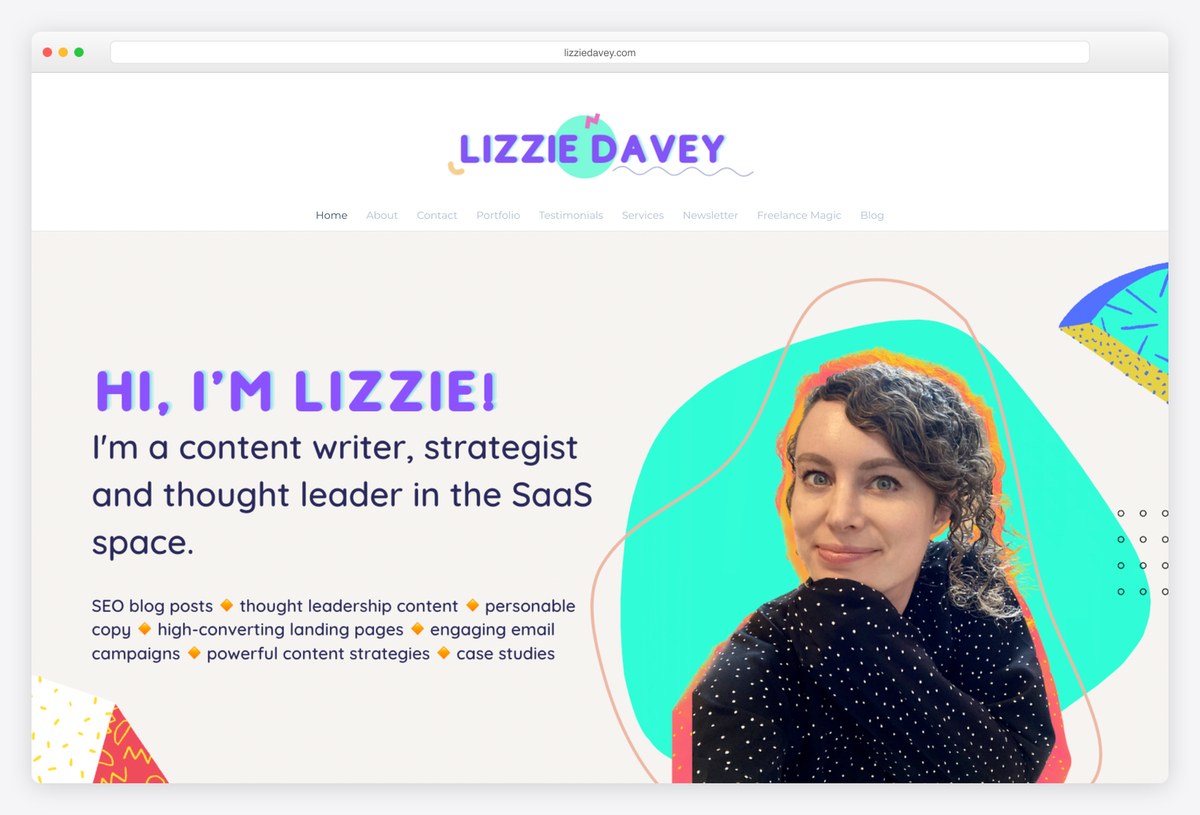
Lizzie Davey is a SaaS and ecommerce content writer in Brighton. Her portfolio headlines are grouped by topic, each followed by the client in brackets, such as Shopify, Klaviyo or Omniscient Digital, and linked to the live article.
Separate sections cover content refreshes and strategy results, including a MightyScout project where she managed a team of 4 writers and editors. Her service pages give prices, from £600 + VAT for content to £5,500 for a one-month strategy, and warn that she has only 1-2 openings for new clients each quarter.
What stands out: Say how many new clients you can take on.
19. Jana Cholakovska
Built with: Squarespace
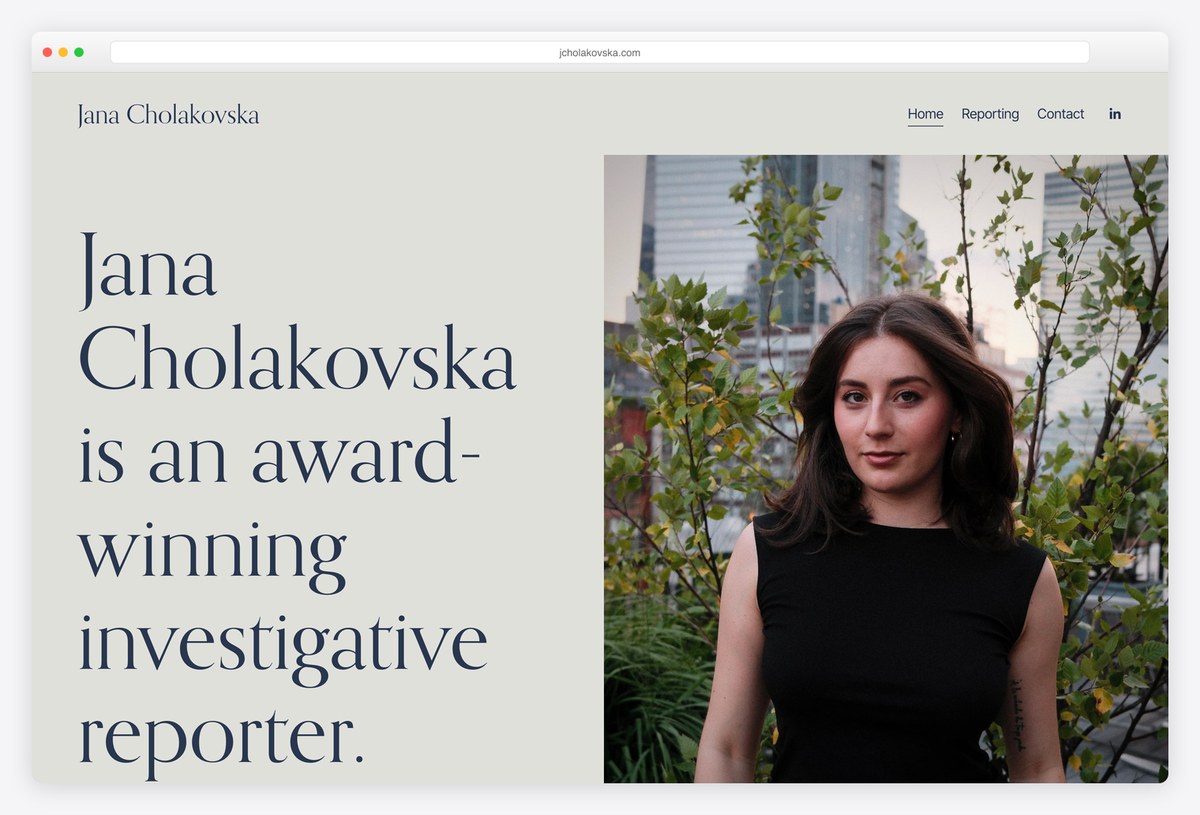
Jana Cholakovska is an investigative reporter at NJ.com, and her site is built for sources as much as for editors. The homepage lists her awards and ends with a tip line: an email address and a Signal handle for end-to-end encrypted contact.
The Clips page is a plain list of headlines in quotation marks, each with its date and a link, running from her current NJ.com investigations back to work for Grist and Public Health Watch. Three pages is enough for a staff reporter who needs credibility, not a services page.
What stands out: Give sources a safe way to reach you.
20. Jennifer Goforth Gregory
Built with: WordPress
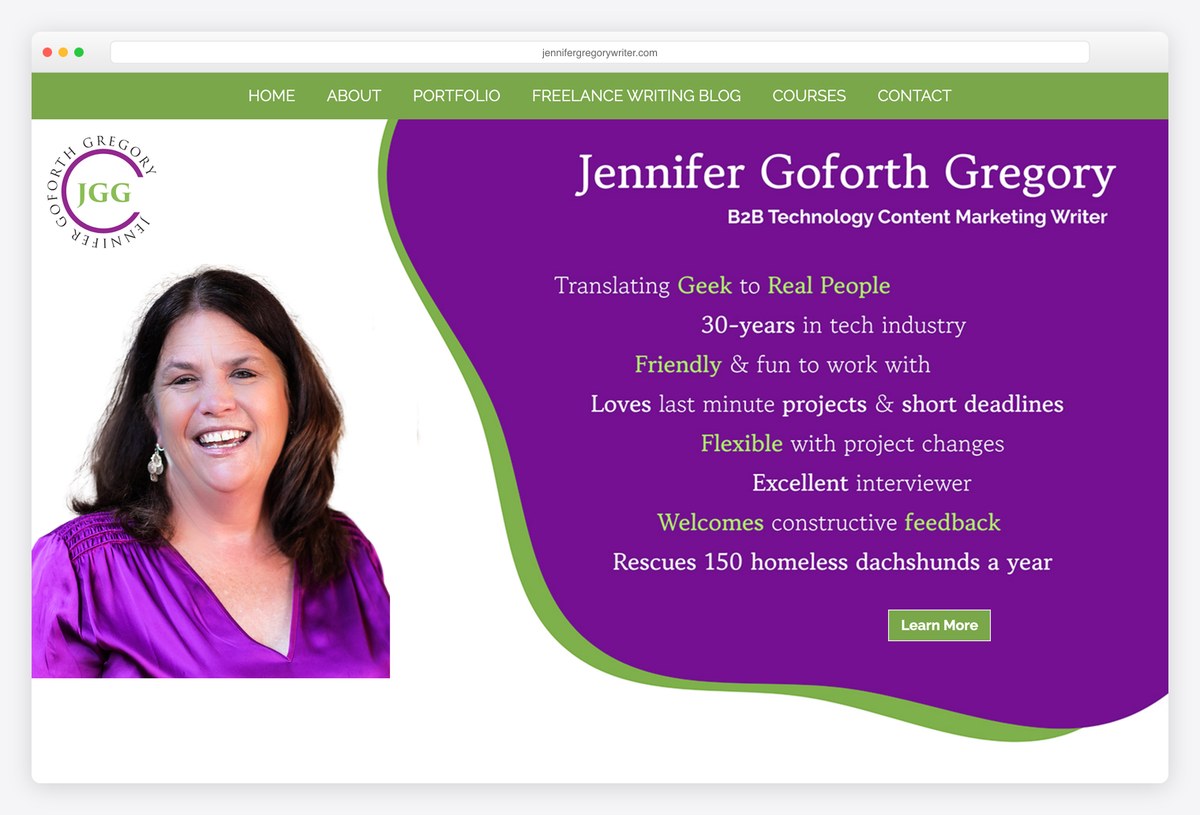
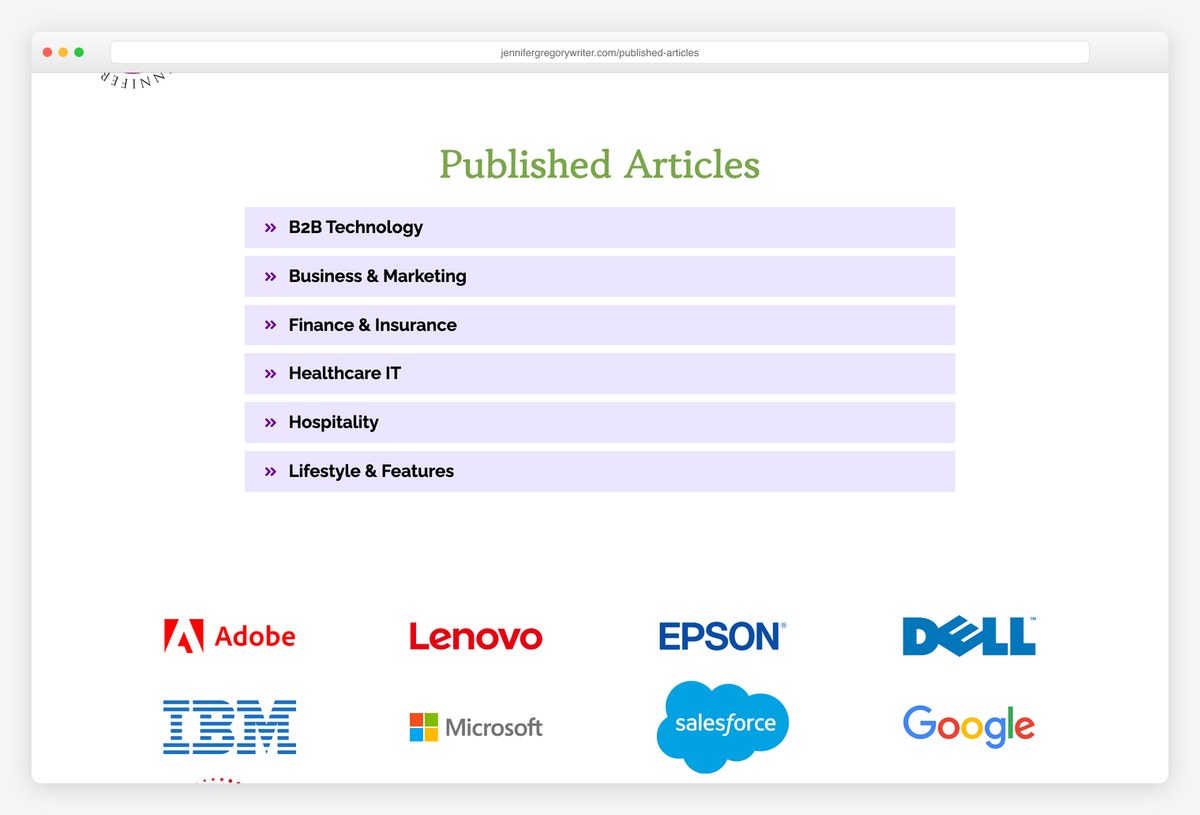
Jennifer Goforth Gregory writes B2B technology content from Raleigh, and her Published Articles page is sorted by industry: B2B Technology, Business & Marketing, Finance & Insurance, Healthcare IT, Hospitality, and Lifestyle & Features. Each tab links straight to the live pieces on client sites, from IBM to Nutanix.
The homepage testimonial from an Industry Dive content manager highlights a skill buyers rarely see in a portfolio: she conducts the high-profile expert interviews, and clients often request her by name. Her About page adds a master’s degree in technical writing.
What stands out: Organise samples by the industries you want to write for.
21. Kayla Voigt
Built with: Squarespace
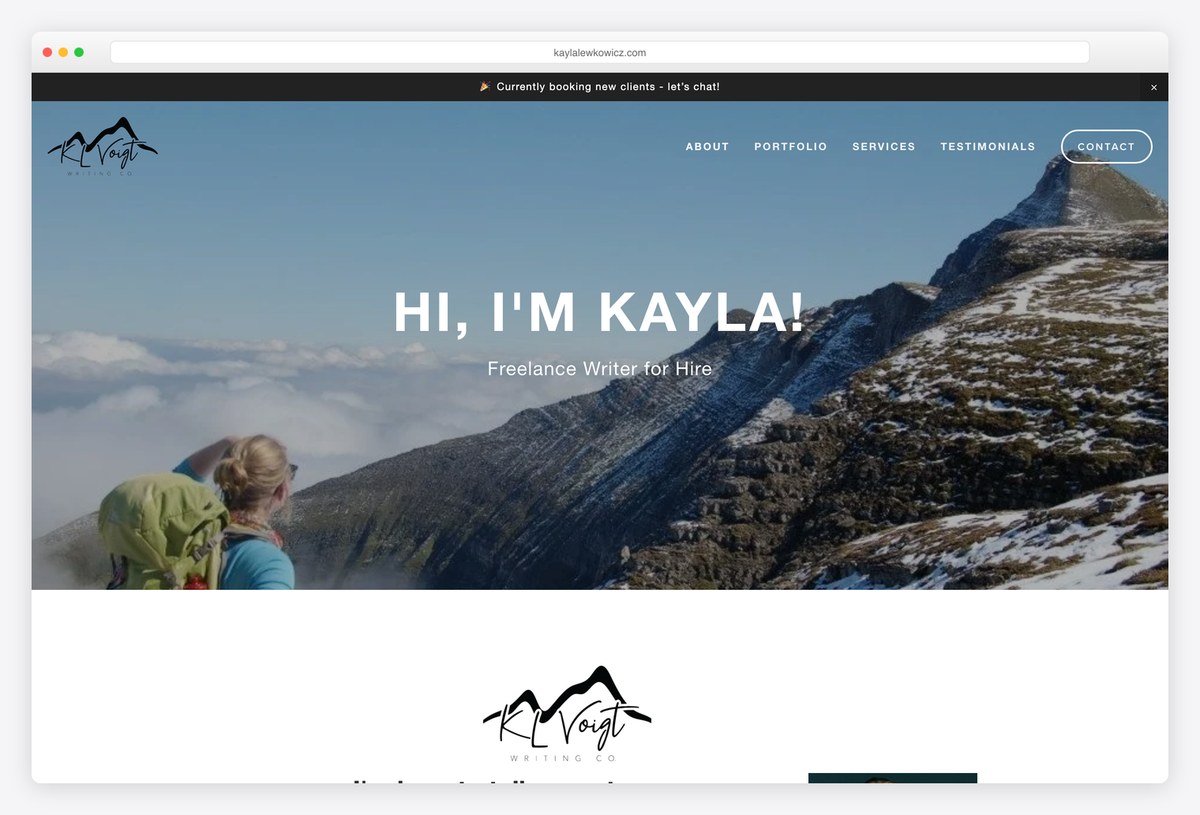
Kayla Voigt writes travel, food and B2B content as KL Voigt Writing Co., and her portfolio opens with jump links to its three sections. Every featured sample has a headline, a one-line summary and the publication, such as USA Today, Fodor’s or The Kitchn, so an editor can skim one niche in seconds.
A banner on every page says she is currently booking new clients. Her Services page separates reporting on assignment from ghostwriting for executives at B2B brands, and the portfolio links to Travel with Toddlers, her toddler-focused travel Substack.
What stands out: Use jump links when you write in more than one niche.
22. Freddie Braun
Built with: Wix
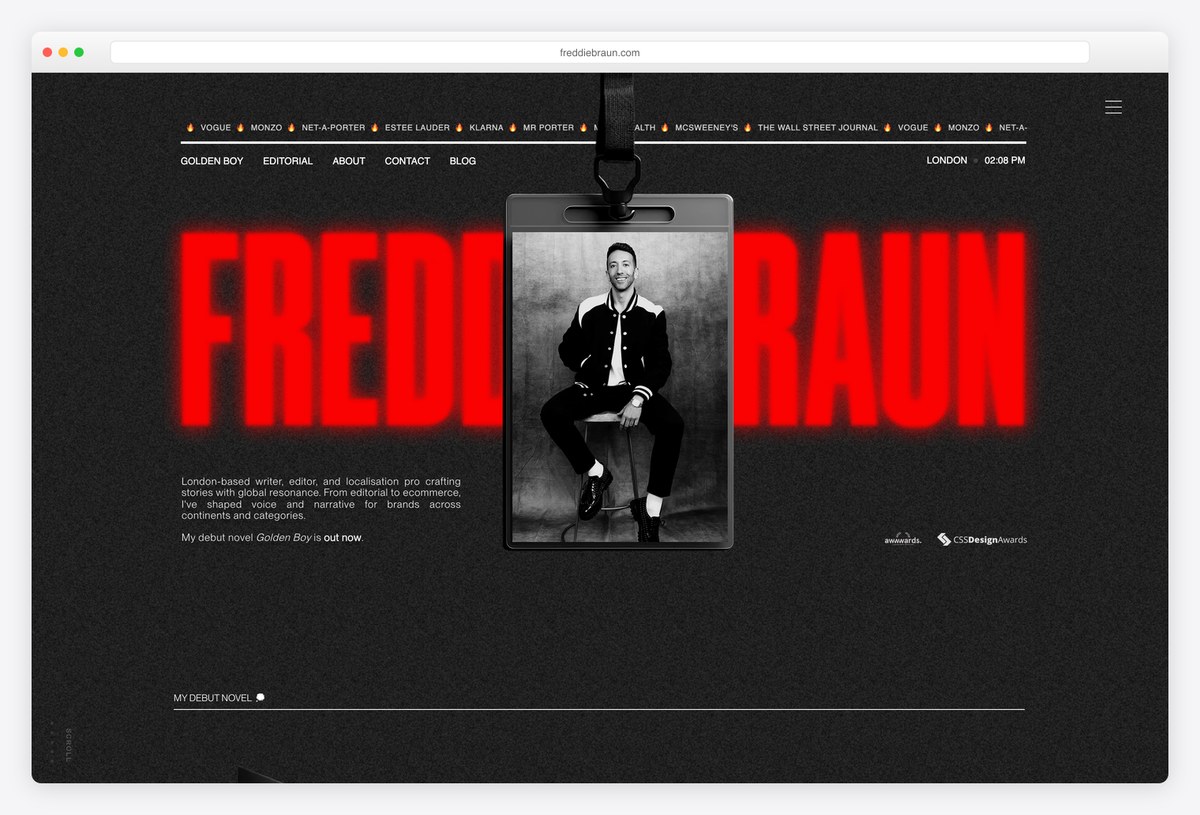
Freddie Braun is a London-based writer, editor and localisation specialist, and his portfolio sorts editorial work into sections, from Vogue interviews to travel for Net-A-Porter’s PorterEdit and satire for McSweeney’s Internet Tendency. An Adaptation section covers his work as German chief sub editor at Net-A-Porter.
Testimonials are labelled by brand rather than by person, Net-A-Porter, Condé Nast and Klarna, and the homepage promotes his debut novel, Golden Boy. It opens on a dark, animated hero with his name in red, a bold choice for a writer who also leads creative copy.
What stands out: Give translation or localisation work its own section.
What Makes a Great Content Writer Portfolio Website?
Show the published piece and name the client. Elise Dopson labels every sample with the brand it was written for, Lizzie Davey puts the client in brackets after each headline, and Paul Maplesden groups samples by client and topic. A link to the live article on the client’s own site is stronger than a PDF, and Jen A. Miller and Douglas Fox add the date, which tells an editor the writer is working now.
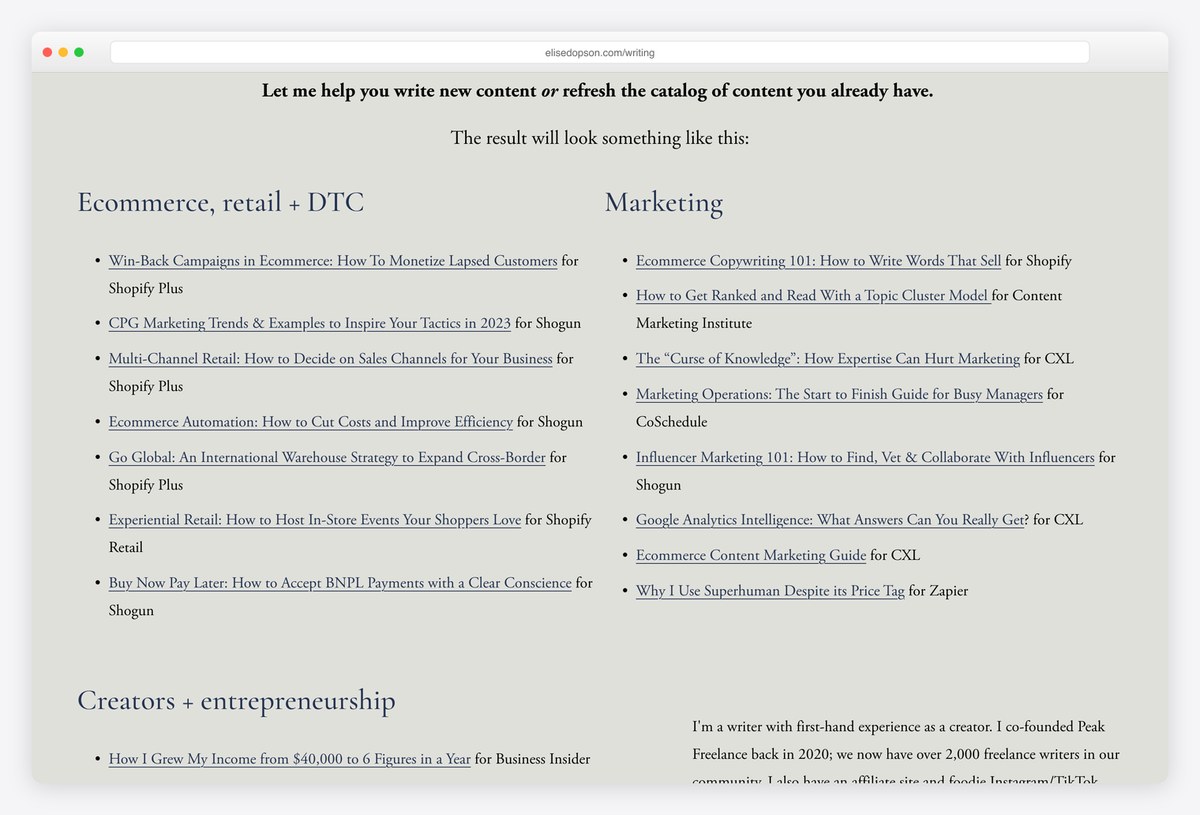
Organise samples the way the buyer searches. Jennifer Goforth Gregory sorts by industry, Zina Kumok by money topic, Karen Rempel by document type, Rachel Pascal by format and Jen A. Miller by market. Kayla Voigt adds jump links for her three niches. Nobody hiring a writer searches by date of publication alone.
Prove results where you can. Nathan Ojaokomo shows where each article ranks on Google and which AI tools cite it, Christian De Pape and Sarah R Kessler put the result in the case study itself, and Emily Stevens opens with a blog she grew as managing editor. A named client shows someone paid for the work; a result shows it worked.
Handle confidential work openly. Belinda Roozemond labels ghostwritten samples, Rachel Pascal lists the kinds of work she cannot show, Brian Jenner describes anonymised speechwriting jobs with prices, and Hilary Liftin lets publishers vouch for books that carry other people’s names. Niki Wanner shows grants won instead of proposals.
Answer the price question the way your buyers shop. Paul Maplesden, Belinda Roozemond, Lizzie Davey, Nathan Ojaokomo and Brian Jenner publish starting prices, and Elise Dopson’s contact form asks for a monthly budget. Niki Wanner states the minimum size of client she takes. Journalists and staff writers usually skip prices entirely, which is fine when an editor sets the fee.
Give every kind of enquiry a route. Zina Kumok separates writing from financial advice, Eric R Stone addresses editors, fixers and translation clients on one contact page, Hilary Liftin names her agent, and Jana Cholakovska gives sources a Signal handle. Lizzie Davey and Nathan Ojaokomo also say whether they have room for new clients.
Choose a platform you will keep updated. Squarespace was the most common platform among these 22 portfolios (8), followed by WordPress (6), with others on custom-coded sites, Next.js, Docusaurus, Webflow, Weebly, Wix and Google Sites. Sarah R Kessler’s Google Sites portfolio is as convincing as any, because the case studies carry it.
Check the basics, including the domain. Of the 19 sites in the previous version of this list, one domain now redirects to a Shopify design studio, another to a placeholder site still showing Lorem ipsum, one returns an error, and one is a coming-soon page. Among new candidates we found a writer’s domain taken over by a gambling site, builder sites whose domains no longer connect, password-protected portfolios, and menu links that lead to error or under-construction pages.
Frequently Asked Questions
What should a content writer portfolio include?
Your best published samples, each labelled with the client and linked to the live piece, grouped the way buyers search, by industry, topic or format. Add a one-line statement of who you write for, a short about page, testimonials with names and job titles, and a clear contact route. Starting prices and availability help, as the portfolios above show.
How do I build a writing portfolio with no clients?
Write the pieces you want to be hired for and publish them where they can be linked: guest posts on industry blogs, your own site, or a newsletter. Nathan Ojaokomo describes starting with guest posts to build bylines before paid work followed. Label self-published samples honestly, keep them in your target niche and replace them as paid work arrives.
How many writing samples should a portfolio have?
Enough to show range within the work you want, and no more than a buyer will scan. Several portfolios above feature a handful of pieces per topic and keep a longer archive on a separate page, as Douglas Fox and Jen A. Miller do. A few strong, relevant, recent samples beat a long list of old ones.
What is the best platform for a writer portfolio?
Squarespace is the most common platform among the 22 portfolios above, followed by WordPress, with others on custom-coded sites, Next.js, Docusaurus, Webflow, Weebly, Wix and Google Sites. Pick one you will keep updating that makes linking to published work easy. A technical writer can go further and build the portfolio as a documentation site, as Ina Ciobanu does.
Should writers show their rates on their portfolio?
Publishing a starting price filters out mismatched enquiries. Paul Maplesden, Belinda Roozemond and Lizzie Davey list prices by format, and Elise Dopson asks for a monthly budget on her contact form. If your work varies too much to price, state your minimum project size or client type instead, as Niki Wanner does.
How do I show ghostwritten or NDA-protected work?
Ask clients whether you can list the work, then label it clearly. Belinda Roozemond marks samples as ghostwritten, Rachel Pascal lists the types of work she cannot share, and Brian Jenner describes anonymised jobs without naming clients. Testimonials from the people who hired you, as on Hilary Liftin’s site, vouch for work that carries someone else’s name.
Wrapping Up
Editors and marketing managers give a writer’s portfolio a minute at most, and the strongest sites above spend it well: live samples with the client named, grouped the way the buyer searches, proof of results where it exists, and a clear route to hire, with a price when the writer can give one.
For more inspiration, see our best portfolio website examples, copywriter websites and UX portfolio examples. Ready to build your own? Start from our writer website templates, a Squarespace writer template, one of our portfolio website templates or a free portfolio website builder.
Browse the other Creative & portfolio website examples (27 more collections), or see website examples for every industry.

Related Posts
Comments (0)