Digilab
Template Details
Author: Colorlib
Updated: October 2026 · v3.0.1
Credits: Images from Unsplash
Description
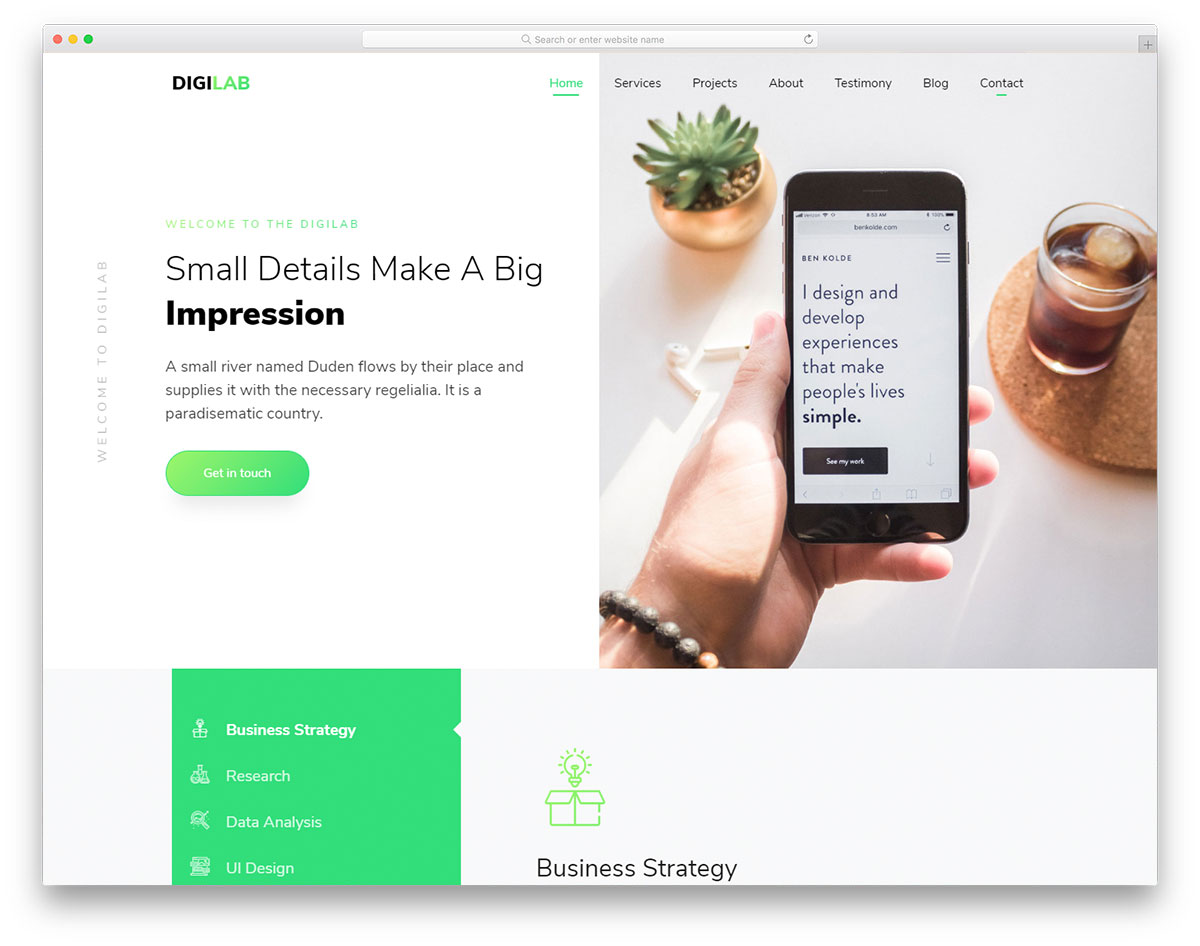
Digilab is a modern, responsive one-page agency website template built on Bootstrap 5. It welcomes your guests with a split-screen slider you can use to showcase your services. Encourage them to take action using call-to-action buttons and score new deals. With Digilab, you create a strong first impression that helps you win over more clients.
Other Digilab features include content that reveals as you scroll, tabbed services, a projects slider, animated stats, a four-step process, partner logos, an FAQ accordion, a testimonials slider and a working contact form with a click-to-load map. You can also implement content marketing with the blog section and its blog post page to drive more traffic. Digilab’s one-page layout lets you present your agency clearly, and it works just as well for a one-person studio.
What’s new in 3.0
- The Sass source ships (the 2.0 download had only Bootstrap’s test files), with the brand colours in one variables file, and npm run build (Dart Sass and esbuild) compiles one minified stylesheet and one script, with Bootstrap trimmed to the parts the pages use. Swiper 14 replaces Swiper 12 on the three sliders, small built-in modules run the scroll reveals and counters, and GLightbox and AOS, which loaded but did nothing, are gone.
- Lighter pages: the home page went from 3.2 MB and 40 requests to 1.2 MB and 31 requests, and the blog post from 1.9 MB and 24 requests to 586 KB and 14 requests. Every photo and background has an AVIF version with the JPG as the fallback (2.0 had AVIF only on the blog cards), with real dimensions and lazy loading, the full-screen preloader is gone, and the download went from 4.7 MB to 3.0 MB.
- No third-party requests: Nunito Sans is self-hosted, the icomoon and Flaticon fonts are replaced by Lucide SVG icons and a 1.2 KB social-logo subset, and the contact map (OpenStreetMap, no API key) loads only when the visitor clicks Show map. The analytics scripts that loaded on both pages are now a commented-out snippet.
- Working forms: the contact and comment forms send through includes/send-email.php, with validation, a spam trap and a status message. Before, the forms had no handler.
- Accessibility: a skip link that works on both pages (2.0’s pointed at a missing target), one h1 per page, names on icon-only links, labelled form fields, a visible focus ring and WCAG AA text contrast, with dark text on the bright green buttons and surfaces.
- Fixed: the “Ux Design” tab opened the UI Design pane, the home page scrolled sideways on tablets, the blog post’s article could stay invisible after load, the comment form rows touched, and the breadcrumb linked to a page that did not exist.
- Ten demo photos that showed brand logos or a real designer’s website are replaced, the partner section shows fictional wordmarks instead of grey placeholder boxes, the testimonials no longer show the same name on all five cards, and the address is fictional.
Pricing Digilab
Single
$19
- Premium support
- Template updates
- For 1 year
- Access all templates
Membership
$129
- Premium support
- Template updates
- For 1 year
- For 1 year
Lifetime
$349
- Premium support
- Template updates
- For life
- For life
Similar Templates