12 Best Free Photoshop Alternatives (Affinity Is Now Free!) 2026
Adobe Photoshop costs $22.99/month ($275/year) — and for the first time, there are free alternatives that genuinely match its capabilities. The biggest shift: Affinity is now completely free. Canva acquired Serif (Affinity’s developer) in 2024, and in October 2025 it relaunched Photo, Designer and Publisher as one free all-in-one Affinity app. Affinity Photo was already considered the best Photoshop alternative — now it costs nothing. Combined with browser-based powerhouses like Photopea that can open PSD files natively, the case for paying Adobe’s subscription has never been weaker. Here are 12 free Photoshop alternatives compared side-by-side.
Key Highlights
- Affinity (the all-in-one successor to Affinity Photo 2) is now free — a full professional photo editor with RAW support, layers, masks, and non-destructive editing that previously cost $70
- Photopea opens PSD, XCF, Sketch, and XD files directly in your browser — the best option when you need PSD compatibility without Photoshop
- GIMP remains the most customizable free editor, with a large plugin library and Python and Script-Fu scripting for automation
- Krita is the best free option for digital art and illustration, with brush engines that rival Photoshop’s painting tools
- RawTherapee and Darktable are both free and rival Adobe Lightroom for RAW photo processing and management
- Adobe Photoshop remains the industry standard, mainly for its Firefly generative AI, plugin ecosystem and Creative Cloud integration, but free alternatives now cover most everyday editing tasks
Free Photoshop Alternative Comparison (2026)
| Editor | Platform | RAW Support | Layers | Plugins | Price | Best For |
|---|---|---|---|---|---|---|
| Affinity (ex-Photo 2) | Win / Mac (iPad coming) | Yes | Yes (full) | Limited (macros, scripting) | Free | Full Photoshop replacement |
| Photopea | Web (browser) | Yes | Yes (full) | No | Free (ads) / $5/mo | PSD file editing |
| GIMP | Win / Mac / Linux | Via plugin | Yes (full) | Yes | Free (open source) | Maximum customization |
| Pixlr | Web + App | No | Yes | No | Free tier / $2.49/mo | AI-powered quick edits |
| Krita | Win / Mac / Linux | No | Yes (full) | Yes | Free (open source) | Digital art & painting |
| Paint.NET | Windows only | Via plugin | Yes | Yes | Free | Lightweight editing |
| RawTherapee | Win / Mac / Linux | Yes (specialist) | No | No | Free (open source) | RAW processing |
| Darktable | Win / Mac / Linux | Yes (specialist) | No | Yes (Lua scripts) | Free (open source) | Photo management + RAW |
| Sumo Paint | Web (browser) | No | Yes | No | Free (ads) / $4/mo | Basic browser editing |
| Polarr | Win / Mac / iOS / Android / Web | Yes | Limited | No | Free tier / $3.99/mo (yearly) | Filters & adjustments |
| Canva Photo Editor | Web | No | Limited | No | Free tier / $15/mo | Simple edits + templates |
| Fotor | Web + Desktop | No | Limited | No | Free tier / $3.33/mo (yearly) | Quick one-click edits |
1. Affinity (formerly Affinity Photo 2)
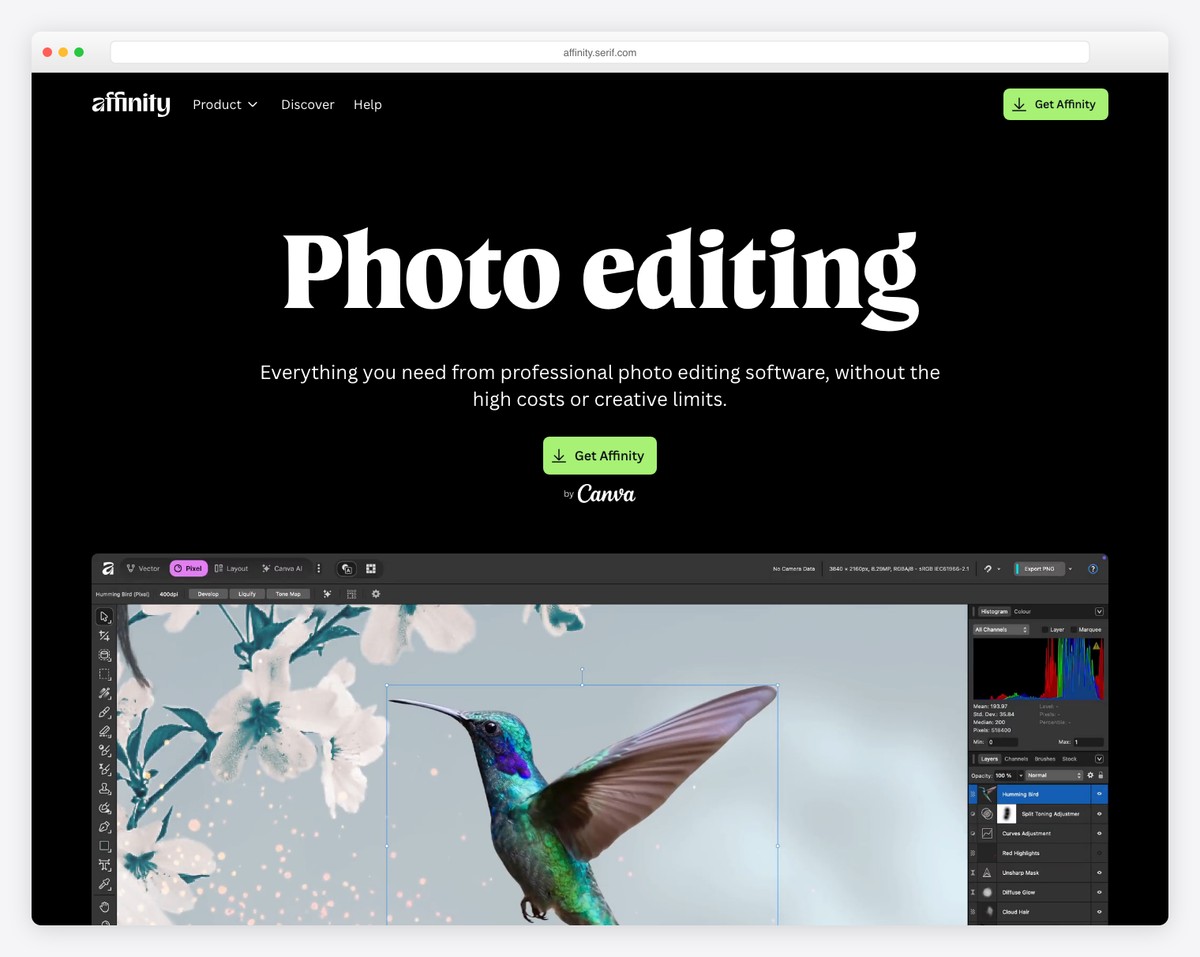
Affinity is the headline story in photo editing. When Canva acquired Serif (the company behind Affinity) in 2024, the industry expected price increases. Instead, in October 2025 Canva merged Photo, Designer and Publisher into a single app and made it completely free; you only need a free Canva account. Affinity Photo 2 was already the most respected Photoshop alternative at $70; at free, its successor fundamentally changes the competitive landscape.
The editor provides a complete professional toolkit: full layer management with blend modes, masks, and smart objects; non-destructive adjustment layers; RAW development with advanced controls; HDR merge; focus stacking; panorama stitching; frequency separation; batch processing; and 32-bit HDR editing. It supports PSD file import (with high compatibility), and its performance on complex files rivals or exceeds Photoshop’s. Available on Windows and macOS; an iPad version of the new app is listed as coming soon. Optional Canva AI tools inside Affinity require a Canva premium plan.
The only areas where Photoshop still leads are: the Content-Aware Fill and generative AI features powered by Adobe Firefly, the massive third-party plugin ecosystem, and deep integration with other Adobe Creative Cloud apps. For photographers, retouchers, compositors, and graphic designers who do not depend on Adobe’s AI features or specific Photoshop plugins, Affinity now delivers most of Photoshop’s capability at no cost. It is the most significant change in the photo editing market in a decade.
2. Photopea
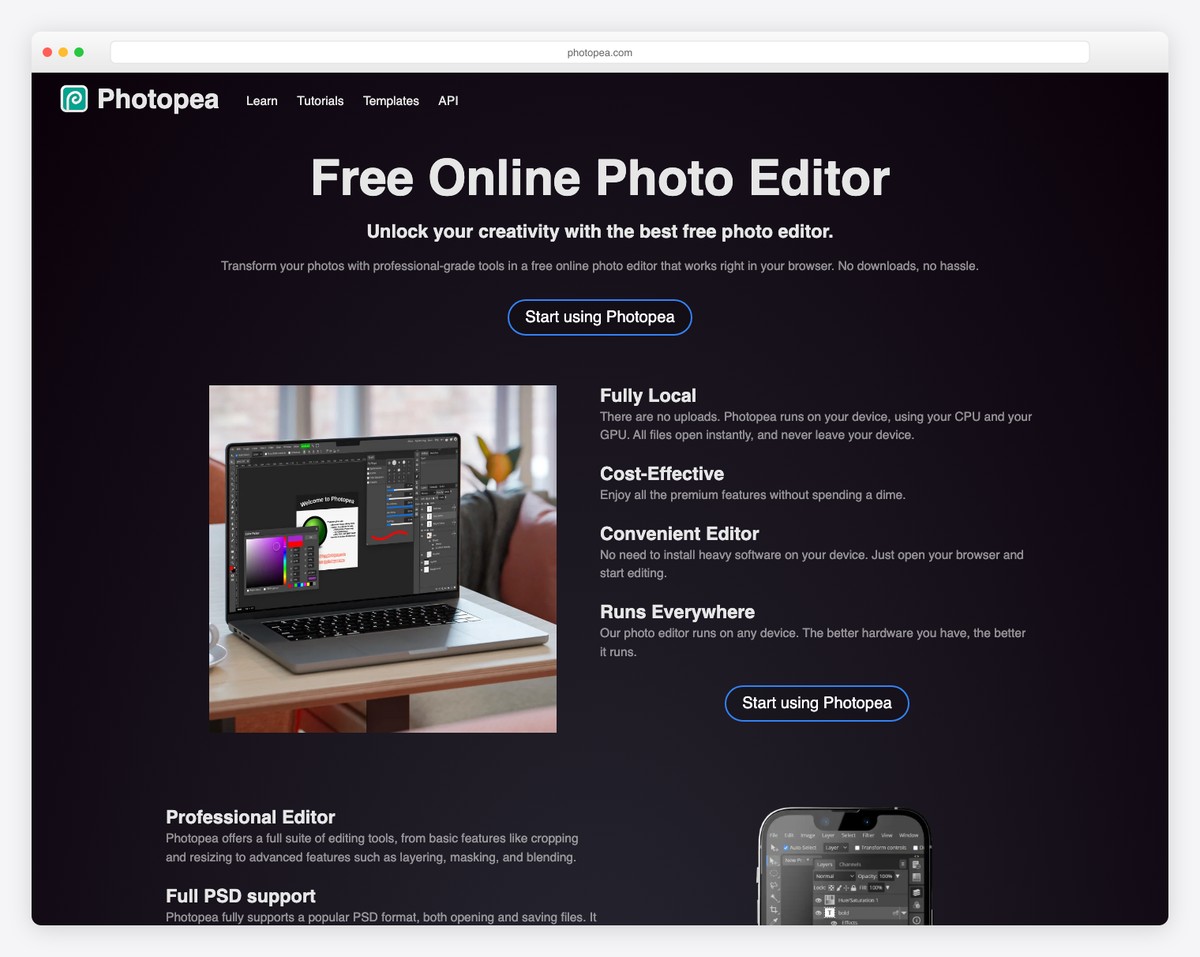
Photopea is the most capable browser-based image editor available — and its ability to open and edit PSD files natively makes it uniquely valuable. Built by a single developer (Ivan Kutskir) over more than a decade, Photopea supports layers, masks, blend modes, smart objects, adjustment layers, filters, and text — all running entirely in your browser with no installation or account required.
Beyond PSD, Photopea opens XCF (GIMP), Sketch, XD (Adobe XD), PDF, SVG, and all common raster formats. The interface deliberately mirrors Photoshop’s layout, making the transition seamless for Photoshop users. Photopea processes everything locally in your browser — files are not uploaded to any server — which addresses privacy concerns. The tool is free with ads, or $5/month to remove ads and unlock extra features.
Photopea is used by millions of people every month and handles complex PSD files with remarkable fidelity. It is the best choice when you receive a PSD file and need to edit it without installing Photoshop. Performance depends on your device and browser, and very large files (100+ layers, 500MB+) can be slow. For regular photo editing, file format compatibility, and accessibility from any device, Photopea is an essential bookmark for every designer and photographer.
3. GIMP
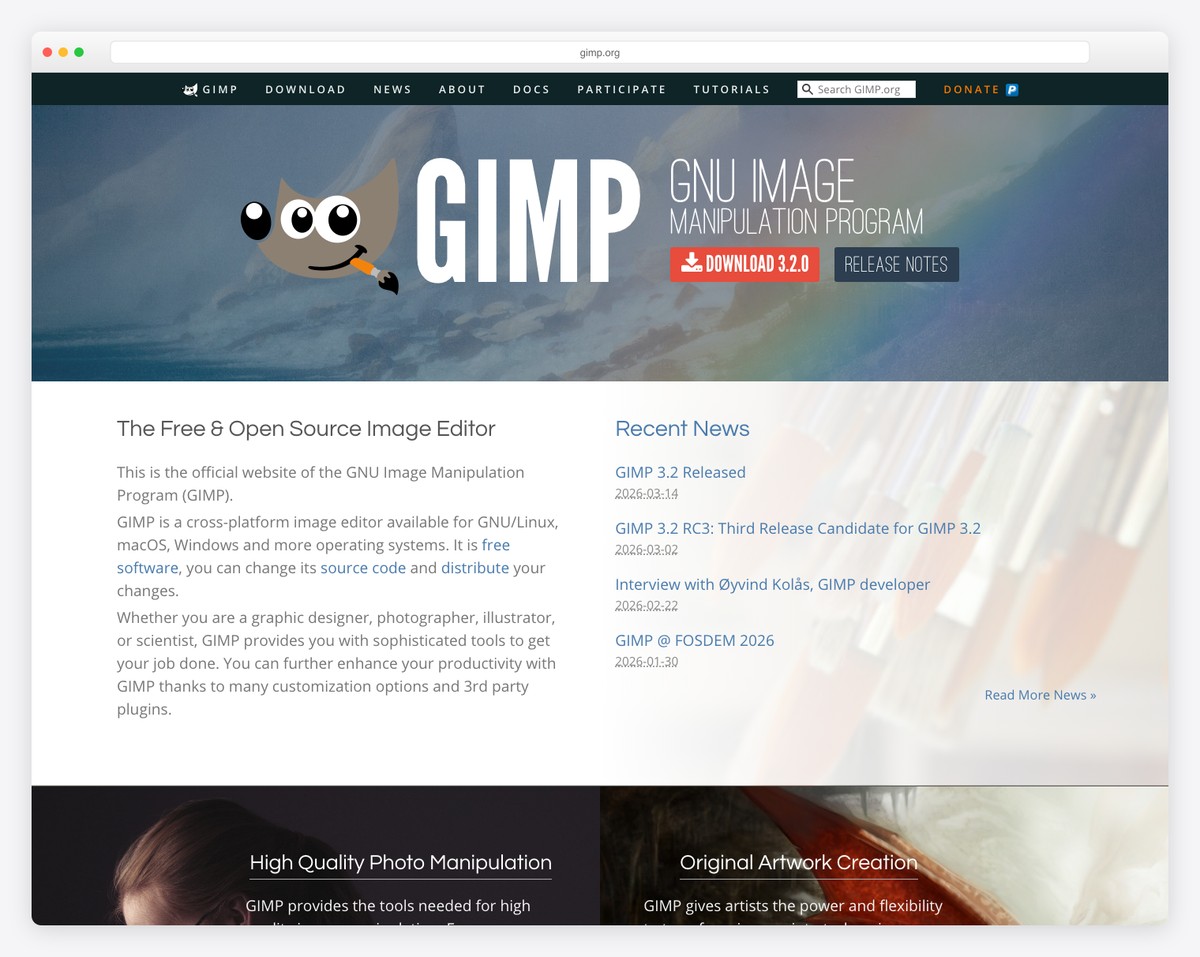
GIMP (GNU Image Manipulation Program) has been the flagship open-source photo editor for about 30 years and remains the most customizable free option available. With a large library of plugins and scripts available (though many older 2.10 add-ons need porting to GIMP 3), GIMP can be extended to handle virtually any image editing task — from batch processing and format conversion to advanced compositing and technical imaging.
Core features include full layer support with blend modes, channel operations, customizable brushes, paths, color management, and extensive filter libraries. GIMP supports RAW files by handing them to darktable or RawTherapee as import plugins, PSD import (with limitations on complex files), and exports to all major formats. The Script-Fu and Python-Fu scripting systems enable automation that no other free editor matches.
GIMP’s interface has historically been its weakest point — the multi-window layout and non-standard tool behavior frustrated users coming from Photoshop. GIMP 3.0 (March 2025) brought a GTK3 interface with HiDPI support and non-destructive filters, and the 3.2 series has continued that work, though it still feels less polished than Affinity or Photopea. For users willing to invest time in learning its workflow, GIMP offers unmatched flexibility and zero cost. See our graphic design statistics for more on the design tools market.
4. Pixlr
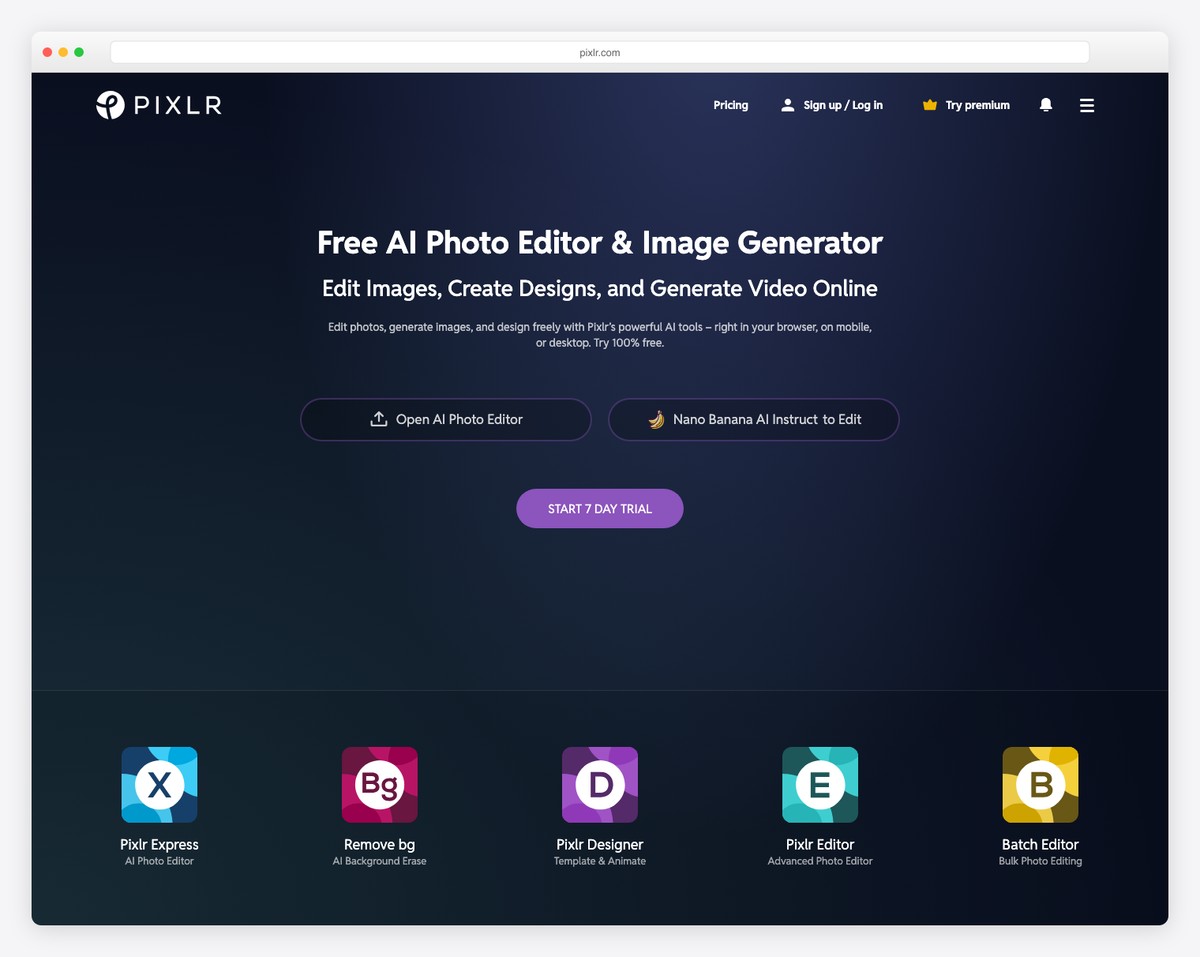
Pixlr is a browser-based and app-based photo editor that has leaned heavily into AI-powered editing in recent years. The free tier includes Pixlr Express (simplified editor) and Pixlr Editor (advanced editor with layers), plus AI tools for background removal, object removal, and image generation. The interface is modern and intuitive, making it accessible to casual editors who find GIMP or Affinity overwhelming.
Pixlr Editor offers layers, masks, blend modes, adjustment tools, retouching brushes, and text — a capable feature set for most photo editing tasks. The AI features work well for common tasks: removing backgrounds is near-instant and surprisingly accurate, and the AI object remover handles simple cases effectively. Pixlr works on phones and tablets as well as desktops.
The free tier is limited by ads, lower export resolution, and restricted access to premium AI features. Pixlr Plus (about $2.49/month) removes ads, and the Premium and Ultra plans add larger monthly AI credit allowances. Pixlr is best for users who want quick, good-enough photo editing with modern AI tools without installing software. It does not compete with Affinity Photo or GIMP on depth, but it wins on convenience and speed for everyday editing tasks.
5. Krita
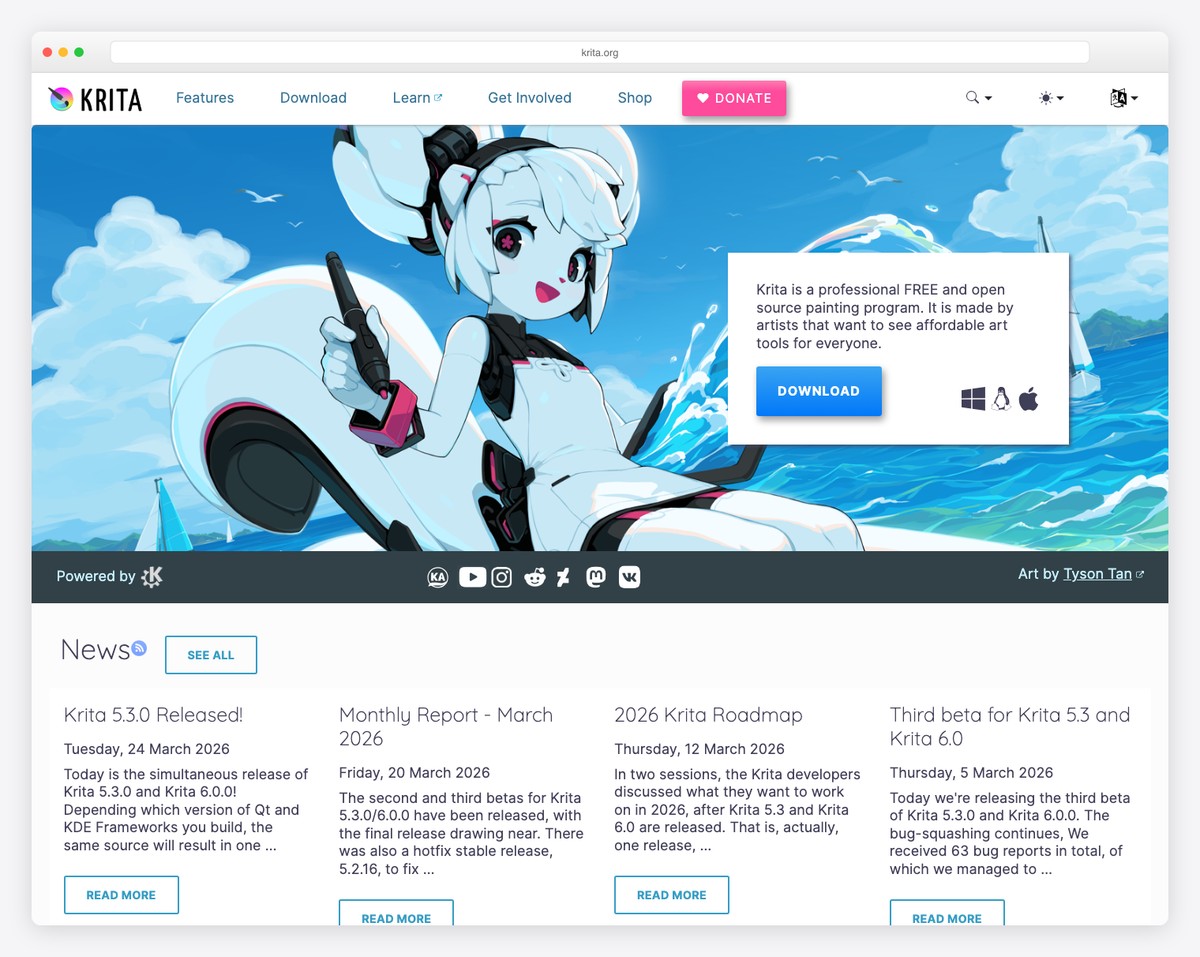
Krita is a free, open-source digital painting application that has become the go-to tool for illustrators, concept artists, and digital painters. While it can handle photo editing, Krita’s strength is its painting engine: over 100 customizable brushes, stabilizer tools for smooth linework, wrap-around mode for seamless textures, multibrush for symmetric painting, and animation support for frame-by-frame work.
Krita supports full layer management, masks, blending modes, vector layers, and non-destructive filters. It handles PSD files (with good compatibility), supports OpenEXR for HDR workflows, and includes color management. The brush engine is Krita’s crown jewel — professional artists praise it as superior to Photoshop’s brush tools in many scenarios, particularly for textured and natural-media brushes.
For photo editing specifically, Krita lacks dedicated tools like RAW development, lens correction, and perspective warp that Affinity Photo and GIMP provide. Krita is not trying to replace Photoshop for photographers — it is replacing Photoshop for painters and illustrators. If digital art is your primary use case, Krita is arguably the best tool available at any price. If photo editing is your focus, Affinity or GIMP will serve you better.
6. Paint.NET
Paint.NET is a Windows-only image editor that fills the gap between the basic Windows Photos app and full-featured editors like GIMP or Affinity Photo. It offers layers, blend modes, effects, a plugin system, and an intuitive interface — all running fast and light. Paint.NET uses under 100MB of RAM on startup compared to 500MB+ for Photoshop or Affinity Photo, making it ideal for older hardware.
The plugin ecosystem extends Paint.NET with additional effects, file format support (including PSD and RAW via plugins), and tools. Popular plugins add features like content-aware resize, advanced color adjustments, and shape tools. The community-driven plugin library has hundreds of additions that keep Paint.NET relevant for intermediate editing tasks.
Paint.NET is not a Photoshop replacement — it lacks adjustment layers, advanced masking, RAW development, and professional color management. But for quick image editing, batch processing with plugins, and everyday tasks like resizing, cropping, color correction, and simple compositing, Paint.NET’s speed and simplicity make it a favorite among Windows users who do not need professional-grade tools.
7. RawTherapee
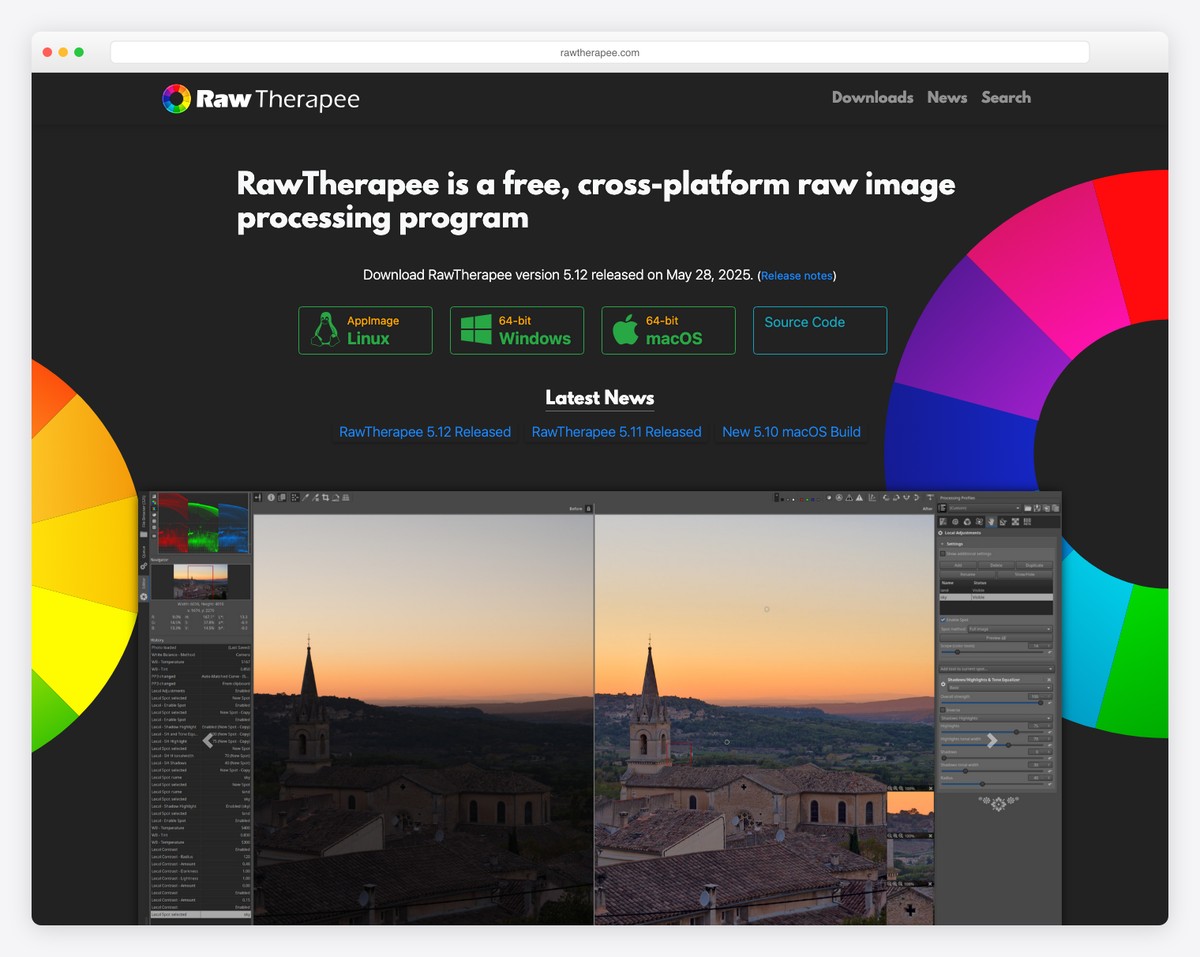
RawTherapee is a free, open-source RAW photo processor that rivals Adobe Camera Raw and Lightroom’s development module in capability. It supports over 100 camera RAW formats, offers advanced demosaicing algorithms, and provides granular control over exposure, white balance, tone curves, noise reduction, sharpening, lens correction, and color management that goes deeper than most paid software.
All edits in RawTherapee are non-destructive — stored as processing profiles rather than modifying originals. The batch processing capabilities are powerful, letting you apply profiles to hundreds of images at once. The tool also provides advanced features like flat-field correction, chromatic aberration removal, and film simulation that cater to serious photographers.
RawTherapee focuses exclusively on RAW development and does not include layers, compositing, retouching, or pixel-level editing. It is a development tool, not a general photo editor. For photographers who shoot RAW and want maximum control over their development process without Adobe’s subscription, RawTherapee combined with GIMP (for retouching) or Affinity Photo (for compositing) provides a complete, professional, and free workflow.
8. Darktable
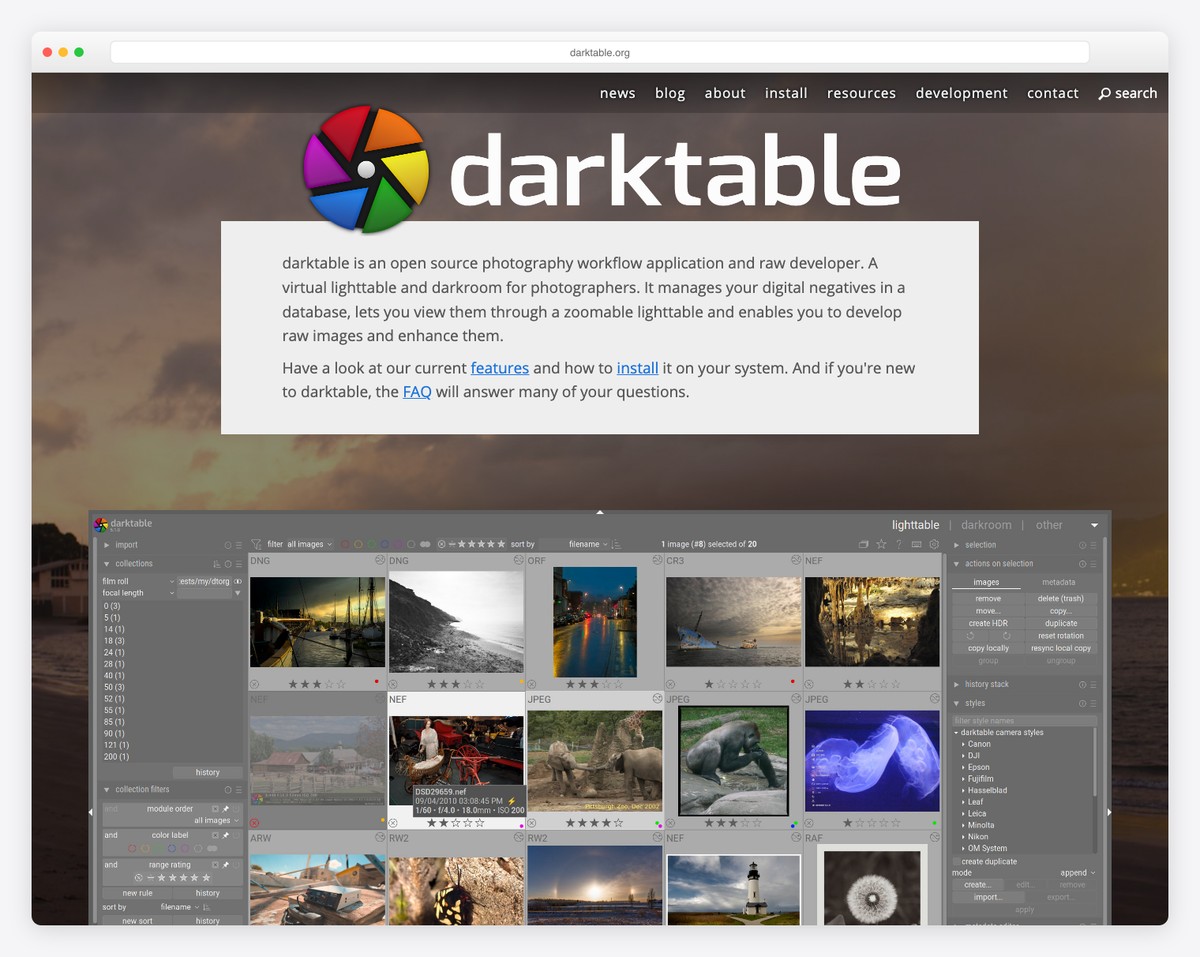
Darktable is a free, open-source photo workflow application that combines RAW development with photo management — making it the most complete free alternative to Adobe Lightroom. The lighttable module handles photo library management with tags, ratings, color labels, and map-based organization. The darkroom module provides non-destructive RAW processing with over 60 image processing modules.
Processing features include exposure, tone mapping, color zones, equalizer (wavelet-based), denoise, chromatic aberrations, lens correction (with lensfun database), local adjustments with masks, and film-inspired tone curves. Darktable also supports tethered shooting and has Lua scripting for automation. The module system is modular and extensible, letting you customize the processing pipeline.
Like RawTherapee, Darktable is not a pixel editor — it does not do layers, compositing, or retouching. But it handles the entire photo workflow that Lightroom covers: import, organize, develop, and export. The learning curve is significant (the module-based approach takes adjustment), but photographers who invest the time report workflows that are as efficient as Lightroom’s. For professional photographers who want to leave Adobe’s ecosystem entirely, Darktable is the most complete free replacement for Lightroom available.
9. Sumo Paint
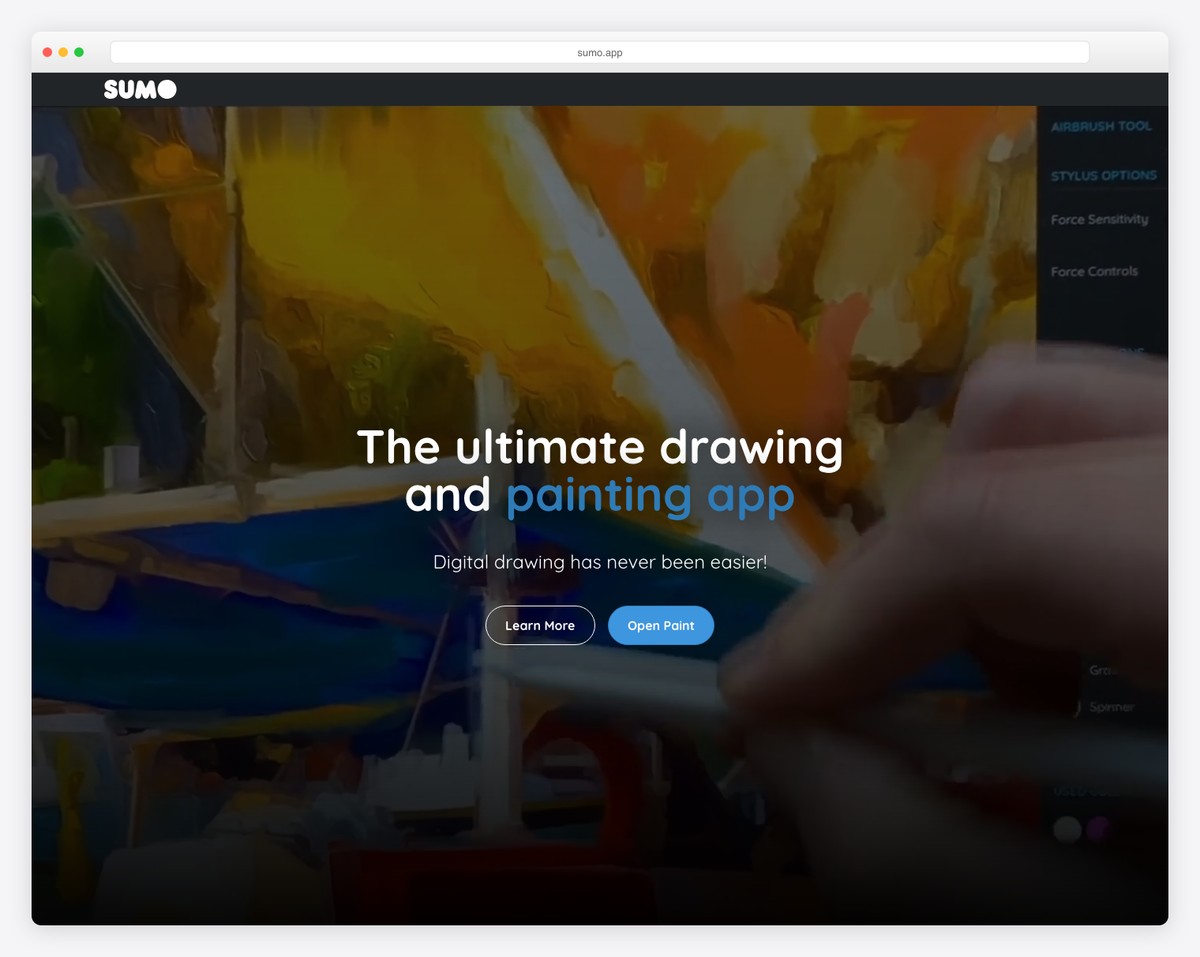
Sumo Paint is a browser-based image editor that has been around since 2008. The free version offers layers, brushes, filters, shapes, text, and gradient tools with an interface reminiscent of classic Photoshop. It runs in any modern browser with no installation or signup required (though an account unlocks saving to the cloud).
The tool is best for basic photo editing and digital painting in the browser. Sumo Paint includes a symmetry tool, custom brushes, and blending modes that make it more capable than typical browser editors. Sumo Pro ($4/month) unlocks the pro features across the Sumo creative suite, including daily AI credits for image generation, upscaling and background removal.
Sumo Paint has been surpassed in capability by Photopea, which offers significantly more features in the same browser-based format. However, Sumo Paint remains a decent option for quick edits and basic digital art when you want a lightweight tool with minimal interface complexity. For serious browser-based editing, Photopea is the better choice.
10. Polarr
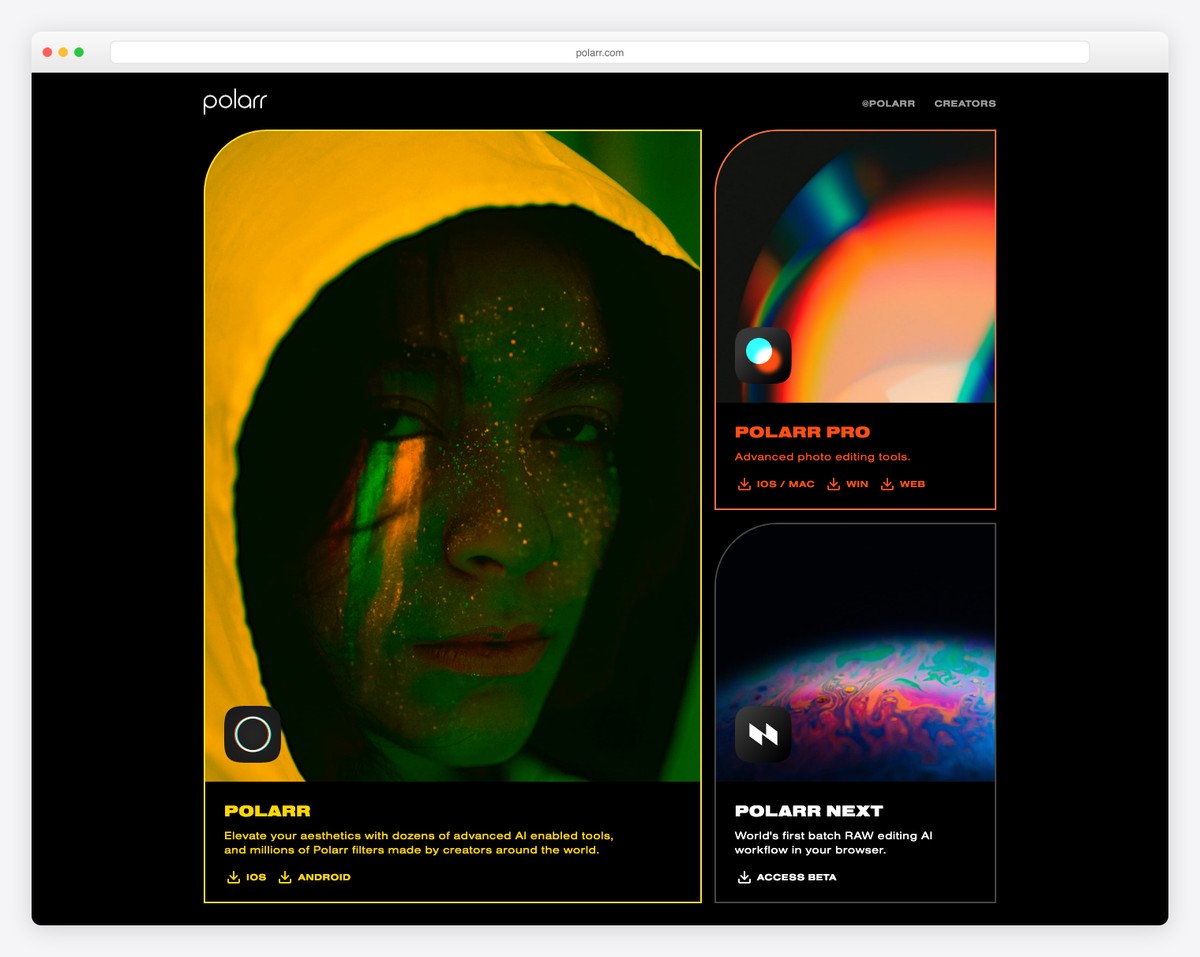
Polarr is a photo editor focused on color grading, filters, and adjustments across all platforms — desktop, mobile, and web. The free tier includes basic adjustments, filters, and overlays. Polarr Pro ($3.99/month billed yearly, or $7.99 month to month) unlocks advanced masking, batch export, and premium filters across mobile, desktop and web. Polarr supports RAW files on desktop and offers non-destructive editing.
Polarr’s strength is color work. The HSL adjustments, curves, split-toning, and LUT support are more refined than most free editors. The filter system lets you create, save, and share custom presets, making it popular among Instagram-focused photographers and content creators. The interface is clean and modern, designed for touch as well as mouse interaction.
Polarr is not a general-purpose photo editor — it lacks layers, compositing, retouching, and selection tools. It is a color and tone adjustment tool, more comparable to Lightroom’s editing panel than Photoshop. For photographers and content creators who primarily need color grading, filter creation, and consistent visual styles across their images, Polarr offers a focused, elegant experience at a fraction of Lightroom’s cost.
11. Canva Photo Editor
Canva’s built-in photo editor is the simplest option on this list — crop, resize, adjust brightness/contrast/saturation, apply filters, and add text or graphics. The free tier is sufficient for basic social media image editing. Canva Pro ($15/month) adds background remover, magic resize, brand kits, and premium templates. Canva also owns Affinity, which remains a separate desktop app.
For actual photo editing — retouching, compositing, RAW processing, or precision color work — Canva is not the right tool. It is designed for creating social media graphics, presentations, and marketing materials that happen to include photos, not for editing photos themselves. The distinction matters: Canva excels at graphic design for non-designers, not photo editing for photographers.
If your needs are limited to basic adjustments and adding text/graphics to photos for social media, Canva’s simplicity is an advantage. If you need anything beyond basic edits, use Affinity (also free, and also owned by Canva) for professional photo editing and Canva for designing graphics that incorporate those edited photos.
12. Fotor
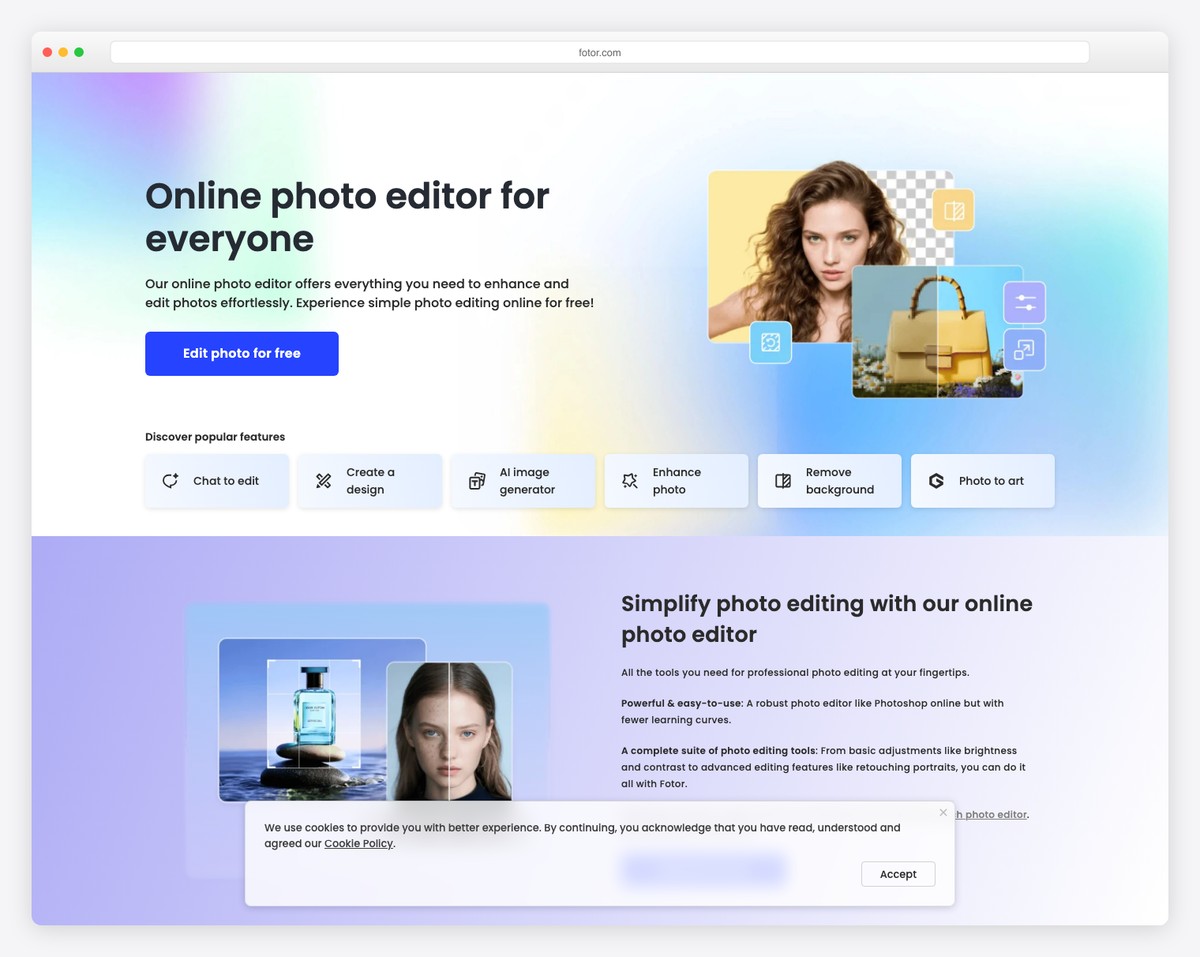
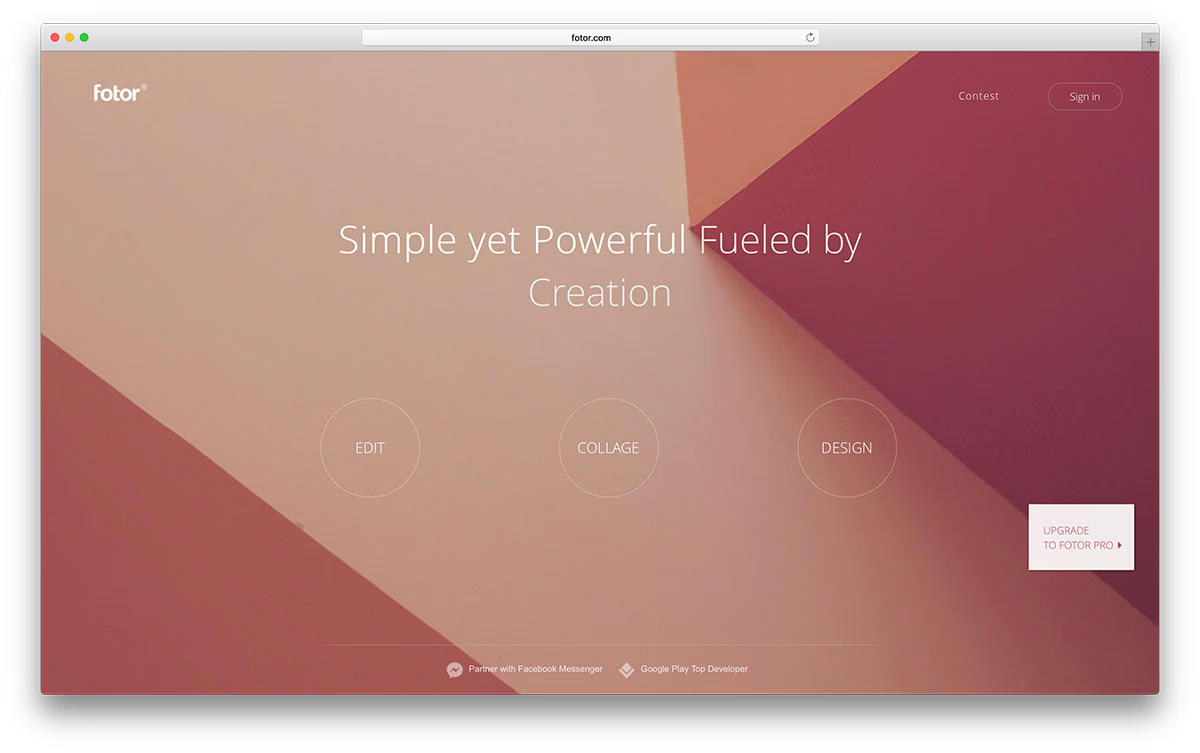
Fotor is a browser-based and desktop photo editor that emphasizes one-click enhancements and templates. The free tier includes basic editing, filters, effects, and portrait retouching. Fotor Pro ($3.33/month billed yearly, or $8.99 month to month) adds AI background removal, premium filters, batch processing, and additional templates. The interface is designed for speed — apply a preset, make minor adjustments, and export.
Fotor includes a “1-Tap Enhance” AI feature that automatically adjusts exposure, color, and clarity. The beauty retouching tools smooth skin, whiten teeth, and reshape features — useful for portrait photography. Fotor also includes a collage maker, design templates, and HDR processing.
Like Canva’s photo editor, Fotor is designed for quick results rather than precise control. It does not offer full layer support, advanced masking, or non-destructive editing workflows. Fotor works best for casual users, real estate photographers doing quick touch-ups, and social media managers who need presentable images fast. For serious editing, Affinity, Photopea, or GIMP are vastly more capable.
Frequently Asked Questions
Is Affinity Photo really free now?
Yes. Canva acquired Serif (the maker of Affinity products) in 2024, and in October 2025 it replaced Photo, Designer, and Publisher with one all-in-one Affinity app that is completely free on Windows and Mac, with an iPad version listed as coming soon. You need a free Canva account, and only the optional Canva AI tools require a paid Canva plan. You get the full professional toolset that previously cost $70 per app, and Canva has said it will stay free.
What is the best free Photoshop alternative overall?
Affinity (formerly Affinity Photo 2) is now the best free Photoshop alternative by a significant margin. It offers professional-grade tools — RAW development, full layer management, non-destructive editing, HDR merge, focus stacking — that previously required either Photoshop or a $70 purchase. For browser-based editing without installation, Photopea is the best alternative. For maximum customization with plugins, GIMP offers the most flexibility.
Which free editors can open PSD files?
Photopea has the best PSD compatibility — it opens complex PSD files with layers, smart objects, and effects largely intact. Affinity also imports PSD files with good fidelity, though some advanced Photoshop-specific features may not translate perfectly. GIMP can open PSD files but has more limited compatibility with complex layer effects and smart objects. Krita also supports basic PSD import.
What is the best free alternative for RAW photo editing?
For RAW development specifically, RawTherapee offers the deepest controls and most advanced demosaicing algorithms. Darktable is the best free Lightroom alternative because it combines RAW processing with photo library management. Affinity (now free) includes excellent RAW development tools integrated with its full editing suite. For a complete free workflow, use Darktable for photo management and RAW development, and Affinity Photo for compositing and retouching. See our free SVG editors guide for vector editing options.
Key Takeaways
- Affinity being free is a game-changer — it is a genuine professional-grade Photoshop alternative that now costs nothing, making it the default recommendation for most users.
- Photopea is essential for anyone who needs to open PSD files without Photoshop — it runs entirely in the browser with no installation and has the best PSD compatibility of any free tool.
- For digital art and illustration, Krita offers brush engines and painting tools that many artists prefer over Photoshop itself.
- Photographers who want to leave Adobe entirely can build a complete free workflow with Darktable (photo management + RAW) and Affinity (editing + compositing).
- The gap between free and paid photo editors has effectively closed for most users — only those depending on Photoshop’s generative AI, specific third-party plugins, or deep Creative Cloud integration still need Adobe’s subscription.

Related Posts


Comments (0)