
50+ Content Marketing Statistics: ROI, Types & Trends (2026)
Last updated: March 2026
91% of B2B marketers use content marketing, content generates 3x more leads at 62% less cost than outbound marketing, and the content marketing industry exceeds $600 billion globally. The average blog post is now 1,416 words, video is used by 91% of businesses, and 72% of content marketers use AI tools in their workflow. Here are 100+ content marketing statistics covering industry size, performance by content type, blogging, video, AI adoption, and ROI measurement for 2026.
Key Content Marketing Statistics (2026)
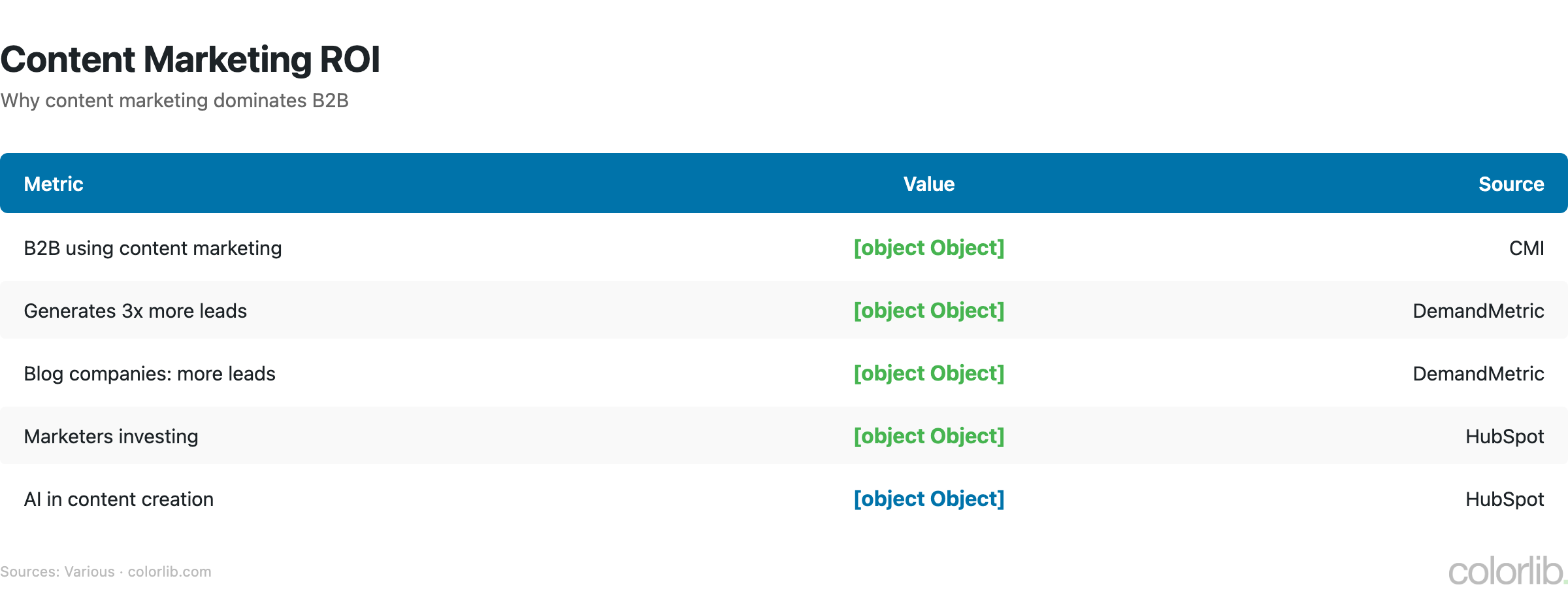
- 91% of B2B marketers use content marketing (Content Marketing Institute)
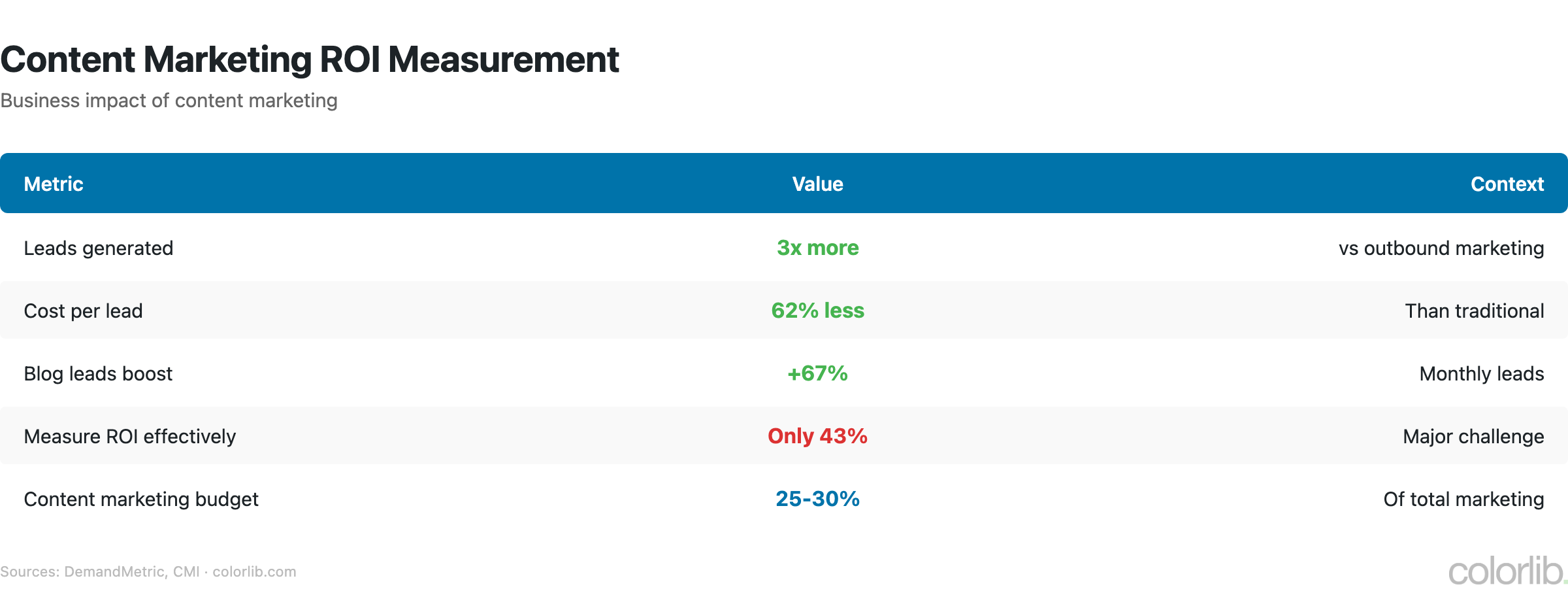
- Content generates 3x more leads at 62% less cost than outbound marketing (Demand Metric)
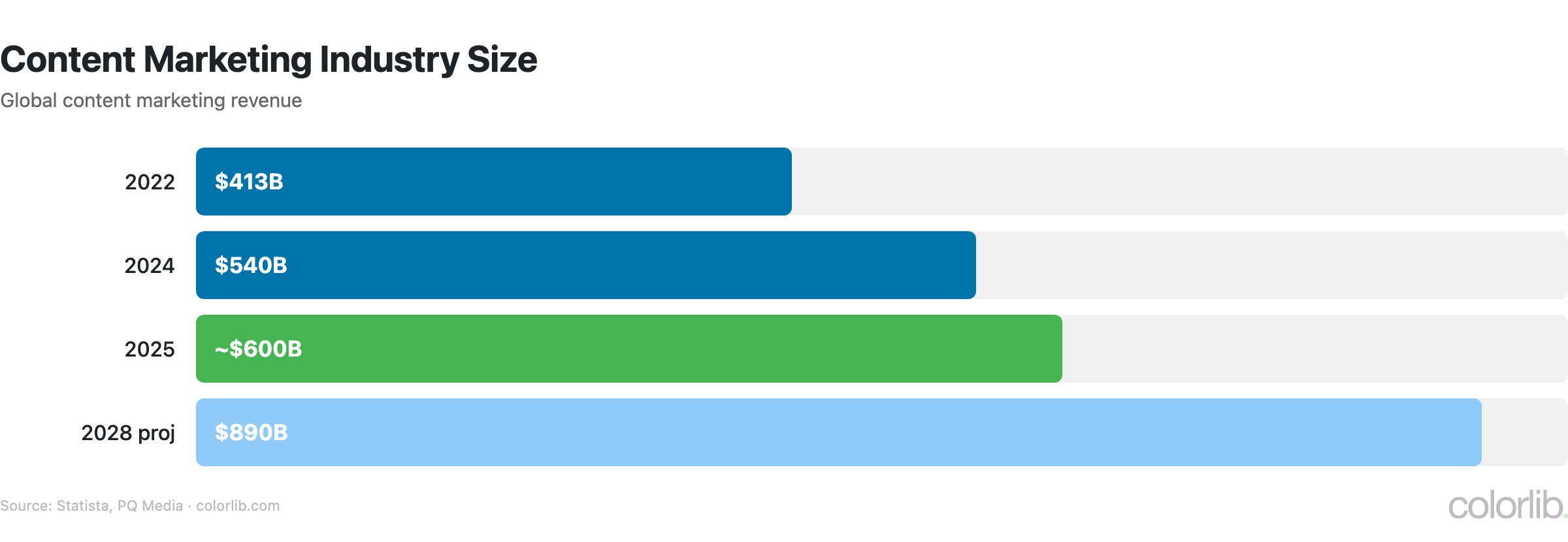
- Content marketing industry size: $600+ billion (Statista)
- 82% of marketers actively invest in content marketing (HubSpot)
- Average blog post length: 1,416 words (Orbit Media)
- 91% of businesses use video as a marketing tool (Wyzowl)
- 72% of content marketers use AI tools (Content Marketing Institute)
Content Marketing Industry Size
| Metric | Value | Source |
|---|---|---|
| Global content marketing industry | $600+ billion | Statista |
| Projected size (2030) | $900+ billion | Grand View Research |
| B2B content marketing spend (avg) | 26% of marketing budget | Content Marketing Institute |
| B2B marketers using content marketing | 91% | Content Marketing Institute |
| Marketers actively investing in content | 82% | HubSpot |
| Companies with dedicated content teams | 62% | Semrush |
| Average content team size | 3-5 people | Content Marketing Institute |
| Content marketing CAGR (2025-2030) | 8.4% | Grand View Research |
- The content marketing industry exceeds $600 billion globally, encompassing blog content, video production, social media content, podcasts, email newsletters, and content strategy services
- 91% of B2B marketers use content marketing, and the average B2B company allocates 26% of its marketing budget to content creation and distribution
- 62% of companies now have dedicated content teams, up from 42% in 2020 — reflecting the professionalization of content as a business function
- Content marketing generates 3x more leads at 62% less cost than traditional outbound marketing (cold calls, print ads, trade shows)
- Despite AI’s efficiency gains, 73% of content leaders say budget is increasing in 2026 — companies are investing more, not less, as AI makes content production faster
Content Types & Performance
| Content Type | Usage Rate | Effectiveness Rating |
|---|---|---|
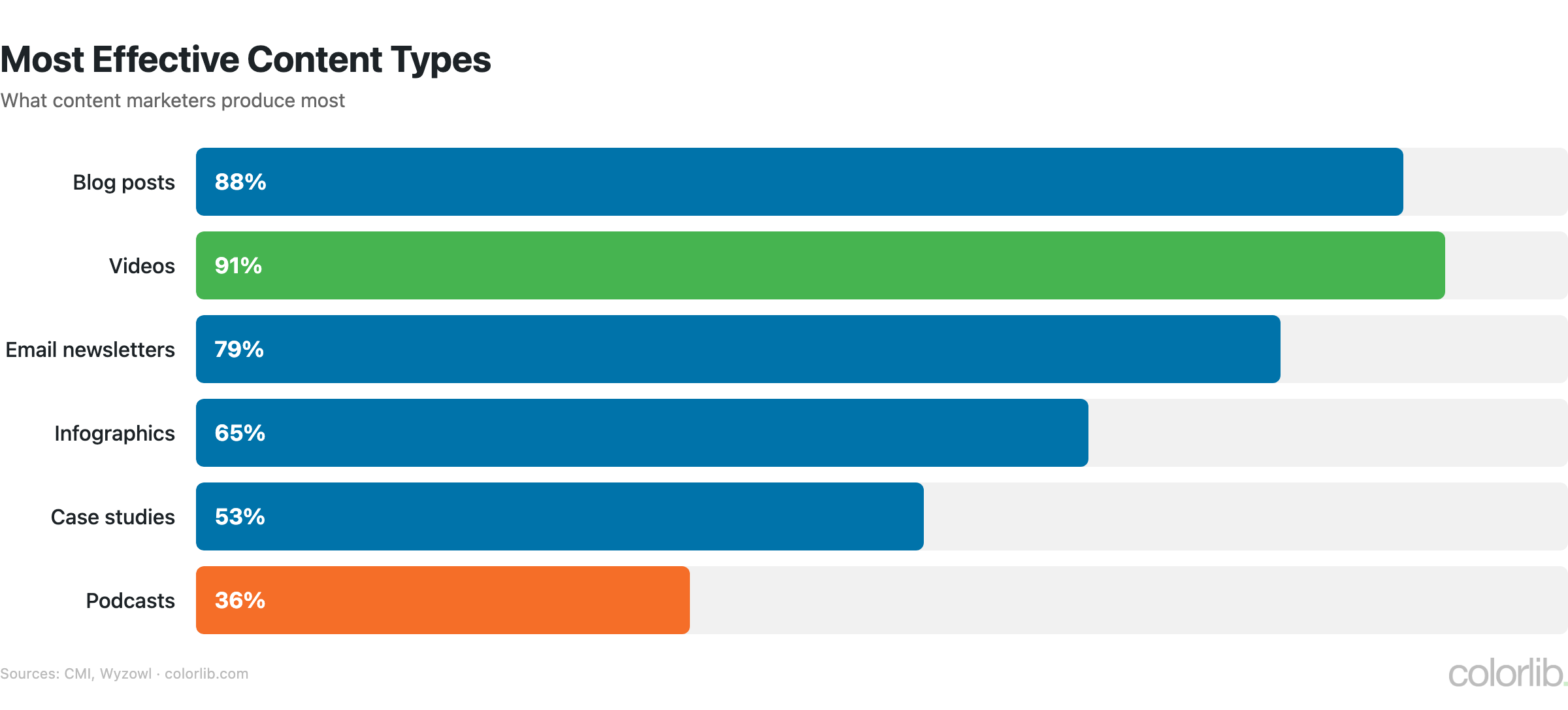
| Blog posts/articles | 89% | 67% rate effective |
| Video content | 91% | 90% rate effective |
| Infographics | 65% | 56% rate effective |
| Case studies | 73% | 73% rate effective |
| Webinars | 57% | 63% rate effective |
| Podcasts | 37% | 52% rate effective |
| White papers/ebooks | 62% | 58% rate effective |
| Interactive content | 45% | 81% rate effective |
- Video is both the most-used (91%) and highest-rated (90% effective) content type — a rare combination that explains why video budgets continue to grow
- Interactive content (calculators, quizzes, assessments) has the highest effectiveness-to-usage gap — 81% rate it effective but only 45% use it, representing an opportunity for early adopters
- Case studies are the most reliable B2B content type — 73% of B2B buyers consult case studies before making purchasing decisions
- Blog posts remain the workhorse of content marketing at 89% usage, though posts over 3,000 words get 3x more traffic and 4x more shares than shorter content
- Podcast audiences have grown to 500 million+ listeners globally, and 37% of marketers now produce podcasts — up from 17% in 2020
Blogging Statistics
| Metric | Value | Source |
|---|---|---|
| Average blog post length | 1,416 words | Orbit Media |
| Posts over 3,000 words | Get 3x more traffic | Semrush |
| Average time to write a post | 4 hours 10 minutes | Orbit Media |
| Companies with blogs | 76% of B2B | Content Marketing Institute |
| Blog’s share of organic traffic | ~55% of website traffic | HubSpot |
| Posts with images | 90% | Orbit Media |
| Posts with video | 24% | Orbit Media |
| Companies publishing 16+ posts/month | Get 4.5x more leads | HubSpot |
- The average blog post has grown to 1,416 words — up 75% from 808 words in 2014 — as search engines increasingly reward comprehensive, in-depth content
- Long-form content pays off: posts over 3,000 words get 3x more traffic, 4x more shares, and 3.5x more backlinks than average-length posts
- Companies that publish 16+ blog posts per month get 4.5x more leads than those publishing 0-4 times, demonstrating the compound effect of consistent content
- Blogs drive roughly 55% of website traffic for companies that maintain them, making blogging the single largest organic traffic source for most businesses
- For a deeper dive into blog-specific trends including monetization, platform market share, and content formats, see our complete blogging statistics report
Video Content Marketing
| Metric | Value | Source |
|---|---|---|
| Businesses using video | 91% | Wyzowl |
| Marketers rating video ROI positive | 90% | Wyzowl |
| Short-form video adoption | 73% | HubSpot |
| YouTube Shorts daily views | 70 billion+ | YouTube |
| Video increases landing page conversions | +86% | EyeView |
| Consumers who watched a video before buying | 82% | Wyzowl |
| Average video marketing budget | $21,000/year (SMBs) | Wyzowl |
| AI-generated video adoption | 28% | HubSpot |
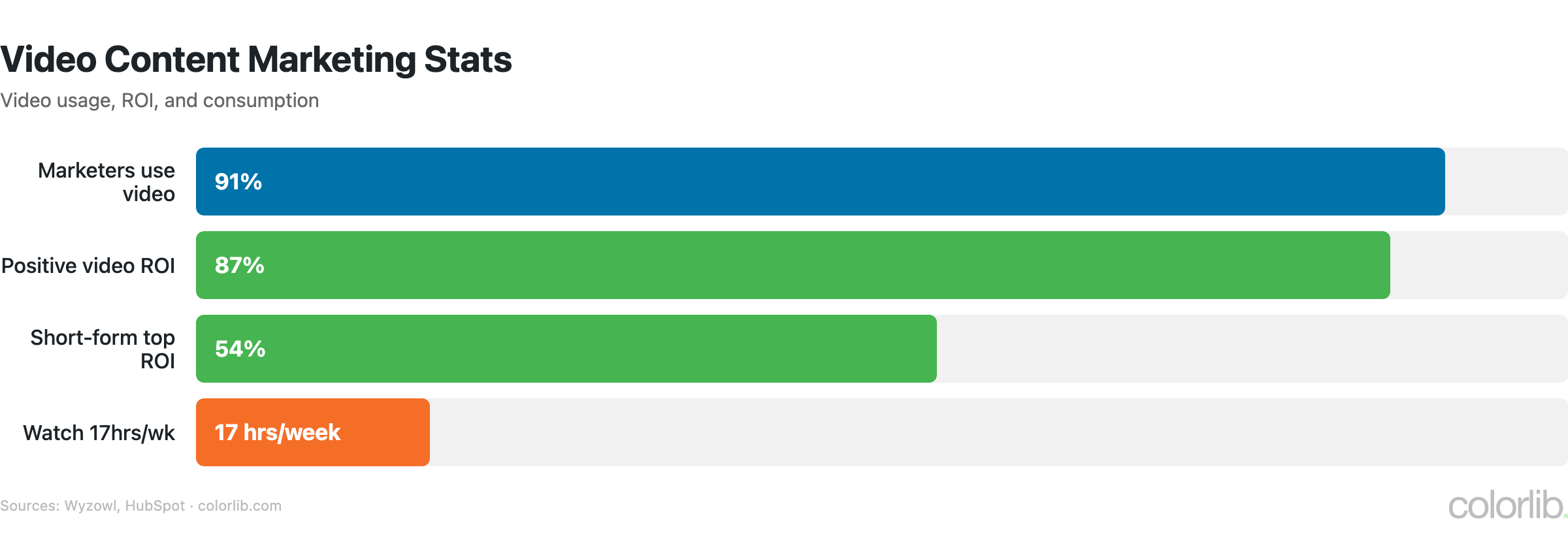
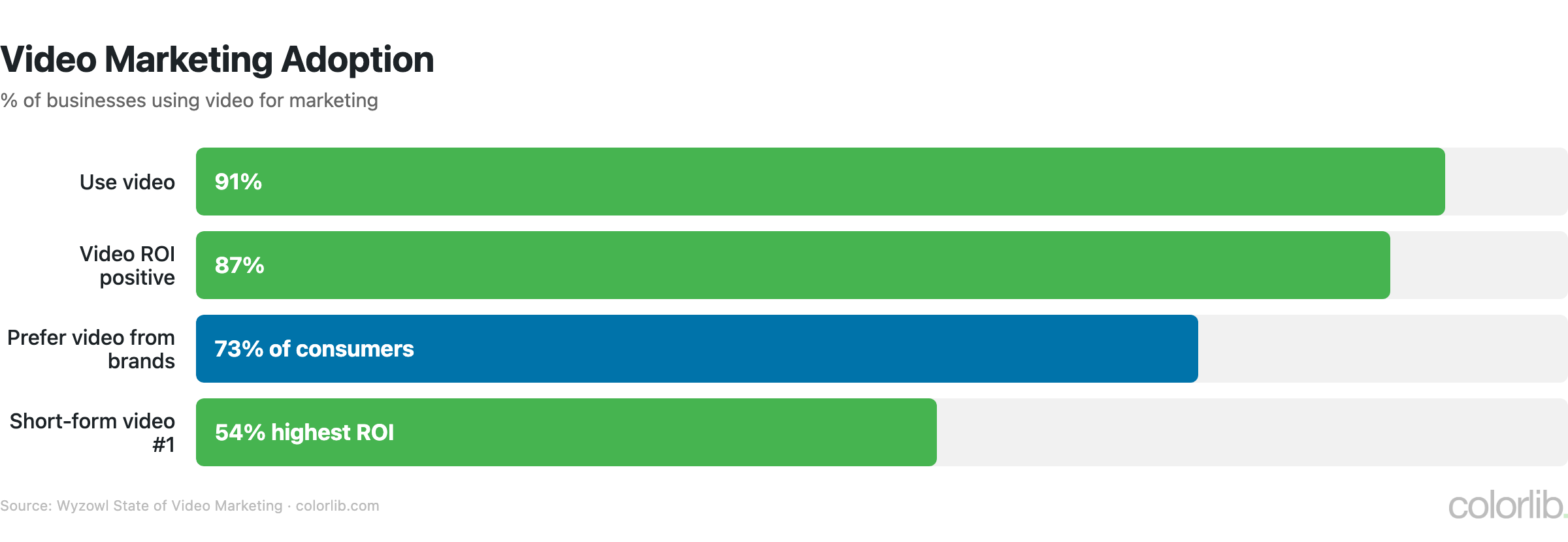
- 91% of businesses use video as a marketing tool, and 90% say it delivers positive ROI — making video the most widely adopted and most effective content format
- Short-form video (<60 seconds) is the fastest-growing format, with 73% of marketers creating it for TikTok, Instagram Reels, and YouTube Shorts
- Adding video to a landing page increases conversions by 86%, and 82% of consumers say watching a video convinced them to make a purchase
- YouTube Shorts alone receives 70 billion daily views, highlighting the massive shift toward snackable video content across all platforms
- 28% of marketers are already using AI-generated video tools (Synthesia, HeyGen, Sora) for content creation — a figure expected to double by 2027
AI in Content Creation
| Metric | Value | Source |
|---|---|---|
| Content marketers using AI tools | 72% | Content Marketing Institute |
| AI used for content ideation | 51% | Content Marketing Institute |
| AI used for first drafts | 45% | Content Marketing Institute |
| AI used for editing/proofreading | 42% | Content Marketing Institute |
| AI used for SEO optimization | 39% | Semrush |
| Content output increase with AI | +50-100% | HubSpot |
| Marketers concerned about AI quality | 58% | Content Marketing Institute |
| Companies with AI content guidelines | 34% | Gartner |
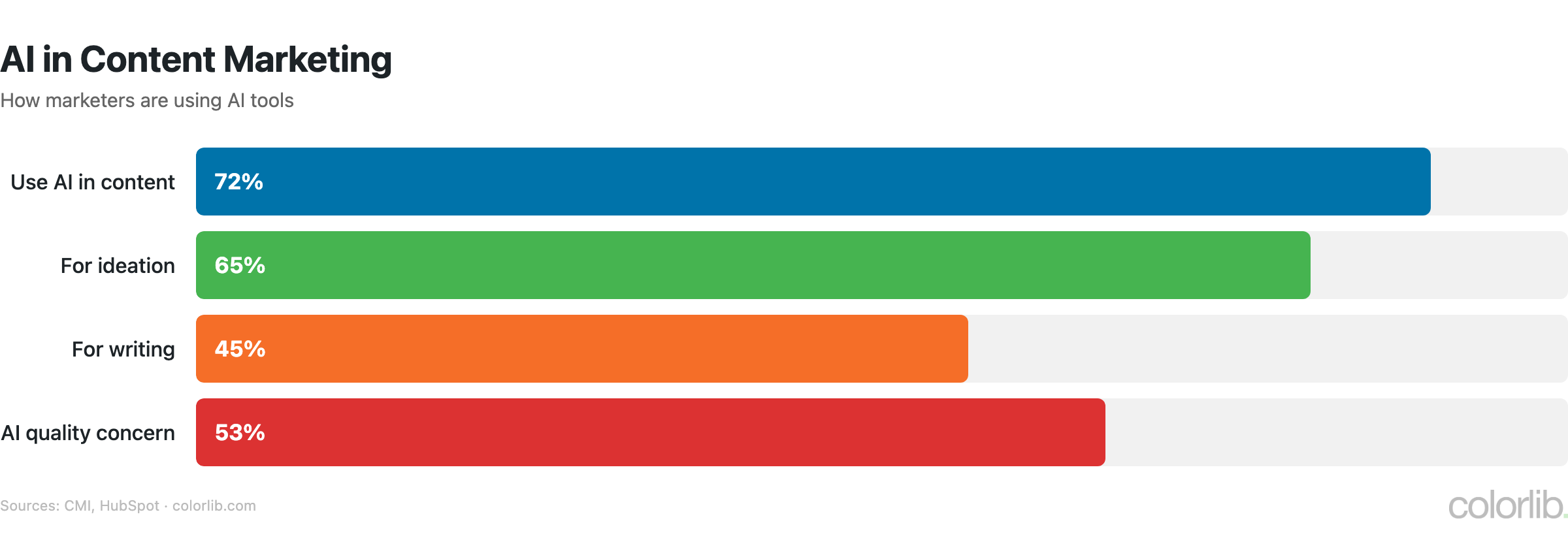
- 72% of content marketers use AI tools in their workflow, primarily for content ideation (51%), first drafts (45%), and editing (42%)
- AI has increased content output by 50-100% for teams that adopt it, but quality concerns persist — 58% of marketers worry about AI-generated content accuracy
- Only 34% of companies have formal guidelines for AI content creation, leaving most teams to figure out appropriate use cases on their own
- The most effective AI workflow is “AI-assisted, human-refined” — using AI for research, outlines, and first drafts, then adding human expertise, voice, and fact-checking
- Google has confirmed that AI-generated content is not penalized if it’s helpful and high-quality, but purely AI-generated content without human oversight tends to underperform in search rankings. For SEO implications, see our SEO statistics report
Content Marketing ROI & Measurement
| Metric | Value | Source |
|---|---|---|
| Content marketing vs. outbound lead cost | 62% cheaper | Demand Metric |
| Content marketing lead generation | 3x more leads | Demand Metric |
| Marketers who measure content ROI | 43% | Content Marketing Institute |
| Top metric: website traffic | 83% track it | Semrush |
| Top metric: engagement | 76% track it | Semrush |
| Top metric: lead generation | 62% track it | Content Marketing Institute |
| Content marketing success rate | 58% report success | Content Marketing Institute |
| Time for content to generate ROI | 6-12 months | Ahrefs |
- Content marketing generates 3x more leads at 62% less cost than outbound marketing, but it requires patience — most content takes 6-12 months to generate meaningful ROI
- Only 43% of marketers consistently measure content marketing ROI, which is a major gap — you can’t improve what you don’t measure
- The top metrics tracked are website traffic (83%), engagement (76%), and lead generation (62%) — revenue attribution is tracked by only 38%
- 58% of content marketers report their strategy is successful, up from 42% in 2022, driven by better AI tools, clearer measurement, and growing executive buy-in
- The compound effect of content is powerful: a single well-ranking blog post can generate traffic and leads for years, making it one of the best long-term investments. For more on how content works with other channels, see our digital marketing statistics
Sources
- Content Marketing Institute — B2B Content Marketing Research
- HubSpot — State of Marketing Report
- Semrush — Content Marketing Statistics
- Orbit Media — Annual Blogging Survey
- Wyzowl — Video Marketing Statistics
- Demand Metric — Content Marketing Infographic
- Grand View Research — Content Marketing Market Report
- Gartner — Marketing Technology Survey
Frequently Asked Questions
What is the ROI of content marketing?
Content marketing generates 3x more leads at 62% less cost than outbound marketing. Companies that publish 16+ blog posts per month get 4.5x more leads than those publishing 0-4 times. The challenge is patience — content typically takes 6-12 months to deliver meaningful ROI, but the compound effect means a single well-performing piece can generate traffic and leads for years. 58% of content marketers report their overall strategy as successful.
What type of content performs best?
Video is the top-performing content type, with 91% of businesses using it and 90% reporting positive ROI. For written content, long-form blog posts (3,000+ words) get 3x more traffic and 3.5x more backlinks than average posts. Case studies are the most effective B2B format (73% effectiveness rating), while interactive content (calculators, quizzes) scores highest in engagement at 81%. The ideal strategy combines multiple content types to reach audiences across different channels and stages of the buyer journey.
Should you use AI for content creation?
72% of content marketers already use AI tools, and those who do report 50-100% increases in output. The most effective approach is “AI-assisted, human-refined” — using AI for research, outlines, and first drafts, then adding human expertise and fact-checking. Google does not penalize AI-generated content that’s genuinely helpful. However, purely AI-generated content without human oversight tends to underperform and carries accuracy risks. Only 34% of companies have formal AI content guidelines.
How long should a blog post be?
The average blog post is 1,416 words, but optimal length depends on the topic. Posts over 3,000 words consistently outperform shorter content for search traffic, shares, and backlinks. However, quality matters more than length — a focused 800-word post that fully answers a specific question will outperform a padded 3,000-word post. The trend is toward comprehensive, authoritative content that covers topics thoroughly. For detailed blogging data, see our blogging statistics report.
Key Takeaways
- Content marketing is a $600B+ industry used by 91% of B2B marketers. It generates 3x more leads at 62% less cost than outbound — and 82% of marketers are actively increasing investment.
- Video is the undisputed king of content. 91% of businesses use video marketing, 90% report positive ROI, and short-form video is the fastest-growing format. Adding video to landing pages boosts conversions by 86%.
- AI is transforming content creation but not replacing humans. 72% of content marketers use AI tools, doubling output — but 58% worry about quality, and the best results come from AI drafts refined by human expertise.
- Long-form content wins in search. Posts over 3,000 words get 3x more traffic, and companies publishing 16+ posts/month get 4.5x more leads. Content marketing is a long game — expect 6-12 months for meaningful ROI.

Related Posts






Comments (0)