
26 Best Game Developer & Game Designer Portfolio Examples 2026
The best game developer portfolios let you play or watch the work, say exactly what the developer did on each title, and show how they got there. These 26 come from level, systems, narrative and UX designers, gameplay, engine and graphics programmers, technical artists, indie developers and new graduates. If you build apps and websites rather than games, see our developer portfolio examples.
We tested 152 web addresses from the articles that rank for this topic, school showcase pages and our own searches, then opened project pages, builds, code links and résumés on every shortlisted site, and identified each platform from the site’s code. Every entry is the person’s own website, not an ArtStation, itch.io or LinkedIn profile. Of the 37 personal portfolios linked from those ranking articles, five no longer load and eight have shown no new work in several years.
Best Game Developer and Game Designer Portfolio Examples
1. Dean Tate
Built with: Squarespace
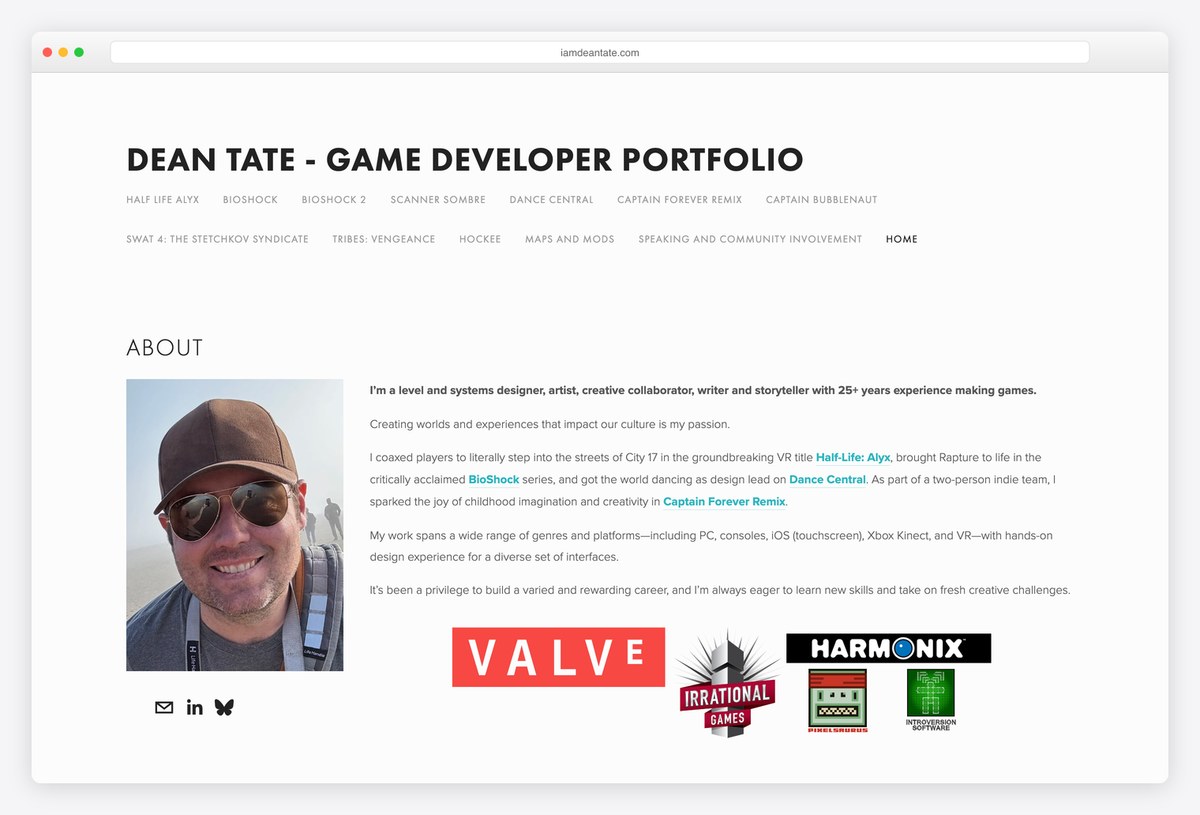
Dean Tate’s home page works as a credit sheet. Every shipped title, from Half-Life: Alyx to BioShock and Dance Central, sits in the top menu, and each project lists his job title, contributions, studio, platforms and the engine and tools he used.
On Half-Life: Alyx he was principal level designer for the “Jeff” chapter; on BioShock he owned the level Neptune’s Bounty and the AI tuning. Project pages add team size and project length, such as a three-month solo level contract on Scanner Sombre, and link each level to a video.
What stands out: Every credit says what he did, where, and with which tools.
2. Jaikar Pothula
Built with: Custom code, Vite build (GitHub Pages)
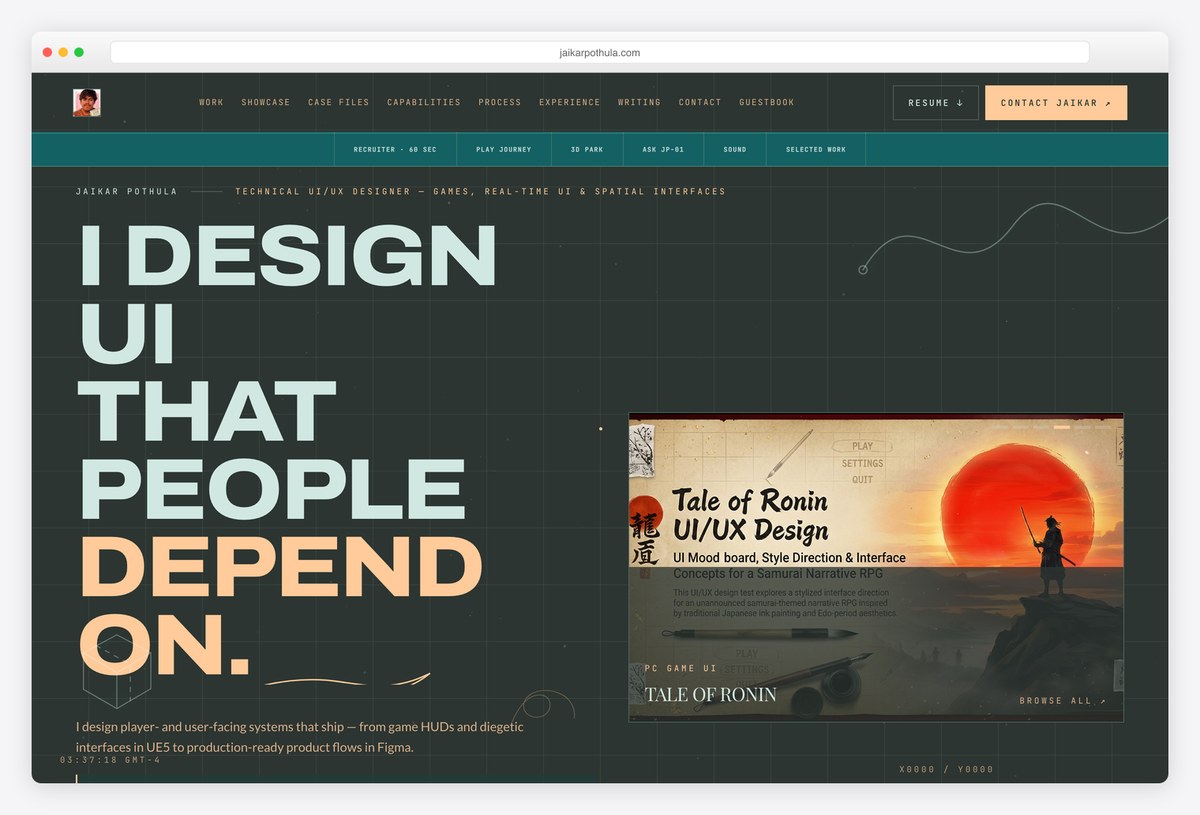
Jaikar Pothula, a technical UI/UX designer in the San Francisco Bay Area, frames each case study as problem, decision and outcome. For The Dark Arrival, a PC game on Steam, the problem was scattered narrative evidence; his answer was a diegetic 3D investigator journal built from modular UMG and Blueprint widgets.
Every case links its proof: the Steam page, the Figma source and a downloadable PDF. The site adds a recruiter mode, a PDF export, two résumés for game and product roles, and a walkable 3D version of the portfolio.
What stands out: Problem, decision and outcome on every case study.
3. Hugo Peters
Built with: Craft CMS
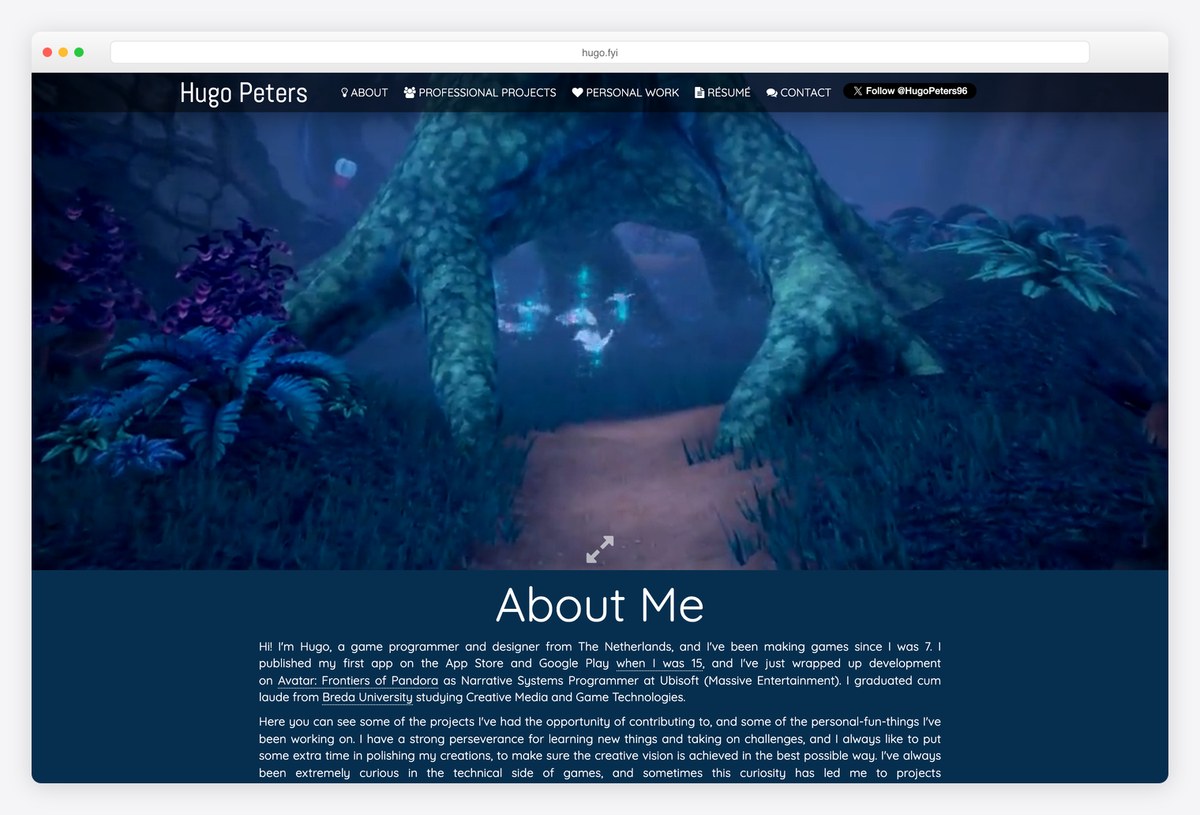
Hugo Peters, a game programmer from the Netherlands, worked on Avatar: Frontiers of Pandora as a narrative systems programmer at Ubisoft Massive, but his personal work is what stands out. He wrote Warlock Engine from scratch in C++, with a level editor and a node graph, and reverse-engineered a PlayStation 3 exclusive.
Project tiles carry tags for language and context and a list of his contributions. The Bolt Storm page, a university game, gives the team size, around 25 people with 12 programmers, and his systems: a state machine, combat, projectile batching and aim assist.
What stands out: Personal engine work that goes well beyond coursework.
4. Lucas Pope
Built with: Custom HTML
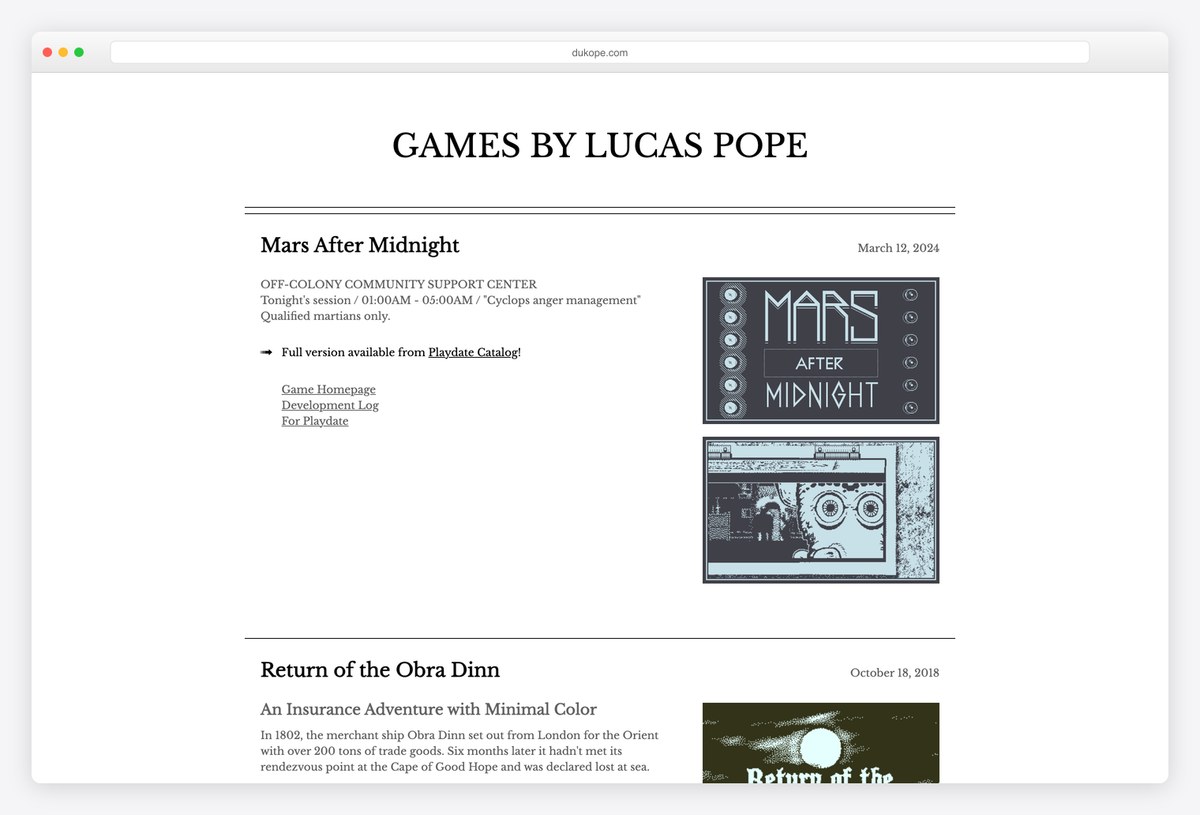
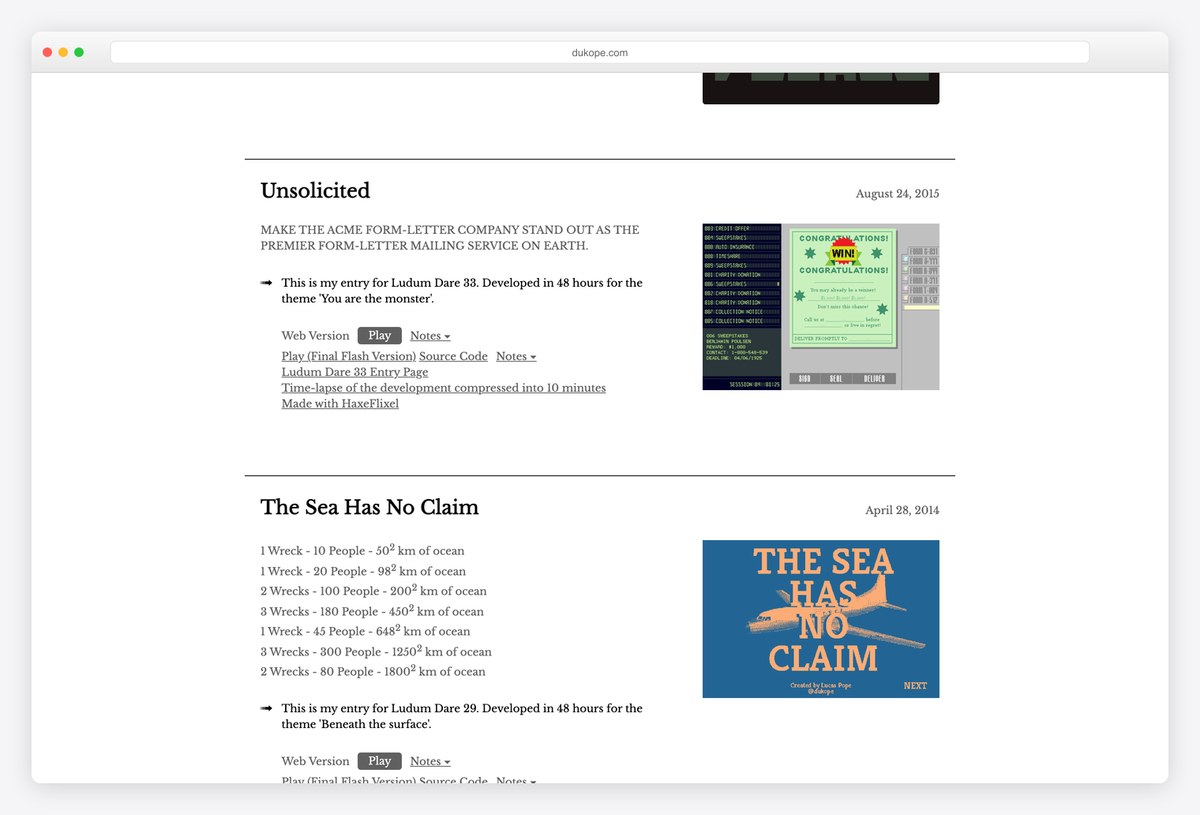
Lucas Pope, the solo developer behind Papers, Please and Return of the Obra Dinn, keeps one plain page of every game he has made, newest first. Each entry links the game’s homepage and development log and says what it was made with, from Unity to Haxe.
Older jam games still play in the browser, converted from Flash to HTML5, and come with their source code. He also shares development time-lapses, a localization post-mortem and the beta assets for modders, so the process behind the finished games is on show too.
What stands out: Playable builds and source code next to the hits.
5. Michiel Werring
Built with: Weebly
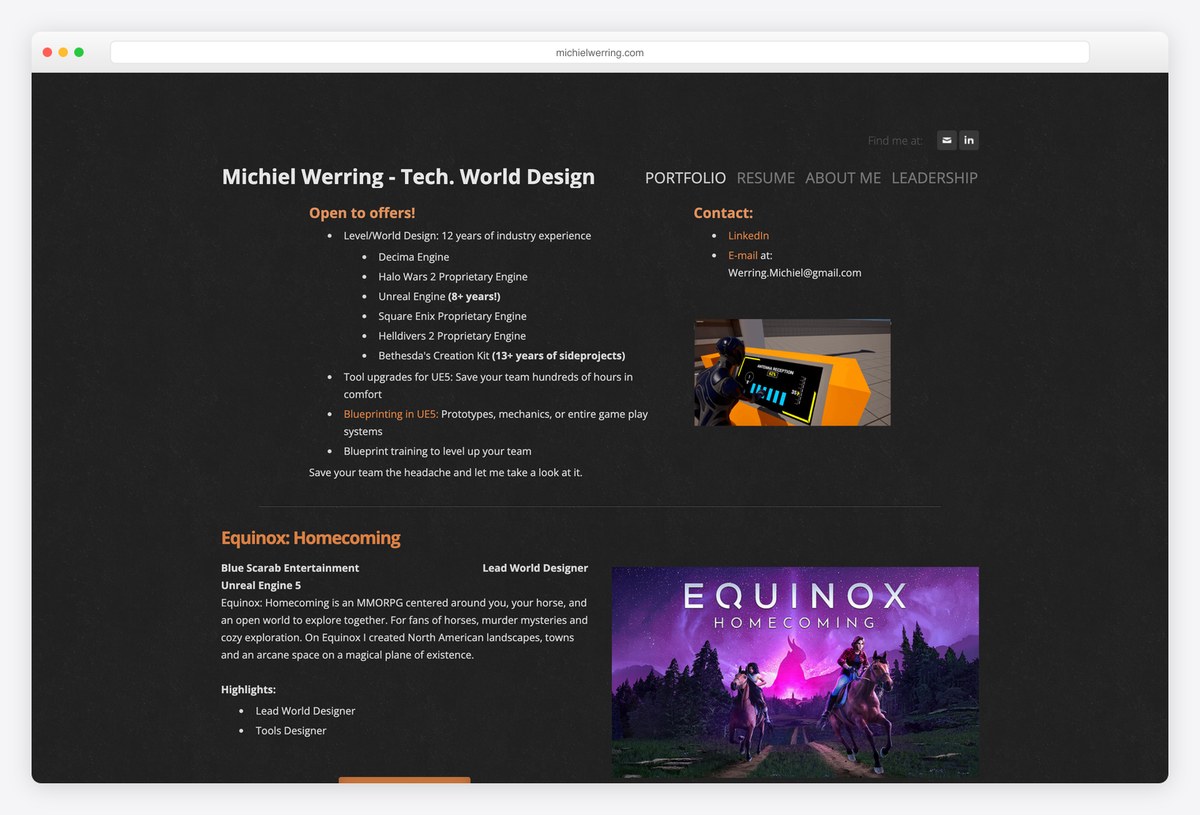
Michiel Werring, a level and world designer, opens with “Open to offers!” and a list of the engines he has worked in, from Decima and Unreal Engine to the proprietary tech behind Helldivers 2 and Halo Wars 2.
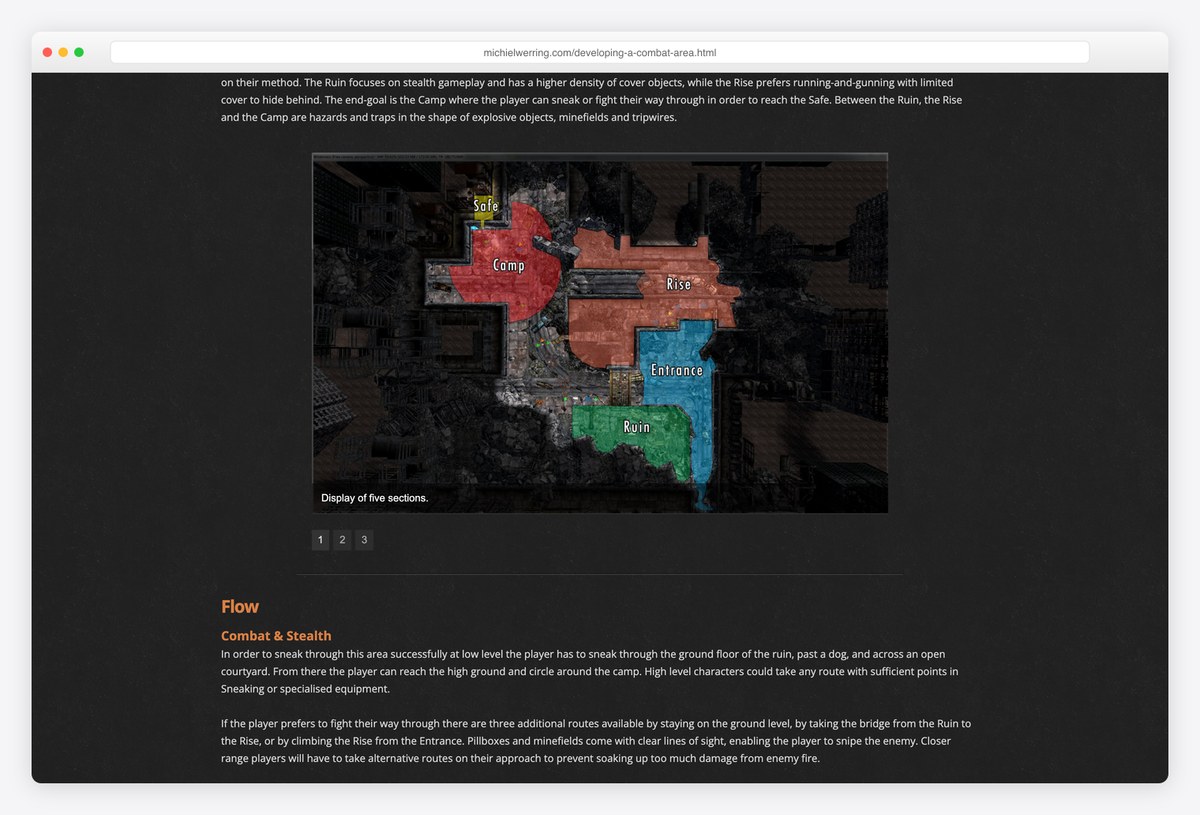
The Helldivers 2 page, where he was lead level designer, explains how he built modular kits for the team and mocked up hundreds of locations in four-minute speed builds. Older mod pages carry full level documentation, with colour-coded maps and separate stealth and combat routes.
What stands out: It shows how he works, not only what shipped.
6. Hannah Nicklin
Built with: WordPress
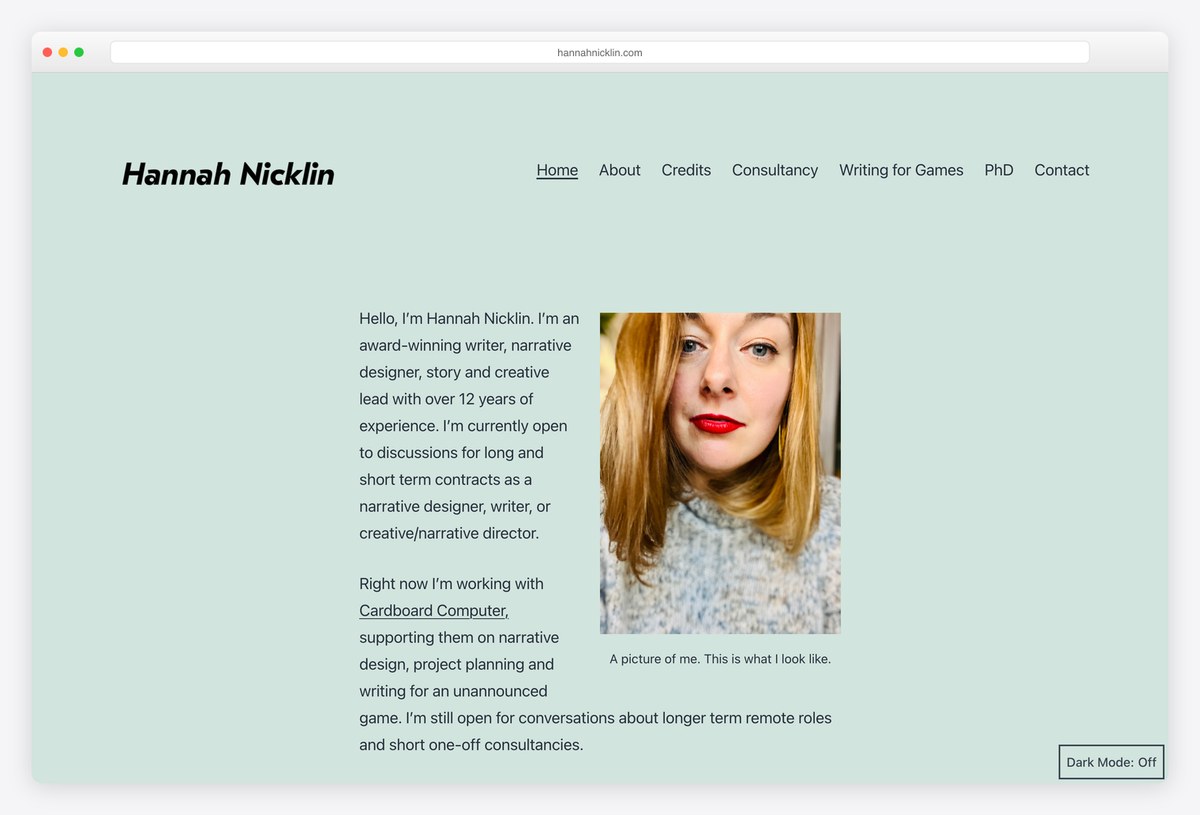
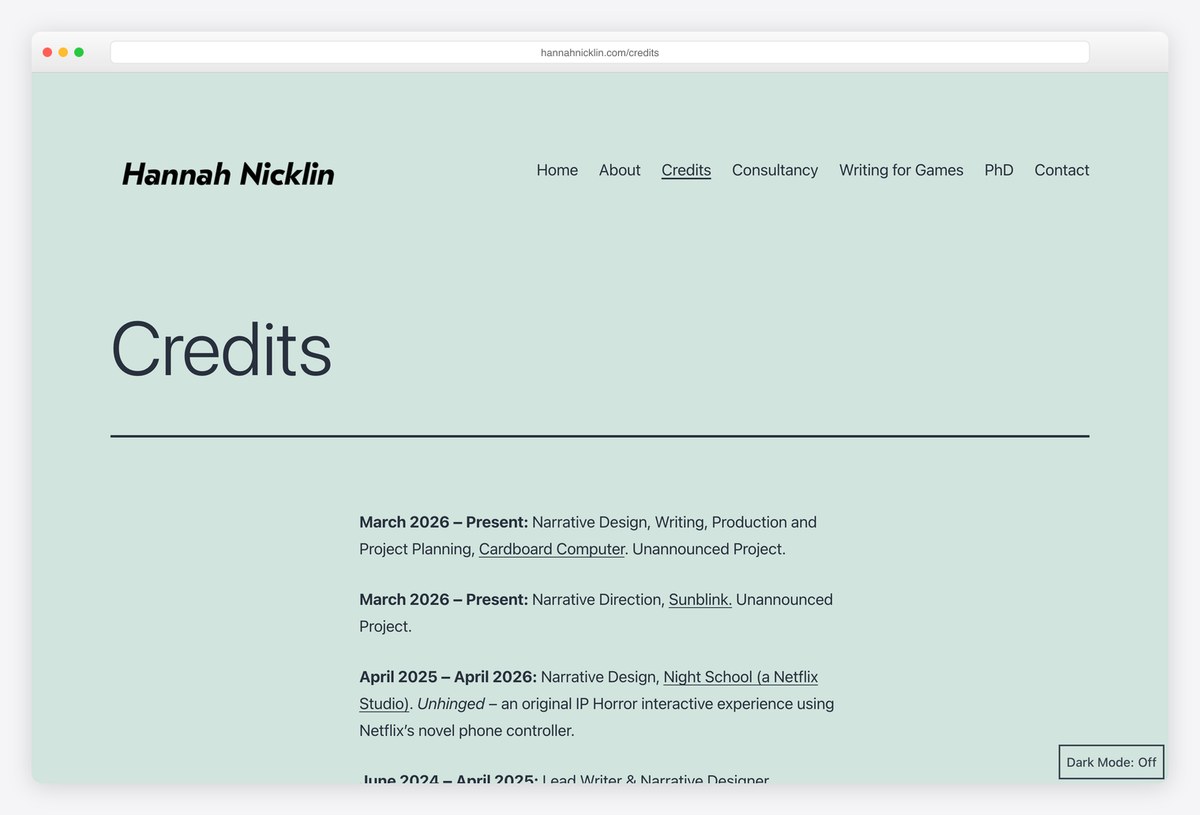
Hannah Nicklin, an award-winning narrative designer and writer, says up front that she is open to long and short contracts, then keeps a dated credits page that reads like a CV: studio, project and exact role for every contract, newest first.
It runs from current narrative work with Cardboard Computer back through Thronglets, a Black Mirror adaptation she led as writer and narrative designer, Saltsea Chronicles, which she directed, and Mutazione. Her book, Writing for Games: Theory & Practice, and her conference talks are linked as well.
What stands out: Credits that name her role on every project.
7. Josh Caratelli
Built with: Strikingly
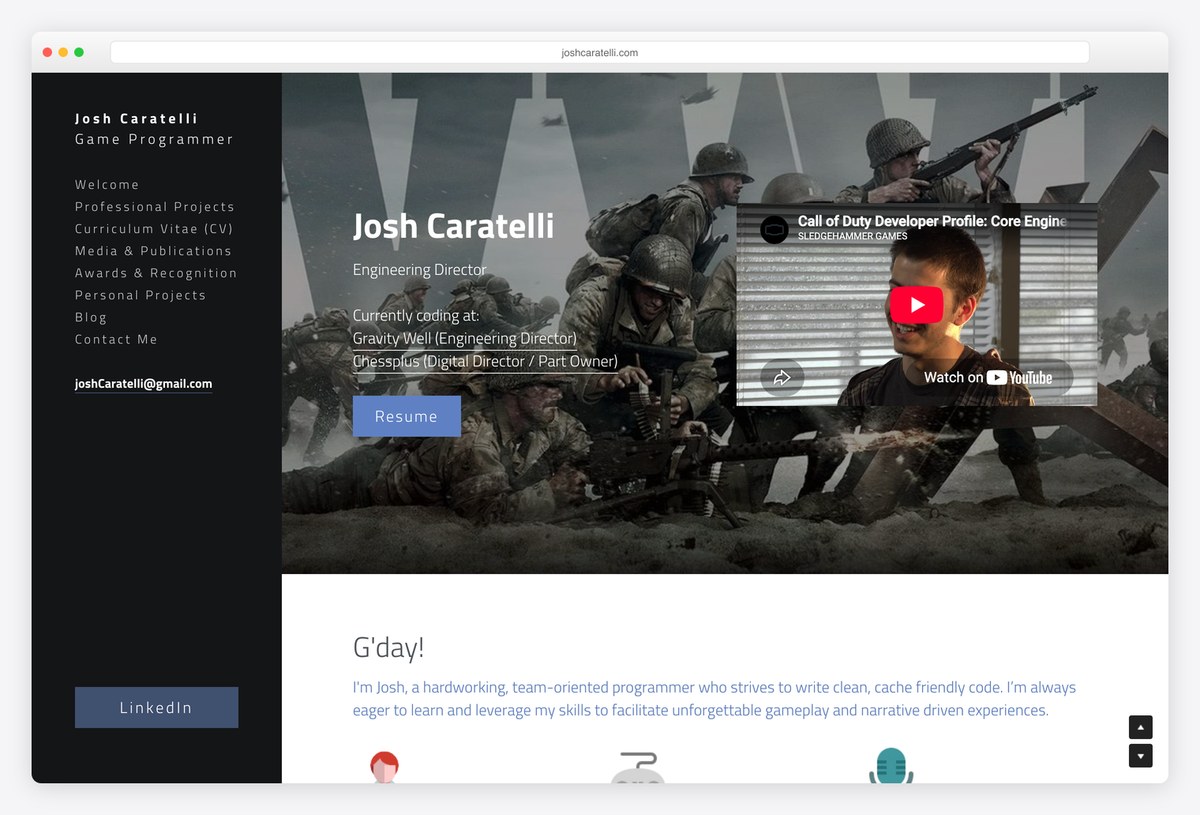
Josh Caratelli, an engineering director at Gravity Well, lists his Call of Duty work system by system. On Vanguard he was part of the destruction strike team; on Modern Warfare and Warzone he helped scale the game to support 150+ players in a large play space.
A sidebar puts professional projects, CV, talks, awards and a blog on one page, with his résumé on the first screen. He studied computer science while shipping four AAA titles, and he offers portfolio reviews, saying he has helped over 50 developers land their first role.
What stands out: He names the systems he built, not only the games.
8. Efrem Torrisi
Built with: Custom HTML (GitHub Pages)
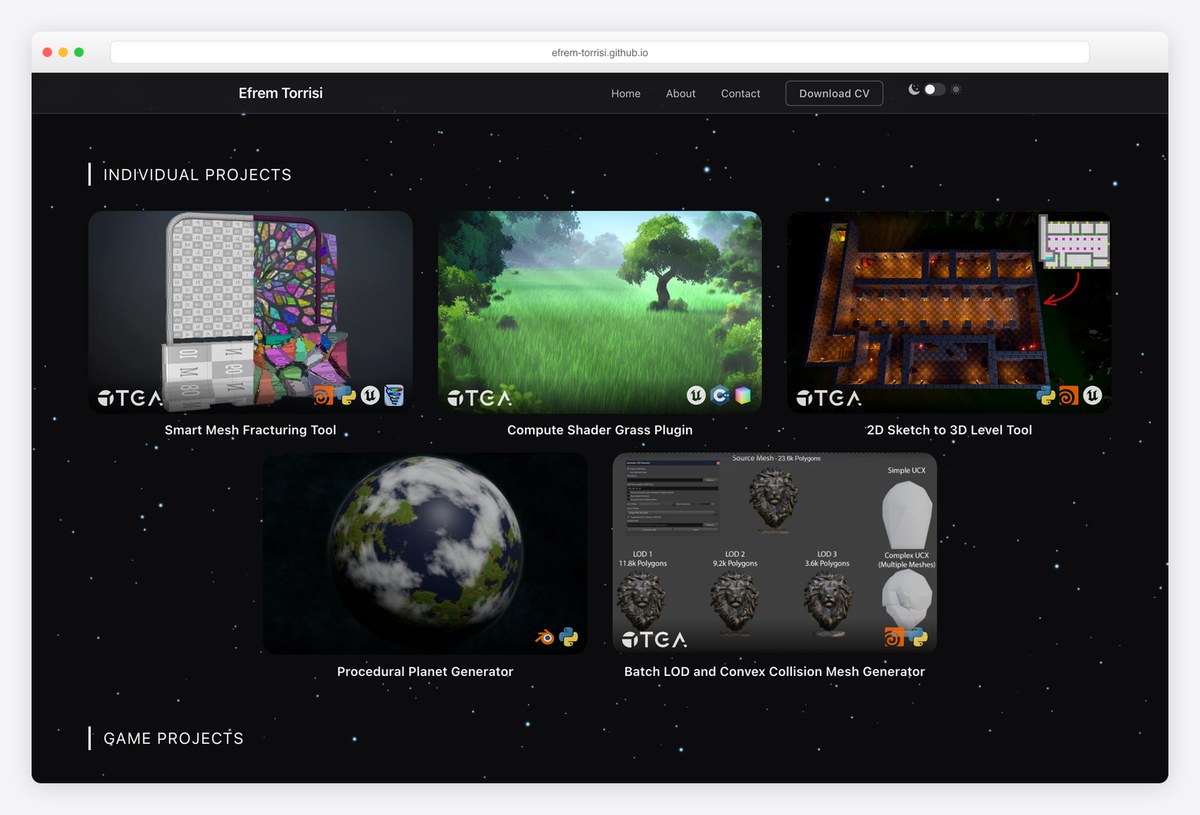
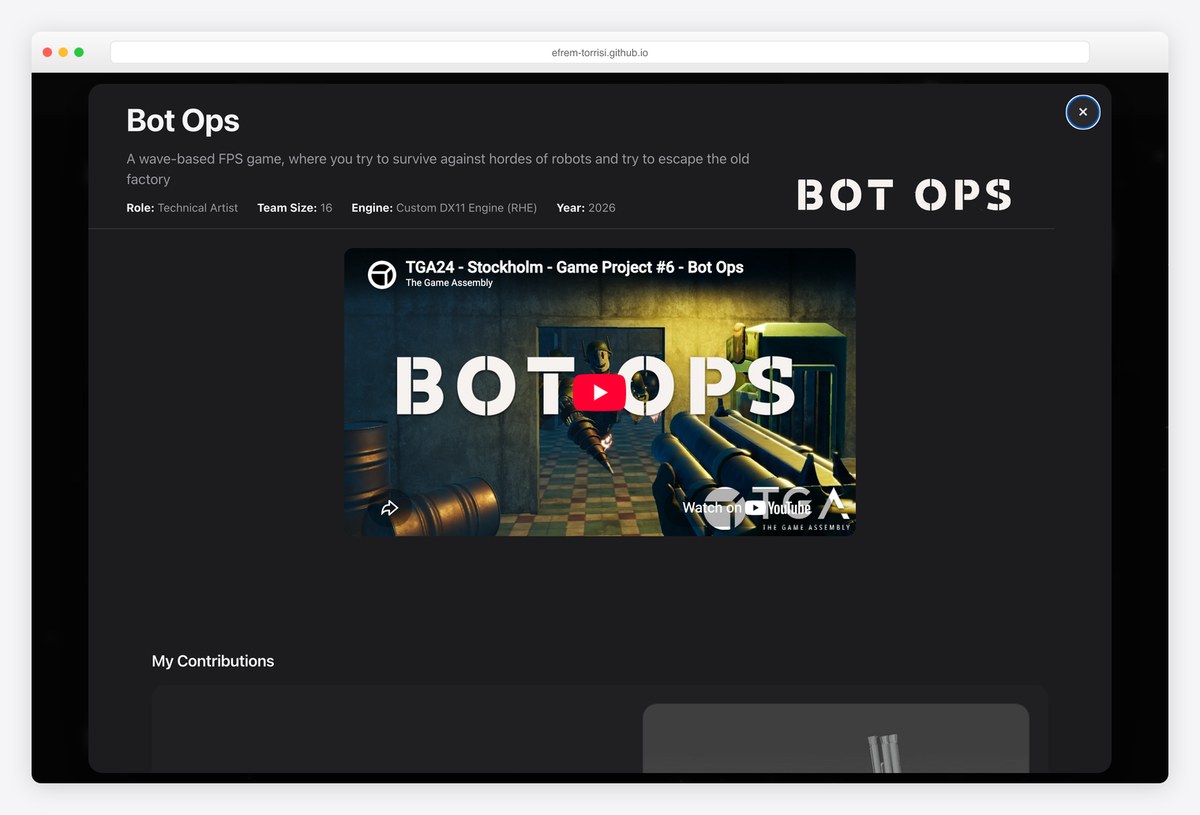
Efrem Torrisi, a technical artist with a bachelor’s degree in game design and graphics, splits his site into individual tools and team games. The tools include an Unreal Engine 5 plugin that renders millions of grass blades on the GPU, a Houdini LOD and collision tool and a Blender planet generator.
Each project opens at its own link with role, tools, team size and year. On Bot Ops, a team of 16 on a custom DX11 engine, he built the first-person rig and matched the camera bone to the engine’s field of view. His CV is in the menu.
What stands out: Tools with a clear technical breakdown.
9. Max Pears
Built with: WordPress
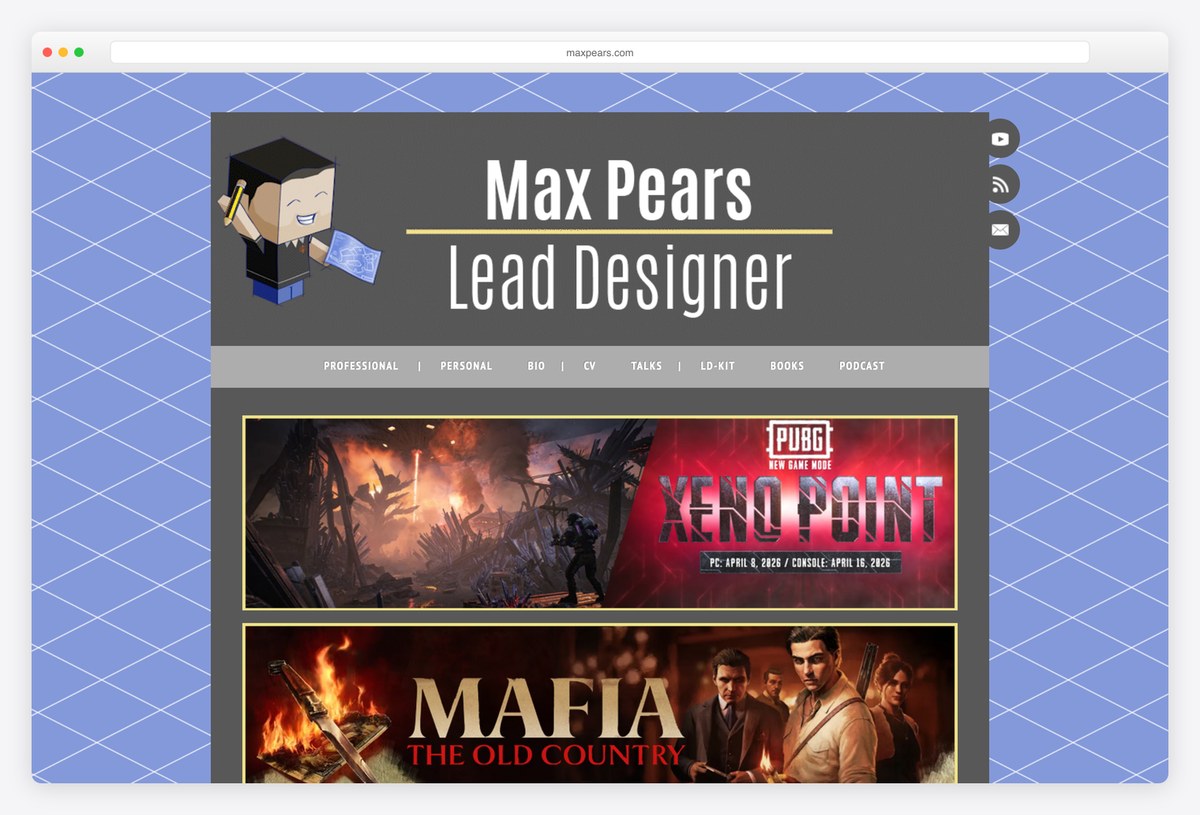
Max Pears, a lead level designer, writes up each project like a design review. Every post opens with the game, platforms, genre, engine, his role and the dates, then walks through the goals and the decisions behind the level.
On PUBG: Xeno Point he describes leading a team of four level designers; on Mafia: The Old Country he pins his stealth section to exact timestamps in a gameplay video. His CV, talks and a level design podcast sit in the menu.
What stands out: Role, dates and engine at the top of every project.
10. Jack Morehart
Built with: Cargo
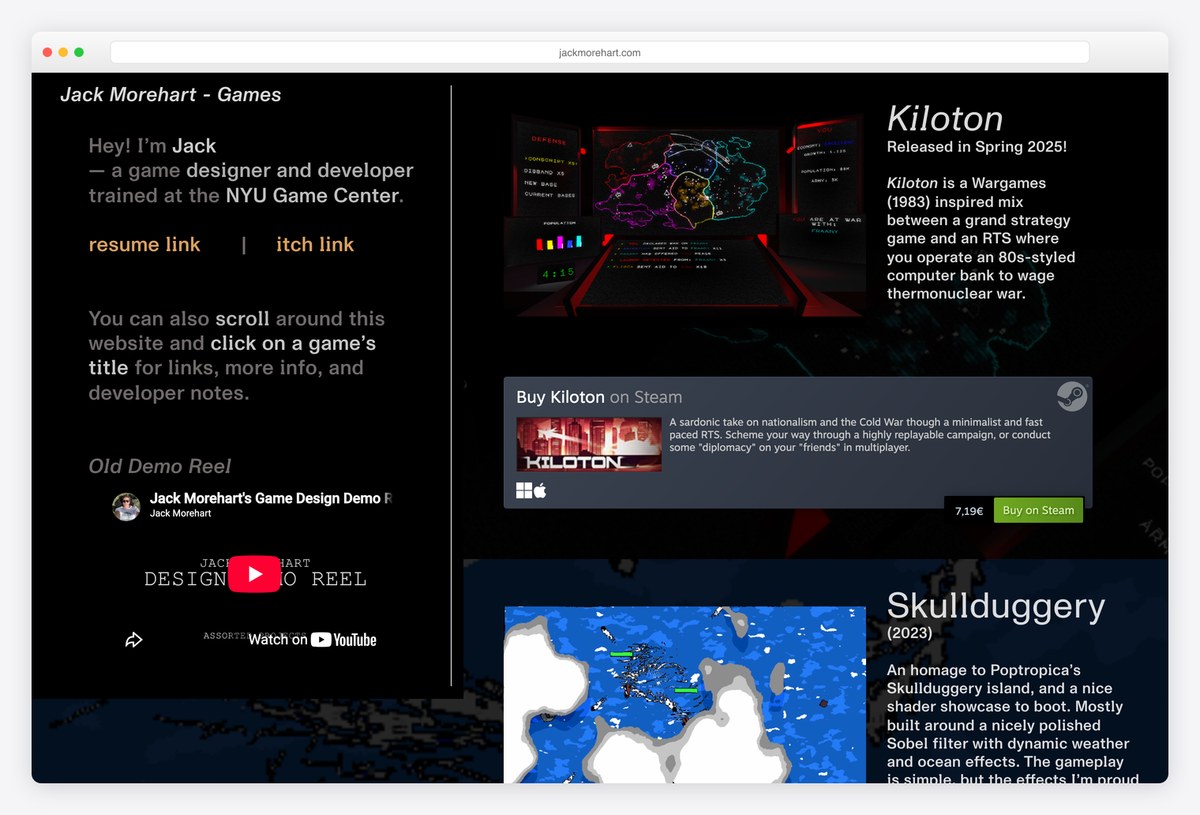
Jack Morehart, a game designer and developer trained at the NYU Game Center, links his résumé and itch.io page in his first sentence. His lead project, Kiloton, a cold-war RTS inspired by WarGames that he made during college, is on Steam.
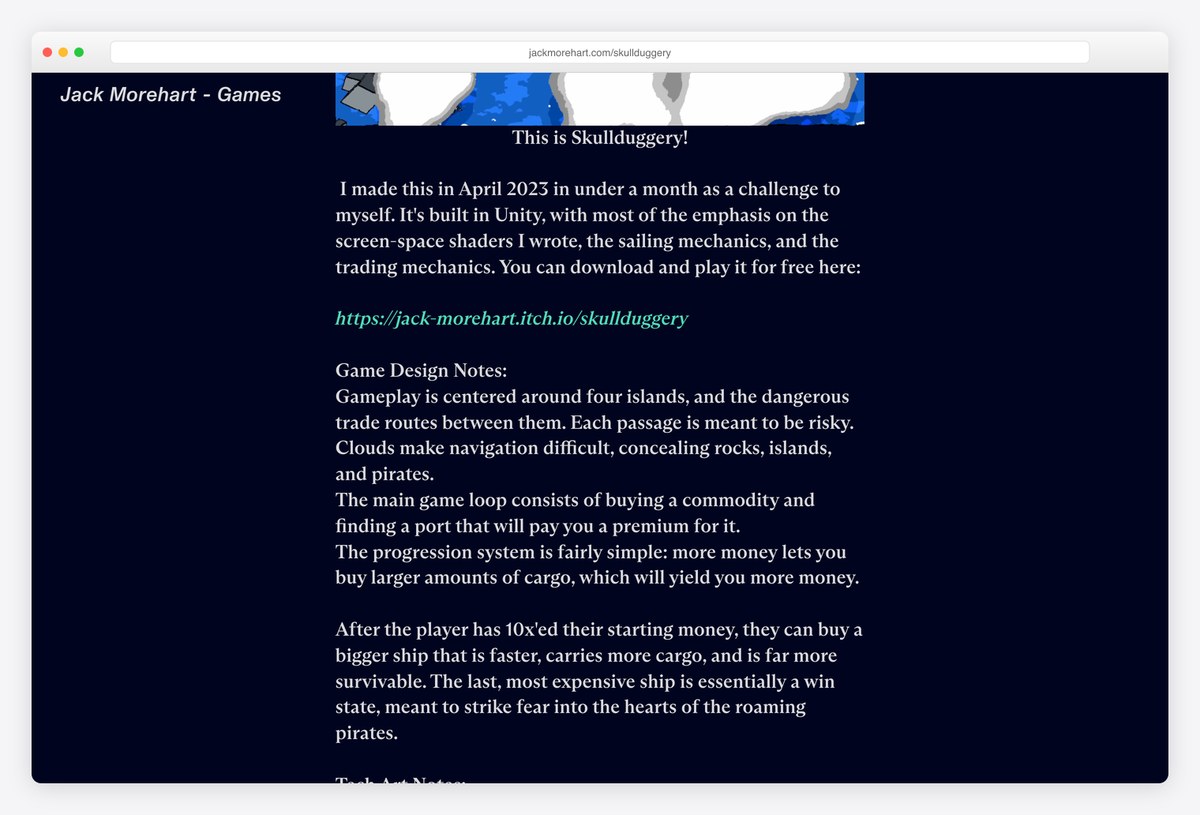
Each game page carries developer notes. For Skullduggery, built in Unity in under a month, he separates game design notes from tech art notes and explains the Sobel filter and sea shader he wrote. Class projects name the course and the team size.
What stands out: Developer notes that explain both design and tech.
11. Molly Jameson
Built with: Jekyll (Amazon S3)
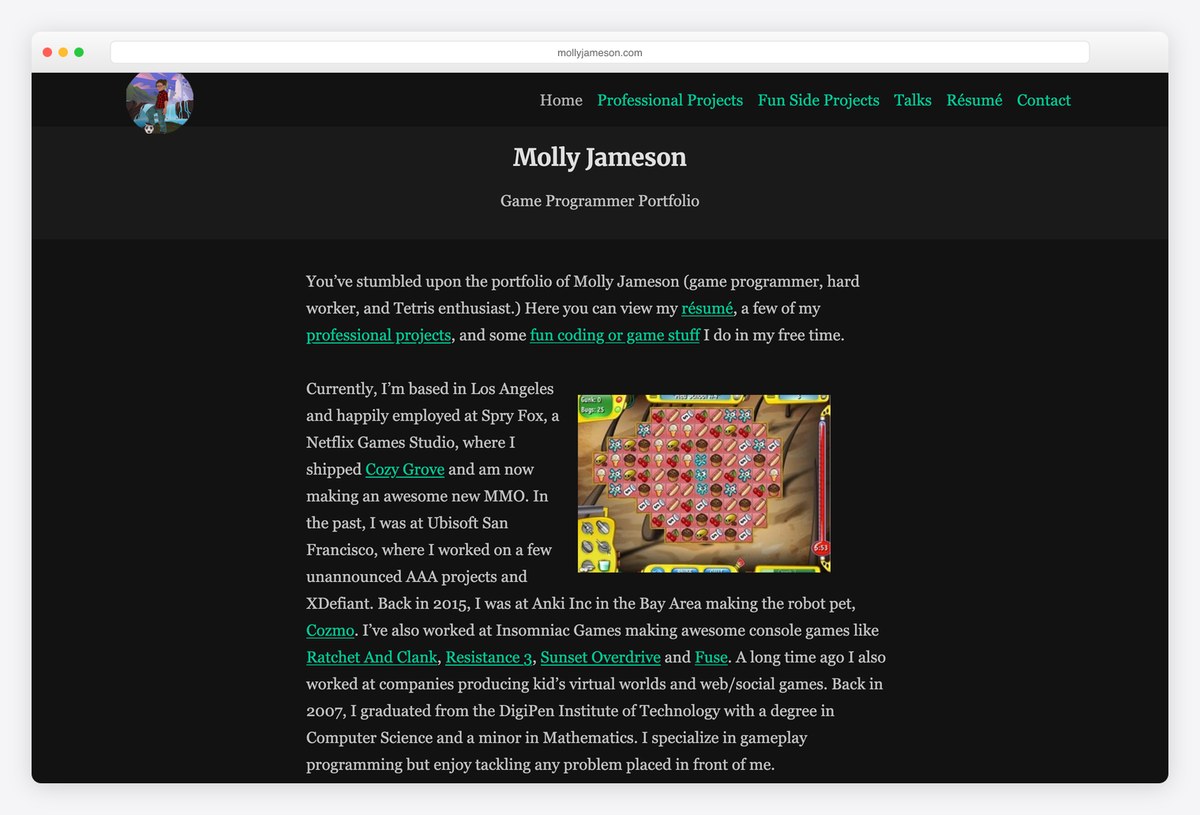
Molly Jameson, a gameplay programmer in Los Angeles, names the tech stack in every project heading, such as Cozy Grove (Unity C#) and Cozmo (C++/C#/Python). Her Cozy Grove notes cover clothing built on Spine skins, input switching between touch, mouse and gamepad, and localization into over 15 locales.
Her résumé is a web page as well as a PDF, and it opens with shipping over a dozen titles across console, PC, web and mobile. Her credits run from Insomniac’s Ratchet And Clank and Resistance 3 to Spry Fox, a Netflix Games Studio. She is a DigiPen graduate.
What stands out: Every project names the language and engine.
12. Anna Parmentier
Built with: Koken
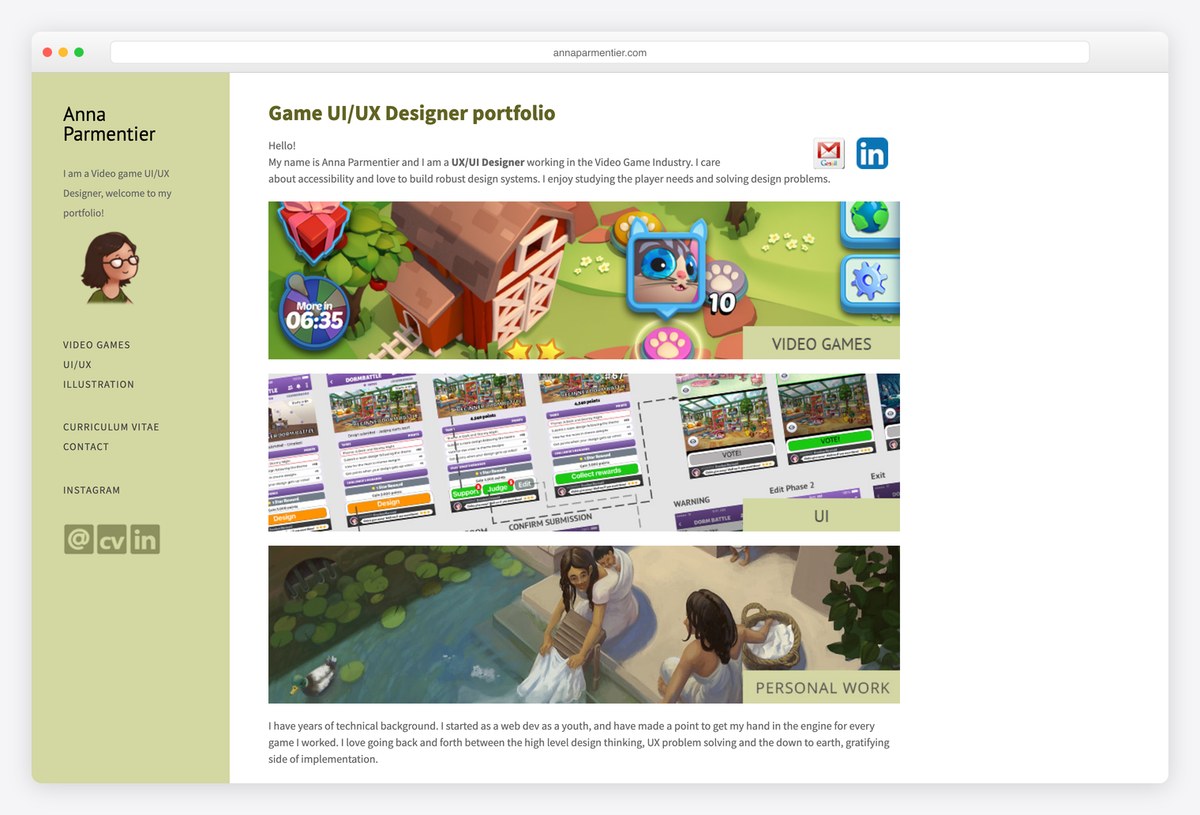
Anna Parmentier, a game UI/UX designer in Vancouver, puts screens from her games on the first page and writes each project up like a spec sheet: genre, platforms, engine, business model, dates and her tasks.
Her Minecraft Legends page covers a launch in 31 languages on five platforms and her work extending accessibility, including flows for text-to-speech and screen narration. She also worked on Homeworld 3 as a tech UX designer. The site runs on Koken, a self-hosted portfolio system.
What stands out: Accessibility work described in detail.
13. Noel Berry
Built with: Custom static site, own C# generator
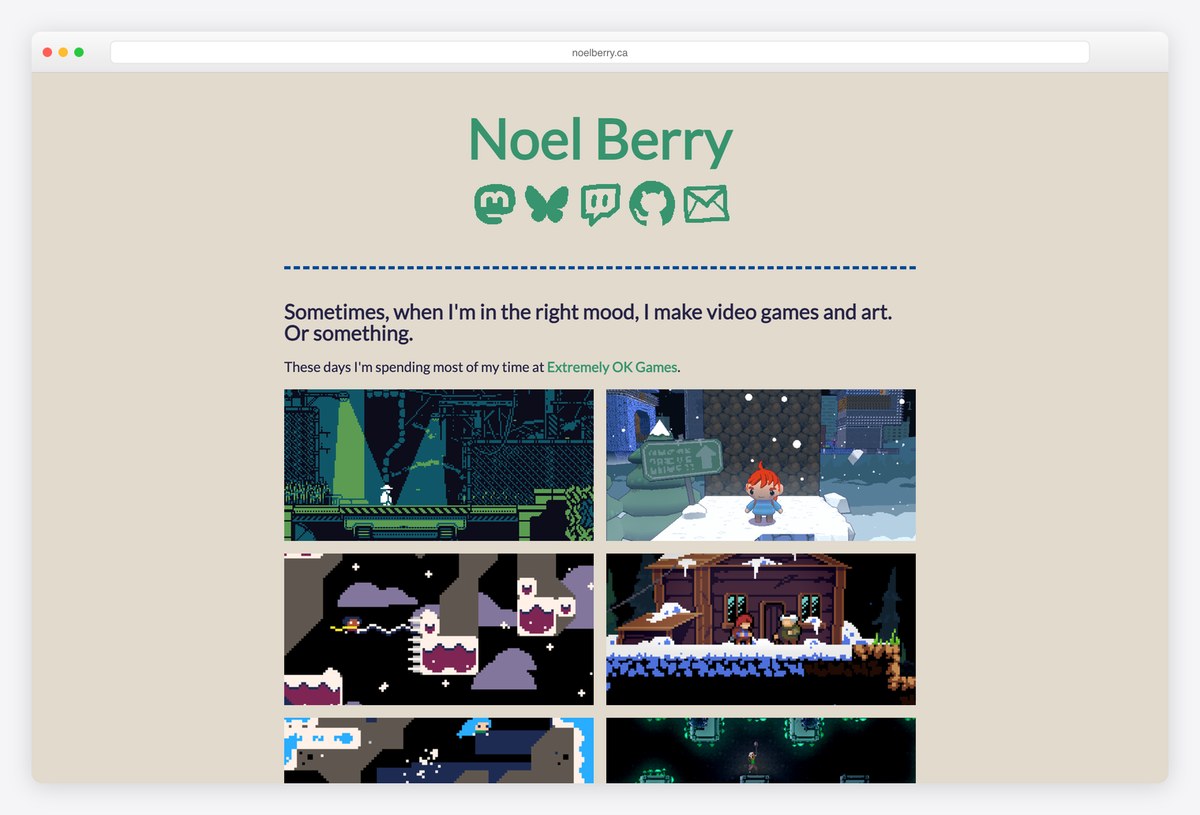
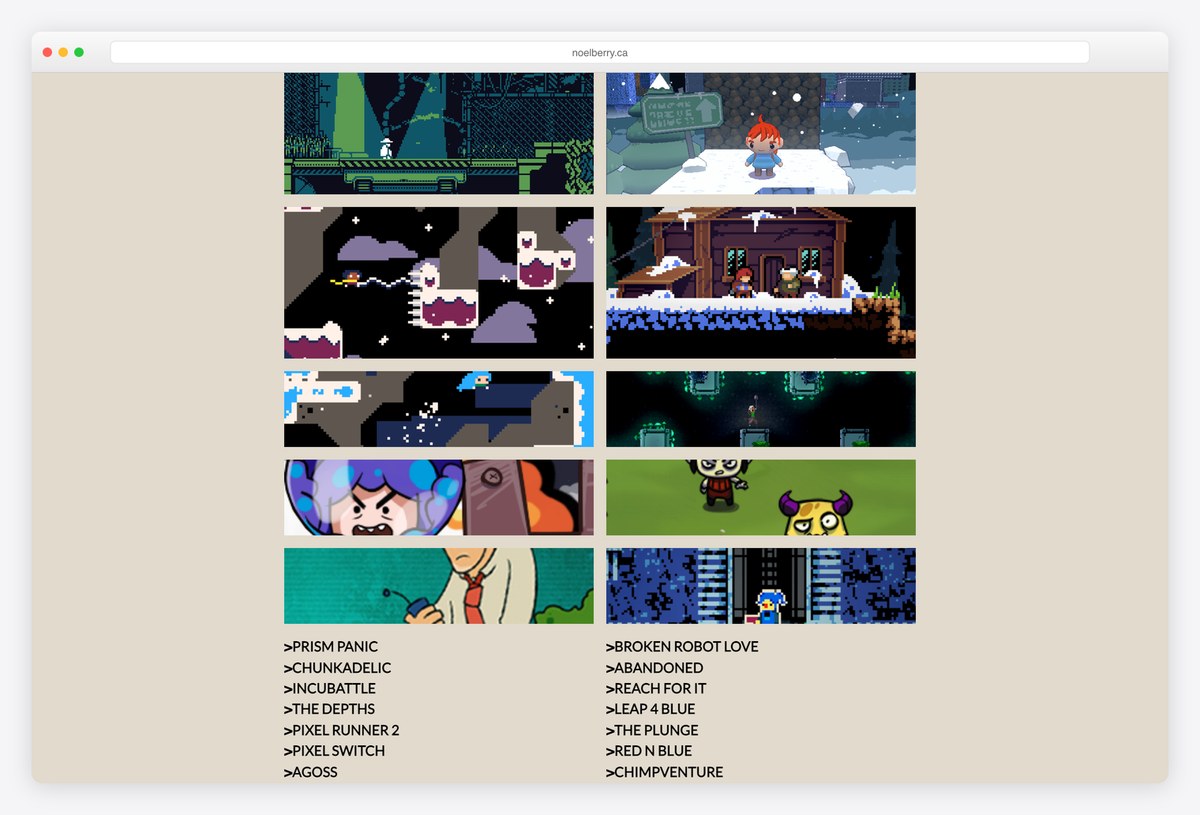
Noel Berry, co-creator of Celeste, keeps a grid of animated game thumbnails, from Celeste and Celeste 64 to City of None, an upcoming game made with his brother. The tone is relaxed: he makes games and art “when I’m in the right mood”.
Two long posts sit on the home page, one on how he makes games without an engine and a technical breakdown of Celeste’s lighting. The site is generated by his own small C# tool, and he links its source code on GitHub.
What stands out: Technical writing that explains how his games work.
14. Angel Georgiev
Built with: Custom HTML (GitHub Pages)
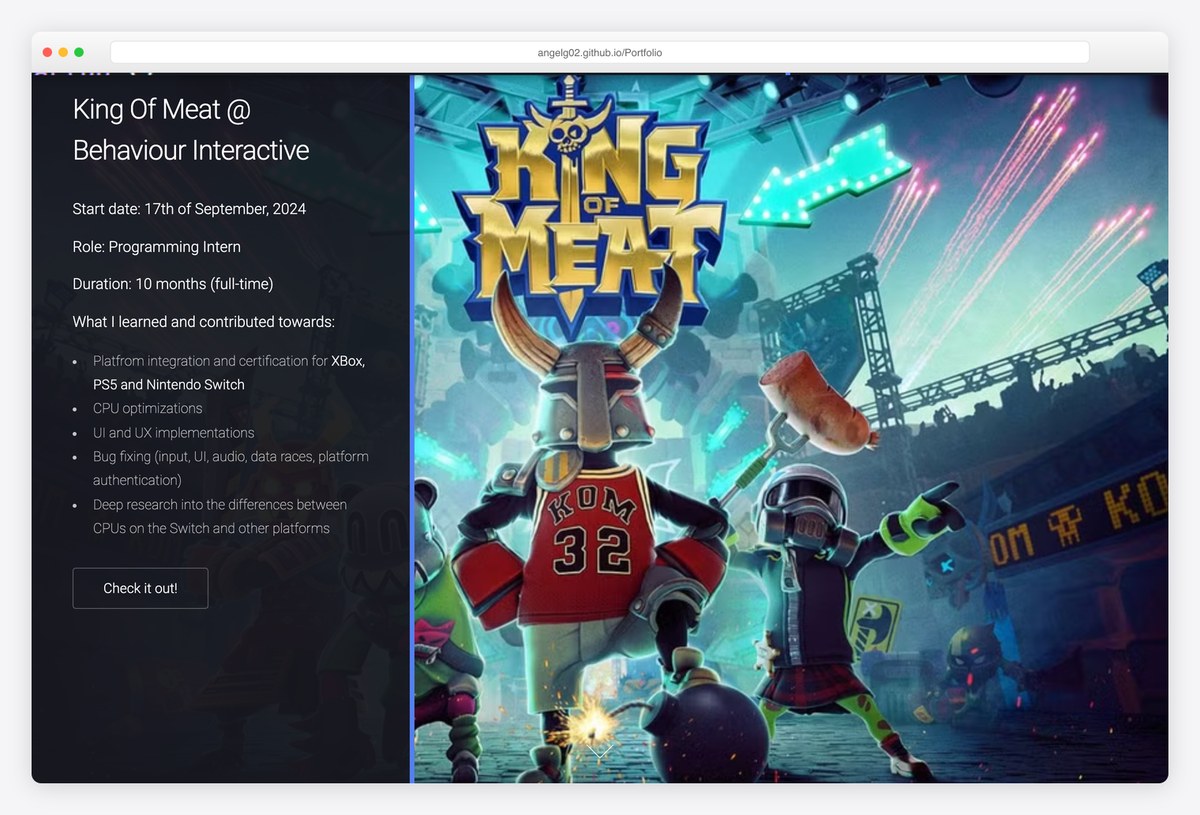
Angel Georgiev, an engine programmer who graduated from Breda University of Applied Sciences, presents each project as a slide with where it was made, his role, the duration, the team size and what he contributed.
The range is wide: a 10-month programming internship at Behaviour Interactive on King of Meat, climbing and vaulting on Sicaria with a team of 40 students, and Sunset, a Rust and WebGPU engine with a sandbox you can try in the browser. Most projects link to GitHub.
What stands out: Team size and duration on every project.
15. Nawaf Bahadur
Built with: Wix
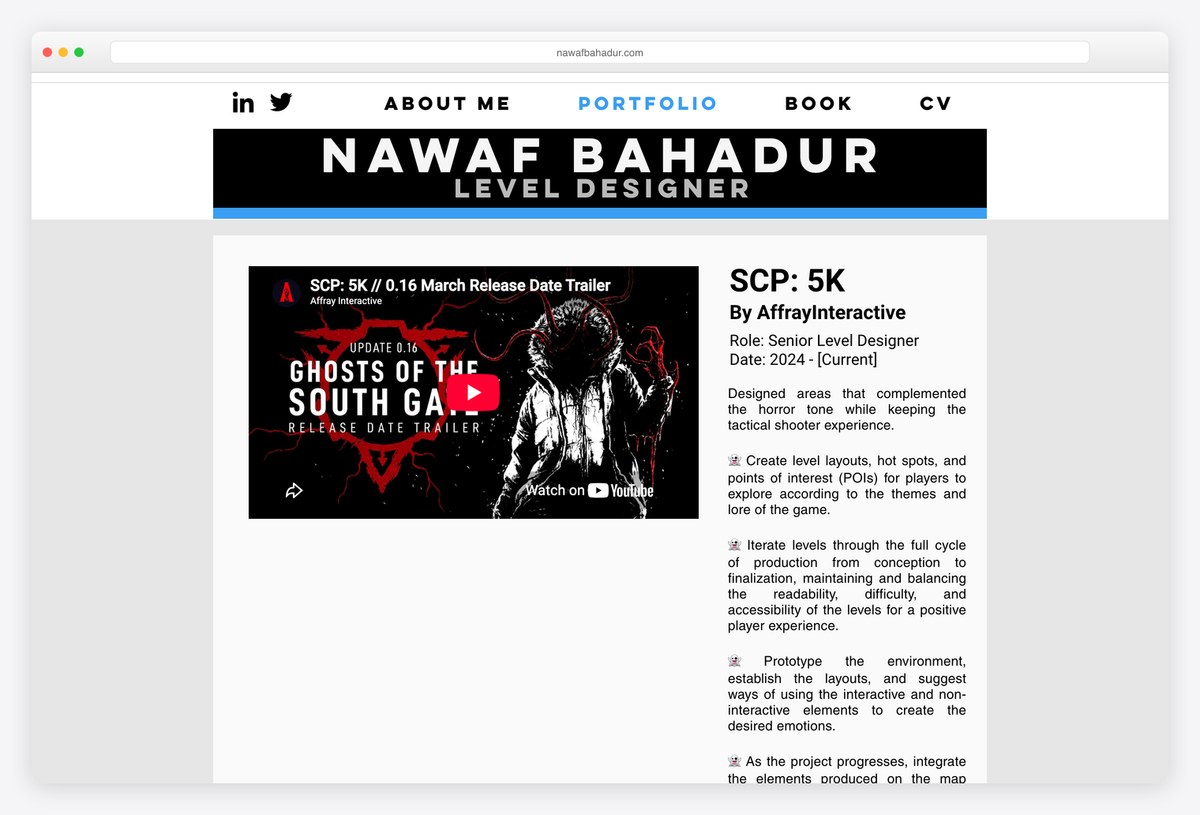
Nawaf Bahadur, a senior level designer in Canada, gives every shipped game the same block: studio, role, dates, responsibilities and a trailer, from the horror shooter SCP: 5K back to Riverbond. Onward, he notes, is one of the most-played games on Meta Quest.
His personal work goes deeper. The Ubisoft NEXT level page lists engine, duration, team size and role, explains the stealth and run-and-gun routes, and offers a Windows build to download; it took third place. He also shares a PDF book of 55 design concepts.
What stands out: Playable builds and process for his personal work.
16. Francisco Múrias
Built with: Custom HTML (GitHub Pages)
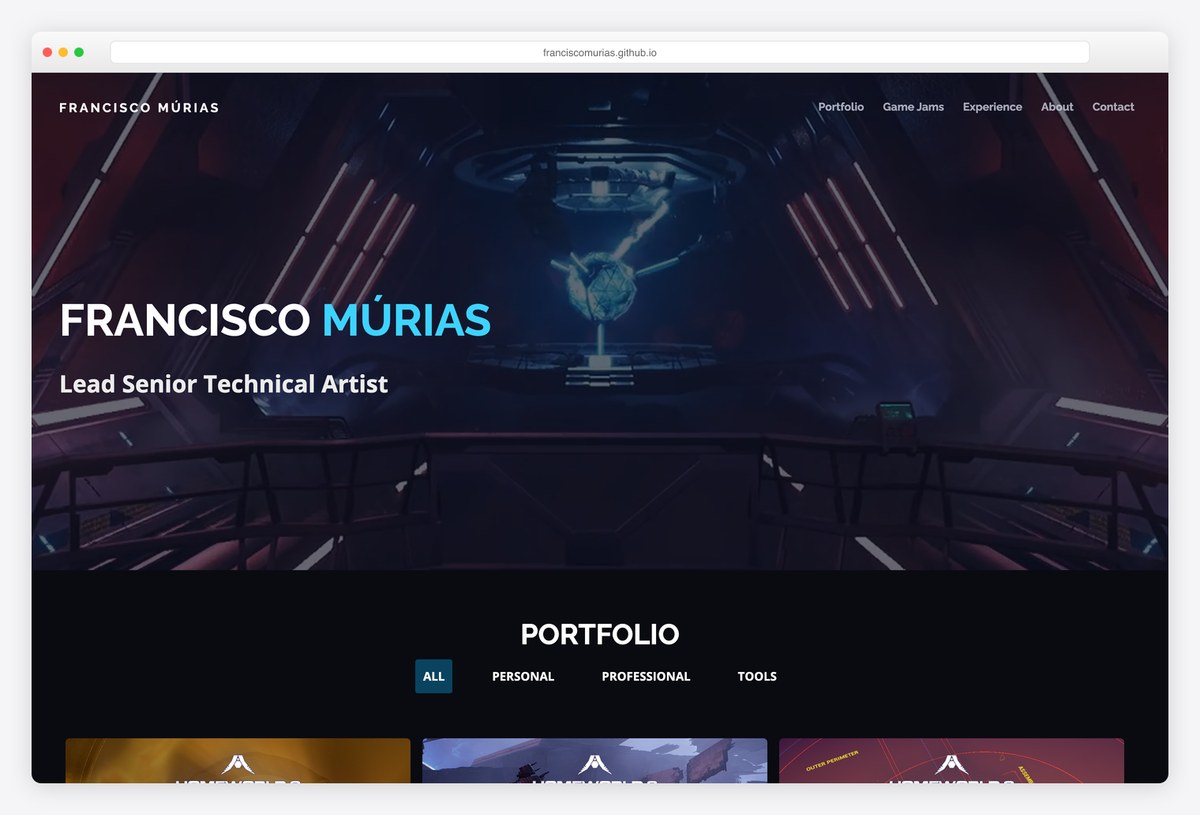
Francisco Múrias, a technical artist, worked on Homeworld 3 at Blackbird Interactive and shows each system separately: volumetric raymarched nebulas, destruction with splat-driven damage and an automated debris pipeline, asteroids and procedural tools.
The grid filters by personal, professional and tools, and each tile opens a video with a one-line summary. Studio work carries a short notice crediting the rights holder, a good habit when showing a client’s game. His master’s thesis on machine learning terrain authoring is here too.
What stands out: Each system is separate, so a lead can see what he owned.
17. Jorge Jimenez
Built with: WordPress
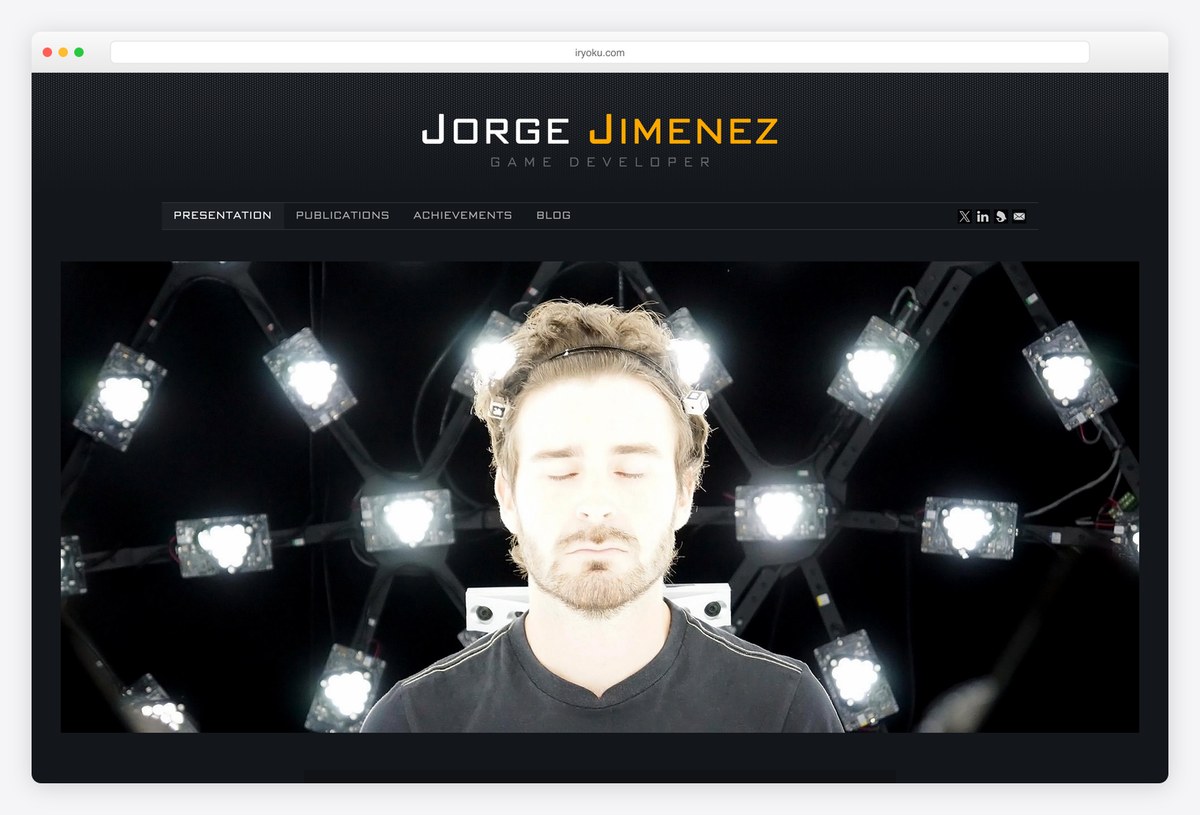
Jorge Jimenez, also known as Iryoku, is a graphics programmer with over 19 years of experience who directed the technical visuals of The Callisto Protocol and now leads technology at Striking Distance Studios. Before that he was a graphics R&D technical director at Activision Blizzard, working on Call of Duty.
A publications page lists his SIGGRAPH and GDC talks with slides and papers, including SMAA and separable subsurface scattering, and an achievements page logs his career as dated, game-style unlocks. His résumé is linked from the home page.
What stands out: Published research alongside shipped games.
18. Lucas Zakaria
Built with: Google Sites
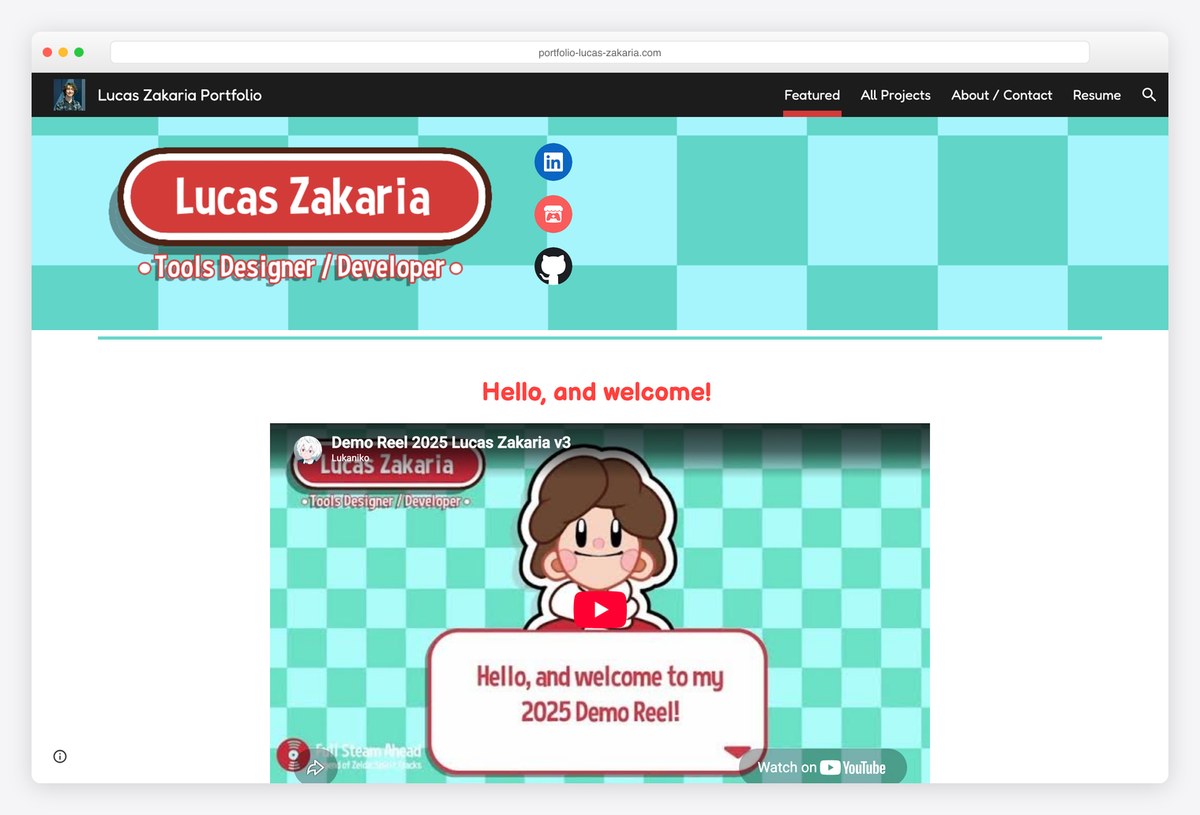
Lucas Zakaria, a tools programmer and designer, tags every project by discipline, such as game design, programming and UI/UX, and opens with a demo reel. He placed second in the Ubisoft NEXT game design competition, and his write-up shows each phase with lessons learned.
The Tom and Foolery’s Tavern page starts from design goals for a moving-platform tool, including “Intuitive to Use”, then links the editor gizmo code. It is all built on Google Sites, proof that a clear student portfolio needs no custom code.
What stands out: Tools designed around what teammates need.
19. Sean Gorman
Built with: Wix
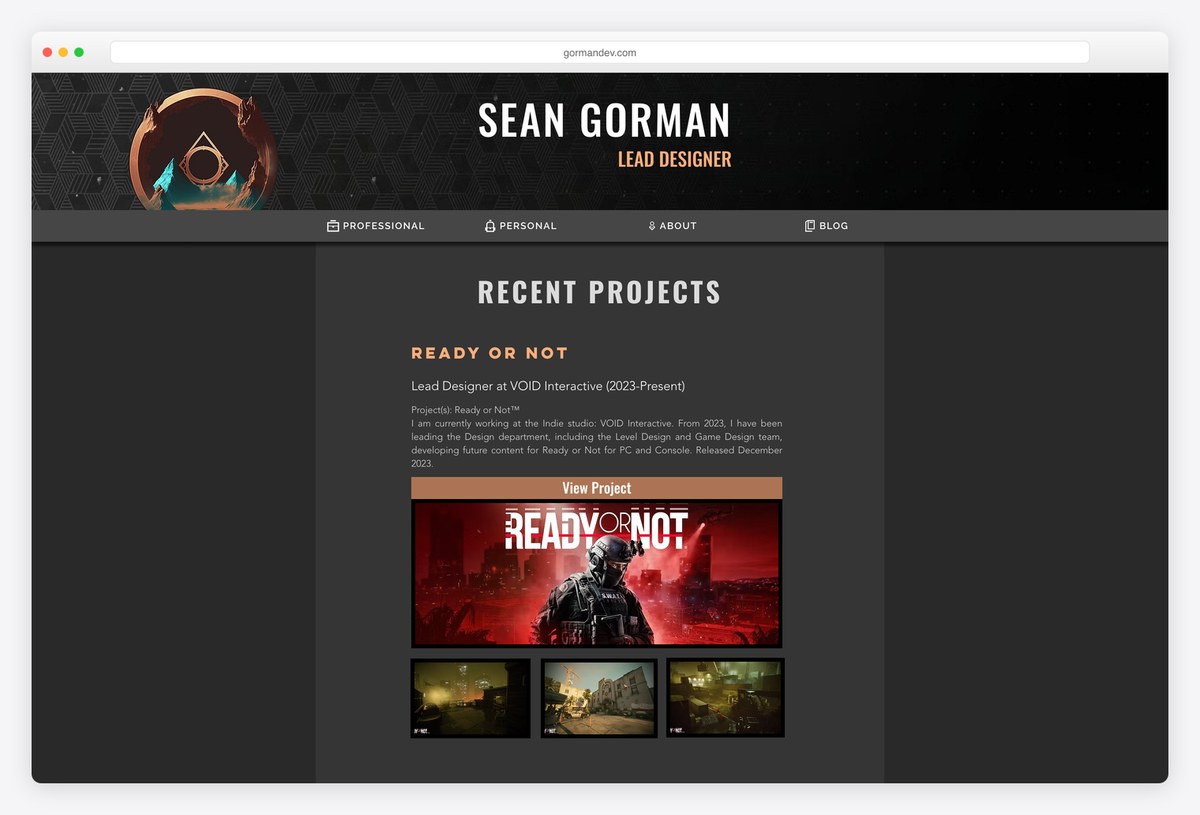
Sean Gorman’s site traces a whole career path, from real-time art intern and environment artist to lead designer at VOID Interactive on Ready or Not. Each role lists the studio, the dates and what he owned.
The Ready or Not page spells out leading a level design team of 4-5 designers and setting up the level design pipeline for DLC. For Suicide Squad at Rocksteady he explains that he spent his first two years as an environment artist before moving into level design, and his course blockouts sit under Personal.
What stands out: A clear path from art to lead design, told role by role.
20. Tom Francis
Built with: WordPress
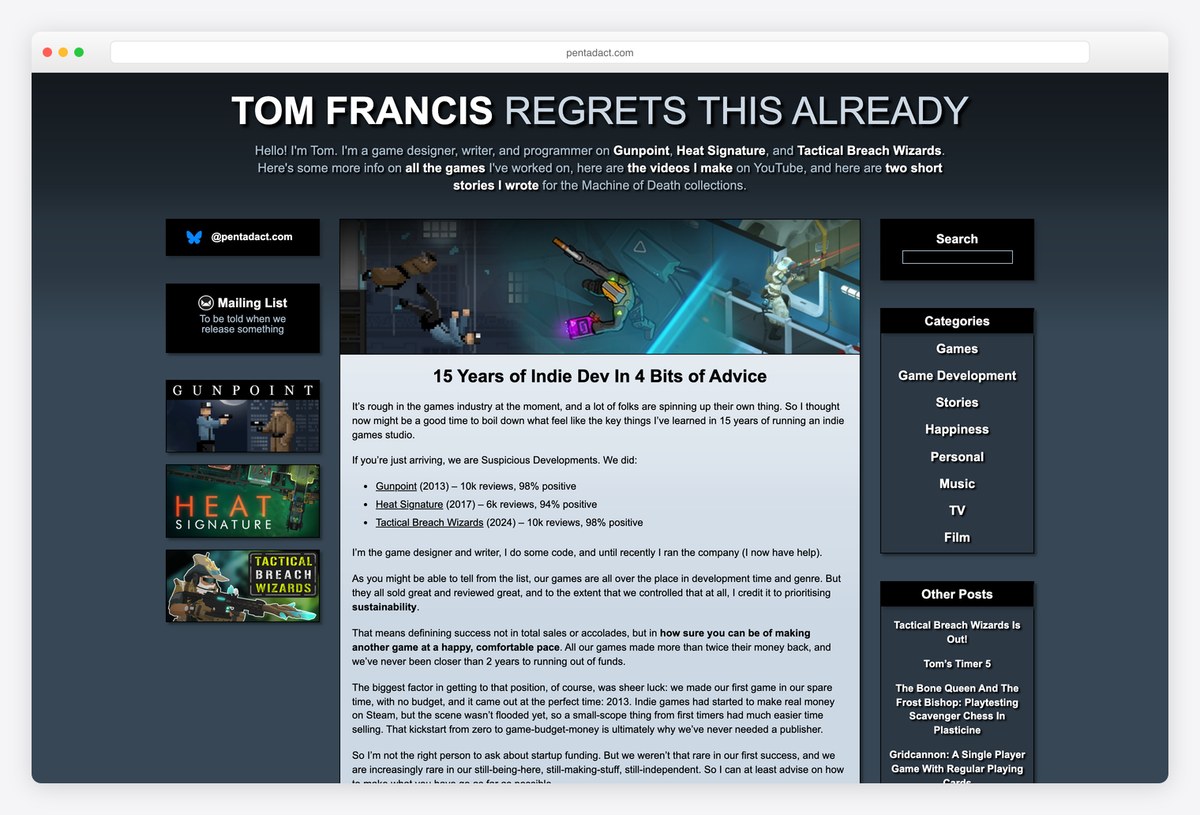
Tom Francis, designer, writer and programmer on Gunpoint, Heat Signature and Tactical Breach Wizards, runs his portfolio as a blog. A pinned page lists every game he has worked on, with the questions people usually ask about each one.
Posts embed trailers, dev log videos and a Steam widget, and he writes design essays about other games, from XCOM to Hitman. A recent post boils down what he has learned running Suspicious Developments, where every game made more than twice its money back.
What stands out: A long public record of design thinking.
21. Germán López
Built with: WordPress
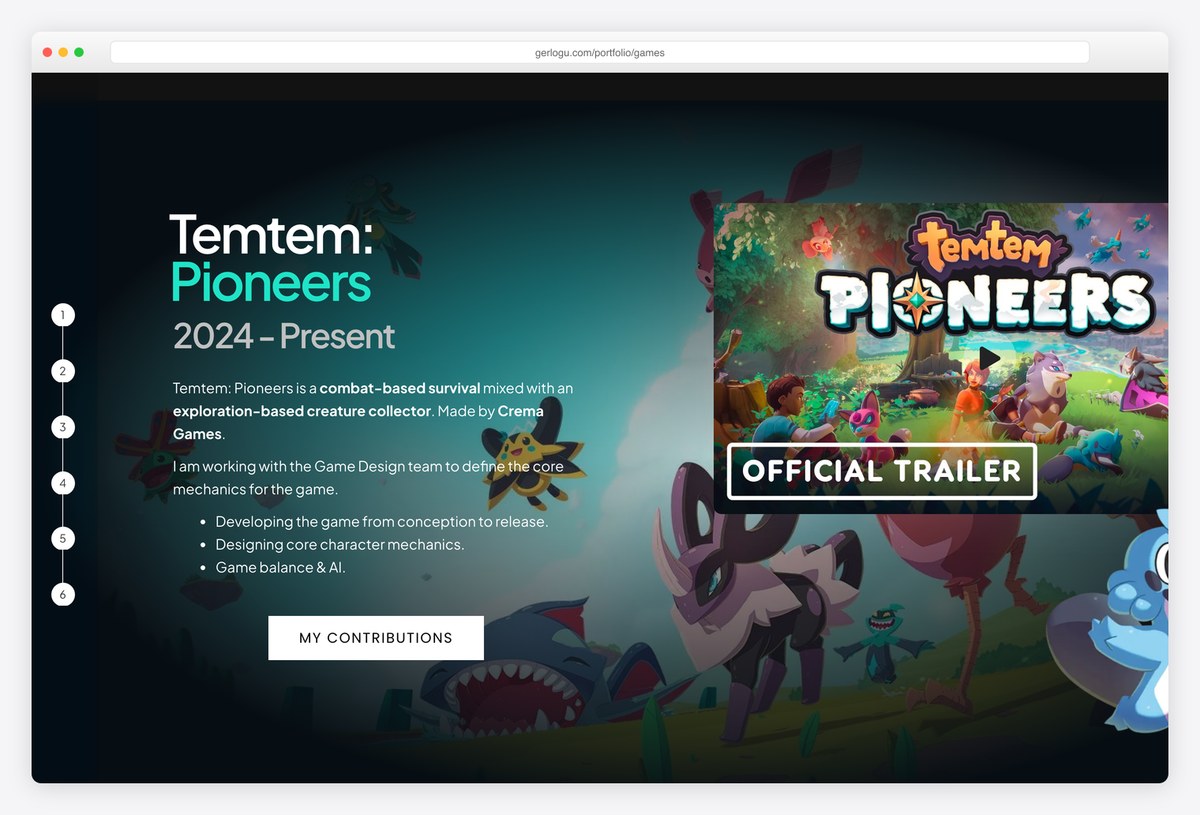
Germán López is a game designer specialised in combat, working at Crema on Temtem: Pioneers and teaching at U-tad. His games page lists each title with the years, a one-line pitch and his contributions, from Vigor at Bohemia Interactive to his master’s project, Howl of Iron.
He backs the design role with tools. Four of his systems, including a graph dialogue system and a bullet hell editor, are public on GitHub, and a blog post breaks down enemy AI and behavior trees using F.E.A.R. as the case study.
What stands out: A designer who shows the tools and the reasoning.
22. Liam O’Connell
Built with: Weebly
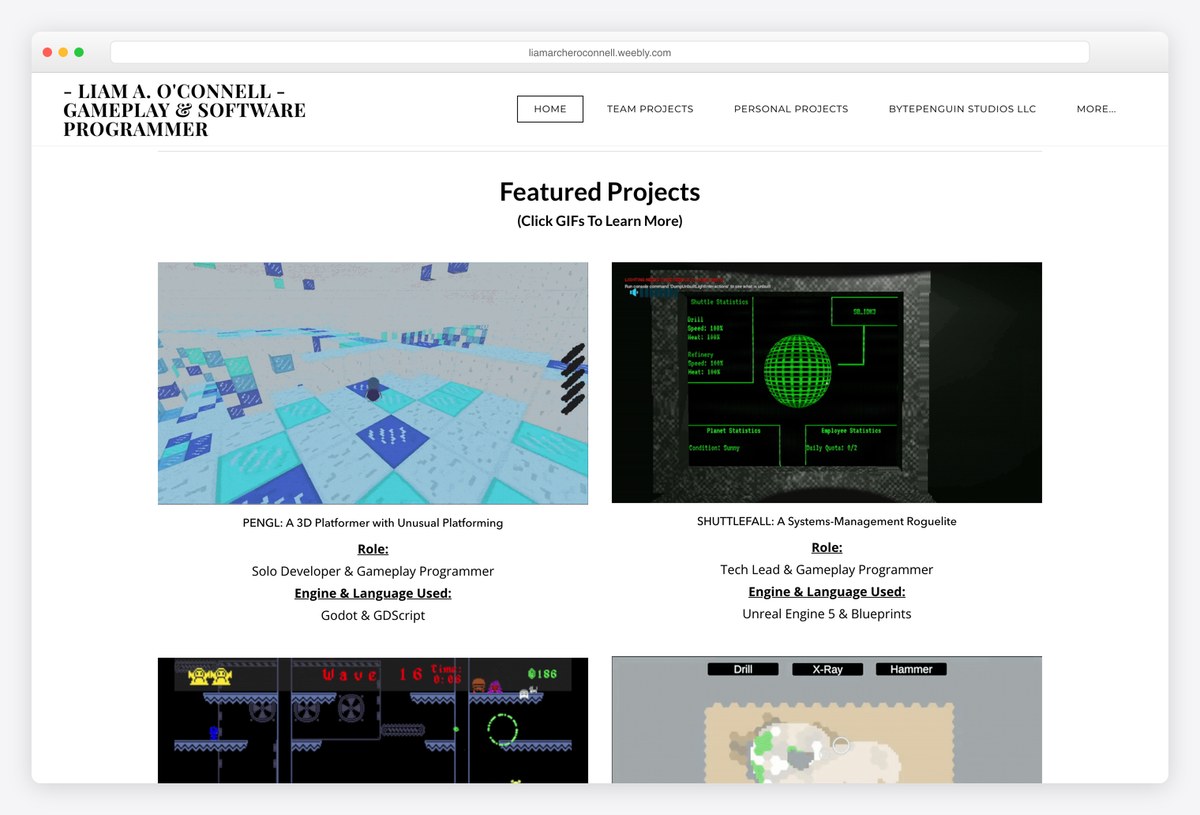
Liam O’Connell, a DigiPen-trained gameplay programmer, gives each featured project two lines under its GIF: his role, and the engine and language. They range from Godot and GDScript to Unity, Unreal Engine 5 and a custom C++ engine.
HexenHold, a tower defense platformer, was built by 5 programmers and 3 designers on the team’s own engine; his page covers the entity component system and the Dear ImGui debug tools he made. A separate page lets you download his endless-wave spawner code.
What stands out: Code samples you can download and read.
23. Arnaud Vanderveken
Built with: Odoo
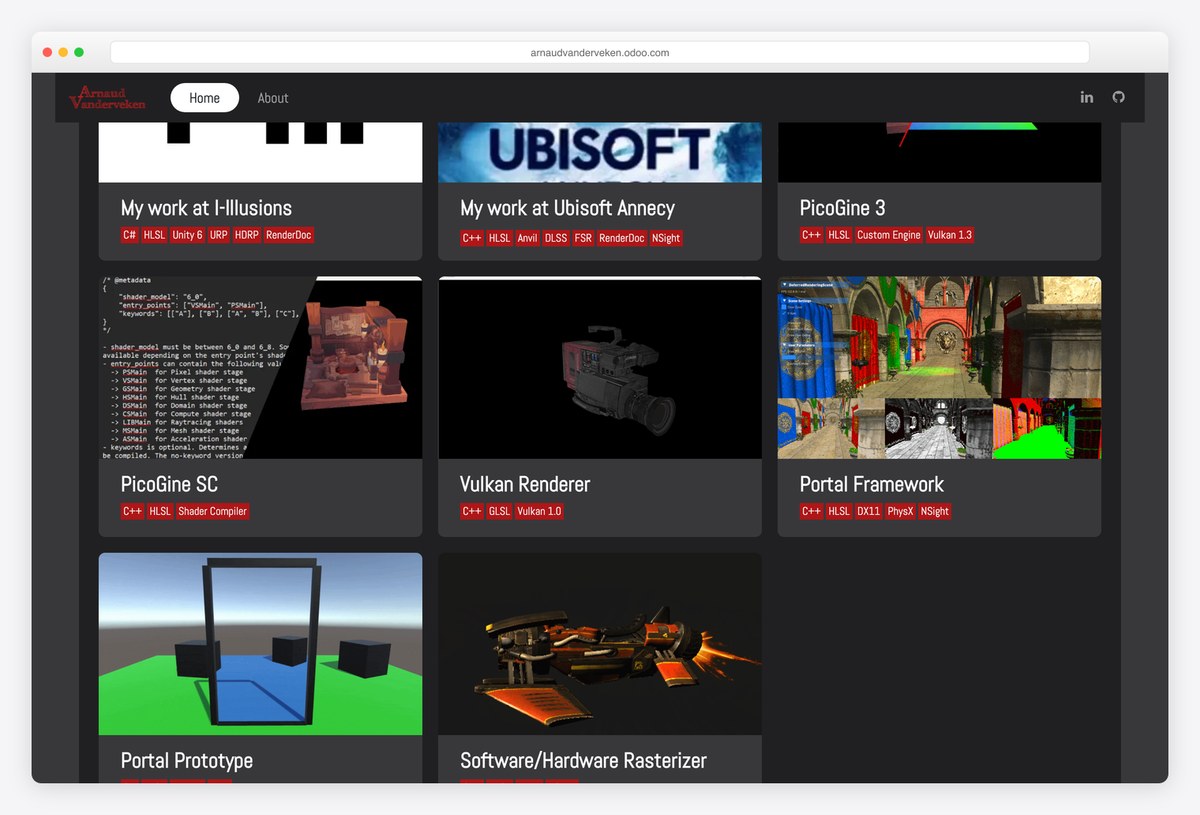
Arnaud Vanderveken, a graphics programmer at I-Illusions who previously worked at Ubisoft Annecy, puts his stack on every project card: languages, engine, graphics API and debugging tools, such as Vulkan 1.3 for his own engine, PicoGine 3.
Personal projects, from a Vulkan renderer to a software rasterizer, each link to their GitHub repository and credit teammates by name. He studied game development at Digital Arts & Entertainment in Belgium, and his site runs on Odoo, a business platform rarely seen in portfolios.
What stands out: The stack on every card, and code for every personal project.
24. Amari O’Connor
Built with: Squarespace
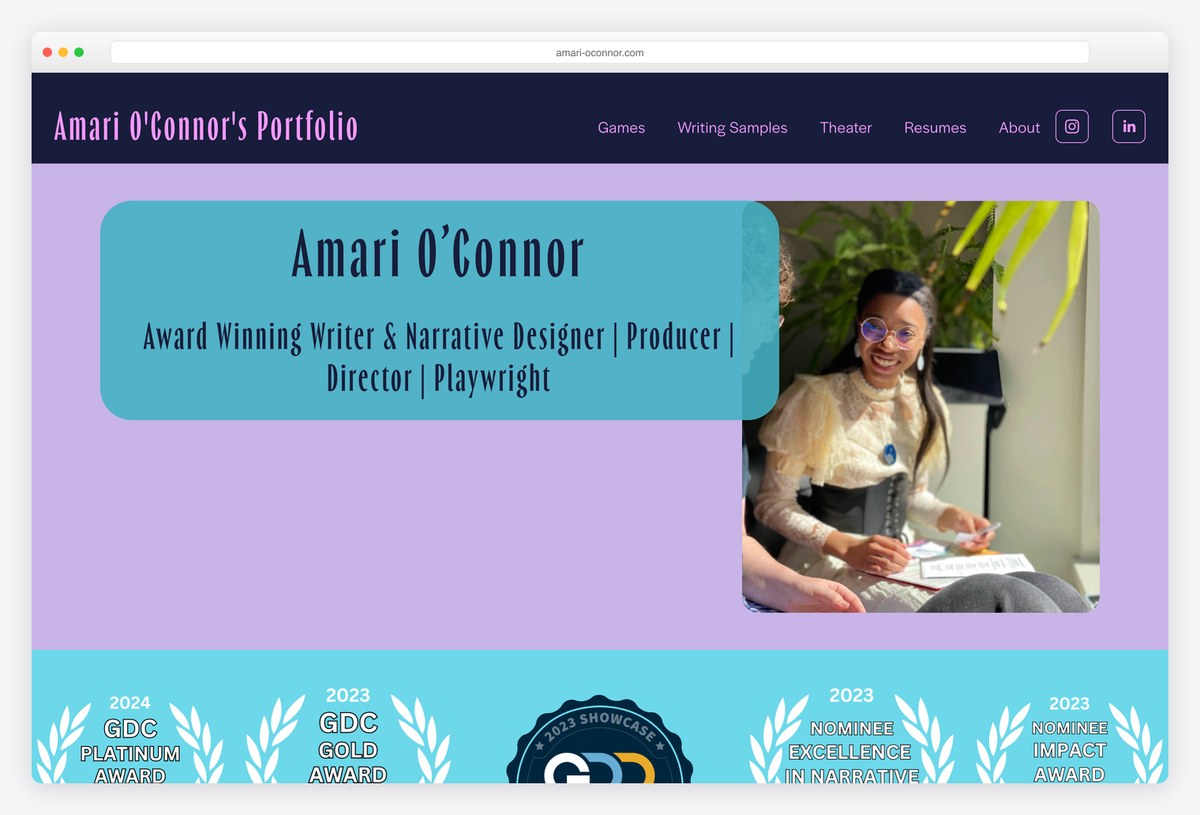
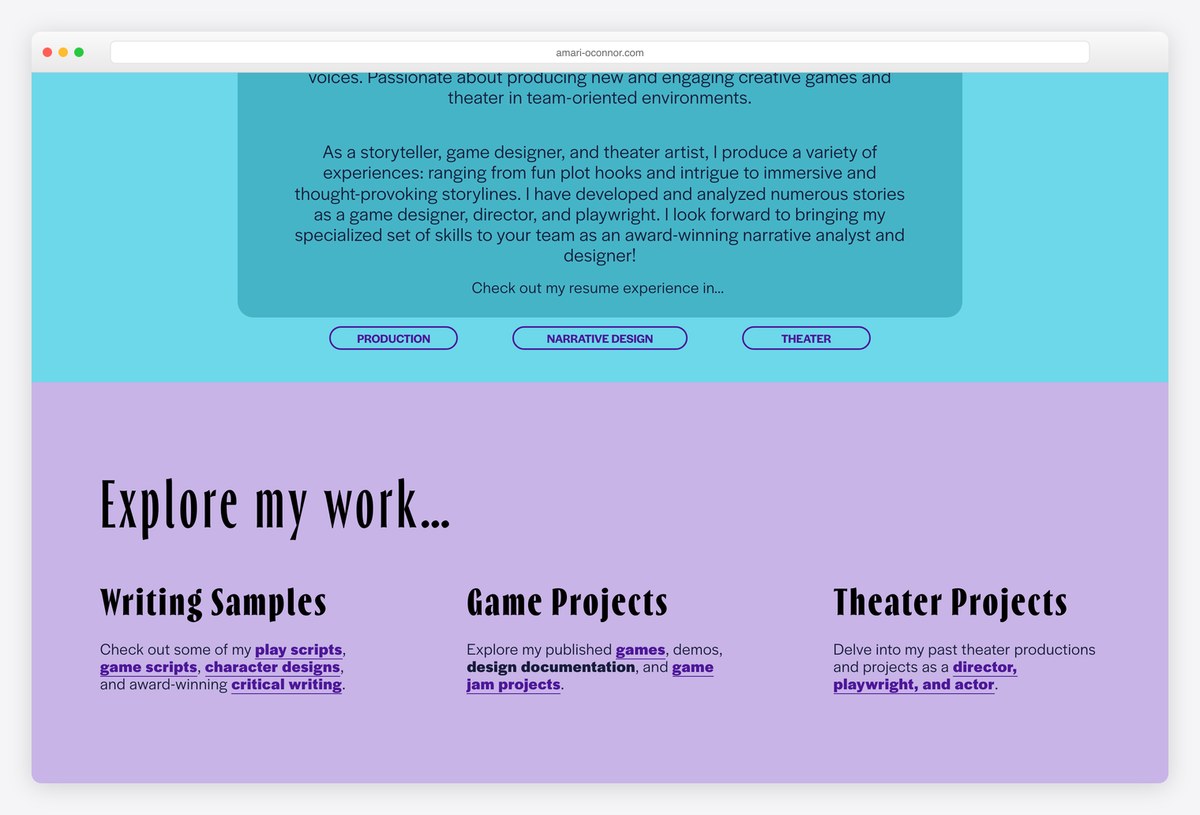
Amari O’Connor, an early-career narrative designer and producer, labels every game with her project role, so it is clear whether she wrote, designed, managed or implemented it. Her games include a short piece about a child coping with her parents’ divorce and a jam game about hiring court jesters.
Writing samples are split into game scripts, play scripts, characters and critical writing. An excerpt from a co-written boss fight script shows her questions and proposals. The Resumes page offers four versions: narrative design, production, theater and game design.
What stands out: A separate résumé for each kind of job.
25. Stephen Lavelle (increpare)
Built with: Custom HTML
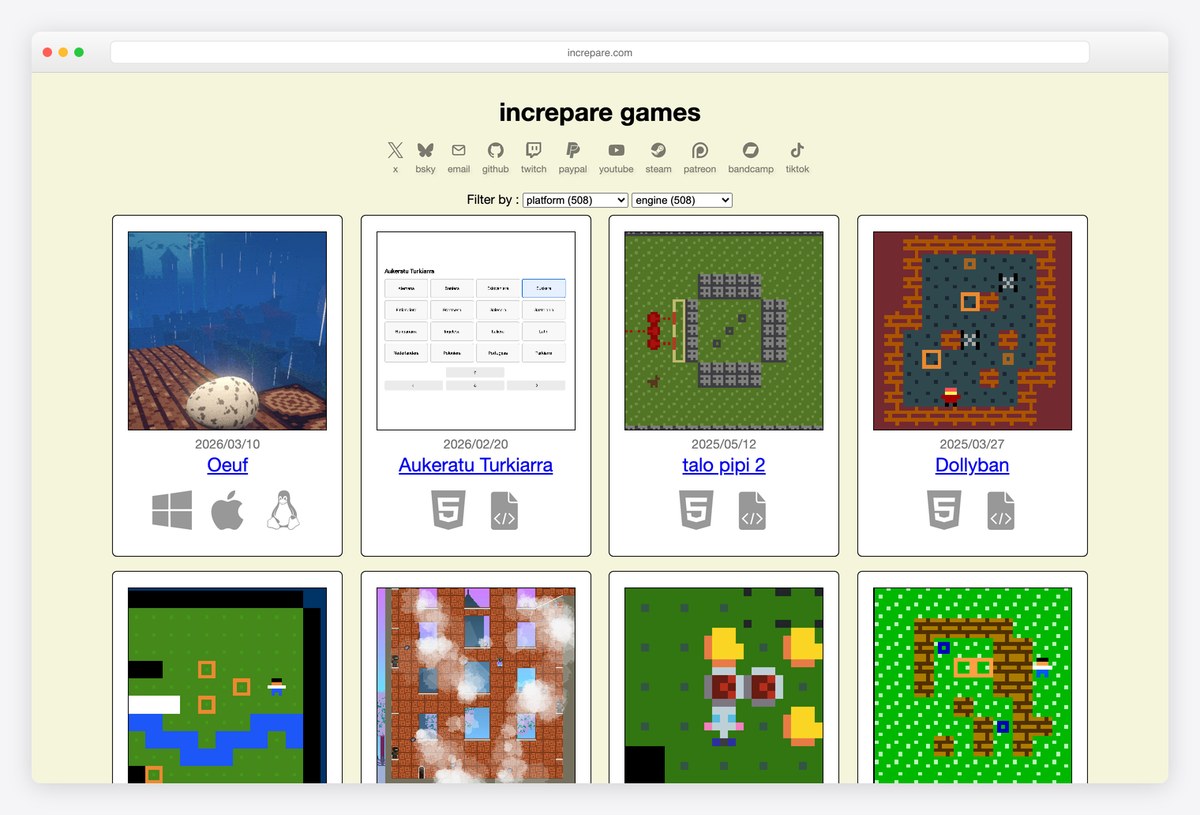
Stephen Lavelle, who publishes as increpare, lists hundreds of games on one page and lets visitors filter them by platform and by engine, from PuzzleScript and Flash to Unity and Godot. Every tile is dated and has buttons to play or download.
Most entries also link their source code. Newer games such as Oeuf go to Steam, while small PuzzleScript games like Dollyban play instantly in the browser. For a prolific solo developer, the engine filter is the quickest way to show range.
What stands out: Filter by engine, then play in the browser.
26. Yoann Pierkot
Built with: Custom HTML and JavaScript (Netlify)
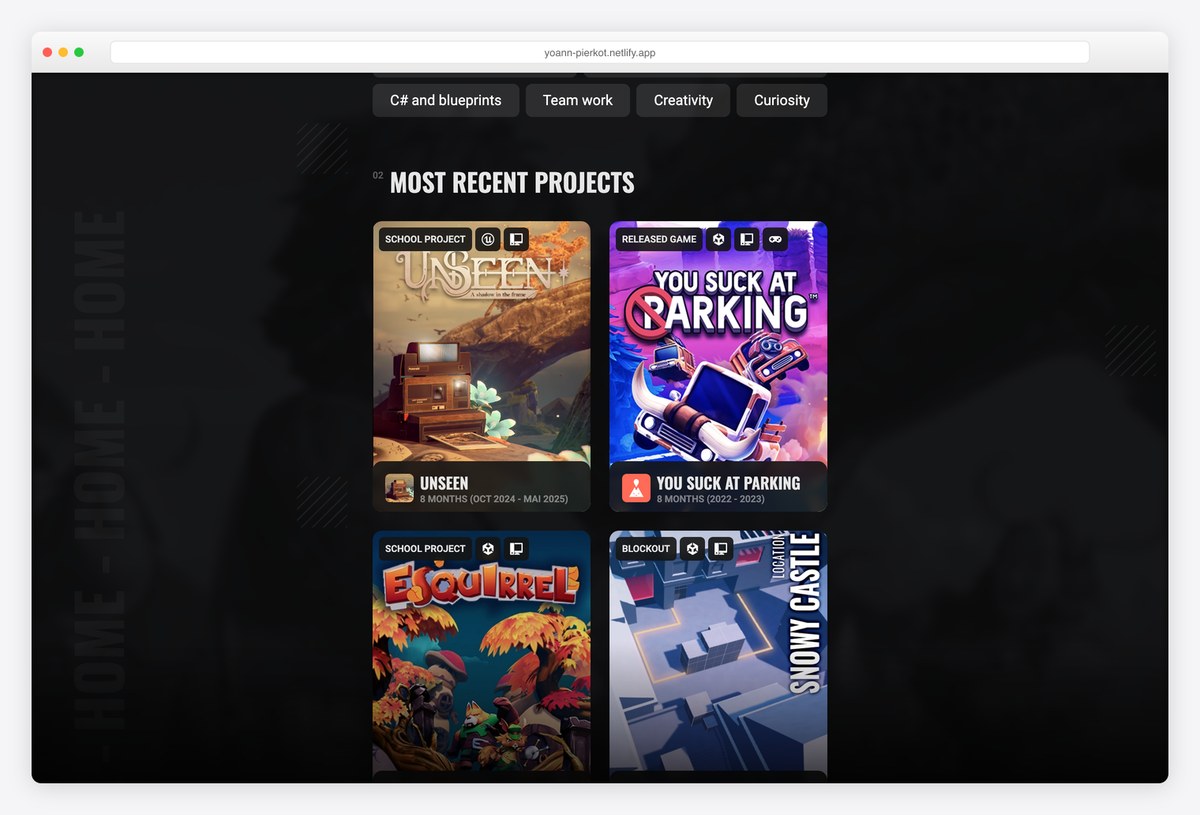
Yoann Pierkot, a junior level designer finishing a master’s degree at Rubika in France, labels every project as a released game or a school project, with its length and his roles. He worked on You Suck at Parking at Happy Volcano as an intern and then as a freelancer.
His skills list uses the language of the job: blockout and layout, metrics and pacing, encounters, playtests and level design documentation. Unseen, his final-year game, took eight months with a team of ten, and his résumé button is on the first screen.
What stands out: Released game or school project, clearly labelled.
What Makes a Great Game Developer Portfolio?
Lead with something to play or watch. A recruiter decides in seconds, so put a build, a short clip or a GIF near the top. Lucas Pope’s jam games still run in the browser, Stephen Lavelle’s filters lead straight to games you can play, Nawaf Bahadur offers a Windows build of his competition level, and Angel Georgiev hosts a sandbox of his own engine.
State your role, team size and engine on every project. Games are made by teams, so the reader needs to know which part was yours. Liam O’Connell puts his role and engine under every GIF, Efrem Torrisi and Angel Georgiev add team size and duration, and Dean Tate lists job title, studio and tools for each credit. A project page that promises details later leaves the reader guessing.
Show the process, not only the result. Level maps, design documents and postmortems prove you can explain your decisions. Michiel Werring publishes level documentation with colour-coded maps and routes, Max Pears writes each mission up with goals and timestamps, Lucas Zakaria shows every phase of a design competition with lessons learned, and Lucas Pope links development logs and a localization post-mortem.
Put shipped credits up front. A released game is the strongest proof you can finish. Dean Tate’s top menu is his credit list, Josh Caratelli lists each Call of Duty title with its platforms, and Hannah Nicklin keeps a dated credits page with her role on every contract. If you show a client’s game, add a short rights notice, as Francisco Múrias does on his Homeworld 3 work.
Programmers: link the code and explain the system. Name what you built and let people read it. Arnaud Vanderveken links a GitHub repository from every personal project, Liam O’Connell offers his spawner code as a download, Noel Berry writes up how he remade Celeste’s lighting, and Josh Caratelli lists the engine systems he worked on rather than only the game titles.
Students: finish small projects and label them honestly. A polished jam or class game with a clear role beats an unfinished epic. Yoann Pierkot marks each project as a released game or a school project, Jack Morehart explains a Unity game he built in under a month, and Lucas Zakaria shows the design goals behind a tool he made for his team’s level designers.
Keep the résumé one click away, and test your links. Jack Morehart and Josh Caratelli put a résumé link on the first screen, Hugo Peters keeps his in the main menu, Jaikar Pothula offers separate game and product versions, and Amari O’Connor offers four. Links rot: of the 37 portfolios linked from the articles that rank for this topic, five no longer load.
Keep video light so the site loads. Autoplaying reels are common in this niche, and they can hide the work: one designer’s home opens on a background video with counters that start at zero. Noel Berry uses small animated thumbnails, Liam O’Connell uses GIFs and Lucas Pope a plain page of images and links, with the full trailer one click away.
Frequently Asked Questions
What should a game developer portfolio include?
Three to six of your best projects, each with a trailer, GIF or playable build, your role, the team size, the engine and what you personally built. Add a short about section, links to itch.io, Steam or GitHub, a résumé one click away and an email address. Liam O’Connell and Efrem Torrisi cover most of this on every project.
How is a game designer portfolio different from a game programmer portfolio?
A designer’s portfolio shows decisions: level maps, blockouts, design documents and the reasoning behind them, as Michiel Werring and Max Pears do. A programmer’s portfolio shows systems and code: what you built, how it works and where the repository is, as Arnaud Vanderveken and Hugo Peters do. Both need your role on each project and a way to see the result.
How many projects should a game developer portfolio have?
Three to six finished projects are enough for a first job, as long as each has a clear role and something to watch or play. More is not better if the extra projects are unfinished. Senior developers can list every credit but should still explain a few in depth, as Dean Tate does with a page for each game.
Should I use itch.io or my own website?
Use both. itch.io is the easiest place to host a playable build, and many portfolios above link to it. Your own site is where you explain your role, show your process and add a résumé, which an itch.io page does not do well. Jack Morehart links his itch.io page in his first sentence, while Lucas Pope hosts browser builds on his own site.
What is the best platform for a game developer portfolio?
There is no single winner. Among the 26 portfolios above, 8 are custom-coded, 5 use WordPress, and Squarespace, Wix and Weebly have two each; Cargo, Craft CMS, Google Sites, Jekyll, Koken, Odoo and Strikingly appear once each. Four are hosted free on GitHub Pages. Choose one that makes video, GIFs and download links easy to add.
How do I make a game portfolio with no shipped games?
Treat student, jam and personal projects as the portfolio and be precise about them. Say what you built, with whom and in which engine, finish each one to a playable state, and label it as a school or personal project, as Yoann Pierkot does. Competitions help too: Lucas Zakaria and Nawaf Bahadur both show placings in Ubisoft NEXT.
Wrapping Up
For more inspiration, see our developer portfolio examples, student portfolio examples and best portfolio website examples. Ready to build your own? Start with a free portfolio website builder or one of our portfolio website templates.

Related Posts







Comments (0)