
WooCommerce Statistics 2026: Stores, Revenue & Market Share
WooCommerce powers 4.05 million live stores, has 7 million+ active installs, and commands a 20-39% share of the global ecommerce market depending on the measurement. With 466 million+ downloads and deep WordPress integration, WooCommerce remains the most flexible open-source ecommerce platform available. Here are 50+ WooCommerce statistics covering market share, revenue, store data, extensions, and performance for 2026.
Key WooCommerce Statistics (2026)
- 4.05 million live WooCommerce stores worldwide in September 2026 (StoreLeads)
- 20-39% of all ecommerce sites use WooCommerce, depending on methodology (Red Stag)
- Live store count down 8% year over year in Q2 2026 (StoreLeads)
- 466 million+ total downloads (WordPress.org)
- 7 million+ active WordPress installs (WordPress.org)
- WooPayments detected on 10.8% of WooCommerce stores (StoreLeads)
- 1,300+ products in the WooCommerce Marketplace (WooCommerce)
WooCommerce Market Share
| Metric | Value | Source |
|---|---|---|
| Share of all ecommerce sites | 20-39% | Red Stag |
| Share of top 1M ecommerce sites | 18.2% | BuiltWith via Red Stag |
| WordPress plugin market share | #1 ecommerce plugin | WordPress.org |
| Live WooCommerce stores (Sep 2026) | 4.05 million | StoreLeads |
| Total downloads | 466 million+ | WordPress.org |
| Active installs | 7 million+ | WordPress.org |
| YoY change in live stores (Q2 2026) | -8% | StoreLeads |
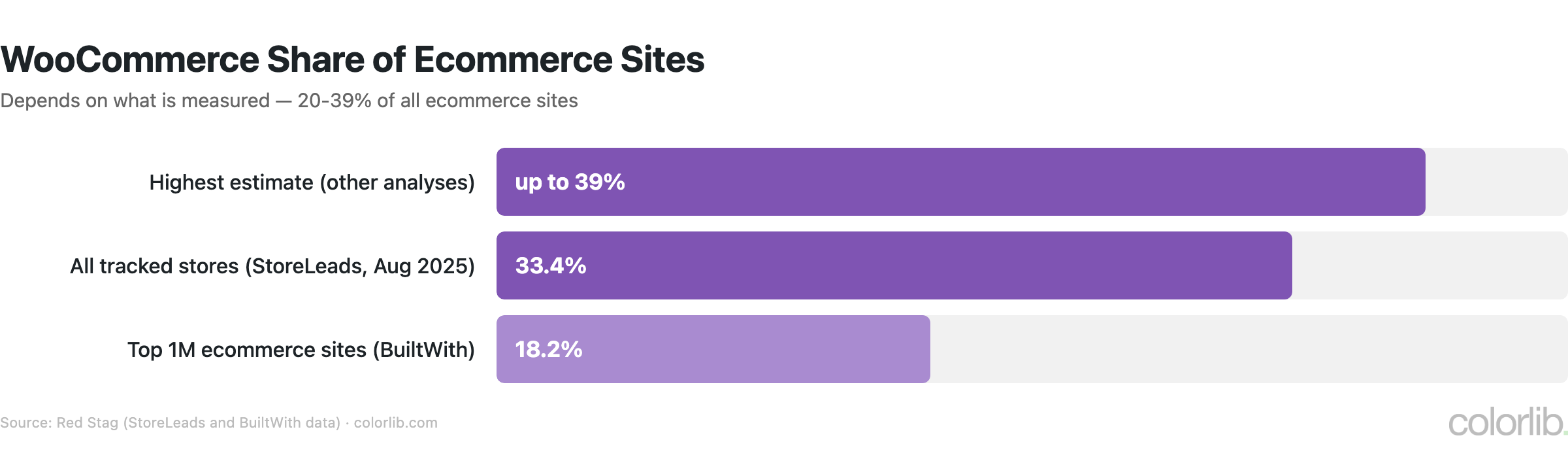
- WooCommerce’s market share varies by measurement: 33.4% of all tracked stores (StoreLeads, August 2025) and up to 39% in other analyses, vs. 18.2% of the top 1 million ecommerce sites (BuiltWith) (Red Stag)
- WooCommerce remains the #1 ecommerce platform globally by store count, though Shopify leads in GMV and enterprise adoption
- Top countries for WooCommerce: US (12.5% of stores), UK (4.4%), Germany (2.9%), India (2.8%) (StoreLeads)
- WooCommerce’s open-source nature means $0 licensing cost, but hosting, premium extensions, and maintenance add ongoing costs
- For the full ecommerce platform landscape, see our CMS market share analysis
WooCommerce Order Value & Payments
| Metric | Value | Source |
|---|---|---|
| Median AOV, new-customer orders | $99 (returning: $108) | Metorik |
| Average daily AOV | $105 | Metorik |
| Mobile vs. desktop AOV | $71 vs. $167 | Metorik |
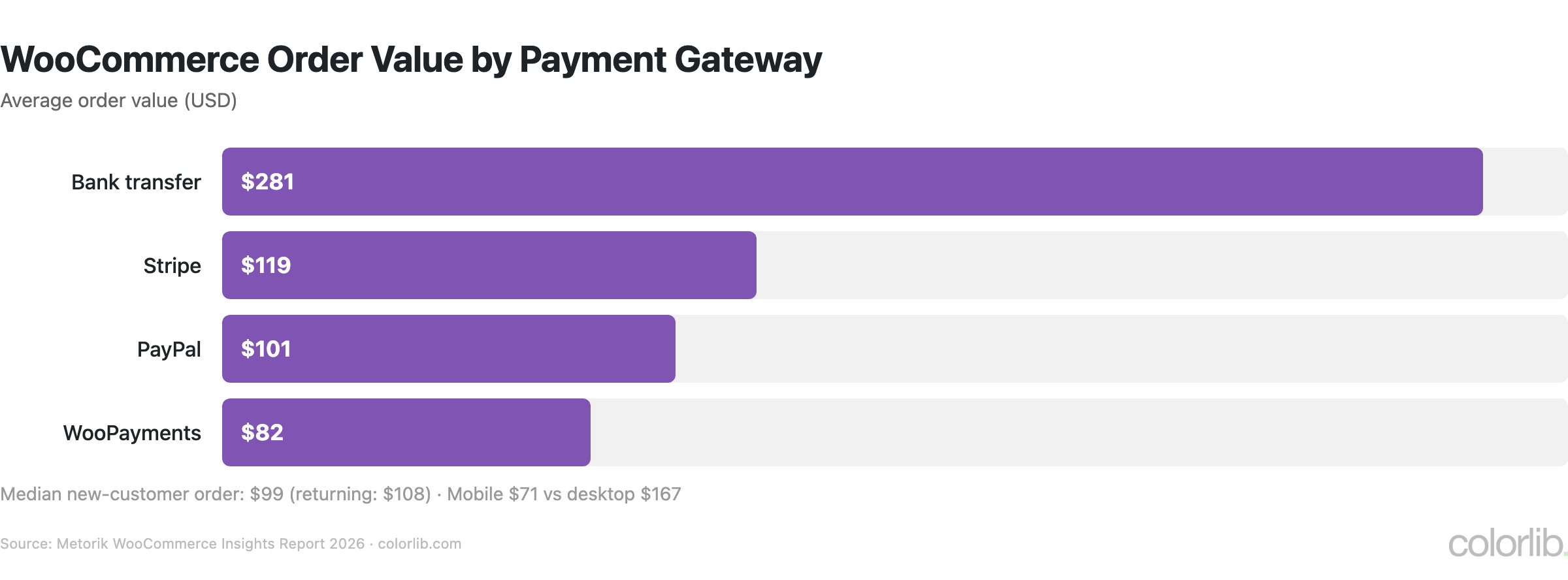
| AOV by gateway | Bank transfer $281, Stripe $119, PayPal $101, WooPayments $82 | Metorik |
| WooPayments adoption | 10.8% of stores (detected) | StoreLeads |
- While WooCommerce leads in store count, Shopify processed $115.6 billion in GMV in Q2 2026 alone (Shopify) — WooCommerce, being self-hosted, publishes no GMV figure
- The majority of WooCommerce stores are small to mid-size businesses: about 72% of stores sell fewer than 50 products (StoreLeads)
- WooPayments (powered by Stripe) is the most-detected Woo extension, yet it appears on only 10.8% of stores (StoreLeads) — most use third-party gateways like PayPal and Stripe directly
WooCommerce Store Statistics
| Metric | Value | Source |
|---|---|---|
| Stores selling fewer than 50 products | ~72% | StoreLeads |
| Average cart abandonment rate (all ecommerce) | 70.22% | Baymard Institute |
| Mobile share of WooCommerce orders | 72% | Metorik |
| Stores with WooCommerce Subscriptions detected | ~41,700 (1.0%) | StoreLeads |
| Most popular theme on Woo stores | Astra (11.5%) | StoreLeads |
- Mobile accounts for 72% of WooCommerce orders, though mobile AOV ($71) is well below desktop ($167) (Metorik), making responsive themes and mobile optimization critical
- Cart abandonment averages 70.22% across ecommerce (Baymard), so recovery emails are worth setting up on any WooCommerce store
- WooCommerce Subscriptions is detected on about 41,700 stores, the third most-detected Woo extension after WooPayments and Mailchimp (StoreLeads)
WooCommerce Extensions & Themes
| Metric | Value | Source |
|---|---|---|
| WooCommerce Marketplace products | 1,300+ | WooCommerce Marketplace |
| WooCommerce-tagged plugins | 9,000+ | WordPress.org |
| E-commerce themes | 3,400+ | WordPress.org |
| Most-detected extension | WooPayments (10.8% of stores) | StoreLeads |
| Second most-detected extension | Mailchimp (4.8%) | StoreLeads |
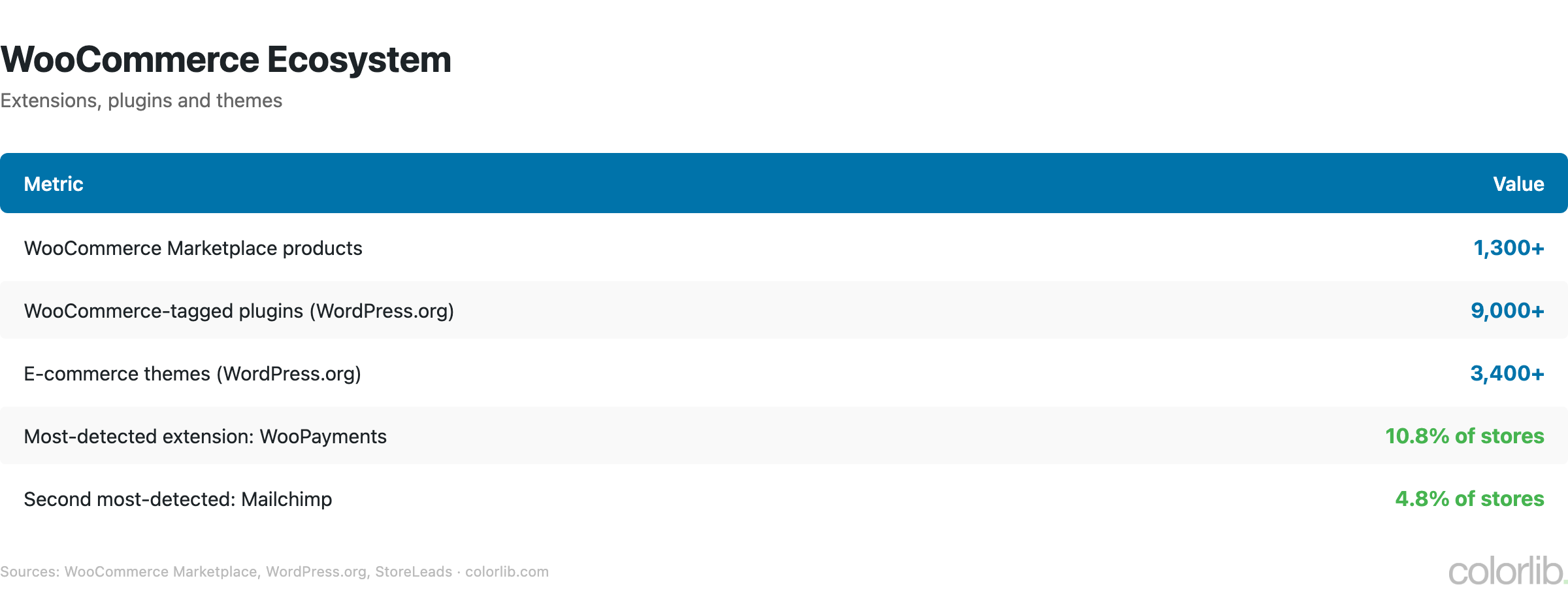
- The WooCommerce ecosystem includes 1,300+ marketplace products and over 9,000 WooCommerce-tagged plugins on WordPress.org
- Gateway choice tracks order size: bank-transfer orders average $281, versus $119 for Stripe, $101 for PayPal, and $82 for WooPayments (Metorik)
- Top free extensions: WooCommerce Stripe Gateway (700K+ installs), Jetpack, WooCommerce PayPal Payments (800K+), YITH WooCommerce Wishlist (400K+)
WooCommerce Performance Statistics
- WordPress, which every WooCommerce store runs on, passes Core Web Vitals on only 45% of mobile sites versus about 75% for Shopify (HTTP Archive, SEJ), due to varied hosting quality and plugin bloat
- The median WordPress mobile page weighs 2,894 KB (HTTP Archive), and WooCommerce product pages often run heavier due to unoptimized images and excessive plugins
- For a deeper dive into WordPress performance, see our WordPress statistics report
WooCommerce vs. Shopify
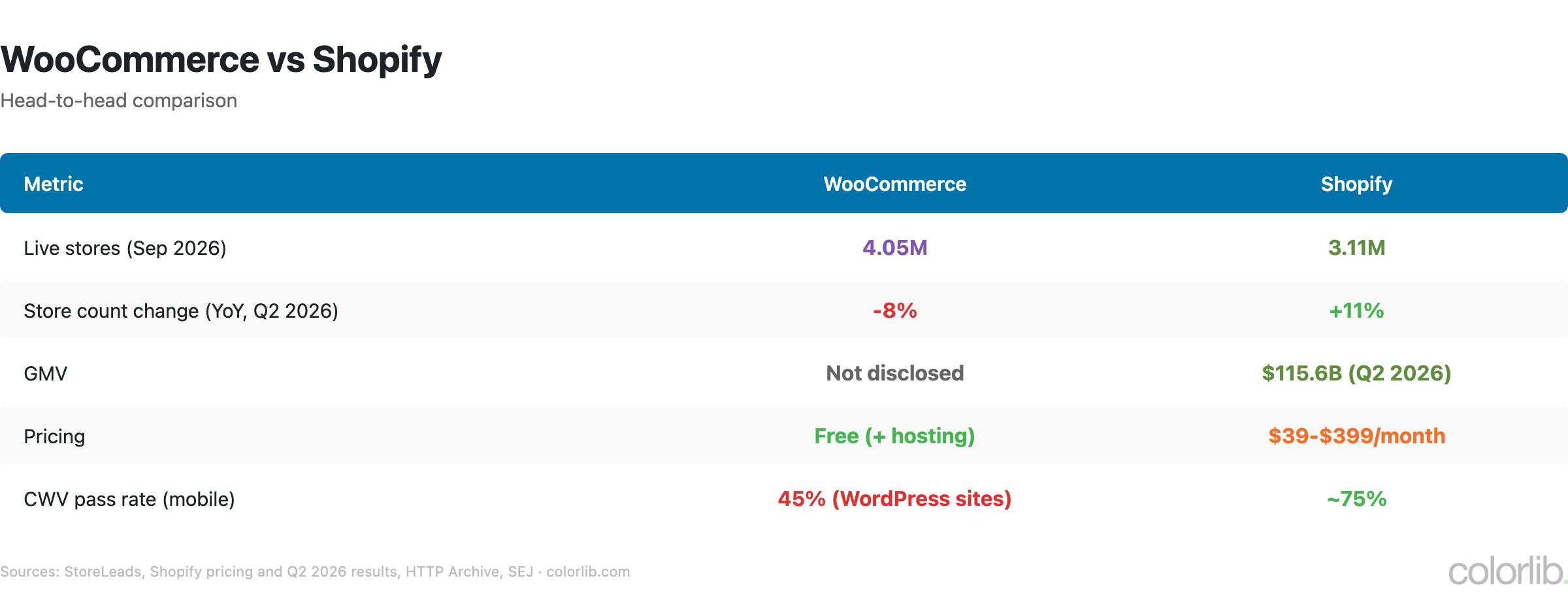
| Metric | WooCommerce | Shopify |
|---|---|---|
| Live stores (Sep 2026) | 4.05 million | 3.11 million |
| GMV | Not disclosed | $115.6 billion (Q2 2026) |
| Pricing | Free (+ hosting) | $39-$399/month ($29-$299 billed yearly) |
| Transaction fees | 0% (gateway fees only) | 0% with Shopify Payments; 0.6-2% with other gateways |
| Customization | Unlimited (open source) | Limited (Liquid templates) |
| Hosting | Self-hosted | Fully hosted |
| Best for | Content-heavy stores | Pure ecommerce |
- WooCommerce leads on live store count (4.05M vs 3.11M), but Shopify’s store count grew 11% year over year in Q2 2026 while WooCommerce’s fell 8% (StoreLeads, StoreLeads)
- WooCommerce’s $0 licensing cost makes it the choice for budget-conscious merchants, though hosting and premium extensions add to total cost of ownership
- WooCommerce’s strength is content + commerce integration — stores that rely heavily on blogging, SEO, and content marketing benefit from WordPress’s publishing tools
- Shopify wins on ease of use, checkout conversion, and performance out of the box — no hosting or plugin management needed
- For the full comparison, see our Shopify statistics report
Key Takeaways
- WooCommerce leads in store count. With 4.05 million live stores and 20-39% of ecommerce sites depending on methodology, WooCommerce is the most widely used ecommerce platform globally, though its live store count fell 8% year over year in Q2 2026.
- Open source is the key differentiator. Zero licensing fees, unlimited customization, and no transaction fees make WooCommerce the most flexible and cost-effective platform for merchants.
- Performance is WooCommerce’s weakness. A 45% Core Web Vitals pass rate for WordPress sites, against about 75% for Shopify, reflects the challenges of self-hosted, plugin-dependent architecture.
- Small business is the sweet spot. About 72% of WooCommerce stores sell fewer than 50 products — the platform excels for content-heavy small businesses rather than high-volume enterprise commerce.
- The extension ecosystem is massive. 1,300+ marketplace products and 9,000+ WooCommerce-tagged plugins provide unmatched flexibility, though plugin quality varies significantly.
- WordPress integration is the moat. For businesses that combine content marketing with ecommerce, WooCommerce + WordPress remains unbeatable — no other platform matches WordPress’s publishing capabilities.
Sources
- StoreLeads — The State of WooCommerce
- WordPress.org — WooCommerce Plugin Page
- WooCommerce — About / Company Info
- Metorik — WooCommerce Insights Report 2026
- Red Stag — WooCommerce Market Share
- HTTP Archive 2025 Web Almanac — CMS Chapter
- Baymard Institute — Cart Abandonment Statistics
Frequently Asked Questions
How many stores use WooCommerce?
WooCommerce powers 4.05 million live stores worldwide (StoreLeads, September 2026), with 7 million+ active WordPress installs and 466 million+ total downloads. It holds 20-39% of the global ecommerce market share depending on how measurement is scoped. The largest markets are the US (12.5% of stores), UK (4.4%), Germany (2.9%), and India (2.8%).
Is WooCommerce really free?
The WooCommerce plugin itself is 100% free and open source. However, running a WooCommerce store requires WordPress hosting ($5-$50/month), a domain ($10-15/year), SSL certificate (often free), and usually some premium extensions for payments, shipping, and marketing. Total cost varies widely with store size, compared to Shopify’s $39-$399/month subscription (billed monthly).
How does WooCommerce compare to Shopify?
WooCommerce leads in store count (4.05M vs 3.11M) and flexibility (open source, unlimited customization), while Shopify dominates in GMV ($115.6B in Q2 2026 alone), growth (store count +11% year over year vs. -8% for WooCommerce), performance (about 75% vs. 45% CWV pass rates for WordPress sites), and ease of use. WooCommerce is best for content-heavy businesses and developers who want full control. Shopify is better for merchants who want a turnkey solution. See our Shopify statistics for the full comparison.
What percentage of ecommerce runs on WooCommerce?
WooCommerce powers 20-39% of all ecommerce websites globally, making it the most widely used platform by store count. The range depends on measurement methodology — StoreLeads counts 33.4% of all tracked stores and other analyses put it near 39%, while BuiltWith measures 18.2% among the top 1 million ecommerce sites. For context, see our CMS market share analysis for the broader platform landscape.

Related Posts






Comments (0)