EnvironmentalOrganization
Template Details
Author: Colorlib
Updated: November 2026 · v3.0.0
Credits: Images from Unsplash
Description
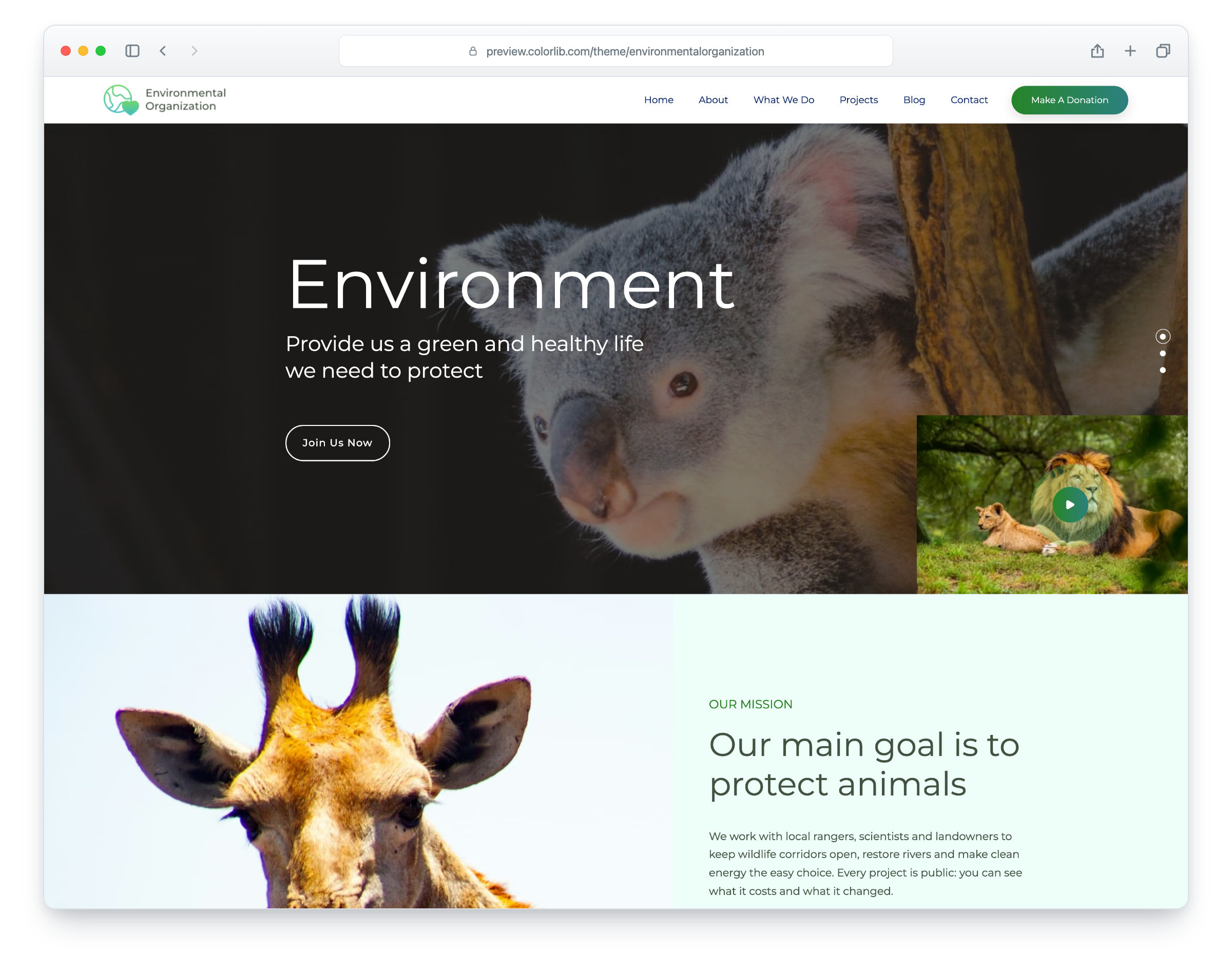
EnvironmentalOrganization is a website template for environmental charities, wildlife organisations and conservation groups, built on Bootstrap 5. The layout is responsive and mobile-ready and works in all popular web browsers. It comes with eight pages: home, about, what we do, projects, blog, blog details, contact and an elements page with typography, buttons, forms, a table and a photo gallery.
The home page has a three-slide hero with a video button, a mission section, three programme cards, a “why join” block with key figures, funded projects with progress bars and a latest-news section. The inner pages reuse those blocks, and the blog has a post list, an article with comments and a comment form, and a sidebar with search, categories, recent posts, tags, photos and a newsletter. The contact page has a working contact form and a click-to-load map. EnvironmentalOrganization gives you a ready-made site to present your campaigns, report on your projects and invite people to donate or volunteer.
What’s new in 3.0
- Bootstrap 5.3.8 (the earlier release used Bootstrap 4.1.3 and jQuery), compiled from Sass together with the theme and the original Bootstrap 4 proportions and colours, and plain JavaScript with no jQuery. Swiper 14 replaces Slick on the hero slider, PhotoSwipe replaces Magnific Popup in the gallery, a keyboard-operable dialog replaces the SlickNav mobile menu, and small built-in modules replace the date picker, select boxes and progress bars. npm run build (Dart Sass and esbuild) compiles one minified stylesheet and one script.
- Lighter pages: all nine pages together went from 35.2 MB and 481 requests to 5.8 MB and 232 requests (the home page from 8.5 MB to 0.9 MB), and the download from 15.7 MB to 4.9 MB. Every photo has an AVIF version with the JPEG as the fallback, real dimensions and lazy loading below the fold, and unused plugins such as jQuery, Owl Carousel, a countdown, a date picker and animate.css are gone.
- No third-party requests: Montserrat is self-hosted, the Flaticon, Themify and Font Awesome 5 icon fonts are replaced by Lucide SVG icons and a small social-logo subset (the Twitter bird is now the X logo), the video loads from YouTube’s privacy-enhanced player only after a click, the Google Maps script and its API key are replaced by a click-to-load OpenStreetMap map, and a Google Analytics 4 snippet stays commented out until you add your own ID.
- Accessibility: skip link, landmarks, one h1 per page, labelled form fields, visible keyboard focus, a phone menu and sub-menu you can use from the keyboard, and darker greens so text, buttons and the footer meet WCAG AA contrast, including the hero text on every slide.
- Working forms: the contact form, the blog comment form and the newsletter send through safe PHP handlers with visible labels, validation and in-page messages, and the blog search lists the matching posts.
- New demo content and photos: conservation copy, five blog posts and an article that fit their photos, three hero slides with their own text, and licensed nature photos at full resolution in place of the earlier party, portrait and shared blog images.
- A documentation page generated from the README, and a standard icon set and photo credits listed in it.
Pricing EnvironmentalOrganization
Single
$19
- Premium support
- Template updates
- For 1 year
- Access all templates
Membership
$129
- Premium support
- Template updates
- For 1 year
- For 1 year
Lifetime
$349
- Premium support
- Template updates
- For life
- For life
Similar Charity & Non-profit Templates View all 38 charity & non-profit templates →