Sneaky
Template Details
Author: Colorlib
Updated: November 2026 · v3.0.0
Credits: Images from Unsplash
Description
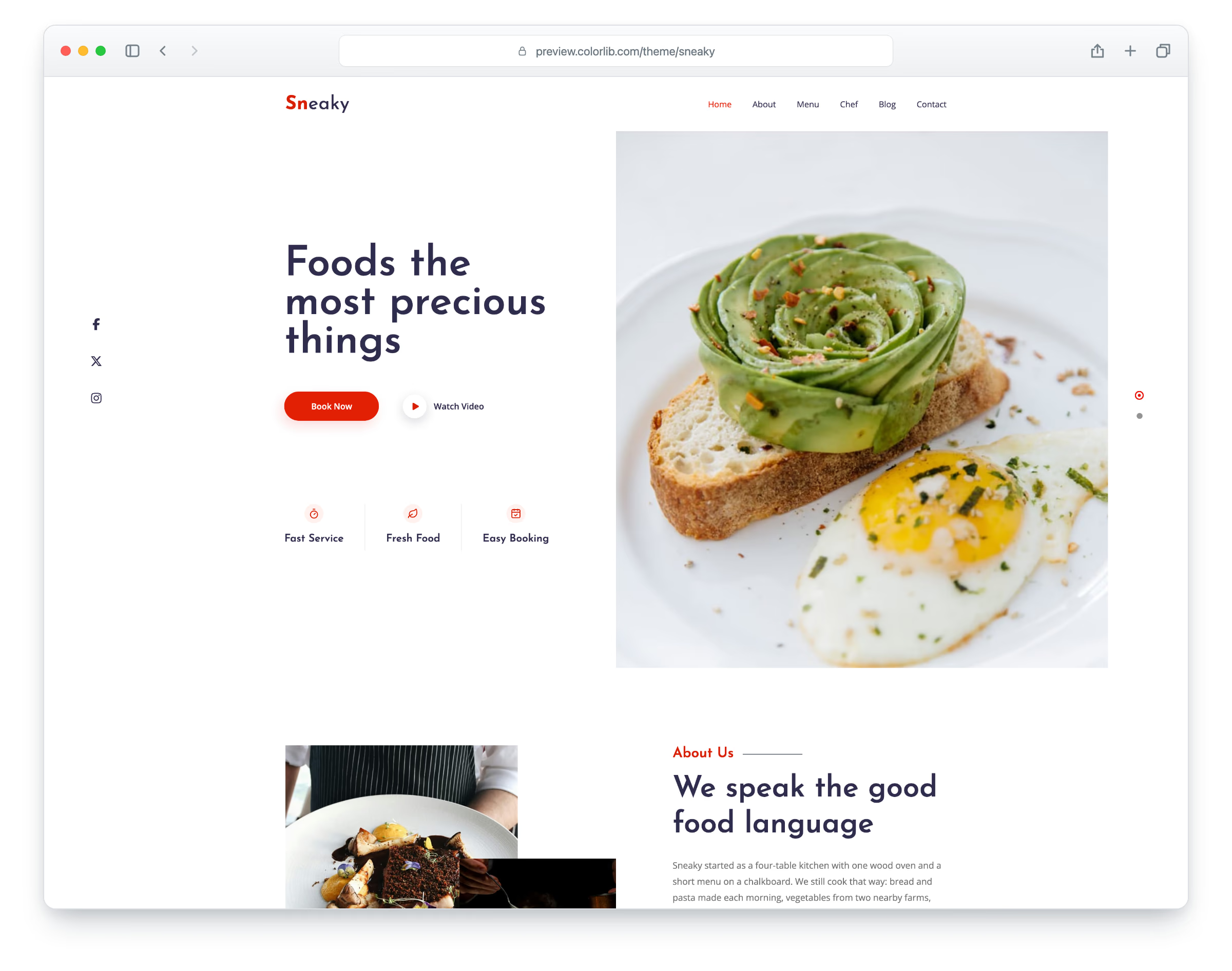
Sneaky is a website template for restaurants, pizzerias and cafés, built on Bootstrap 5. The layout is responsive and works in all popular web browsers. It comes with seven pages: home, about, menu, chef, blog, blog post and contact.
The home page has a hero slider with a video button, a featured-dish carousel, a pizza offer card, menu highlights, a call-to-action band, chef cards, a table reservation form and the latest blog posts. The menu page lists starters, mains and desserts with prices, the blog has a working search, and the contact page has a click-to-load map and a contact form. Sneaky gives a restaurant a ready-made site that lets its dishes do the talking.
What’s new in 3.0
- Bootstrap 5.3.9 (the earlier release used Bootstrap 4.1.3 and jQuery), compiled from Sass with the original proportions, and plain JavaScript with no jQuery. Swiper 14 replaces Owl Carousel, a native dialog replaces Magnific Popup for the hero video, and npm run build (Dart Sass and esbuild) compiles the stylesheets and one script.
- Lighter pages: the seven pages together went from 24.6 MB and 249 requests to 5.3 MB and 202 requests, and the download from 14.3 MB to 3.2 MB. Every photo has an AVIF version with the JPEG as the fallback, real dimensions and lazy loading below the first screen.
- No third-party requests: Josefin Sans and Open Sans are self-hosted, the Themify and Flaticon icon fonts are replaced by Lucide SVG icons and a small social-logo subset, Google Maps is replaced by a click-to-load OpenStreetMap placeholder, and the hero video loads from YouTube’s privacy-enhanced player only after a click.
- Accessibility and contrast: a skip link, one h1 per page, visible keyboard focus, labelled form fields, text and sticky-header colours raised to WCAG AA contrast and a Blog menu that opens from the keyboard.
- Working forms: the table reservation, contact, comment and newsletter forms post to the included PHP handlers with a spam trap and show their own success and error messages. Set the recipient address before you publish.
- New demo content: seventeen dishes with prices, three chefs, five blog posts and one full article. Stock photos that were too small or unrelated to a restaurant were replaced with food and kitchen photography, and the blog search works without a backend.
Pricing Sneaky
Single
$19
- Premium support
- Template updates
- For 1 year
- Access all templates
Membership
$129
- Premium support
- Template updates
- For 1 year
- For 1 year
Lifetime
$349
- Premium support
- Template updates
- For life
- For life
Similar Restaurant Templates View all 42 restaurant templates →