Sensive
Template Details
Author: Colorlib
Updated: November 2026 · v3.0.0
Credits: Images from Unsplash
Description
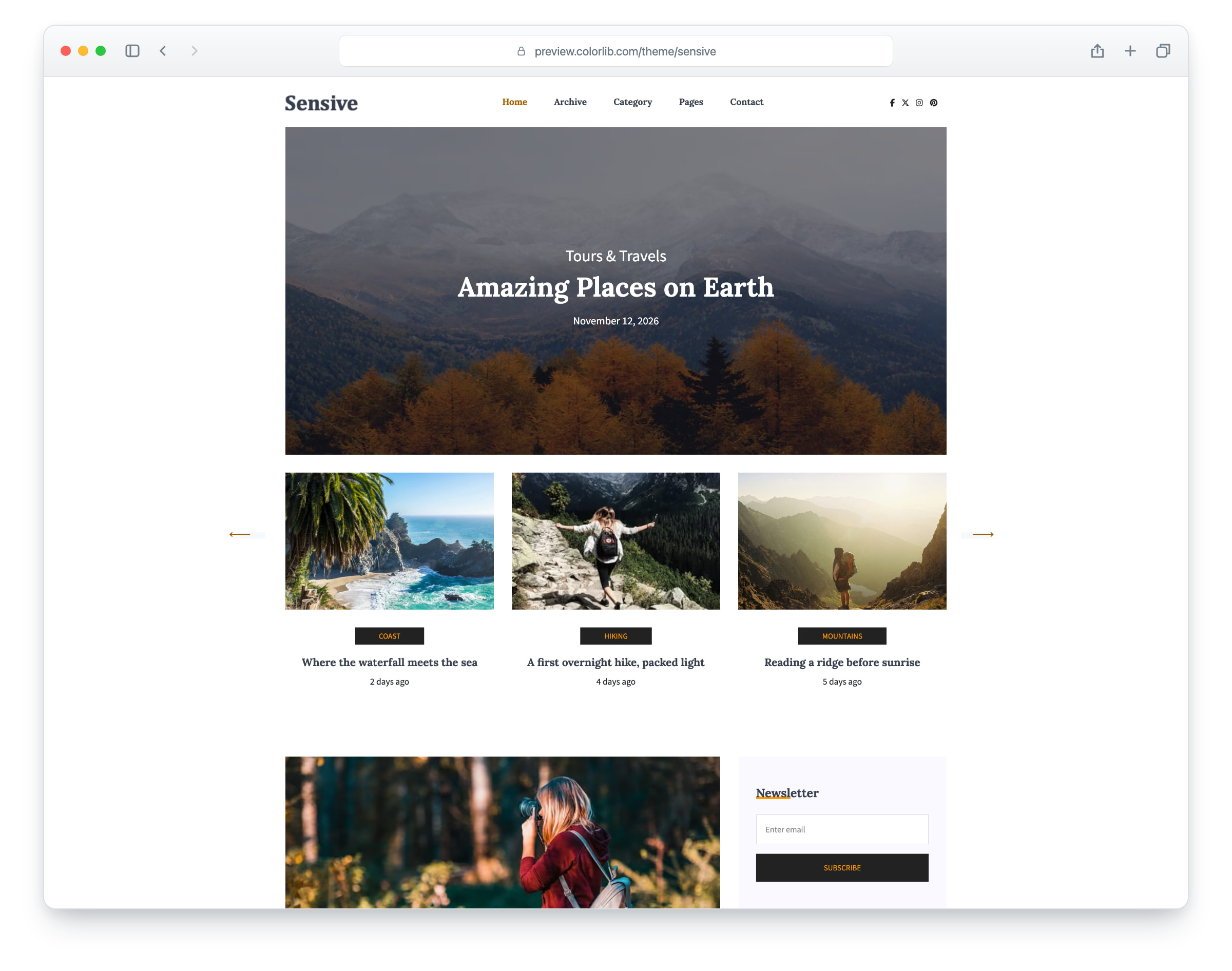
Sensive is a travel and lifestyle blog website template built on Bootstrap 5. The layout is responsive and works in all popular web browsers. It comes with five pages: home, archive, category, blog details and contact.
The home page has a hero, a three-up story slider, a featured-story list with pagination and a sidebar with a newsletter form, categories, popular posts and tags. The archive and category pages show story cards with the same sidebar, the article page has a quote, author line, previous and next links, comments and a reply form, and the contact page has a message form and a click-to-load map. The black and amber palette and the Lora headings keep the original quiet, readable look, and the design suits travel, personal, DIY and lifestyle blogs.
What’s new in 3.0
- Bootstrap 5.3.8 (the earlier release used Bootstrap 4.1 and jQuery), compiled from Sass with the original proportions, and plain JavaScript with no jQuery. Swiper 14 runs the story slider and Lucide SVG icons replace the icon fonts. npm run build (Dart Sass and esbuild) compiles minified styles and one script.
- Lighter pages: the five pages together went from 16.8 MB to 3.6 MB, and the download from 20.8 MB to 2.6 MB. Photos are served as AVIF with a JPEG fallback, with real dimensions and lazy loading below the fold.
- No third-party requests: Lora and Source Sans Pro are self-hosted, the map loads only when a visitor clicks “Show map” and needs no API key, and a Google Analytics 4 snippet stays commented out until you add your own ID.
- Working forms: the contact, comment and newsletter forms send through php/send-email.php and php/subscribe.php with validation, a spam trap, visible labels and an in-page message. Before, the forms posted to a missing script or a third-party mailing list.
- Accessibility: a skip link and a main landmark on every page, one h1 per page, an ordered heading outline, a readable phone menu with large touch targets, names on icon-only links, visible focus rings and WCAG AA colour contrast.
- Demo content: travel journal stories and fictional authors and commenters replace the placeholder text, the menu and pagination links go to real pages, and the photos are credited in the README.
Pricing Sensive
Single
$19
- Premium support
- Template updates
- For 1 year
- Access all templates
Membership
$129
- Premium support
- Template updates
- For 1 year
- For 1 year
Lifetime
$349
- Premium support
- Template updates
- For life
- For life
Similar Blog Templates View all 58 blog templates →