Jony
Template Details
Author: Colorlib
Updated: November 2026 · v3.0.0
Credits: Images from Unsplash, except the home page portrait
Description
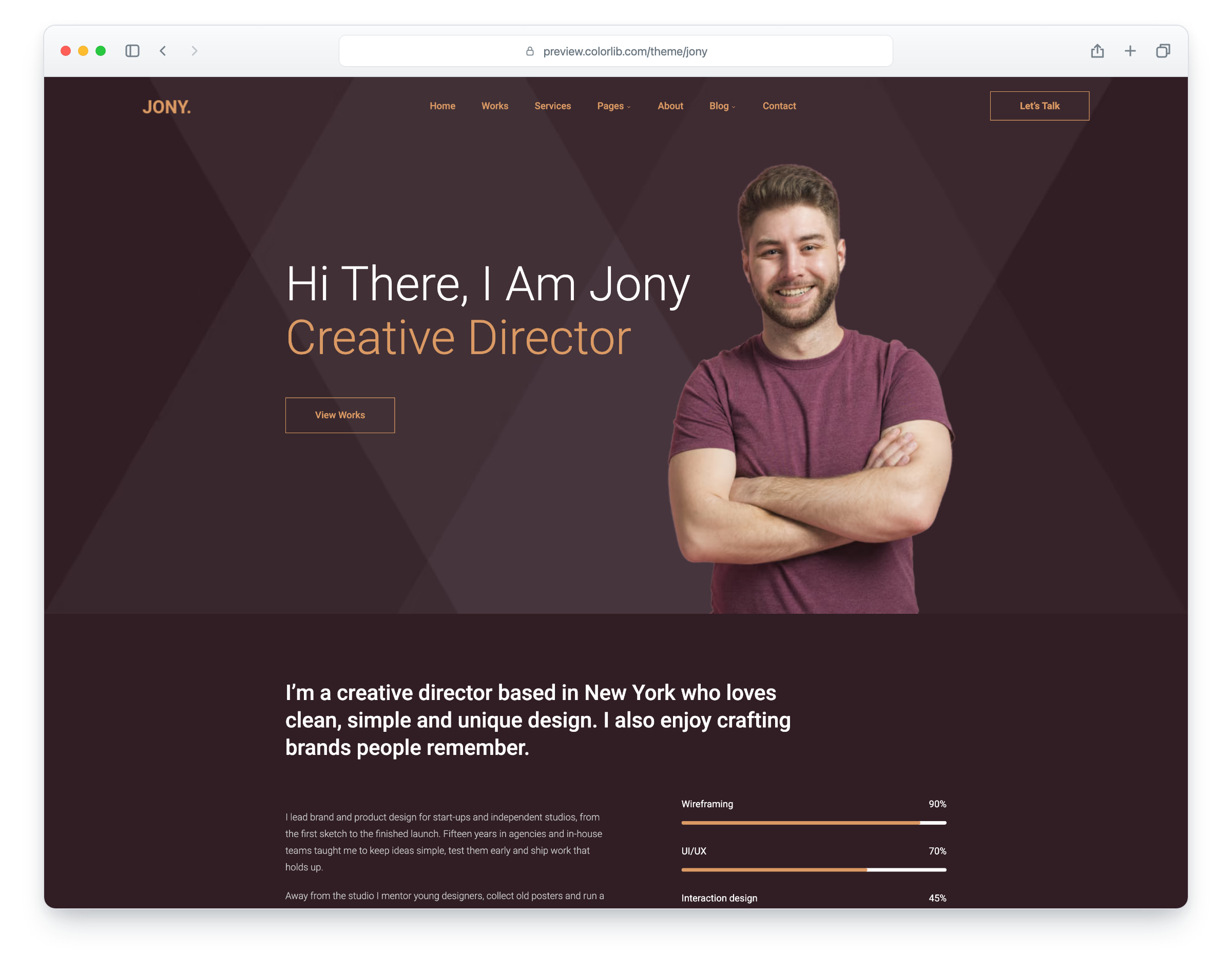
Jony is a responsive portfolio website template for creative directors, designers and independent studios, built on Bootstrap 5. It has a dark plum and copper look, a hero with a portrait, skill bars, service cards, a works grid, a testimonial slider and a call-to-action with social links. The nine pages are home, works, services, about, work details, blog, blog post, contact and elements.
The work details page is laid out as a short case study, the blog has a sidebar with categories, recent posts, tags and a newsletter box, and the contact page has a working contact form and a click-to-load map. The elements page collects typography, buttons, a table, a photo gallery, lists and form controls.
What’s new in 3.0
- Bootstrap 5.3.8 (the earlier release used Bootstrap 4.0), compiled from Sass, and plain JavaScript with no jQuery. Swiper 14 runs the testimonial slider, PhotoSwipe the gallery, and the mobile menu is a native dialog. npm run build (Dart Sass and esbuild) compiles one minified stylesheet and one script.
- Lighter pages: the nine pages went from 20.69 MB and 487 requests to 5.01 MB and 244 requests, and the home page from 3.04 MB and 54 requests to 0.64 MB and 26 requests. Every photo has an AVIF version with a JPG or PNG fallback and real dimensions. The download is 3.5 MB.
- No third-party requests: Roboto is self-hosted, the icon fonts are replaced by Lucide SVG icons and a small social-logo subset, and the Google Maps script is gone in favour of a map that loads only when you click it. A Google Analytics 4 snippet stays commented out until you add your own ID.
- Working forms: the contact form, comment form and newsletter box send through a PHP mail handler (set your address in php/send-email.php) with a spam trap and clear success and error messages.
- Accessibility: skip link, one h1 per page, visible keyboard focus, labelled icon links and progress bars, text contrast of at least 4.5:1 and reduced-motion support.
- New sample content for a creative director’s portfolio: fictional projects, clients and articles, and replacement photos where the earlier ones were too small or showed brands (credits are in the README).
- Documentation page and README with the build steps and a changelog.
Pricing Jony
Single
$19
- Premium support
- Template updates
- For 1 year
- Access all templates
Membership
$129
- Premium support
- Template updates
- For 1 year
- For 1 year
Lifetime
$349
- Premium support
- Template updates
- For life
- For life
Similar Resume Templates View all 20 resume templates →